
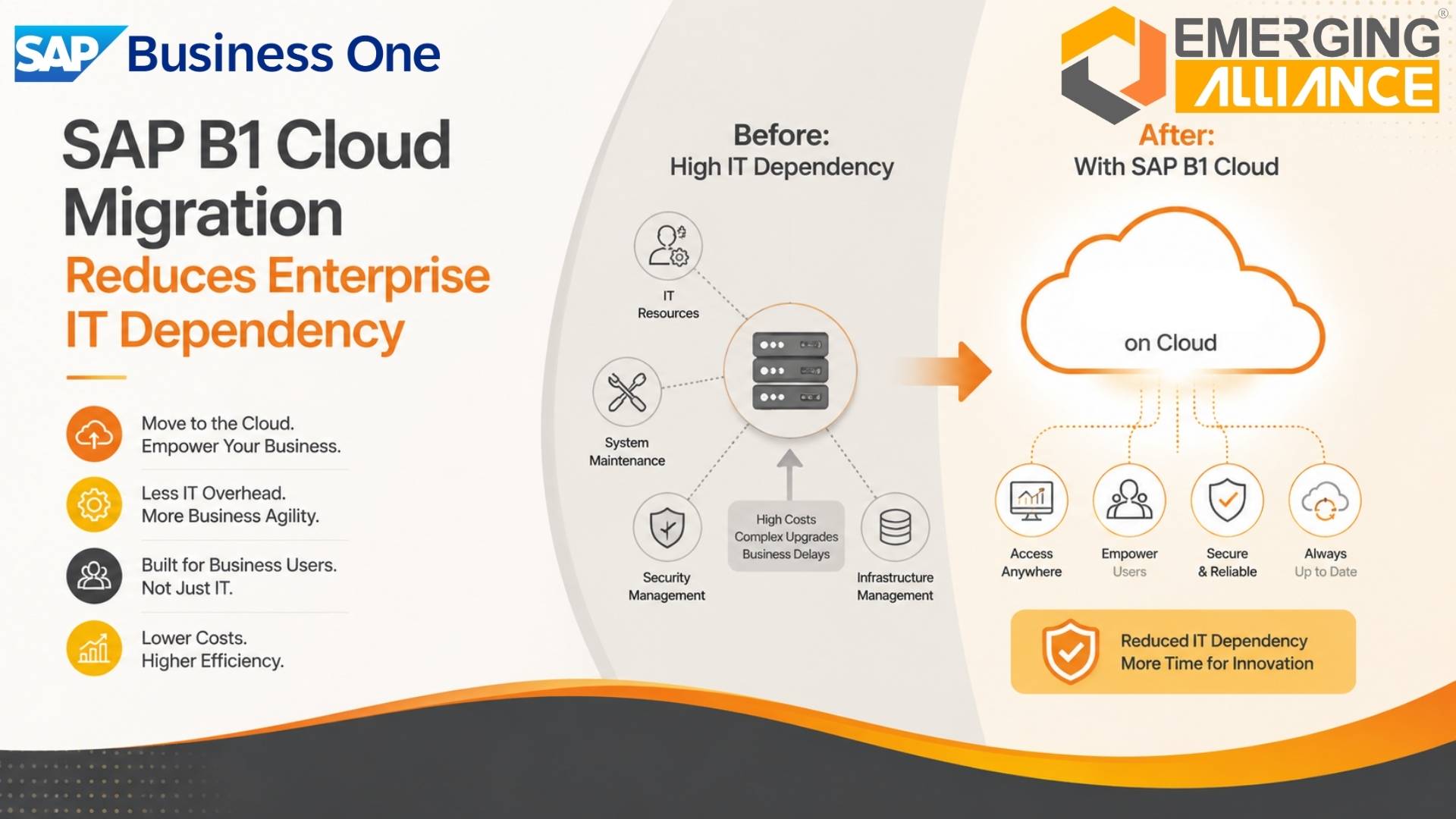
SAP B1 Cloud Migration Reduces Enterprise IT Dependency
SAP B1 Cloud Migration for secure, scalable, low-risk ERP operations
Enterprise growth often exposes the hidden limitations of traditional ERP infrastructure. Internal IT teams become overloaded. ERP upgrades slow down operations. Remote accessibility becomes inconsistent. Security risks increase. Infrastructure costs become unpredictable. This is where SAP B1 Cloud Migration becomes a strategic business decision instead of a technical upgrade.
Modern enterprises are no longer evaluating ERP systems only based on functionality. They are evaluating operational agility, scalability, compliance readiness, security posture, and long-term cost optimization.
Organizations still running an on-premise ERP environment frequently struggle with:
- Dependency on internal IT teams for every change
- Downtime during upgrades or maintenance
- Limited remote access capabilities
- High infrastructure and server maintenance costs
- Delayed reporting and visibility gaps
- Business continuity risks
- Slow integration with modern digital platforms
A cloud-based SAP Business One environment changes this operating model completely.
Instead of managing infrastructure complexity internally, enterprises gain a scalable ERP ecosystem that supports growth, automation, visibility, and faster decision-making.
At Emerging Alliance, SAP B1 cloud transformation is approached as a business modernization initiative focused on operational resilience, performance optimization, and long-term scalability.
Why SAP B1 Cloud Migration Is Becoming an Executive-Level Priority
Many organizations initially implemented ERP systems for operational control. But over time, on-premise ERP environments often create new bottlenecks.
As businesses scale across locations, users, warehouses, distributors, and remote teams, traditional infrastructure struggles to keep up.
Common Enterprise Challenges With On-Premise ERP
Infrastructure Dependency Slows Business Agility
Internal IT teams spend excessive time managing:
- Server maintenance
- Backup monitoring
- System patching
- Performance troubleshooting
- VPN access management
- Security updates
This creates operational delays and increases dependency on a small internal support structure.
Visibility Gaps Impact Decision-Making
Disconnected systems and delayed reporting create:
- Inventory visibility issues
- Slow financial consolidation
- Delayed operational approvals
- Forecasting inaccuracies
- Revenue leakage from manual workflows
Executives need real-time ERP visibility — not delayed operational summaries.
Scaling ERP Infrastructure Becomes Expensive
Expanding infrastructure for additional users, branches, or workloads often requires:
- New servers
- Hardware investments
- Additional IT resources
- Higher maintenance costs
- Increased downtime risk
This slows enterprise expansion initiatives.
SAP Business One Cloud ERP Creates a Scalable Operating Model
A properly executed SAP Business One cloud ERP environment enables enterprises to operate with greater flexibility, security, and control.
Instead of maintaining infrastructure internally, organizations gain access to a centralized cloud-based ERP architecture optimized for performance and scalability.
Business Benefits of SAP B1 Migration to Cloud
Faster Access Across Distributed Teams
Cloud-based SAP Business One enables secure access for:
- Remote teams
- Multi-location operations
- Regional offices
- Sales teams
- Service operations
- Leadership stakeholders
This improves collaboration and operational continuity.
Reduced IT Infrastructure Burden
A modern SAP Business One cloud hosting strategy reduces dependency on physical infrastructure and minimizes internal maintenance complexity.
Enterprises can reduce:
- Hardware management overhead
- Backup administration
- Infrastructure downtime
- Disaster recovery risks
- Server upgrade cycles
Improved ERP Performance and Scalability
As business operations grow, cloud infrastructure scales without disrupting operations.
This becomes critical for enterprises managing:
- High transaction volumes
- Seasonal demand spikes
- Multi-entity operations
- Manufacturing workflows
- Distribution networks
Better Security and Compliance Readiness
Modern cloud-based SAP B1 solutions support:
- Secure data environments
- Controlled access management
- Centralized monitoring
- Backup automation
- Business continuity planning
This strengthens operational resilience while supporting compliance initiatives.
SAP B1 On-Premise to Cloud Migration Improves Operational Visibility
One of the biggest advantages of SAP B1 on-premise to cloud transformation is centralized enterprise visibility.
Executives no longer need to rely on fragmented operational reports generated from multiple disconnected systems.
Real-World Operational Scenario
Consider a growing manufacturing enterprise operating across multiple warehouses and regional sales offices.
In a traditional on-premise setup:
- Inventory reports are delayed
- Remote users face VPN access issues
- Finance teams struggle with data consolidation
- IT teams constantly troubleshoot server performance
- Business approvals slow down during peak operations
After moving to a cloud-based SAP Business One environment:
- Leadership gains real-time dashboards
- Branch operations access the same live ERP environment
- Reporting becomes centralized
- System performance improves
- Approval workflows accelerate
- Downtime risks reduce significantly
This directly impacts operational efficiency and business responsiveness.
SAP Business One Cloud Hosting Supports Long-Term Cost Optimization
Many enterprises assume cloud migration is purely an infrastructure change. In reality, it directly impacts long-term operational economics.
Areas Where Enterprises Improve ROI
Lower Infrastructure Capital Investment
Organizations reduce dependency on:
- Physical server purchases
- Hardware refresh cycles
- Data center maintenance
- Backup infrastructure investments
Predictable ERP Operating Costs
Cloud models improve financial predictability through controlled infrastructure planning and optimized resource allocation.
Reduced Downtime Costs
System downtime impacts:
- Revenue operations
- Customer experience
- Production continuity
- Financial processing
- Supply chain coordination
Cloud-based ERP environments help reduce these operational disruptions.
Better Resource Utilization
Internal IT teams can shift focus from infrastructure maintenance toward:
- Process optimization
- Automation initiatives
- Analytics
- Governance
- Digital transformation projects
This creates higher strategic business value.
Choosing the Right SAP Business One Cloud Hosting Provider Matters
Not every migration delivers the same business outcome.
A successful SAP B1 cloud implementation requires more than infrastructure deployment.
It requires:
- ERP process understanding
- Migration governance
- Security planning
- Business continuity strategy
- Integration expertise
- Post-migration optimization
What Enterprises Should Evaluate
Migration Planning Capability
The migration partner should assess:
- Existing ERP architecture
- Database performance
- Integration dependencies
- User access structures
- Workflow bottlenecks
SAP Business One Expertise
Cloud migration decisions should align with operational realities — not generic hosting models.
Security and Compliance Readiness
Enterprises should validate:
- Backup strategy
- Access governance
- Disaster recovery planning
- Infrastructure monitoring
- Data protection controls
Long-Term Transformation Support
Migration is not the end goal.
The real objective is continuous ERP optimization, scalability, automation, and enterprise growth enablement.
This is where strategic transformation partners create measurable long-term value.
Emerging Alliance Helps Enterprises Modernize SAP B1 Operations
Emerging Alliance works with enterprises looking to modernize ERP operations without disrupting business continuity.
The focus extends beyond technical migration.
The objective is to help organizations:
- Reduce operational dependency
- Improve ERP scalability
- Strengthen visibility
- Optimize workflows
- Support remote operations
- Improve decision-making speed
- Build future-ready ERP infrastructure
Whether the requirement involves SAP Business One to cloud migration, ERP modernization, infrastructure optimization, or operational transformation, the approach remains business-first and outcome-driven.
Ready to Reduce ERP Infrastructure Dependency?
If your enterprise is experiencing:
- ERP performance bottlenecks
- Infrastructure scalability issues
- High maintenance overhead
- Remote access limitations
- Visibility gaps across operations
- Increasing IT dependency
It may be time to evaluate a secure and scalable SAP B1 cloud strategy.
FAQs About SAP B1 for Cloud Migration
1. How does SAP B1 Cloud Migration support enterprise scalability?
SAP B1 Cloud Migration allows enterprises to scale users, locations, operational workloads, and data processing without constantly upgrading physical infrastructure or expanding internal IT dependency.
2. Why are enterprises moving from SAP Business One on-premise solution to cloud platforms?
Many enterprises are moving to cloud-based SAP Business One environments to improve operational flexibility, remote accessibility, security management, and real-time business visibility.
3. Can SAP Business One cloud hosting improve business continuity?
Yes. Cloud hosting environments help reduce operational disruption through centralized backups, disaster recovery planning, infrastructure redundancy, and controlled system monitoring.
4. What should enterprises evaluate before SAP B1 migration to cloud?
Organizations should assess ERP customizations, integrations, database performance, user access models, security requirements, and operational workflows before migration planning begins.
5. How does cloud-based SAP B1 solution improve executive visibility?
Cloud ERP environments provide centralized dashboards, faster reporting access, real-time operational monitoring, and improved decision-making across departments and business units.
6. Is SAP B1 cloud implementation suitable for multi-location businesses?
Yes. Enterprises operating across branches, warehouses, sales offices, or international teams benefit from centralized access and standardized workflows through cloud deployment.
7. How does SAP Business One cloud ERP help reduce operational bottlenecks?
Cloud ERP environments streamline approvals, improve data accessibility, reduce system delays, and eliminate infrastructure-related disruptions that slow enterprise workflows.
8. Can SAP Business One cloud platforms support future digital transformation initiatives?
Yes. Cloud-based ERP infrastructure provides a more flexible foundation for automation, analytics, AI integration, workflow optimization, and scalable enterprise modernization strategies.
9. What industries benefit most from SAP Business One cloud migration?
Manufacturing, distribution, healthcare, pharmaceuticals, retail, engineering, and service-driven enterprises commonly benefit from improved visibility, scalability, and operational efficiency.
10. Why is choosing the right SAP Business One cloud hosting provider important?
The right provider ensures migration governance, security readiness, infrastructure stability, ERP optimization, integration management, and long-term operational support aligned with business goals.
Connect with Emerging Alliance to assess your current ERP environment and identify a low-risk migration roadmap aligned with your business goals.