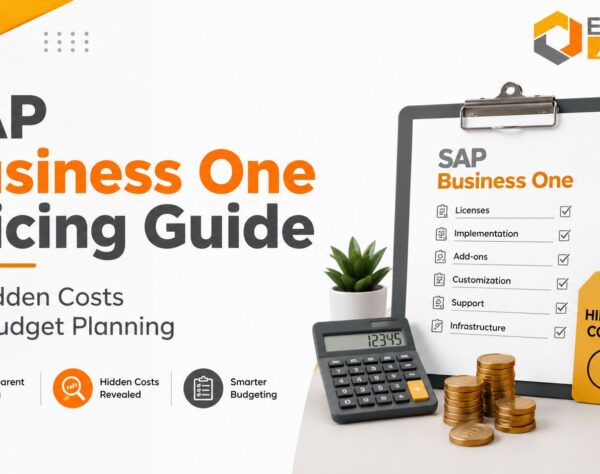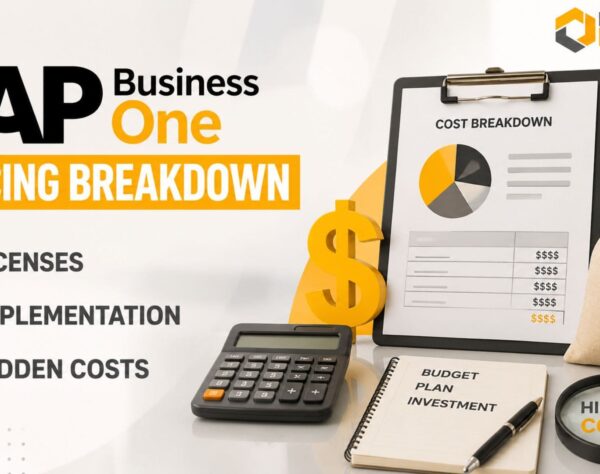


SAP Business One Pricing The Real Driver of Long-Term Success

SAP Business One Pricing That Supports Long-Term Business Growth
Enterprise leaders rarely fail because they invest in ERP. They fail because they underestimate how ERP pricing impacts long-term scalability, operational continuity, and digital transformation outcomes.SAP Business One Pricing is no longer just a software procurement discussion. For growing enterprises, manufacturers, distributors, and service organizations, pricing directly influences implementation flexibility, automation maturity, compliance readiness, and future expansion capacity.
Many businesses initially choose ERP platforms based only on short-term software cost. Over time, hidden inefficiencies emerge:
- fragmented operational visibility
- rising manual processing overhead
- disconnected reporting systems
- compliance exposure
- workflow delays
- inventory inaccuracies
- revenue leakage across departments
This is where a strategic ERP roadmap matters more than a low entry price.
As enterprises modernize operations, choosing the right SAP Business One implementation partners in India becomes equally important as evaluating SAP B1 Pricing itself. A transformation-focused partner like Emerging Alliance helps organizations align ERP investment with measurable business outcomes, operational resilience, and long-term growth objectives.
Why SAP Business One Pricing Impacts Enterprise Scalability
SAP Business One Pricing should be evaluated as a business scalability framework rather than a standalone software expense.
Many SMEs and mid-sized enterprises adopt ERP systems to solve immediate operational issues. However, without a scalable licensing and deployment strategy, organizations often encounter:
- expensive system rework
- process bottlenecks during expansion
- reporting limitations across branches
- disconnected inventory and finance workflows
- rising support and maintenance costs
SAP Business One software in India supports enterprises that require structured growth while maintaining operational control.
A well-planned ERP investment allows businesses to:
- standardize workflows across departments
- improve financial visibility
- automate procurement and inventory operations
- centralize compliance management
- enable real-time decision-making
- reduce dependency on spreadsheets
For leadership teams, the focus should not only be SAP license cost per user in India. The larger question is whether the ERP ecosystem can sustain future operational complexity.
Understanding SAP B1 Pricing Models for Modern Enterprises
Organizations evaluating SAP B1 Price in India typically compare cloud and on-premise deployment structures. Both models serve different operational priorities.
SAP Business One Cloud Pricing
Cloud ERP models are increasingly preferred by growing businesses looking for operational agility and lower infrastructure dependency.
Key advantages include:
- lower upfront infrastructure investment
- faster deployment timelines
- remote accessibility for distributed teams
- simplified system upgrades
- scalable subscription models
- predictable operational expenditure
SAP B1 subscription pricing is particularly effective for businesses prioritizing rapid expansion and multi-location collaboration.
SAP Business One On-Premise Pricing
On-premise ERP environments remain relevant for enterprises requiring greater infrastructure control and industry-specific compliance management.
This model is often preferred by:
- manufacturing enterprises
- regulated industries
- businesses with custom integration environments
- organizations with internal IT governance requirements
SAP Business One On-Premise Pricing typically involves:
- perpetual licensing costs
- server infrastructure investment
- maintenance contracts
- customization expenses
- upgrade management
The right choice depends on operational maturity, compliance expectations, and long-term digital transformation strategy.
Hidden ERP Costs Enterprises Often Ignore During Evaluation
Many organizations focus only on SAP software price in India while overlooking long-term operational impact.
This creates major financial and process inefficiencies after implementation.
Commonly Ignored ERP Cost Factors
Customization Complexity
Poorly designed ERP customization increases:
- implementation delays
- maintenance dependency
- upgrade conflicts
- reporting inconsistencies
SAP Business One customization cost should always be evaluated alongside future scalability.
Integration Challenges
Modern enterprises require ERP integration with:
- CRM platforms
- eCommerce systems
- warehouse management tools
- payroll software
- business intelligence platforms
Weak integration planning leads to disconnected workflows and duplicate data processing.
Support and Maintenance
SAP B1 support and maintenance cost becomes a long-term operational factor.
Without proactive ERP governance, businesses experience:
- downtime risks
- delayed issue resolution
- performance degradation
- user adoption problems
Upgrade and Expansion Costs
As organizations scale, SAP B1 upgrade cost and module expansion become critical budgeting considerations.
Businesses should assess:
- branch expansion readiness
- multi-currency capability
- additional user licensing
- analytics requirements
- automation scalability
ERP success depends on lifecycle planning, not initial deployment alone.
How SAP Business One Pricing Improves Operational ROI
ERP investment becomes valuable when it eliminates inefficiencies that directly affect profitability and business continuity.
Enterprises implementing SAP ERP for growing businesses typically target measurable improvements in operational performance.
Real-World Operational Scenarios
Manufacturing Operations
A manufacturing company using disconnected systems often struggles with:
- production planning delays
- inaccurate inventory forecasting
- procurement inefficiencies
- material shortages
ERP automation improves inventory visibility, production scheduling, and vendor coordination.
This directly reduces operational waste and revenue disruption.
Multi-Branch Distribution Businesses
Distributors managing operations across multiple locations frequently encounter:
- inconsistent stock visibility
- delayed financial consolidation
- duplicate procurement activity
- inaccurate demand planning
SAP Business One modules pricing may initially appear higher than entry-level ERP systems, but centralized operational visibility significantly improves long-term efficiency.
Finance and Compliance Management
Finance leaders increasingly prioritize:
- audit readiness
- GST compliance
- real-time reporting
- automated reconciliations
- approval workflow tracking
ERP implementation reduces manual intervention while improving financial governance.
For enterprises evaluating ERP software pricing India, ROI should be measured through operational control, process automation, and scalability readiness rather than software acquisition cost alone.
Choosing the Right SAP Business One Implementation Partners in India
Technology alone does not transform enterprises. Strategy-driven implementation does.
Many ERP projects fail because businesses work with vendors focused only on deployment instead of long-term operational alignment.
Emerging Alliance positions ERP as part of a broader enterprise transformation roadmap.
This includes:
- business process consulting
- ERP architecture planning
- workflow optimization
- integration strategy
- automation consulting
- analytics enablement
- long-term scalability planning
For enterprise decision-makers, the objective is not simply implementing software. It is creating a connected operational ecosystem capable of supporting sustainable growth.
What Enterprises Should Expect from an ERP Transformation Partner
A strategic ERP consulting partner should help businesses:
- identify operational inefficiencies
- map process dependencies
- reduce workflow bottlenecks
- improve reporting accuracy
- align ERP architecture with growth plans
- support digital transformation initiatives
The right ERP solution partner becomes an operational advisor, not just a software provider.
SAP Business One Pricing Is a Long-Term Business Decision
SAP Business One Pricing directly influences how effectively enterprises scale operations, manage compliance, automate workflows, and maintain profitability during growth.
Businesses that evaluate ERP purely on initial licensing cost often encounter higher operational expenses later through fragmented systems, inefficient reporting, and scalability limitations.
A strategic ERP investment delivers value through:
- operational transparency
- automation maturity
- process standardization
- faster decision-making
- financial control
- sustainable scalability
Emerging Alliance helps enterprises evaluate SAP Business One Pricing through a long-term transformation lens, ensuring ERP investment supports both immediate operational efficiency and future business expansion.
For organizations planning ERP modernization, this is the right time to assess whether current systems are enabling growth or silently restricting it.
Accelerate Enterprise Growth with Emerging Alliance
Emerging Alliance helps enterprises design scalable ERP ecosystems that improve visibility, automate operations, and support long-term digital transformation goals.
Whether your organization is evaluating SAP Business One Cloud Pricing, on-premise deployment, licensing strategy, or operational scalability, our consultants help align ERP investment with measurable business outcomes.
FAQs About SAP Business One Pricing
1. What factors influence SAP Business One Pricing in India?
SAP Business One Pricing depends on deployment model, number of users, licensing structure, customization requirements, integrations, and support scope.
2. How does SAP Business One Cloud Pricing differ from on-premise pricing?
Cloud pricing typically follows a subscription model with lower infrastructure investment, while on-premise deployment involves perpetual licensing and server ownership costs.
3. What is included in SAP Business One license cost?
The license cost generally includes user access rights, core ERP modules, and platform functionality. Additional modules and integrations may increase overall pricing.
4. Is SAP B1 Pricing suitable for manufacturing companies?
Yes. SAP Business One supports manufacturing operations through production planning, inventory management, procurement automation, and operational reporting.
5. How do SAP Business One implementation partners in India impact ERP success?
Experienced implementation partners help reduce deployment risks, optimize workflows, improve adoption, and align ERP systems with business growth objectives.
6. What are the long-term maintenance costs associated with SAP B1 licensing cost in India?
Long-term costs may include annual maintenance, upgrades, support services, infrastructure management, and customization updates.
7. Can SAP Business One integrate with third-party business applications?
Yes. SAP Business One supports integrations with CRM systems, eCommerce platforms, payroll software, warehouse systems, and analytics tools.
8. How does SAP Business One improve ROI for growing enterprises?
ERP improves operational efficiency by automating workflows, reducing manual errors, enhancing reporting visibility, and improving inventory and financial control.
9. What industries commonly use SAP Business One software in India?
Manufacturing, distribution, retail, healthcare, engineering, professional services, and trading businesses widely use SAP Business One.
10. What challenges should businesses prepare for during ERP migration?
Common challenges include data migration accuracy, user adoption, process restructuring, integration complexity, and operational transition planning.
Connect with Emerging Alliance Schedule a strategic ERP consultation with us today.