

Connect, Optimize, and Scale Healthcare Operations with SAP Business One

Unify healthcare operations with SAP Business One healthcare—connect finance, inventory, and patient workflows
In modern healthcare environments, operational fragmentation is not just an IT inconvenience—it is a measurable financial and clinical risk. Hospitals and healthcare service facilities often operate with siloed systems across billing, pharmacy, labs, and patient management. This disconnect directly impacts efficiency, compliance, and decision-making. SAP Business One for Healthcare addresses this structural gap by creating a unified, real-time ecosystem across all operational layers. Instead of reconciling data across multiple tools, organizations leverage a single SAP Business One healthcare solution to centralize and standardize workflows.
The result is not incremental improvement—it’s systemic transformation.
Where Disconnected Systems Fail Healthcare Leaders
Most CIOs and Digital Transformation Heads underestimate the compounded cost of system fragmentation. The inefficiencies are not isolated—they cascade across departments.
Key operational breakdowns include:
- Disconnected billing, inventory, and patient management system workflows
- Heavy reliance on manual data entry, increasing duplication and errors
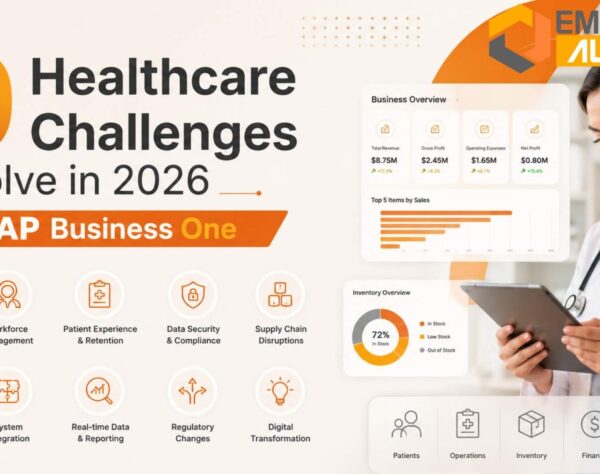
- Lack of real-time dashboards for hospitals, limiting visibility
- Inventory inefficiencies impacting Healthcare procurement management and supply chain continuity
- Compliance exposure due to inconsistent Medical data compliance standards
- Delayed financial reporting affecting Healthcare Financial Management
- Poor coordination across labs, pharmacy, and administrative units
This environment restricts scalability and directly impacts patient experience. Without Healthcare ERP integration, organizations operate reactively instead of strategically.
How SAP Business One ERP for Healthcare Industry Eliminates Operational Silos
The shift from fragmented tools to a SAP Business One ERP for healthcare industry is fundamentally about integration. This is not just software deployment—it’s architecture consolidation.
SAP B1 Healthcare unifies core functions:
- Financials and Healthcare accounting software SAP
- Inventory and Supply chain management for hospitals
- Patient lifecycle via integrated Patient management system
- Compliance workflows including Healthcare audit management
- Data intelligence through SAP B1 analytics and reporting
By leveraging SAP Business One ERP features, healthcare organizations can:
- Enable Healthcare workflow automation across departments
- Centralize data into a single source of truth
- Gain real-time insights via Healthcare reporting system
- Improve patient care through connected Patient data analytics
- Transition to scalable Cloud-based healthcare ERP environments
The key differentiator is that SAP Business One Healthcare Modules are adaptable. Whether it’s diagnostics, pharmacy, or multi-location hospital networks, the platform aligns with operational complexity.
From Operational Chaos to Strategic Control: Business Outcomes That Matter
The transition to a SAP Business One healthcare solution is justified not by technology—but by measurable business outcomes.
Organizations that successfully implement SAP Business One implementation healthcare strategies achieve:
- End-to-end visibility: Unified dashboards replace fragmented reporting
- Cost control: Reduced leakages in procurement and inventory
- Data accuracy: Elimination of redundant entries across systems
- Regulatory alignment: Strengthened Medical data compliance frameworks
- Faster decisions: Real-time insights from SAP B1 solution analytics
- Operational scalability: Seamless expansion across locations and services
Critically, Healthcare digital transformation becomes sustainable—not just a one-time initiative.
This is where Implementing SAP Business One transitions from IT execution to enterprise strategy.
Beyond Implementation: Building a Future-Ready Healthcare ERP Ecosystem
Deploying SAP Business One ERP for Healthcare is only one phase. The real value is unlocked through continuous optimization and integration.
A strategic approach includes:
- End-to-end SAP implementation tailored for healthcare workflows
- Integration with lab systems, EHR, and pharmacy platforms
- Data migration into a unified Healthcare reporting system
- Custom Real-time dashboards for hospitals
- Advanced SAP B1 analytics and reporting for executive decision-making
- Continuous system optimization and support
Organizations that treat ERP as a living system—not a static deployment—achieve sustained ROI.
This is where partnering with a transformation-focused team—not just a vendor—becomes critical.
Ready to Eliminate System Silos and Drive Healthcare Efficiency?
Disconnected systems are not just slowing operations—they are eroding profitability and increasing risk.
A well-executed SAP Business One for Healthcare strategy enables you to:
- Integrate every department into a unified platform
- Strengthen financial and operational control
- Enhance patient experience through connected workflows
- Build a scalable, future-ready healthcare ecosystem
Take the next step. To know more about our products & services, visit us at: https://www.emerging-alliance.com/
FAQs About SAP Business One for Healthcare
1. How does SAP B1 for Healthcare handle multi-location hospital operations?
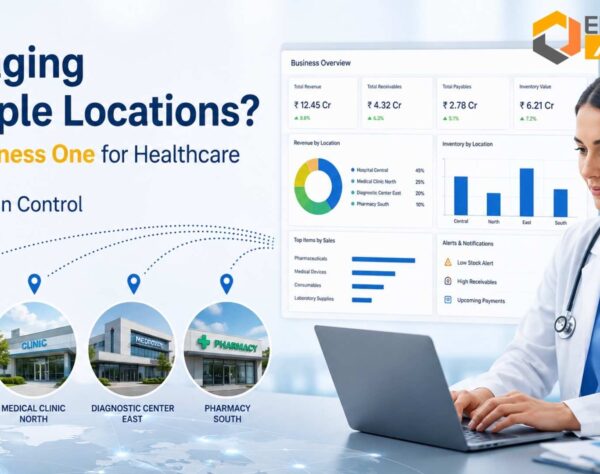
It centralizes data across locations while allowing unit-level controls, ensuring consistency and visibility.
2. Can SAP B1 Healthcare integrate with existing EHR systems?
Yes, through APIs and middleware, enabling seamless Healthcare ERP integration.
3. What makes SAP B1 suitable for mid-sized healthcare organizations?
It offers enterprise-grade capabilities without the complexity and cost of large-scale ERP systems.
4. How does SAP B1 improve Healthcare Financial Management?
By automating accounting, billing, and reporting into a unified financial structure.
5. Does SAP Business One support compliance requirements in healthcare?
Yes, it enforces structured data governance and audit trails for Medical data compliance.
6. What kind of analytics does SAP B1 provide for hospitals?
Advanced SAP B1 analytics and reporting with real-time dashboards and predictive insights.
7. How does SAP Business One optimize hospital inventory?
It enables demand forecasting, stock tracking, and procurement automation.
8. Is SAP B1 ERP for Healthcare scalable for future expansion?
Yes, it supports multi-entity, multi-location growth with cloud deployment options.
9. What are the key SAP Business One Healthcare Modules?
Finance, inventory, procurement, patient management system, and analytics modules.
10. How long does SAP Business One implementation healthcare typically take?
Timelines vary based on complexity, integrations, and data migration scope, typically ranging from weeks to months.
Want to speak to an expert? Fill in the form below, and we will be in touch with you shortly!