
Optimize Your Enterprise Growth with Smart, Scalable SAP B1 Pricing
Build a cost-efficient roadmap with SAP B1 pricing clarity
Most enterprises don’t struggle with ERP because of technology they struggle because of pricing misalignment. The real issue with SAP B1 Pricing is not that it is high, but that it is often misunderstood. Many CXOs enter ERP conversations expecting a straightforward cost structure. What they encounter instead is a layered pricing model involving licenses, implementation, infrastructure, and long-term maintenance. Without clarity, this leads to budget overruns, underutilized licenses, and poor ROI realization.
The question is no longer “What is the SAP B1 price in India?”
The real question is “How do we structure SAP Business One pricing to align with business growth and financial control?”
Why SAP Business One Pricing Feels Complex
SAP Business One pricing & cost details are inherently dynamic because the solution is designed to adapt to different business models, industries, and growth stages. This flexibility is powerful but it also introduces complexity.
The final SAP software price in India depends on several interconnected decisions:
- The mix of user licenses and access levels
- Deployment approach (cloud vs on-premise)
- Depth of customization and integrations
- Industry-specific workflows
- The capability of your implementation partner
This is why two companies evaluating SAP Business One price in India can receive very different cost structures even within the same industry.
Understanding SAP B1 Pricing Models
At a strategic level, SAP B1 pricing is driven by two major decisions: how you license the software and how you deploy it.
Perpetual vs Subscription (Licensing or Subscription Costs)
Enterprises typically choose between a capital expenditure model and an operational expenditure model.
A perpetual license involves a one-time SAP B1 license upfront cost, followed by annual SAP Business One’s maintenance costs in India. This model is often preferred by organizations seeking long-term cost stability and ownership.
In contrast, a subscription-based model spreads the SAP Business One cost over time. While the initial investment is lower, the long-term cost structure depends on usage and duration.
The right decision is not about cost alone it is about aligning pricing with your financial strategy.
Cloud vs On-Premise Cost Structure
Deployment plays a major role in shaping your SAP B1 ERP price in India.
Cloud-based deployments reduce upfront infrastructure and installation costs while offering scalability and predictable recurring expenses. On-premise deployments, however, require higher initial investment but provide greater control and long-term cost efficiency for stable operations.
The choice should be guided by scalability plans, IT maturity, and risk tolerance not just immediate cost savings.
SAP B1 License Strategy: Where Cost Optimization Begins
One of the most critical drivers of SAP Business One license cost is how you structure your user licenses. This is where many enterprises unintentionally overspend.
SAP offers multiple SAP B1 license types, primarily:
- Professional licenses, which provide full system access
- Limited licenses, which restrict access based on roles (finance, logistics, CRM)
A poorly planned license mix results in inflated SAP license cost per user in India. However, when aligned correctly with job roles, a structured SAP Business One license comparison chart can significantly optimize overall cost.
What Actually Drives SAP Business One Cost
To truly understand SAP Business One pricing facts, enterprises must look beyond just license costs and evaluate the complete investment landscape.
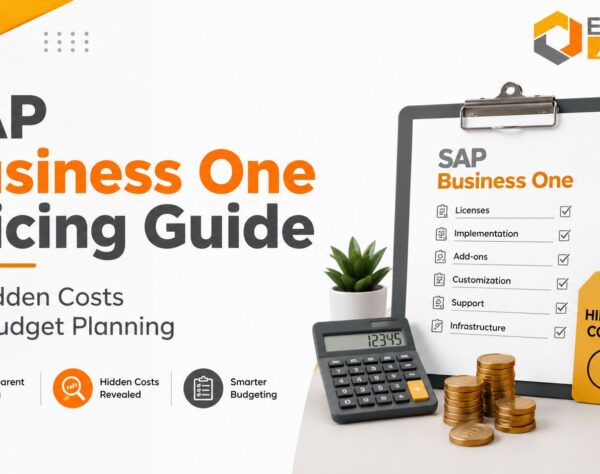
The total cost typically includes:
- SAP software license cost – the base SAP B1 price in India depending on user types
- SAP B1 implementation – configuration, deployment, and business process alignment
- Customization and integration – tailoring the system to business workflows
- SAP B1 add-on costs – additional tools like barcode systems, analytics, or mobility
- Infrastructure or cloud subscription – depending on deployment model
- Ongoing support and maintenance – including SAP B1 consultant charges
Together, these elements define your Total Cost of Ownership (TCO) which is far more important than the initial purchase price.
SAP B1 Cost Across Business Sizes
There is no fixed SAP Business One price list, but cost structures generally evolve with business scale.
For smaller businesses, SAP B1 cost for a small business is typically lower due to fewer users and minimal customization. As organizations grow, SAP B1 cost for a medium-sized business includes integrations and process automation.
At the enterprise level, SAP B1 cost for a large enterprise reflects multi-entity operations, complex workflows, and advanced reporting requirements.
The goal is not to minimize cost but to ensure that cost aligns with business value and scalability.
Where Enterprises Go Wrong with SAP B1 Pricing
Despite the flexibility of SAP Business One pricing, many organizations fall into predictable traps.
Common mistakes include:
- Over-investing in high-level licenses without role alignment
- Underestimating the price of SAP B1 implementation
- Ignoring future scalability needs during initial planning
- Selecting partners based on cost rather than capability
- Overlooking add-ons and integration costs until later stages
These decisions often lead to cost escalations and delayed ROI.
A Smarter Approach to SAP B1 Pricing
A strategic approach to SAP B1 pricing begins with clarity and long-term thinking.
Enterprises that succeed typically:
- Design a role-based licensing structure to optimize usage
- Evaluate SAP Business One cost over a 5-year horizon
- Plan for scalability, including users, modules, and integrations
- Demand a customized SAP Business One price instead of generic packages
- Work with experienced SAP Business One implementation partners in India
This approach transforms pricing from a cost burden into a strategic advantage.
Strategic Perspective: Pricing as an Investment Lever
At the executive level, SAP Business One pricing should not be treated as a procurement decision. It is a financial strategy decision.
A well-structured pricing model enables:
- Predictable ERP budgeting
- Controlled operational costs
- Faster ROI realization
- Scalable business growth without financial shocks
In contrast, a poorly structured model results in inefficiencies that compound over time.
Get SAP B1 Pricing Right the First Time
At Emerging Alliance, we approach SAP Business One pricing as a strategic blueprint not just a quote.
We help enterprises:
Govern long-term costs through structured support
- Break down and understand SAP Business One pricing & cost details
- Optimize license structures to reduce unnecessary spend
- Plan implementation costs with precision
- Design scalable ERP architectures
Get a tailored SAP B1 pricing breakdown Plan your ERP investment with zero surprises
FAQs About SAP B1 pricing
1. How do I structure SAP B1 pricing to avoid budget overruns?
Start with a role-based license strategy, define scope clearly, and calculate 5-year TCO including implementation, add-ons, and support.
2. What is the ideal license mix for optimizing SAP B1 cost?
A balanced combination of professional and limited licenses aligned to user roles ensures cost efficiency without overpaying.
3. How much of SAP Business One cost is driven by implementation vs licensing?
In many cases, implementation and customization can match or exceed license costs, making partner selection critical for ROI.
4. How can enterprises reduce SAP B1 license cost without compromising functionality?
By mapping user responsibilities accurately and avoiding unnecessary full-access licenses.
5. What hidden costs should be considered in SAP Business One pricing?
Add-ons, integrations, data migration, training, and long-term support often contribute significantly beyond initial pricing..
6. How does scalability impact SAP B1 pricing over time?
As users, locations, and integrations increase, costs scale—making early planning essential to avoid future cost spikes.
7. Is SAP B1 pricing suitable for multi-entity or multi-location businesses?
Yes, but pricing must be structured to support consolidation, intercompany transactions, and reporting needs efficiently.
8. How do SAP B1 packages differ based on industry requirements?
Industry-specific needs drive customization, integrations, and add-ons, which directly influence the final pricing model.
9. What role does an implementation partner play in controlling SAP B1 cost?
A strategic partner ensures accurate scoping, avoids rework, optimizes licensing, and accelerates ROI.
10. How can I ensure SAP Business One pricing delivers long-term ROI?
Focus on process alignment, scalable architecture, and continuous optimization rather than just initial cost reduction
Connect with the experts at Emerging Alliance to build a cost-efficient SAP roadmap aligned with your business growth strategy.