
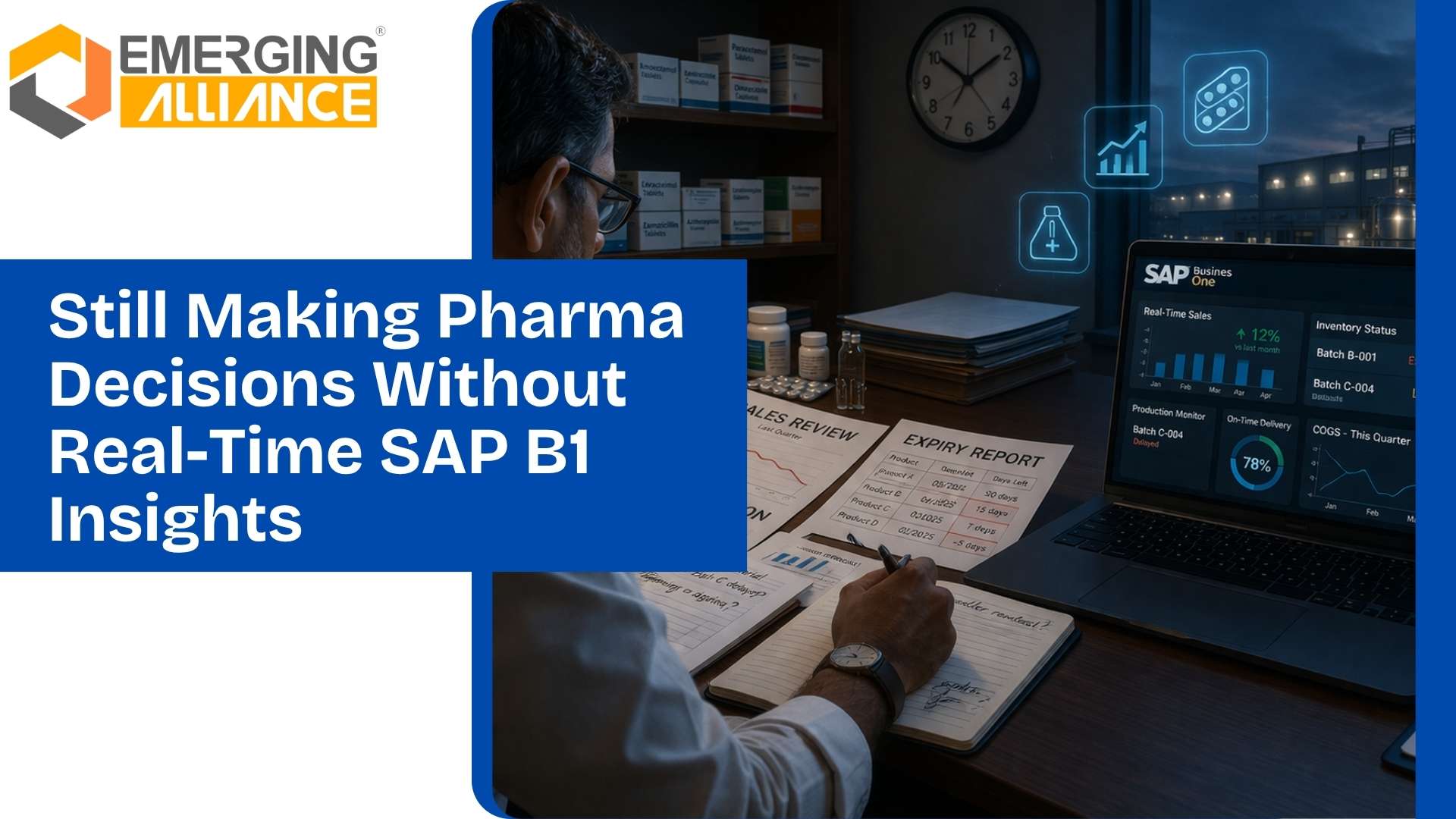
Still Making Pharma Decisions Without Real-Time SAP B1 Insights

Every delayed report is slowing your growth more than you think
Pharma with SAP B1 underscores a critical reality: in pharmaceutical operations, decisions are only as strong as the data behind them. Yet many organizations still rely on delayed reports, fragmented systems, and manual consolidation to understand what’s happening across production, inventory, compliance, and finance. This is no longer an operational inconvenience it’s a strategic risk.
A missed batch discrepancy, an untracked expiry, or a delayed compliance report doesn’t just impact operations. It directly affects revenue, regulatory exposure, and brand credibility.
This is where SAP Business One for the pharma industry is redefining how modern pharmaceutical enterprises operate replacing lagging insights with real-time decision intelligence.
The Hidden Cost of Operating Without Real-Time Visibility
Most pharma businesses underestimate the true cost of delayed data because the impact is distributed across departments.
Inventory Inefficiencies That Erode Margins
Without real-time inventory insights, companies either overstock to stay “safe” or face unexpected stockouts. Both scenarios impact working capital and customer commitments.
Compliance Risks That Escalate Quickly
Regulatory frameworks demand precision. When data is outdated or incomplete, audit readiness becomes reactive instead of proactive—creating unnecessary exposure.
Batch Traceability Gaps
In the absence of unified systems, tracing a batch across procurement, production, and distribution becomes time-consuming and error-prone—especially during recalls.
Slow Decision Cycles at the Leadership Level
When leadership relies on weekly or monthly reports, decisions are always one step behind reality. In a fast-moving pharma market, that delay compounds into lost opportunities.
Why Legacy Systems Fail Modern Pharma Demands
Many organizations believe they have “ERP in place,” but the real issue lies in how that system is structured and used.
Disconnected Data Silos
Production, inventory, finance, and quality often operate on separate systems or partially integrated tools. This fragmentation eliminates a single source of truth.
Manual Reporting Dependencies
Teams spend more time preparing reports than acting on insights. By the time reports reach leadership, the data is already outdated.
Limited Real-Time Monitoring
Traditional systems were not designed for live operational visibility. They capture transactions—but fail to convert them into actionable intelligence.
Scalability Constraints
As pharma businesses grow, legacy systems struggle to handle increasing complexity multiple warehouses, regulatory layers, and global supply chains.
What Real-Time SAP Business One Delivers for Pharma
Modern pharma organizations are shifting toward SAP Business One ERP for pharmaceutical industry because it transforms data into immediate, actionable intelligence.
Unified Real-Time Dashboards
Executives gain a single view of operations inventory levels, production status, financial performance, and compliance metrics all updated in real time.
End-to-End Batch Traceability
From raw material intake to final distribution, every batch is tracked with precision. This ensures faster recalls, stronger compliance, and reduced risk.
Intelligent Inventory Management
With SAP B1 inventory management pharma, businesses can optimize stock levels, reduce expiries, and align procurement with actual demand.
Integrated Quality and Compliance Controls
Built-in workflows support regulatory compliance, documentation, and audit readiness—without relying on manual intervention.
Faster, Data-Driven Decisions
Instead of waiting for reports, leadership teams can act instantly based on live insights improving responsiveness across the organization.
The Real Business Impact at Scale
Adopting SAP Business One pharma software is not just a technology upgrade it’s a shift in how decisions are made.
Improved Operational Efficiency
Automation reduces manual workload, allowing teams to focus on high-value activities instead of data consolidation.
Stronger Regulatory Confidence
With real-time data and traceability, audits become structured and predictable rather than stressful and reactive.
Optimized Working Capital
Better inventory control leads to reduced carrying costs and improved cash flow management.
Enhanced Forecasting Accuracy
With accurate, real-time data, demand planning becomes more reliable—reducing production mismatches.
Scalable Growth Enablement
As operations expand, the system scales seamlessly supporting multi-location, multi-process environments without complexity.
The Strategic Shift Pharma Leaders Can’t Delay
The question is no longer whether your organization has data.
The real question is how quickly can you act on it?
In a highly regulated, margin-sensitive, and time-critical industry like pharma, delayed insights translate directly into lost control.
Organizations that adopt SAP ERP for pharma manufacturing with real-time intelligence are not just improving efficiency, they are building a resilient, scalable, and future-ready enterprise.
Ready to Move from Delayed Reports to Real-Time Control?
If your leadership team is still making decisions based on outdated data, it’s time to rethink your ERP strategy.
Request a personalized SAP Business One pharma demo today and see how real-time insights can transform your operations, compliance, and growth trajectory.
FAQs About SAP Business One for Pharma
1. How does SAP Business One support real-time decision-making in pharma?
It provides live dashboards and integrated data across departments, enabling leaders to make immediate, data-driven decisions without waiting for reports.
2. Can SAP B1 handle complex batch tracking requirements?
Yes, it offers end-to-end batch tracking, ensuring full traceability from procurement to distribution.
3. Is SAP Business One suitable for growing pharma companies?
It is designed to scale with business growth, supporting expanding operations, compliance needs, and multi-location management.
4. How does SAP B1 improve regulatory compliance?
It centralizes data, automates documentation, and ensures audit-ready reporting aligned with pharma regulations.
5. What makes SAP B1 different from traditional ERP systems?
Its real-time capabilities, integrated architecture, and pharma-specific functionalities set it apart from legacy systems.
6. Can SAP B1 integrate with existing pharma systems?
Yes, it supports integration with third-party applications, ensuring a seamless data flow across systems.
7. How does SAP B1 improve inventory management in pharma?
It provides real-time stock visibility, expiry tracking, and demand-based replenishment planning.
8. What role do SAP B1 partners play in implementation?
They ensure the system is customized to pharma-specific workflows and aligned with business objectives.
9. Is cloud deployment available for SAP Business One pharma?
Yes, it supports both on-premise and cloud deployment, offering flexibility based on business needs.
10. How long does SAP B1 pharma implementation take?
Timelines vary based on complexity, but structured implementations focus on rapid deployment with minimal disruption.
Fill the form below and connect with our experts at Emerging Alliance.