
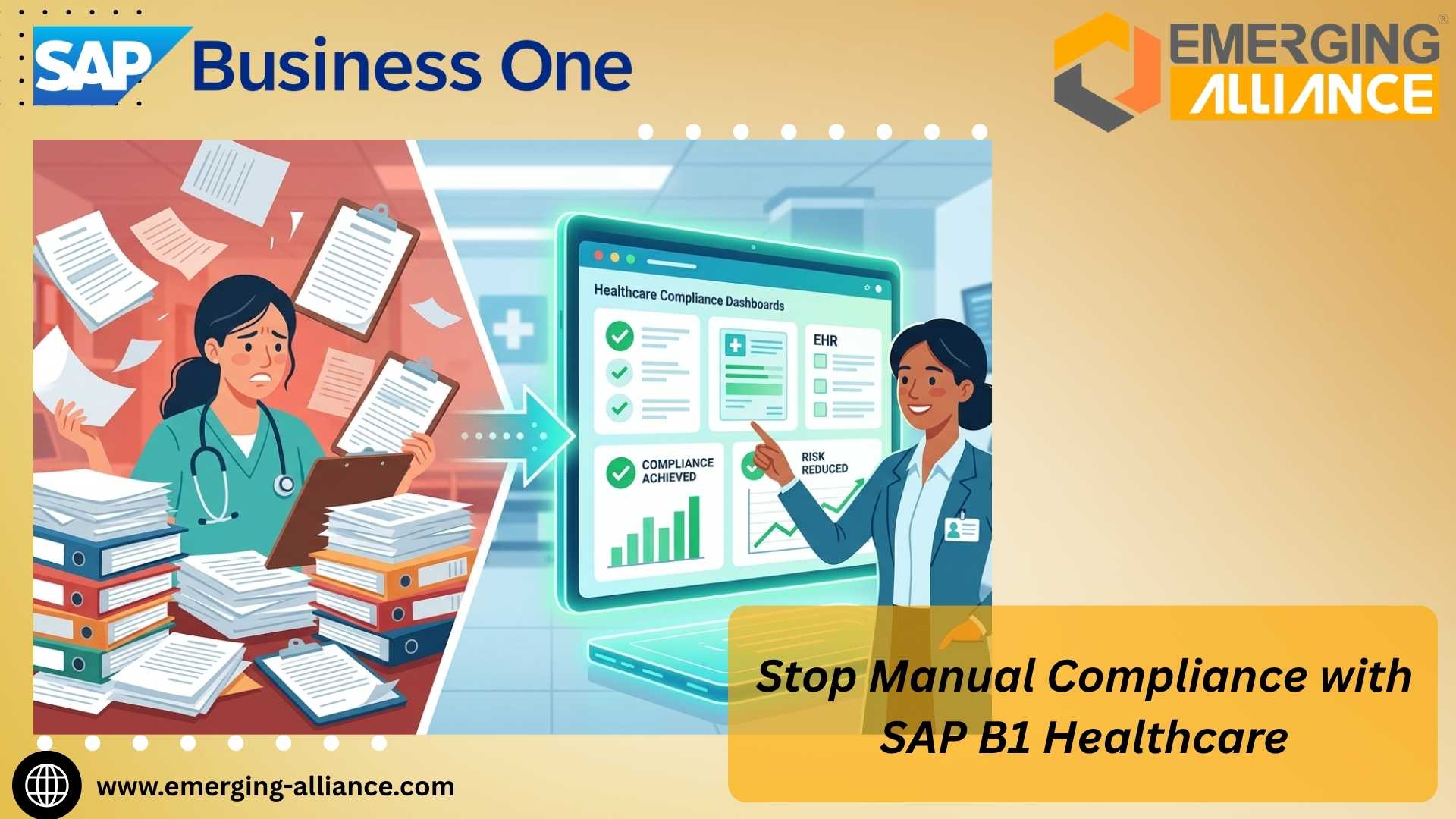
Stop Manual Compliance with SAP B1 Healthcare
Manual Compliance is Risky Transform Healthcare Operations with SAP B1
Regulatory environments have evolved to the point where compliance is no longer a back-office function but a board-level risk variable. Yet many healthcare providers, diagnostic chains, and pharmaceutical distributors still rely on spreadsheets, disconnected systems, and manual documentation an approach that may appear manageable but often conceals systemic exposure such as inconsistent audit trails, delayed regulatory reporting, human error in batch and expiry tracking, and a lack of real-time compliance visibility. For CIOs and COOs, this is not just an operational inefficiency; it is a strategic vulnerability. This is where SAP B1 Healthcare shifts compliance from reactive firefighting to a proactive, system-driven control architecture
The True Cost of Manual Compliance in Healthcare Operations
Manual compliance doesn’t fail loudly, it fails silently, until it becomes expensive.
1. Data Integrity Breakdowns
When compliance data is handled manually, inconsistencies across systems become inevitable. This compromises traceability, especially in high-risk areas like drug batches and patient-linked records.
2. Audit Readiness Becomes Reactive
Instead of being audit-ready, teams scramble to compile data when regulators step in—creating stress, delays, and exposure.
3. Regulatory Penalties & Legal Exposure
Non-compliance isn’t just a risk it translates directly into financial penalties, operational shutdowns, and reputational damage.
4. Fragmented Systems Create Blind Spots
Disconnected tools for inventory, finance, and patient care management lead to compliance silos, where no single source of truth exists.
5. Operational Inefficiency at Scale
Manual workflows don’t scale. As organizations grow, compliance complexity multiplies without the systems to support it.
Why Manual Compliance Models Are Structurally Unsustainable
Healthcare organizations are evolving but manual compliance frameworks are not.
- Regulatory requirements are becoming more dynamic and granular
- Global operations demand standardized compliance frameworks
- Data volumes are increasing exponentially
- Stakeholders expect real-time reporting and transparency
Manual systems cannot deliver:
- Real-time analytics for hospitals
- Centralized healthcare reporting tools
- Integrated medical supply chain management software
To stay compliant, organizations must move from manual control → system-driven governance.
How SAP B1 Healthcare Redefines Compliance Management
SAP B1 Healthcare is not just an ERP it is a compliance-centric digital backbone for healthcare enterprises.
It embeds compliance into daily operations rather than treating it as a separate function.
Automated Compliance Workflows
From documentation to approvals, SAP Business One modules automate compliance workflows ensuring consistency and eliminating manual dependencies.
Real-Time Traceability
Track every batch, serial number, and expiry in real time with SAP B1 healthcare modules, enabling instant audit access.
Centralized Data Architecture
Break down silos with a unified system that integrates:
- Financial management in healthcare
- Inventory and supply chain for hospitals
- Patient care management
Built-In Regulatory Alignment
With structured workflows and audit trails, SAP ERP for Healthcare ensures compliance is embedded and not enforced manually.
Core Capabilities That Strengthen Compliance Control
Batch, Serial & Expiry Tracking
Essential for pharmaceuticals and medical devices, this ensures complete product lifecycle traceability.
Automated Audit Trails
Every transaction is recorded, time-stamped, and accessible making audits seamless.
Integrated Healthcare Financial Management
Ensure compliance across billing, insurance, and financial reporting with SAP B1 for healthcare accounting.
Real-Time Reporting & Analytics
Leverage data analytics in healthcare ERP to monitor compliance KPIs and identify risks proactively.
Cloud-Based Accessibility
With SAP Business One cloud for healthcare, decision-makers gain access to compliance insights anytime, anywhere.
From Compliance Risk to Strategic Control: Business Impact
Organizations adopting SAP Business One ERP for healthcare providers typically shift from reactive compliance to strategic governance.
Reduced Compliance Risk
Automated validation and controls significantly lower the risk of human error.
Faster Audit Cycles
Audit preparation time reduces dramatically with real-time access to structured data.
Improved Operational Efficiency
Automation eliminates repetitive manual tasks, freeing teams to focus on value-driven work.
Scalable Compliance Framework
Whether expanding across regions or services, compliance processes scale seamlessly.
Enhanced Decision-Making
With real-time visibility, leaders can make data-driven compliance decisions not assumptions.
Key Indicators Your Compliance Model Needs Immediate Transformation
If any of the following apply, your organization is already exposed:
- Compliance data is maintained in spreadsheets
- Audit preparation takes weeks instead of hours
- Inventory and compliance data are not synchronized
- Regulatory updates require manual process changes
- There is no single system for healthcare enterprise resource planning (ERP)
These are not operational issues, they are strategic risks.
Strategic Implementation: Why Partner Choice Matters
Implementing SAP B1 Healthcare is not just a technology upgrade—it is a compliance transformation initiative.
A successful SAP B1 implementation for medical institutions requires:
- Deep understanding of healthcare regulations
- Customization using healthcare-specific SAP Business One modules
- Seamless system integration and data migration
- Ongoing optimization and support
This is where working with experienced SAP B1 consultants for healthcare industry becomes critical—not just for deployment, but for long-term compliance excellence.
The Future of Healthcare Compliance Is System-Driven
The Healthcare Industry’s Future will be defined by organizations that treat compliance as a strategic capability, not a regulatory burden.
With SAP Business One healthcare software solutions, organizations can:
- Automate healthcare workflows
- Improve patient care with SAP B1
- Ensure continuous audit readiness
- Build a scalable, compliant growth model
The shift is clear:
From manual processes → to intelligent, automated compliance ecosystems
Compliance Is No Longer Optional It’s Foundational
Manual compliance is not just inefficient it is unsustainable in a high-stakes healthcare environment.
SAP B1 Healthcare enables organizations to:
- Eliminate compliance risks
- Centralize operations
- Achieve real-time visibility
- Scale with confidence
For decision-makers, the question is no longer “Should we transform?”
It is “How soon can we eliminate the risk?”
Request a Demo: Transform Compliance into a Competitive Advantage
If your organization is still managing compliance manually, you are operating with unnecessary risk exposure and limited control. In regulated industries, this is not sustainable.
Get a personalized demo of SAP Business One for Healthcare and see how you can eliminate compliance gaps, strengthen audit readiness, and gain real-time operational visibility all while building a scalable, secure foundation for growth.
FAQs About SAP B1 for Healthcare
1. How does SAP B1 Healthcare handle regulatory audits across multiple locations?
SAP B1 centralizes audit data across locations, enabling unified reporting and consistent compliance standards globally.
2. Can SAP B1 Healthcare support batch recalls with full traceability?
Yes, it provides end-to-end batch tracking, allowing instant identification and recall of affected products.
3. How does SAP B1 ensure data integrity in healthcare operations?
Through automated validations, role-based access, and system-controlled workflows, reducing manual errors.
4. Is SAP B1 suitable for small and medium-sized healthcare organizations?
Yes, it is designed to scale, making it ideal for growing healthcare providers.
5. How does SAP B1 integrate with existing healthcare systems?
It supports seamless integration with third-party applications, ensuring data continuity.
6. What compliance standards can SAP B1 Healthcare support?
It can be configured to align with local and global regulatory frameworks through structured workflows.
7. How does SAP B1 improve healthcare financial management compliance?
It automates billing, reporting, and financial tracking, ensuring accuracy and transparency.
8. Can SAP B1 provide real-time compliance dashboards?
Yes, decision-makers get access to real-time dashboards for compliance monitoring.
9. What role do add-ons play in SAP Business One healthcare modules?
Add-ons extend functionality to meet specific healthcare compliance needs.
10. How long does SAP B1 implementation for healthcare typically take?
Timelines vary based on complexity, but structured implementation ensures faster ROI and compliance readiness.
Fill out the form below to connect with Emerging Alliance and take the next step toward compliance-driven performance.