
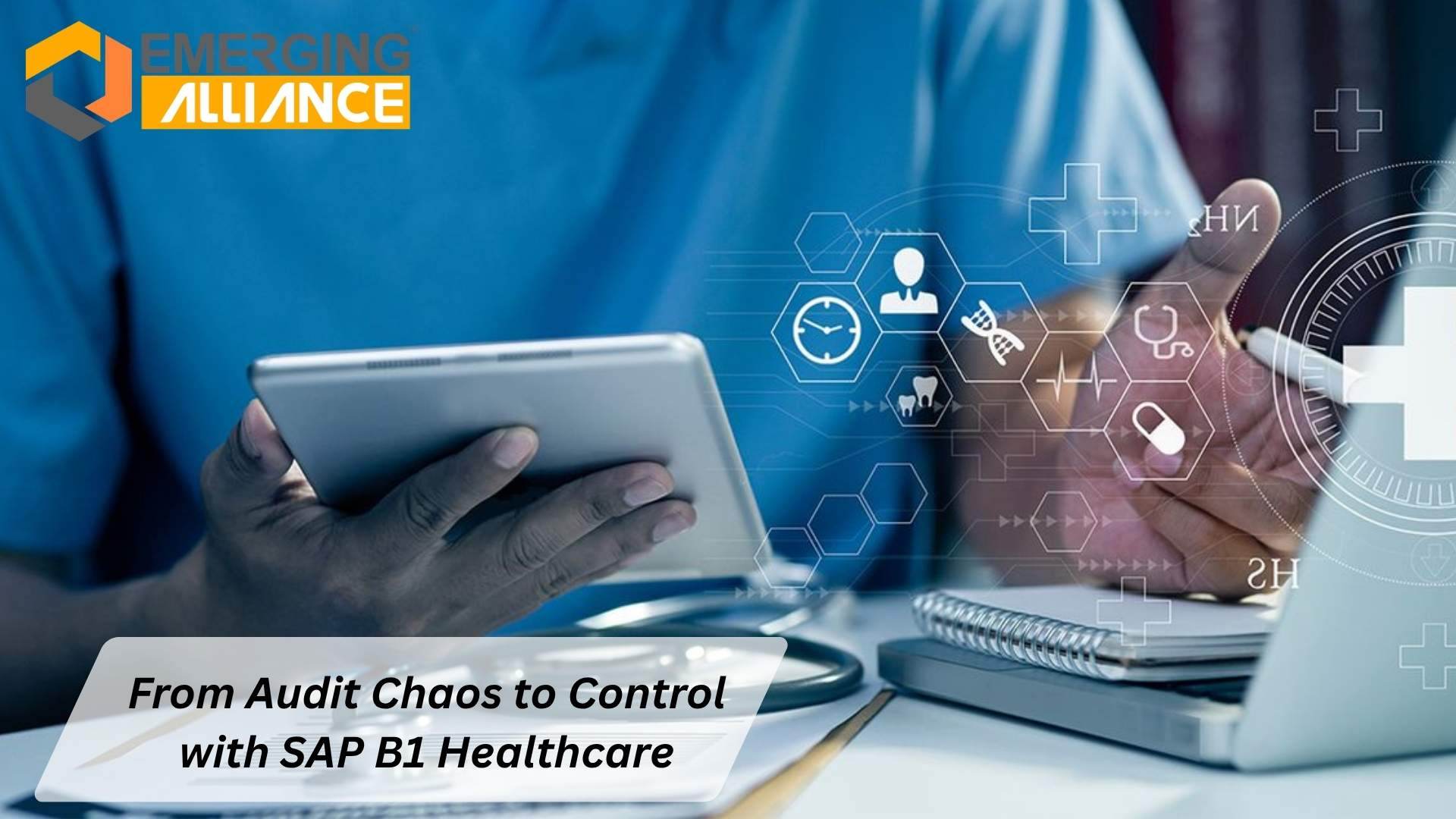
From Audit Chaos to Control with SAP B1 Healthcare
Transform compliance processes with automated batch tracking, expiry control, and audit trails
Compliance within the healthcare ecosystem is no longer confined to meeting regulatory mandates; it has become a fundamental operational priority, especially with the growing adoption of SAP B1 Healthcare solutions. SAP B1 Healthcare enables organizations to move beyond reactive compliance and build a more structured, strategic approach to audit readiness. Despite this shift, many healthcare organizations still function within fragmented systems, where audit readiness is handled reactively instead of being embedded into strategy. The challenges are consistent disconnected audit trails, manual or siloed management of batch and expiry data, prolonged regulatory reporting timelines, and data inconsistencies that elevate compliance risks. In this scenario, SAP Business One for pharmaceutical and healthcare enterprises serves as a strategic enabler, extending beyond a traditional ERP to act as an integrated compliance control framework.
Why Healthcare Audits Spiral into Chaos
Audit challenges rarely stem from a single issue. They are typically the result of systemic gaps in data architecture and process governance.
Fragmented Data Ecosystems
Multiple systems across procurement, inventory, billing, and patient care create data silos, making traceability nearly impossible.
Manual Intervention in Critical Processes
From batch tracking to expiry management, reliance on spreadsheets introduces human error and audit inconsistencies.
Lack of Real-Time Visibility
Without real-time analytics for hospitals, audit preparation becomes a retrospective exercise rather than a continuous process.
Increasing Regulatory Complexity
Healthcare providers must comply with evolving standards yet most systems are not built for dynamic regulatory reporting.
The result? Audit chaos becomes a recurring operational disruption.
The Hidden Cost of Poor Audit Control
Audit inefficiencies don’t just impact compliance they directly affect financial performance and operational scalability.
- Delayed Audits = Delayed Decisions
Leadership lacks timely insights to make strategic calls. - Compliance Penalties & Risk Exposure
Even minor discrepancies in batch traceability can lead to serious regulatory consequences. - Revenue Leakages
Inventory mismatches, billing errors, and expired stock contribute to avoidable financial loss. - Operational Inefficiency
Teams spend more time preparing for audits than driving growth.
For healthcare enterprises, this is not sustainable. The shift must be from audit preparation → audit readiness.
Reimagining Compliance with SAP Business One
Modern healthcare organizations are moving toward integrated, cloud-based healthcare ERP systems that unify operations, finance, and compliance into a single platform.
SAP Business One ERP for healthcare providers is designed to do exactly that.
It brings together:
- Financial management in healthcare
- Inventory and supply chain for hospitals
- Patient care management and billing
- Compliance and audit tracking
All within a unified architecture that ensures data consistency, traceability, and governance.
This is where SAP B1 Healthcare modules stand out offering industry-aligned capabilities without the complexity of large-scale ERP deployments.
How SAP B1 Transforms Audit Management
The real value of SAP Business One healthcare software solutions lies in how it operationalizes compliance.
1. End-to-End Batch Traceability
Track every drug or medical device across its lifecycle—from procurement to patient delivery.
With medical supply chain management software, traceability becomes instant, not investigative.
2. Automated Expiry Management
Eliminate manual tracking with system-driven alerts and controls.
Ensure FEFO (First Expiry First Out) compliance across inventory.
3. Real-Time Audit Trails
Every transaction is logged automatically creating a tamper-proof audit trail that simplifies regulatory checks.
4. Unified Data Across Departments
With SAP ERP for healthcare, finance, operations, and inventory work on a single source of truth.
5. Advanced Reporting & Compliance Dashboards
Leverage healthcare reporting tools and data analytics in healthcare ERP to generate audit-ready reports instantly.
6. Cloud-Based Accessibility
With SAP Business One cloud for healthcare, decision-makers can access compliance data anytime, anywhere.
From Reactive Audits to Proactive Governance
The transition from chaos to control is not just about technology, it’s about redefining how healthcare organizations approach compliance.
With SAP B1 implementation for medical institutions, audits become:
- Continuous instead of periodic
- Automated instead of manual
- Predictive instead of reactive
This enables leadership to move from firefighting compliance issues to strategically managing risk and performance.
Why the Right Implementation Partner Matters
Implementing SAP Business One for healthcare industry is not just a technical deployment, it is a strategic transformation initiative.
Success depends on:
- Deep understanding of healthcare workflows
- Expertise in SAP Business One modules and add-ons
- Ability to align ERP with compliance frameworks
- Continuous support, optimization, and training
This is where experienced SAP B1 consultants for healthcare industry play a critical role ensuring that the system delivers measurable ROI, not just functionality.
Take Control of Your Compliance Before It Controls You
Healthcare organizations that treat compliance as a back-office function will continue to face audit chaos.
Those that invest in Healthcare Enterprise Resource Planning (ERP) solutions like SAP Business One will gain a competitive advantage through control, visibility, and scalability.
Ready to move from audit chaos to control? If compliance complexity is slowing down your operations, it’s time to take a more structured and proactive approach. Discover how SAP Business One can transform your healthcare processes with real-time audit readiness, complete batch traceability, and automated compliance workflows.
FAQs About SAP B1 Healthcare
1. How does SAP Business One ensure end-to-end batch traceability across multi-location healthcare operations?
SAP Business One for pharma enables serialized batch tracking across procurement, storage, distribution, and patient-level transactions, ensuring complete backward and forward traceability even across multiple warehouses or branches.
2. Can SAP B1 Healthcare support regulatory audit requirements specific to different countries?
Yes, SAP Business One cloud for healthcare supports localization and compliance frameworks, allowing healthcare providers to align with country-specific regulations such as FDA, CDSCO, or GCC healthcare standards through configurable reporting and audit logs.
3. How does SAP B1 handle audit trail integrity and prevent data tampering?
SAP Business One healthcare modules maintain system-generated, time-stamped audit logs for every transaction, with role-based access control and authorization workflows ensuring that any modification is recorded and traceable.
4. What level of automation can be achieved in expiry and recall management using SAP B1?
SAP B1 implementation for medical institutions enables automated expiry alerts, FEFO-based inventory allocation, and rapid recall identification by tracing affected batches within seconds across the supply chain.
5. How does SAP Business One integrate clinical, financial, and inventory data for audit reporting?
SAP ERP for healthcare unifies financial management, medical supply chain management, and operational data into a single platform, allowing real-time audit reports without manual data consolidation.
6. Can SAP B1 Healthcare scale for enterprise-level audit requirements with high transaction volumes?
Yes, SAP business one ERP for Healthcare Industry is designed to scale from mid-sized healthcare providers to large enterprises, handling high transaction volumes while maintaining performance and audit accuracy.
7. How does SAP B1 support proactive compliance monitoring instead of reactive audit preparation?
With real-time analytics for hospitals and compliance dashboards, SAP Business One enables continuous monitoring of deviations, helping organizations identify risks before audits rather than during them.
8. What role do SAP Business One add-ons play in enhancing healthcare compliance?
Healthcare-specific SAP Business One modules and add-ons extend core capabilities to include advanced compliance features such as barcode scanning, regulatory reporting formats, and validation workflows.
9. How quickly can audit-ready reports be generated using SAP B1 Healthcare?
With integrated healthcare reporting tools, audit-ready reports can be generated instantly using pre-configured templates and real-time data, eliminating weeks of manual preparation.
10. What is the typical impact of SAP B1 implementation on compliance-related operational costs?
By automating workflows, reducing manual errors, and minimizing compliance risks, SAP B1 for healthcare accounting significantly lowers the cost of audit preparation, penalties, and operational inefficiencies over time.
Fill out the form below to request a personalized demo with Emerging Alliance and see how you can bring accuracy, visibility, and control to your compliance framework.