
SAP Business One Cloud Migration Escape Legacy ERP Limits
A strategic SAP B1 Cloud Migration roadmap for CIOs driving future-ready IT infrastructure
Modern enterprises running SAP Business One (SAP B1) often reach a critical turning point. Systems originally deployed as an on-premise SAP Business One ERP platform begin to limit agility, scalability, and IT efficiency. Infrastructure costs rise, upgrades become complex, and data accessibility becomes a strategic bottleneck. This is where SAP Business One (SAP B1) Cloud Migration becomes a transformative IT strategy rather than a simple system upgrade. Moving from a SAP Business One on-premise solution to a cloud-based SAP Business One solution enables CIOs to modernize architecture, increase system resilience, and align ERP capabilities with digital transformation goals.
At Emerging Alliance, organizations are guided through a structured migration framework that converts traditional ERP infrastructure into a secure, scalable SAP Business One Cloud platform designed for long-term growth.
Why Enterprises Are Transitioning SAP Business One Systems to the Cloud
Organizations operating a traditional on-premises SAP B1 environment often face operational friction caused by aging infrastructure and limited system flexibility.
Migrating to a cloud-based SAP Business One environment removes these limitations and unlocks a modern IT architecture where performance, accessibility, and scalability become built-in capabilities.
A SAP Business One Cloud solution enables companies to:
- Deploy ERP in a secure cloud-based environment
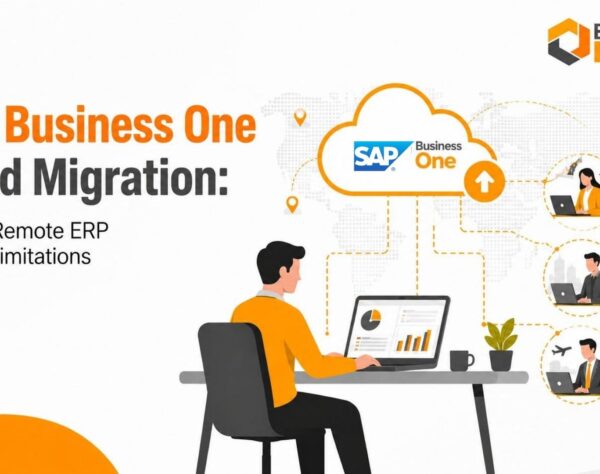
- Access the SAP Business One application cloud from any location
- Eliminate hardware dependency associated with SAP Business One on-premises solution
- Simplify upgrades and maintenance of the SAP B1 application
- Enable centralized operations across global teams
With a SAP Business One Cloud platform, IT leaders can focus less on infrastructure maintenance and more on strategic innovation.
Building a Strategic SAP B1 Cloud Transformation Roadmap
A successful SAP B1 cloud migration process requires more than moving servers. CIOs must design a structured roadmap that protects data integrity while optimizing system architecture.
The migration strategy typically begins with an assessment of the existing SAP B1 environment running within an on-premise SAP Business One ERP framework. This phase evaluates database structures, integrations, customizations, and performance constraints.
The roadmap then progresses through key stages:
Infrastructure Assessment and Planning
Organizations first analyze the existing SAP Business One solution architecture and identify dependencies within the SAP B1 solution landscape.
Secure SAP B1 Data Migration
Critical business data must be transferred carefully during the SAP B1 data migration stage. This ensures the SAP Business One Cloud migration maintains operational continuity while eliminating legacy system constraints.
System Reconfiguration for the Cloud
The ERP system is optimized to run within a SAP Business One Cloud hosting environment, enabling higher availability and flexible resource allocation.
Cloud Deployment and Validation
Once configured, the SAP B1 cloud implementation undergoes rigorous validation to ensure performance, integration stability, and operational continuity across departments.
Operational Advantages of Moving SAP Business One to a Cloud Platform
A properly executed SAP B1 migration to cloud fundamentally improves ERP performance and scalability.
Enterprises operating a cloud-based SAP B1 solution gain several strategic benefits:
Scalability
The SAP Business One Cloud solution allows organizations to scale users, storage, and computing power without hardware investments.
Accessibility
With the SAP Business One application cloud, employees and leadership teams access real-time ERP insights from anywhere.
Business Continuity
Modern SAP Business One Cloud hosting solution environments offer automated backups, redundancy, and disaster recovery.
Upgrade Efficiency
Regular SAP B1 cloud upgrade cycles become significantly easier compared with maintaining an aging SAP Business One on-premise solution.
Ensuring Security and Compliance in a Cloud-Based SAP B1 Environment
Security remains a primary concern when organizations consider SAP Business One cloud migration.
A robust SAP Business One Cloud hosting provider ensures enterprise-grade protection across infrastructure and data layers.
A secure SAP Business One Cloud hosting environment typically includes:
- Multi-layer encryption and secure network architecture
- Identity access management
- Continuous system monitoring
- Built-in SAP Business One cloud security frameworks
- Disaster recovery and backup protocols
These controls strengthen governance and reduce operational exposure during and after the SAP B1 system migration.
Managing Risk and Optimizing Cloud ERP Costs
CIOs must also evaluate financial and operational risk during the SAP B1 Cloud migration process.
A carefully planned migration strategy helps organizations achieve:
SAP B1 cloud risk management
Controlled transition planning ensures minimal disruption during SAP B1 system migration.
SAP B1 cloud cost optimization
A cloud-based SAP Business One solution eliminates infrastructure overhead associated with maintaining physical ERP servers.
Flexible resource allocation
Companies pay only for resources used within the SAP Business One Cloud hosting solution, enabling predictable IT budgeting.
These capabilities convert ERP infrastructure into a scalable operational service rather than a capital-heavy IT investment.
Why Enterprises Choose Emerging Alliance for SAP Business One Cloud Transformation
Migrating ERP systems requires deep technical expertise and a strong understanding of business processes.
As an experienced SAP Partner, Emerging Alliance delivers specialized SAP Business One services designed to ensure smooth migration from SAP Business One on-premise infrastructure to a modern SAP Business One Cloud solution.
Organizations benefit from:
- Structured SAP B1 cloud migration frameworks
- Certified ERP consultants and architects
- Secure SAP Business One Cloud hosting provider infrastructure
- Advanced SAP B1 data migration methodologies
- End-to-end SAP B1 cloud implementation
With a proven track record delivering SAP Business One cloud solutions provider expertise, Emerging Alliance helps enterprises unlock the full value of cloud-based SAP Business One platforms.
Future-Proofing ERP Strategy With SAP Business One Cloud Platforms
Digital transformation demands systems capable of supporting innovation, automation, and global operations.
Migrating to a SAP Business One Cloud platform prepares organizations for the future by enabling:
- Real-time analytics and integrated reporting
- Faster system upgrades and innovation cycles
- Seamless integration with other business applications
- High availability across distributed teams
The result is a resilient SAP Business One solution architecture that supports continuous business expansion.
FAQs About SAP Business One Cloud Migration
1. What is involved in moving SAP Business One systems to a cloud environment?
Transitioning an ERP landscape typically involves infrastructure planning, SAP B1 data migration, application optimization, and deployment within a secure SAP Business One Cloud hosting environment.
2. How long does a typical SAP B1 migration project take?
The duration depends on system complexity, customization levels, and data volume within the existing SAP Business One on-premises solution.
3. Is cloud-based SAP Business One secure for enterprise data?
Yes. Modern SAP Business One Cloud hosting providers implement encryption, secure access control, and continuous monitoring to protect ERP data.
4. Can existing integrations work after moving SAP B1 to the cloud?
Most integrations can be preserved and optimized within a cloud-based SAP Business One solution, depending on system architecture.
5. What are the cost advantages of deploying SAP Business One in the cloud?
Companies reduce infrastructure expenses while benefiting from predictable subscription costs and improved SAP B1 cloud cost optimization.
6. Will users need retraining after transitioning to cloud ERP?
User experience remains largely consistent because the SAP B1 application interface stays familiar even after moving to the cloud.
7. What happens to historical ERP data during the transition?
All operational and financial records are securely transferred during the SAP B1 data migration phase.
8. Can businesses scale ERP resources after cloud deployment?
Yes. A SAP Business One Cloud platform allows organizations to increase system resources as operational demands grow.
9. Is downtime expected during ERP migration to the cloud?
A carefully planned SAP B1 cloud migration process minimizes downtime and ensures continuity across business operations.
10. Why should organizations work with an SAP-certified partner?
An experienced SAP Partner ensures the migration aligns with ERP best practices, system performance standards, and long-term business strategy.