

UAE E-Invoicing: Closing Compliance Gaps in SAP Business One
Quick Answer
UAE e-invoicing is moving businesses from document-based invoicing toward structured electronic invoice exchange and reporting. For SAP Business One users, compliance depends not only on connecting the ERP to an Accredited Service Provider (ASP), but also on the accuracy of master data, tax configuration, invoice fields, integrations, validation, error handling, and transaction workflows.
The UAE Ministry of Finance defines an e-invoice as structured invoice data issued and exchanged electronically between a supplier and buyer and reported electronically to the Federal Tax Authority. PDFs, Word documents, scanned invoices, images, and invoices sent by email do not qualify as e-invoices.
For SAP Business One users, the practical challenge is therefore broader than invoice transmission. A business can have an ERP that generates invoices correctly but still encounter compliance gaps because the underlying customer, supplier, tax, product, pricing, or transaction data is incomplete or incorrectly configured.
The UAE e-invoicing framework uses the Peppol standard and an Accredited Service Provider model. The official rollout includes phased implementation, with mandatory implementation beginning January 1, 2027 for businesses with annual revenue of AED 50 million or more, July 1, 2027 for businesses below AED 50 million, and October 1, 2027 for in-scope government entities. The Ministry subsequently extended the ASP appointment deadline for businesses above AED 50 million from July 31, 2026 to October 30, 2026, while keeping the January 1, 2027 implementation deadline unchanged.
For companies running SAP Business One, the priority should be to identify and close ERP data, process, integration, and validation gaps before the mandatory implementation date.
UAE E-Invoicing Requirements for SAP Business One Users
The UAE e-invoicing framework applies to in-scope business-to-business (B2B) and business-to-government (B2G) transactions, subject to the applicable exclusions. Businesses can also voluntarily implement e-invoicing from July 1, 2026.
The important distinction is that e-invoicing is not simply the conversion of an SAP Business One invoice into a PDF or electronic document.
The invoice data must be structured and processed through the UAE e-invoicing framework. This means the ERP environment needs to provide accurate transaction information to the integration layer and ultimately the business’s Accredited Service Provider.
For SAP Business One users, this creates several areas that should be assessed:
A successful implementation therefore requires both technical connectivity and business-process readiness.
UAE E-Invoicing Timeline: What SAP Business One Businesses Need to Prepare For
The UAE is following a phased implementation model.
| Business category | ASP appointment deadline | Mandatory implementation |
|---|---|---|
| Businesses with annual revenue ≥ AED 50 million | October 30, 2026* | January 1, 2027 |
| Businesses with annual revenue < AED 50 million | March 31, 2027 | July 1, 2027 |
| In-scope government entities | March 31, 2027 | October 1, 2027 |
The Ministry also states that voluntary implementation is available from July 1, 2026.
This timeline changes how SAP Business One projects should be approached.
Businesses should not wait until the mandatory date to begin ERP assessment. Master-data remediation, integration design, ASP selection, configuration, testing, user acceptance testing, and production deployment all require lead time.
Where SAP Business One Compliance Gaps Can Occur
The most significant risks are often not visible on the invoice itself.
A typical SAP Business One transaction may involve:
A gap at any stage can affect the final e-invoice.
For example, an incorrect VAT code can produce an incorrect tax amount. An incomplete customer identifier can prevent successful validation. A missing mandatory field can cause rejection even though the original SAP Business One invoice appears normal to the user.
This is why e-invoicing readiness should be assessed at the process and data level, not only at the integration level.
SAP Business One Master Data and UAE E-Invoicing Readiness
Master data is one of the first areas that should be reviewed.
Common gaps can include:
When invoice data is generated from unreliable master data, the integration cannot automatically correct every underlying business-process problem.
A structured e-invoicing implementation should therefore include a master-data quality assessment before integration testing.
For larger SAP Business One environments, this can also be an opportunity to identify duplicate business partners, inactive records, inconsistent tax configurations, and other data-quality issues that may affect downstream reporting.
VAT and Tax Configuration Gaps in SAP Business One
Tax configuration is another critical area.
The business should review how SAP Business One handles:
- Standard-rated supplies
- Zero-rated transactions
- Exempt transactions
- Out-of-scope transactions
- Tax-exempt customers or transactions where applicable
- Credit notes
- Debit adjustments
- Discounts
- Freight and additional charges
- Reverse-charge scenarios where applicable
- Multiple tax treatments
The objective is not to create a separate tax process outside the ERP.
Instead, the business should determine whether its existing SAP Business One configuration produces the correct structured information required for the UAE e-invoicing process.
Any tax configuration assessment should be validated against the applicable UAE tax and e-invoicing requirements rather than assuming that existing ERP settings are automatically compliant.
Mandatory Invoice Data: Why ERP Data Accuracy Matters
The UAE Ministry of Finance publishes specific mandatory-field requirements for electronic invoices.
This means businesses should map the required information against the fields available in their SAP Business One environment.
A useful readiness exercise is:
This approach identifies gaps before production.
For example, if a required customer identifier exists in a separate system rather than SAP Business One, the project team must decide whether to:
- synchronize the data,
- create or configure an ERP field,
- use an integration mapping,
- validate the value before invoice submission, or
- redesign the relevant master-data process.
That is a much more practical approach than simply asking whether SAP Business One “supports e-invoicing.”
How the UAE E-Invoicing Model Works
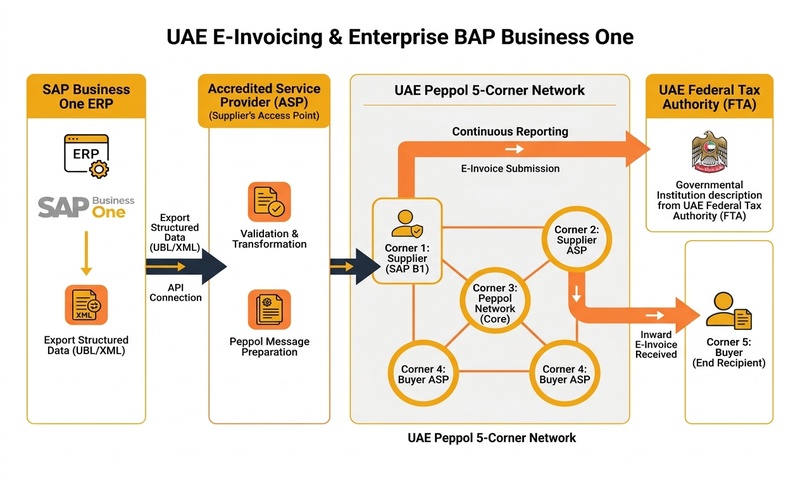
UAE e-invoicing model: Structured data flows from SAP Business One through accredited service providers across the Peppol exchange network with mandatory FTA tax data reporting.
The UAE framework uses a Peppol-based model involving Accredited Service Providers.
The Ministry of Finance describes a process in which the supplier’s ASP validates and processes e-invoice data, transmits it to the buyer’s ASP, and reports the applicable tax data document to the designated reporting mechanism. The buyer’s ASP validates the invoice, communicates status, and delivers the invoice to the buyer.
The simplified flow is:
with tax reporting occurring through the prescribed framework.
The important implication is that SAP Business One should be treated as a key source system for accurate transaction data, while the e-invoicing network and ASP provide the required exchange and reporting capabilities.
This distinction should be clearly understood during implementation.
PINT AE and Peppol: What SAP Business One Teams Need to Know
The UAE e-invoicing programme is based on the international OpenPeppol standard. The Ministry’s programme documentation also identifies PINT AE and the Tax Data Document (TDD) within the UAE framework.
For an SAP Business One project, the practical question is not simply whether the ERP can generate an invoice.
The project team needs to establish:
These questions should be answered during solution design rather than after go-live.
Closing SAP Business One E-Invoicing Integration Gaps
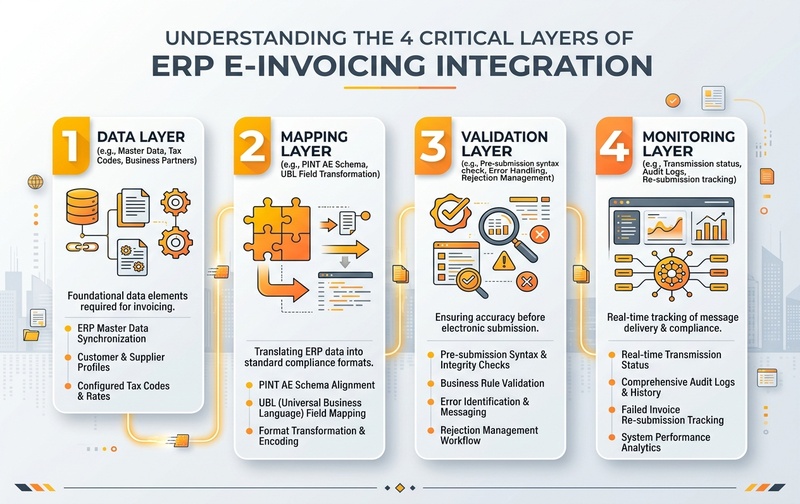
Closing ERP integration gaps: A structured 4-layer architecture ensuring SAP Business One transaction integrity, PINT AE schema mapping, pre-submission validation, and real-time monitoring.
Integration is where many businesses initially focus, but connectivity alone does not guarantee operational readiness.
A robust SAP Business One e-invoicing integration should address four layers.
1 Data Layer
The ERP should provide accurate:
- Business partner data
- Item/service data
- Tax information
- Pricing
- Currency
- Invoice values
- Document references
- Credit-note information
- Required identifiers
2 Mapping Layer
The implementation should map SAP Business One fields to the required e-invoice structure. This is where gaps such as missing fields, incompatible formats, or inconsistent values should be identified.
3 Validation Layer
The solution should identify errors before or during transmission. Examples include:
- Missing mandatory information
- Invalid identifiers
- Incorrect tax treatment
- Invalid document references
- Calculation inconsistencies
- Unsupported values
4 Monitoring Layer
Users need visibility into:
- Submitted invoices
- Accepted invoices
- Rejected invoices
- Validation errors
- Transmission status
- Reporting status
- Resubmission requirements
Without monitoring, an integration can technically exist while finance teams remain unaware of failed transactions.
Common UAE E-Invoicing Risks for SAP Business One
SAP Business One E-Invoicing Readiness Checklist
Before implementation, a business should be able to answer “yes” to the following:
Any “no” should be treated as a potential readiness gap requiring further assessment.
How to Evaluate an Accredited Service Provider for SAP Business One
The UAE Ministry of Finance publishes an official list of Accredited Service Providers.
For an SAP Business One business, ASP evaluation should go beyond asking whether the provider is accredited.
Consider:
| Evaluation area | What to verify |
|---|---|
| Accreditation | Current UAE accreditation status |
| ERP integration | Compatibility with SAP Business One |
| Data mapping | Support for required UAE invoice structure |
| Peppol | Relevant Peppol capabilities |
| Validation | Pre-submission and response handling |
| Error management | Clear rejection and correction process |
| Monitoring | Transaction and status visibility |
| Security | Data protection and access controls |
| Support | UAE implementation and technical support |
| Scalability | Ability to support transaction volumes and future growth |
The Ministry’s accreditation framework itself includes technical evaluation, testing, security, support, maintenance, and other requirements for service providers.
SAP Business One E-Invoicing Implementation: A Practical Approach
A controlled implementation can follow six stages.
Stage 1 Regulatory Scope Review
Confirm whether the business and transaction types fall within the applicable UAE e-invoicing scope and identify the relevant implementation timeline.
Stage 2 ERP Readiness Assessment
Review:
- SAP Business One version
- Database environment
- Localization
- Tax configuration
- Business partner master data
- Item master data
- Invoice processes
- Credit-note processes
- Existing integrations
Stage 3 Data Mapping
Map UAE e-invoice requirements to SAP Business One fields and identify missing or unreliable information.
Stage 4 ASP and Integration Design
Select an accredited provider and define how SAP Business One will exchange invoice data with the provider.
Stage 5 Testing
Test:
- Standard invoices
- Credit notes
- Tax scenarios
- Discounts
- Multiple currencies where applicable
- Data-validation failures
- Rejections
- Corrections
- Resubmissions
- Status updates
Stage 6 Go-Live and Monitoring
After deployment, establish ownership for monitoring, exception handling, system updates, regulatory changes, and ongoing support.
Why UAE E-Invoicing Readiness Is an ERP Issue
The UAE e-invoicing programme is fundamentally about structured transaction data, not simply replacing paper invoices with electronic documents.
That makes the ERP environment important.
For SAP Business One users, compliance depends on the quality of the information moving through the transaction lifecycle.
- If customer data is wrong, the e-invoice can be wrong.
- If tax configuration is wrong, the tax information can be wrong.
- If mandatory fields are missing, validation can fail.
- If integration monitoring is weak, rejected invoices may remain unresolved.
- If users do not understand the exception process, finance operations can become dependent on manual intervention.
Therefore, UAE e-invoicing readiness should be approached as a business-process, data-quality, tax, integration, and ERP project, rather than an isolated IT connection.
When Should SAP Business One Businesses Start Preparing?
Businesses should begin before their mandatory implementation deadline.
The Ministry’s phased programme provides specific ASP appointment and implementation dates, while voluntary implementation is already available from July 1, 2026.
Starting early provides time to:
- identify data-quality problems,
- clean master data,
- review tax configuration,
- select an ASP,
- design integrations,
- map invoice fields,
- test transactions,
- train users,
- resolve validation failures,
- establish monitoring procedures.
For businesses approaching a January 2027 implementation deadline, waiting until the final weeks can compress several separate workstreams into one high-risk deployment.
Conclusion
UAE e-invoicing readiness is not simply a matter of generating electronic invoices from SAP Business One.
The bigger challenge is closing the gaps between ERP data, tax configuration, business processes, structured invoice requirements, integration, validation, and reporting.
For SAP Business One businesses, the most effective preparation starts with a readiness assessment. Identify inaccurate master data, review tax configuration, map mandatory fields, evaluate the ASP and integration architecture, test real transaction scenarios, and establish a process for handling rejected or failed invoices.
The UAE Ministry of Finance has already established the national framework, published implementation guidance, and begun the phased rollout. Businesses should therefore treat e-invoicing as an ERP-readiness project rather than a last-minute compliance task.
FAQs About UAE E-Invoicing and SAP Business One
See How SAP Business One Can Close UAE E-Invoicing Gaps
Evaluate your SAP Business One setup, invoice workflows, tax configuration, and integration requirements for UAE e-invoicing.
Book a demo to identify potential compliance gaps and define the right implementation scope.