

SAP Business One vs SAP S/4HANA: ERP Selection by Business Complexity and Growth
Quick Answer: SAP Business One vs SAP S/4HANA
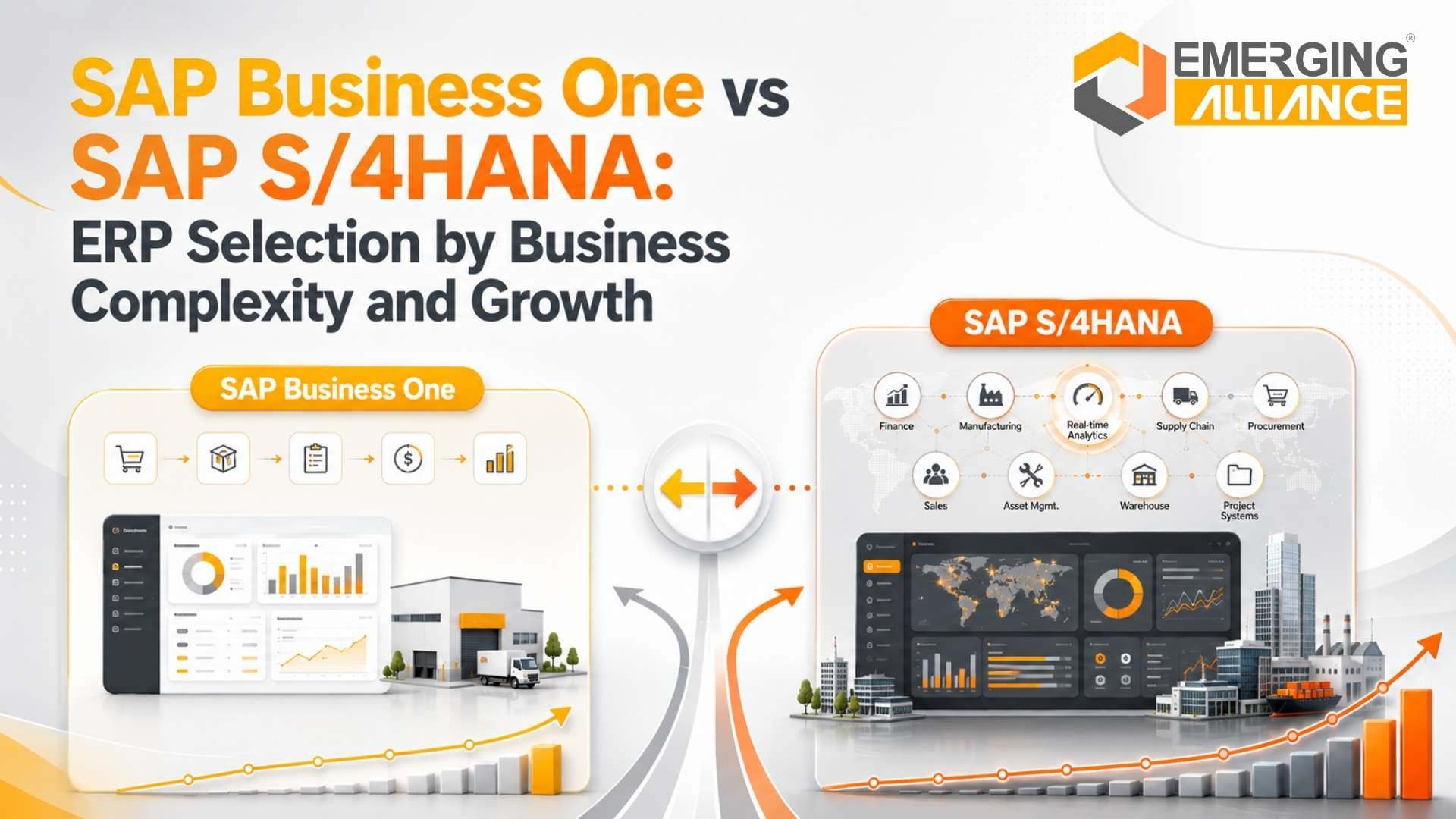
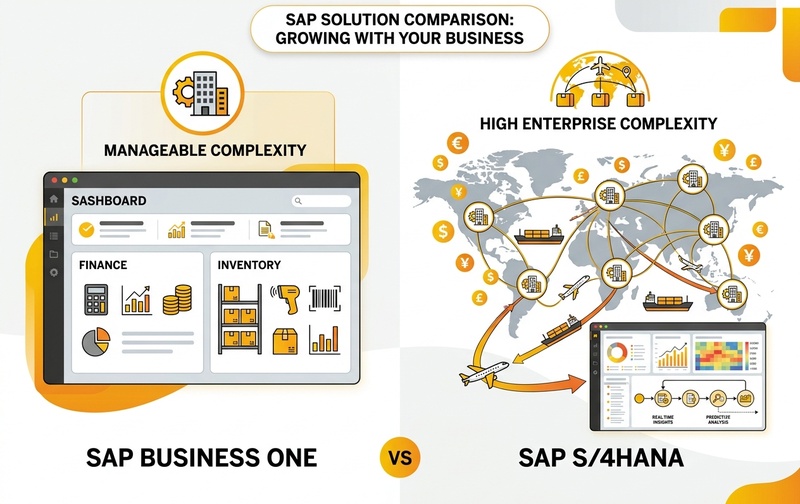
SAP Business One and SAP S/4HANA serve different levels of business complexity rather than simply different company sizes.
SAP Business One is typically a strong fit for small and midsize businesses, subsidiaries, manufacturers, distributors, and growing companies that need integrated finance, inventory, purchasing, sales, production, and operational control without enterprise-scale ERP complexity.
SAP S/4HANA is better suited when a business requires more extensive global process standardization, complex multi-entity operations, sophisticated supply chains, enterprise-wide integrations, advanced governance, or broader cloud transformation capabilities.
However, company size alone should not determine the decision. SAP also positions SAP S/4HANA Cloud Public Edition for midsize companies that require scalable cloud ERP capabilities.
The right choice should be based on business complexity, process requirements, integration landscape, scalability, implementation effort, total cost of ownership, and long-term growth strategy.
SAP Business One vs SAP S/4HANA at a Glance
| Comparison Area | SAP Business One | SAP S/4HANA |
|---|---|---|
| Primary Fit | Small and midsize businesses and subsidiaries | Midsize to large and complex organizations |
| Business Complexity | Low to moderate | Moderate to very high |
| Core ERP Scope | Finance, sales, purchasing, inventory, CRM, production, reporting | Enterprise finance, manufacturing, supply chain, procurement, asset management, sales and broader enterprise processes |
| Database | Microsoft SQL Server or SAP HANA | SAP HANA |
| Deployment | On-premise and partner-hosted/cloud environments | Public cloud, private cloud and applicable enterprise deployment models |
| Implementation Complexity | Generally lower | Generally higher |
| Multi-Entity Requirements | Suitable for many SME and subsidiary scenarios | Strong for complex multi-company and global operations |
| Integration Requirements | Suitable for common business integrations and extensions | Designed for broader enterprise integration landscapes |
| Customization & Extensibility | Add-ons, APIs and partner extensions | Extensive configuration, APIs, SAP BTP and enterprise extensibility |
| Analytics | Operational reporting with advanced HANA-based analytical capabilities where applicable | Enterprise-scale embedded analytics and advanced data capabilities |
| AI Capabilities | More limited and often extension-dependent | Broader embedded SAP Business AI capabilities |
| Typical TCO | Generally lower | Generally higher due to scope and transformation requirements |
| Best Decision Driver | Operational requirements and manageable complexity | Enterprise complexity and transformation requirements |
The table provides a starting point. The final ERP decision requires a closer look at how your organization operates.
What Is SAP Business One?
SAP Business One is an enterprise resource planning solution designed primarily for small and midsize businesses.
It provides an integrated platform for managing core business functions instead of maintaining separate applications and spreadsheets for finance, inventory, sales, purchasing, customer management, and operations.
SAP Business One commonly supports areas such as:
For growing businesses, the value of SAP Business One is usually not about implementing the largest possible ERP environment.
It is about creating one reliable operational system before disconnected systems, spreadsheets, manual approvals, and duplicate data become difficult to manage.
SAP currently positions SAP Business One for small and midsize organizations seeking greater control over their business or subsidiary operations.
Where SAP Business One Typically Fits Best
SAP Business One can be particularly relevant for organizations that:
- Have outgrown standalone accounting software
- Manage inventory across warehouses
- Need tighter control over purchasing and stock
- Manufacture or assemble products
- Operate distribution businesses
- Need integrated sales and finance information
- Want to reduce spreadsheet dependence
- Need stronger financial visibility
- Want ERP without unnecessary enterprise complexity
- Operate as a subsidiary of a larger group
The key advantage is functional integration with comparatively manageable ERP complexity.
What Is SAP S/4HANA?
SAP S/4HANA is SAP’s ERP platform built on the SAP HANA database.
It supports significantly broader and deeper enterprise processes across areas including:
- Finance
- Procurement
- Manufacturing
- Supply chain
- Asset management
- Sales
- Service
- Enterprise projects
- Product-related processes
- Analytics
- Enterprise governance
SAP S/4HANA should not be viewed only as an ERP for very large corporations.
Modern SAP ERP strategy includes different deployment approaches designed for different levels of standardization, transformation, and organizational complexity.
SAP S/4HANA Cloud Public Edition
SAP S/4HANA Cloud Public Edition is a standardized cloud ERP environment designed around predefined processes and SAP best practices.
SAP describes Public Edition as a scalable ERP platform with capabilities across finance, supply chain, HR, and sales, and explicitly states that it can be suitable for midsize companies.
It can be relevant for companies that:
- Want a cloud-first ERP strategy
- Are comfortable adopting standardized processes
- Want subscription-based ERP
- Need stronger international scalability
- Want continuous cloud innovation
- Require enterprise integration through SAP Business Technology Platform
- Are willing to adapt processes rather than heavily customize the ERP core
Public Edition therefore changes the traditional assumption that SAP S/4HANA is relevant only to very large enterprises.
SAP S/4HANA Cloud Private Edition
SAP Cloud ERP Private, historically associated with SAP S/4HANA Cloud Private Edition, is targeted toward organizations requiring broader ERP depth and flexibility.
SAP describes the private edition as providing extensive business-process scope while allowing greater extensibility and enterprise requirements than a highly standardized public-cloud model.
It becomes particularly relevant where organizations have:
- Extensive existing SAP processes
- Complex industry requirements
- Significant customization requirements
- Global operating models
- Large integration landscapes
- Complex transformation requirements
- Greater need for process flexibility
SAP Business One vs SAP S/4HANA: Key Differences
The correct comparison is not simply: Small company → SAP Business One, Large company → SAP S/4HANA. A better approach is to compare the platforms against the actual complexity of the organization.
1. Business Complexity
Business complexity is one of the strongest ERP selection criteria.
SAP Business One generally fits organizations whose processes can be managed through a relatively unified operational model.
For example, a manufacturer may need:
- Sales orders
- Purchasing
- Bill of materials
- Production orders
- Material planning
- Inventory control
- Batch or serial tracking
- Financial accounting
Those requirements alone do not automatically justify an enterprise-scale ERP. SAP Business One can support many such scenarios.
SAP S/4HANA becomes more relevant when complexity expands into areas such as:
- Multiple countries
- Large numbers of legal entities
- Sophisticated intercompany processes
- Global process templates
- Enterprise-wide consolidation
- Complex supply-chain planning
- Extensive integration requirements
- Large asset-management environments
- Group-wide master-data governance
- Complex organizational structures
ERP complexity should match business complexity. Choosing an ERP that is too simple can restrict growth. Choosing an ERP that is unnecessarily complex can increase cost, implementation time, governance effort, and change-management risk.
ERP Selection Decision Pathway:
2. Financial Management
Both SAP Business One and SAP S/4HANA provide financial-management capabilities.
SAP Business One includes functionality around:
- General ledger
- Accounts payable
- Accounts receivable
- Banking
- Budgeting
- Cost accounting
- Financial reporting
- Fixed assets
- Cash-flow visibility
For many small and midsize organizations, this provides a strong foundation for integrated financial control.
SAP S/4HANA supports considerably broader enterprise finance requirements, particularly where companies need areas such as:
- Complex organizational structures
- Advanced enterprise accounting
- Group-level processes
- Large-scale financial operations
- Global financial governance
- Enterprise treasury requirements
- More extensive planning and analytics
- Complex intercompany scenarios
A CFO should therefore ask: How complex is our financial operating model today, and what will it look like over the next five to ten years?
3. Inventory and Supply Chain
SAP Business One is frequently used by organizations where inventory is central to the business.
Typical capabilities include:
- Item management
- Warehouse management
- Batch tracking
- Serial-number tracking
- Purchasing
- Goods receipts
- Inventory transfers
- Stock valuation
- Material requirements planning
- Sales-order processing
This can be sufficient for many manufacturers, distributors, wholesalers, and product businesses.
However, supply-chain requirements can move beyond traditional inventory management.
SAP S/4HANA becomes more appropriate when the organization needs a wider enterprise architecture involving:
- Large-scale global supply networks
- Complex planning environments
- Advanced procurement processes
- Enterprise manufacturing
- Extensive logistics processes
- Large supplier ecosystems
- Advanced asset management
- Cross-company operational planning
The decision should therefore be based on the complexity of the supply chain, not simply whether the business has a supply chain.
4. Manufacturing
Both solutions can support manufacturing, but they address different levels of operational complexity.
SAP Business One can fit manufacturers requiring:
- Bills of materials
- Production orders
- Material requirements planning
- Inventory control
- Procurement
- Resource planning
- Batch and serial traceability
- Production-related costing
- Sales and financial integration
This can make SAP Business One appropriate for many discrete and process-oriented SME manufacturing scenarios, often with industry-specific extensions where necessary.
SAP S/4HANA becomes more relevant when manufacturing spans:
- Multiple plants
- Multiple countries
- Large production networks
- Complex planning requirements
- Enterprise asset management
- Extensive quality-management requirements
- Large-scale supply-chain coordination
- Advanced cross-business-unit manufacturing processes
Again, manufacturing alone does not automatically require S/4HANA. Manufacturing complexity does.
5. Database Architecture
SAP Business One can operate with either Microsoft SQL Server or SAP HANA.
SAP documentation confirms that SAP Business One environments can use either database architecture.
SAP S/4HANA, by contrast, is built around the SAP HANA database.
An important misconception should also be avoided.
Using SAP Business One on Microsoft SQL Server does not mean business transactions are not processed in real time.
The more meaningful distinction is that certain SAP Business One analytical capabilities are specifically available in HANA-based environments. SAP documentation, for example, notes that some analytical services in SAP Business One Cloud require SAP HANA.
Therefore, HANA versus SQL Server should be evaluated according to:
- reporting requirements
- analytical workload
- architecture
- application compatibility
- integration needs
- infrastructure strategy
—not through an oversimplified “real time versus non-real time” comparison.
6. Integration
Modern ERP rarely operates independently.
ERP may need to connect with:
- CRM
- Ecommerce
- Banking
- Warehouse systems
- Logistics platforms
- Manufacturing systems
- Business intelligence
- Payroll
- HR platforms
- Supplier portals
- Mobile applications
- Third-party applications
SAP Business One supports integration through APIs, Service Layer capabilities, add-ons, partner solutions, and integration technologies.
SAP documentation confirms that the SAP Business One Service Layer supports both SAP HANA and Microsoft SQL Server environments.
Therefore, describing SAP Business One as having simply “limited integrations” is inaccurate.
The more relevant difference is the scale of the integration architecture.
SAP S/4HANA is designed for broader enterprise landscapes and can integrate with SAP and non-SAP systems through technologies such as SAP Business Technology Platform and SAP Integration Suite. SAP specifically highlights these technologies for integrating S/4HANA Cloud Public Edition with other enterprise applications.
Ask this question: How many systems must the ERP connect with—and how strategically important are those integrations? The answer can materially influence the ERP selection.
7. Customization and Extensibility
Customization is another area where overly simple comparisons can create the wrong expectation.
SAP Business One can be extended through:
- Add-ons
- APIs
- Service Layer
- Software Development Kit capabilities
- Partner-developed applications
- Industry-specific solutions
This creates considerable flexibility for SME and subsidiary environments.
SAP S/4HANA offers broader enterprise extensibility.
Depending on deployment model, organizations can use:
- Configuration
- APIs
- Extensions
- SAP Business Technology Platform
- Side-by-side applications
- Enterprise integration services
However, modern ERP strategy increasingly emphasizes avoiding unnecessary modifications to the ERP core.
The decision should therefore not be: Which ERP allows more customization?
A better question is: How much of our business genuinely requires differentiation from standard ERP processes?
Excessive customization can create:
- Upgrade complexity
- Higher support costs
- Technical debt
- Integration challenges
- Longer implementations
8. Analytics and Reporting
Business leaders expect ERP to provide more than transaction processing.
They expect visibility.
SAP Business One provides reporting and analytics for core operational areas such as:
- Sales
- Finance
- Inventory
- Purchasing
- Business partners
- Production
HANA-based Business One environments can provide additional analytical capabilities.
SAP S/4HANA provides a broader enterprise analytics environment and deeper embedded analytical capabilities appropriate for large organizational structures and enterprise-wide processes.
The key question for decision-makers is: Are we trying to understand one business operation—or coordinate insight across a complex enterprise?
9. AI and Automation
AI has become an increasingly important ERP consideration.
SAP is adding AI capabilities across its enterprise application ecosystem, including its cloud ERP portfolio.
SAP S/4HANA Cloud Public Edition is currently positioned by SAP as an ERP platform with embedded AI supporting business processes.
SAP Business One can also participate in automation and AI-driven scenarios, particularly through integrations and extensions, but it does not currently offer the same breadth of native enterprise AI positioning as SAP’s cloud ERP portfolio.
However, AI should not become the primary ERP selection criterion.
A company with poor master data, undefined processes, or weak governance will not solve those issues simply by selecting an ERP with more AI features.
Process readiness still matters first.
SAP Business One vs SAP S/4HANA Cost and Total Cost of Ownership
One of the most common questions buyers ask is: Which ERP is cheaper?
In most comparable scenarios, SAP Business One will generally involve a lower implementation and operating complexity than a large S/4HANA transformation.
But ERP cost cannot be compared accurately using software price alone.
A proper total cost of ownership assessment should evaluate:
- Software licensing or subscription
- Implementation services
- Infrastructure
- Cloud hosting
- Integrations
- Add-ons
- Custom development
- Data migration
- Testing
- User training
- Change management
- Internal project resources
- Support
- Maintenance
- Future upgrades
- Compliance requirements
SAP S/4HANA initiatives frequently cover a wider organizational transformation scope.
That naturally increases investment.
But selecting SAP Business One simply because the initial project is cheaper can also be the wrong decision when a company already has enterprise-scale requirements.
The goal is not to choose the cheapest ERP.
The goal is to choose the ERP whose total cost is justified by the complexity it needs to manage.
Implementation Complexity and Time-to-Value
Implementation complexity differs substantially between ERP projects.
SAP Business One implementations are generally narrower because the solution commonly addresses a more contained organizational environment.
The project may focus on:
- Finance
- Sales
- Procurement
- Inventory
- Manufacturing
- Reporting
- Data migration
- User training
SAP S/4HANA programs may include much broader transformation requirements involving:
- Multiple business units
- Process redesign
- International operations
- Master-data transformation
- Enterprise integrations
- Legacy-system retirement
- Large-scale data migration
- Organizational change
- Governance
- Extensive testing
- Global rollouts
However, deployment model matters.
SAP states that SAP S/4HANA Cloud Public Edition uses predefined best practices and can support comparatively accelerated cloud adoption.
Therefore, it would be inaccurate to assume that every S/4HANA implementation is necessarily a multiyear transformation.
Implementation duration depends on:
- Scope
- Organization size
- Countries
- Process complexity
- Customization
- Data quality
- Integrations
- Decision-making speed
- Change readiness
Cloud and Deployment Options
Deployment strategy is becoming a major ERP selection criterion.
SAP Business One
SAP Business One can operate in on-premise and hosted/cloud environments.
SAP documentation describes SAP Business One Cloud landscapes using either Microsoft SQL Server or SAP HANA.
Cloud architecture is commonly delivered through SAP partners or hosting environments.
SAP S/4HANA
Current SAP cloud ERP strategy provides two major options:
- Public Edition: Designed around standardized cloud processes and subscription economics.
- Private Edition: Designed for organizations needing broader scope and flexibility while moving ERP into a managed cloud model.
SAP explicitly distinguishes between its standardized public-cloud solution and its more flexible private-cloud environment.
Your cloud strategy should therefore consider:
- Standardization
- Customization
- IT operating model
- Upgrade strategy
- Regulatory requirements
- Integration requirements
- Data residency
- Infrastructure ownership
- Internal SAP capabilities
Scalability: When SAP Business One Is Enough—and When S/4HANA Makes More Sense
Scalability is often misunderstood.
Growing revenue or adding employees does not automatically mean a company must move from SAP Business One to S/4HANA.
ERP scalability should be assessed across several dimensions.
Organizational scalability
How many:
- Companies
- Branches
- Plants
- Warehouses
- Countries
will the ERP support?
Transaction scalability
How much operational volume must be processed?
Process scalability
How complex are:
- Approvals
- Procurement
- Manufacturing
- Inventory
- Finance
- Intercompany processes
becoming?
Integration scalability
How many applications, interfaces, APIs, and external platforms must the ERP coordinate?
Governance scalability
Does the organization require centralized:
- Master data
- Compliance
- Process controls
- Global templates
- Reporting
?
If complexity remains manageable, SAP Business One may continue to support significant growth.
If organizational and process complexity expands dramatically, S/4HANA may become more appropriate.
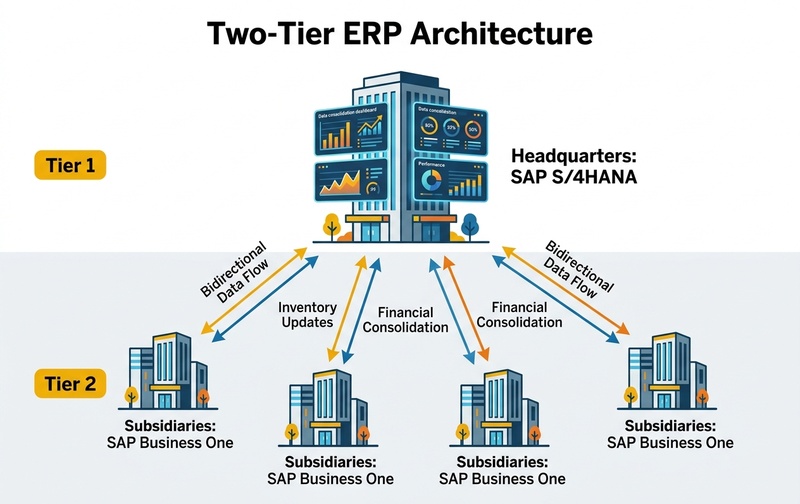
Two-Tier ERP: Using SAP Business One with SAP S/4HANA
The ERP decision does not always need to be: SAP Business One OR SAP S/4HANA.
Large groups can use different ERP tiers.
For example:
Headquarters: SAP S/4HANA
↓
Regional subsidiaries: SAP Business One
This model is commonly known as two-tier ERP.
It can help organizations avoid deploying the full complexity of a corporate ERP into every smaller subsidiary.
SAP Business One may manage local operations such as:
- Finance
- Sales
- Purchasing
- Inventory
- Local manufacturing
- Local reporting
while information is consolidated or integrated with the corporate environment.
Two-tier ERP can be relevant when:
- A group acquires new businesses
- Subsidiaries operate differently from headquarters
- Smaller entities need faster ERP deployment
- Corporate ERP is too complex for local operations
- International expansion requires localized operating systems
- Group reporting still needs centralized visibility
For multinational organizations, this scenario should be evaluated before assuming that every entity needs the same ERP platform.
Two-Tier ERP Subsidiary Consolidation Flow:
When Should a Business Move from SAP Business One to SAP S/4HANA?
There is no universal revenue, employee, or transaction threshold that automatically determines when a business must move.
Instead, watch for increasing complexity.
Migration or ERP re-evaluation may become appropriate when:
1. Global Operations Become Difficult to Manage
The organization operates across many countries, currencies, companies, and regulatory environments.
2. Intercompany Requirements Become Complex
Transactions between entities require more sophisticated automation, governance, or consolidation.
3. Supply-Chain Complexity Expands
Planning and coordinating global production, procurement, logistics, and suppliers becomes difficult.
4. Enterprise Integration Grows
The company needs ERP to operate as part of a large application ecosystem.
5. Group Governance Becomes Critical
Corporate leadership requires standardized processes, master data, controls, and reporting across the organization.
6. Business Processes Require Greater Depth
Existing ERP functionality or extensions are no longer sufficient for operational requirements.
At that stage, the right question is not: “Has SAP Business One reached its limit?”
It is: “Has our business architecture become complex enough to justify a different ERP operating model?”
Which SAP ERP Should You Choose?
Choose SAP Business One When
SAP Business One is worth serious consideration if your priorities include:
- Integrating finance, inventory, sales and purchasing
- Improving operational visibility
- Replacing spreadsheets and disconnected systems
- Managing manufacturing or distribution
- Controlling inventory more accurately
- Standardizing core business processes
- Implementing ERP without unnecessary enterprise complexity
- Supporting a small or midsize organization
- Running an independent subsidiary
- Achieving faster operational control
For these scenarios, introducing S/4HANA-level complexity may not create proportional B2B business value.
Evaluate SAP S/4HANA When
S/4HANA becomes more compelling when your organization requires:
- Enterprise-wide process harmonization
- Complex multi-entity finance
- Extensive global operations
- Advanced enterprise supply-chain processes
- Large-scale manufacturing environments
- Strong global governance
- Extensive enterprise integrations
- Broader analytics
- Enterprise cloud transformation
- Large-scale ERP standardization
SAP S/4HANA Cloud Public Edition may also deserve consideration for midsize organizations seeking standardized, scalable cloud ERP—not only traditional large enterprises.
Consider Two-Tier ERP When
Evaluate SAP Business One alongside S/4HANA when:
- Headquarters already runs SAP S/4HANA
- Subsidiaries have simpler requirements
- Acquired companies need faster ERP deployment
- Regional businesses require local autonomy
- Full corporate ERP deployment would be unnecessarily complex
- Group-level reporting and integration are still required
This can provide a more practical balance between global governance and local operational simplicity.
Make the ERP Decision Based on Complexity—not Company Size Alone
The most expensive ERP mistake is not necessarily choosing the more expensive platform.
It is choosing an ERP whose architecture does not match the business.
SAP Business One can provide growing companies with integrated finance, inventory, purchasing, manufacturing, sales, and operational visibility without the scope of an enterprise transformation.
SAP S/4HANA provides significantly broader capabilities when business operations demand enterprise-level scale, integration, standardization, governance, and global complexity.
And for some organizations, the right architecture may involve both through a two-tier ERP strategy.
Before making the decision, assess:
- Your current processes
- Business complexity
- Future expansion
- Integration landscape
- Number of entities
- Cloud requirements
- Implementation resources
- Total cost of ownership
The objective should not be to buy the biggest ERP.
The objective should be to select the ERP architecture that supports sustainable growth without creating unnecessary cost or operational complexity.