

SAP Business One for Semiconductor Manufacturing: Inventory, Traceability and Production Control
Quick Answer
SAP Business One can help semiconductor businesses connect inventory, purchasing, production planning, sales, and financial information within one ERP environment. Its suitability depends on manufacturing complexity, traceability requirements, quality processes, and integration needs. Businesses requiring advanced wafer genealogy, equipment-level data collection, or real-time process control may need dedicated manufacturing systems alongside ERP.
Semiconductor Manufacturing Challenges That Require Better Operational Control
Semiconductor businesses operate in environments where material availability, product quality, production schedules, and cost accuracy directly affect operational performance. Even small gaps in information can create delays, excess inventory, difficult investigations, or unreliable delivery commitments.
Manufacturing models vary considerably across the semiconductor industry. Integrated device manufacturers, fabless companies, foundries, assembly and test providers, and semiconductor equipment suppliers do not have identical ERP requirements. The right system must reflect the actual operating model rather than assuming every business needs the same capabilities.
Common operational challenges include:
- Material visibility: Maintaining accurate information about components, raw materials, work in progress, and finished products.
- Traceability: Connecting material batches, supplier information, production transactions, and customer shipments where required.
- Production coordination: Aligning material availability, purchasing, manufacturing schedules, and order commitments.
- Quality management: Recording inspections, nonconformances, corrective actions, and quality-related decisions through suitable processes.
- Cost control: Understanding material consumption, purchasing costs, production expenses, scrap, and inventory valuation.
- System integration: Exchanging information between ERP, manufacturing execution systems, warehouse applications, quality systems, and other operational platforms.
When these activities are managed through disconnected spreadsheets and separate applications, teams may spend excessive time reconciling records instead of resolving production issues. Management can also struggle to establish whether a delay originated in procurement, inventory, production, quality, or an integration failure.
An ERP evaluation should therefore begin with specific operational problems. The objective is not simply to introduce another software platform. It is to determine whether business processes, data, and systems can be coordinated more reliably.
Inventory Accuracy and Material Traceability Across Semiconductor Operations
Inventory accuracy is essential when businesses manage specialised materials, electronic components, production supplies, and finished semiconductor products. Inaccurate stock records can affect production schedules, purchasing decisions, inventory valuation, and delivery commitments.
SAP Business One provides ERP capabilities for managing item records, purchasing, inventory transactions, warehouse information, and stock valuation. Depending on the configured processes and licensed functionality, businesses may use these capabilities to improve visibility into material movements and inventory balances.
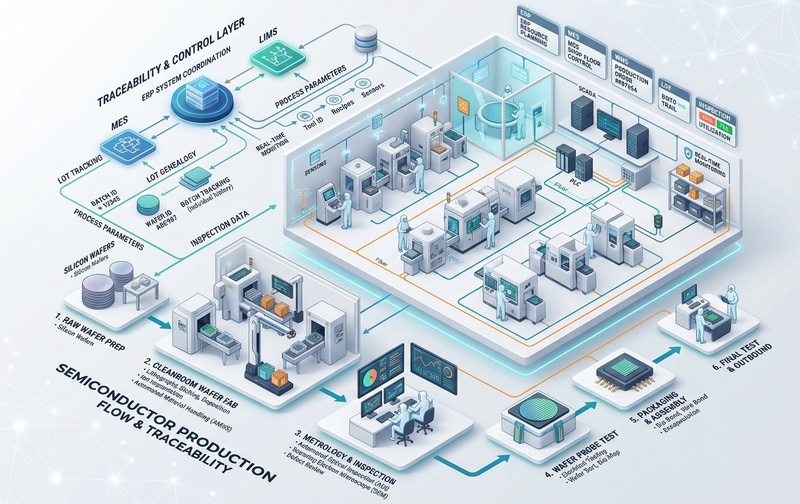
Material availability and lot genealogy tracking across cleanroom wafer fabrication and semiconductor component production.
Improving material availability
A connected inventory and purchasing process helps teams compare recorded stock, open purchase orders, demand, and expected receipts. This information supports more informed replenishment decisions and reduces dependence on manually consolidated spreadsheets.
For example, if a production order requires specific components, planners need to understand whether those materials are available, already allocated, awaiting receipt, or affected by an inventory discrepancy. Reliable records make it easier to identify shortages before they disrupt planned work.
Businesses should also establish clear rules for item master data, warehouse transactions, stock adjustments, and approval responsibilities. Software cannot compensate for inconsistent item codes, delayed transaction entry, or uncontrolled manual changes.
Establishing appropriate traceability
Traceability requirements depend on the product, manufacturing stage, customer obligations, and applicable quality standards. Some businesses need basic batch tracking, while others require detailed genealogy connecting incoming materials, individual production stages, equipment history, test results, and shipped units.
SAP Business One may support selected inventory and batch-management requirements through its available functionality and configuration. However, the required level of traceability must be tested against real scenarios before implementation.
A traceability assessment should establish whether the proposed solution can answer questions such as:
- Which supplier batch was received for a particular material?
- Which inventory transactions moved that material between locations?
- Which production order or assembly consumed the material?
- Which finished products or customer shipments may be affected by a quality issue?
- Can the required records be retrieved within the business’s investigation timeframe?
These questions should be demonstrated using representative data. If complete wafer-level genealogy, device-level tracking, or detailed equipment history is required, a dedicated manufacturing execution or quality system may be necessary.
The objective is to define traceability requirements precisely and confirm that the proposed ERP and connected systems can satisfy them.
Production Planning, Material Requirements and Cost Visibility
Semiconductor operations require coordination between demand, material availability, production capacity, and delivery commitments. Planning complexity varies according to whether a business manufactures wafers, performs assembly and testing, supplies semiconductor components, or produces equipment used by semiconductor manufacturers.
SAP Business One includes production-related capabilities for supported manufacturing scenarios. Businesses should evaluate these capabilities against their actual planning model, product structures, routing requirements, production orders, and reporting needs.
Connecting demand with material planning
Production planning becomes difficult when sales forecasts, customer orders, stock balances, purchasing schedules, and production requirements are maintained separately.
A connected ERP process can help planners assess material requirements and coordinate purchasing with operational demand. The exact planning approach depends on the available functionality, data quality, configuration, and the complexity of the manufacturing environment.
Before implementation, businesses should confirm how the system will handle:
- Product structures and bills of materials.
- Material availability and replenishment requirements.
- Production order creation and status tracking.
- Planned versus actual material consumption.
- Supplier lead times and purchasing exceptions.
- Changes to demand, priorities, or production schedules.
These capabilities should not be confused with advanced factory scheduling. Semiconductor fabrication may involve complex process sequences, equipment constraints, cleanroom capacity, queue times, yield dependencies, and specialised dispatching rules. Standard ERP planning may not address these requirements on its own.
Strengthening production cost visibility
Cost information is useful only when transactions and assumptions are reliable. Incomplete material issues, inconsistent inventory records, delayed production reporting, and incorrect item costs can weaken management reporting.
A suitable ERP process can connect purchasing, inventory, production transactions, and financial records to improve visibility into costs. Management can then investigate differences between expected and recorded consumption, review inventory valuation, and assess the financial effect of operational changes.
However, the quality of cost reporting depends on the costing method, system configuration, production data, and accounting controls. Businesses should validate the treatment of scrap, rework, overheads, work in progress, and production variances before relying on reports for investment decisions.
The practical objective is to establish dependable cost information that supports decisions about procurement, production efficiency, pricing, and profitability.
Quality Management, Scrap Tracking and Manufacturing Data
Quality requirements in semiconductor operations can extend beyond routine inspection. Depending on the business, they may involve incoming material checks, process records, test results, nonconformance investigations, corrective actions, supplier quality, and customer-specific documentation.
ERP can support the business transactions associated with quality processes, but the required controls must be mapped explicitly. Businesses should not assume that every specialised semiconductor quality workflow is available as standard functionality.
Connecting quality information with operations
When a quality issue is identified, relevant teams may need to determine which materials, production orders, inventory balances, or shipments could be affected. The speed and reliability of this investigation depend on how well records are connected across the systems involved.
An ERP implementation should define where quality results are recorded, which system owns the authoritative record, how affected inventory is controlled, and how exceptions are escalated.
Where testing applications or laboratory information management systems hold detailed inspection data, integration may be required to connect the relevant results or references with ERP transactions.
Understanding scrap, rework and yield
Scrap and rework can affect material consumption, production capacity, delivery schedules, and manufacturing costs. Businesses need consistent transaction rules for recording rejected materials, rework activities, and adjustments to inventory or production records.
SAP Business One may provide useful ERP-level visibility into recorded transactions and costs, depending on the process design. Advanced semiconductor yield analysis, wafer-map interpretation, process-window monitoring, and equipment-level defect analysis generally require specialised manufacturing or analytics capabilities.
The distinction matters because financial visibility and process engineering are different requirements. ERP can help explain the recorded business impact of production activity, while dedicated manufacturing systems may be needed to analyse detailed process behaviour.
SAP Business One Integrations for Semiconductor Manufacturing
Semiconductor businesses often use multiple applications because different systems are designed for different operational tasks. ERP manages core business transactions, while specialised platforms may control shop-floor execution, equipment connectivity, laboratory results, warehouse automation, or product lifecycle information.
The goal is to define how these systems exchange accurate information without creating duplicate records or uncontrolled manual work.
ERP and manufacturing execution systems
A manufacturing execution system (MES) can manage detailed production execution, work-in-progress tracking, process instructions, and manufacturing data collection. Depending on the environment, it may also connect to equipment or capture detailed production events.
SAP Business One may serve as the ERP layer for purchasing, inventory, sales, and financial transactions while an MES manages specialised factory execution. The division of responsibility must be designed around the business’s actual requirements.
Before approving the integration, confirm which system owns production orders, material consumption, completion quantities, lot genealogy, quality status, and other critical records. Define how failed messages, duplicate transactions, and delayed updates will be detected and resolved.
Warehouse, quality and reporting integrations
Additional integrations may be needed for barcode-based warehouse transactions, quality applications, electronic data collection, customer portals, or business intelligence platforms.
A robust integration design should specify:
- The source of truth for each data entity.
- Data formats, identifiers, and validation rules.
- Transaction timing and synchronisation requirements.
- Error handling, retries, and exception ownership.
- Access controls and audit requirements.
- Monitoring, reconciliation, and support responsibilities.
Integration quality should be tested using realistic scenarios, including missing material records, rejected quality results, partial production completions, network interruptions, and duplicate messages.
The objective is not to connect every application indiscriminately. It is to create a dependable information flow that supports operational decisions and reduces unnecessary reconciliation.
SAP Business One Suitability for Different Semiconductor Business Models
The suitability of SAP Business One depends on what the business manufactures, how complex its operations are, and which processes require specialised control.

A structured evaluation framework helps semiconductor businesses assess ERP capabilities against operational complexity and MES integration requirements.
| Business model | Key evaluation priorities |
|---|---|
| Fabless semiconductor company | Procurement, supplier coordination, outsourced manufacturing visibility, inventory, order management, and financial control |
| Semiconductor component distributor | Inventory accuracy, purchasing, sales fulfilment, warehouse operations, and traceability requirements |
| Assembly and test provider | Production orders, material consumption, batch traceability, quality data, and MES integration |
| Semiconductor equipment supplier | Bills of materials, procurement, assembly planning, service parts, inventory, and project or service requirements |
| Wafer fabrication facility | Advanced process control, equipment integration, detailed genealogy, yield analytics, and specialised MES capabilities |
This comparison is a starting point, not a suitability verdict. Two businesses within the same category can have substantially different technical requirements.
A fabless company coordinating outsourced production may have a different system scope from a wafer fabrication facility managing complex process sequences and equipment-level data. Similarly, a component distributor may prioritise warehouse traceability and fulfilment rather than manufacturing execution.
Businesses should document their most critical workflows and classify each requirement as standard ERP functionality, configuration, an add-on, an integration, or a capability that requires another specialised platform.
This prevents implementation scope from being based on broad product claims rather than operational evidence.
Implementation Requirements, Customization and Data Migration Risks
ERP implementation quality depends on process design, master data, integration architecture, user adoption, and ongoing governance. Selecting suitable software is only one part of the decision.
Semiconductor businesses should pay particular attention to material identifiers, supplier records, product structures, inventory balances, batch information, production data, and the historical records needed for operational or quality investigations.
Establishing reliable master data
Inconsistent item codes, duplicate supplier records, incomplete bills of materials, and incorrect units of measure can create problems across purchasing, inventory, planning, and reporting.
Before migration, define data ownership, validation rules, cleansing responsibilities, and approval procedures. Test representative records and reconcile opening balances before the system becomes operational.
Where traceability is required, confirm that relevant batch identifiers and relationships can be migrated or retained in an accessible legacy archive. Do not assume historical genealogy will remain usable simply because a data file has been transferred.
Controlling customization and integration scope
Customization can address specific business requirements, but excessive modifications can increase testing, upgrade, support, and maintenance complexity.
Each proposed change should have a documented business justification. The implementation team should assess whether the requirement can be handled through standard functionality, configuration, an established add-on, or integration with a specialist application.
Critical workflows should be tested from end to end. For example, a material receipt should be validated through inventory availability, any required quality controls, production consumption, finished-product recording, and financial reporting where those processes apply.
Preparing users and support teams
Users need clear procedures for transaction entry, exception handling, approvals, and escalation. Training should be based on actual responsibilities rather than generic system demonstrations.
The business should also define support ownership, incident priorities, integration monitoring, backup and recovery arrangements, and change-management procedures.
A well-designed implementation establishes not only how the system works on launch day but also how it will remain accurate and maintainable as products, suppliers, and operational requirements change.
Evaluating ERP Fit, Implementation Scope and Business Value
Senior decision-makers should evaluate ERP suitability using measurable operational requirements rather than a feature checklist alone.
Start by identifying the problems that create the greatest cost or risk. Examples may include material shortages, inventory discrepancies, slow traceability investigations, inconsistent production cost reporting, manual reconciliation, or delayed management information.
For each problem, define the current process, the desired outcome, the relevant data, and the system capabilities required to achieve that outcome.
A structured evaluation should cover five areas:
- Operational fit: Can the proposed solution support the business’s actual purchasing, inventory, production, quality, and fulfilment workflows?
- Traceability and compliance: Can it produce the records required for investigations, customer obligations, audits, and internal controls?
- Integration feasibility: Can ERP exchange reliable information with MES, warehouse, quality, equipment, and reporting systems where needed?
- Implementation risk: Are data migration, customization, user adoption, testing, support, and ownership clearly defined?
- Business value: Can the company measure improvements in inventory accuracy, reconciliation effort, reporting timeliness, material availability, or other relevant operating measures?
A business case should distinguish measurable benefits from assumptions. For example, reduced manual reconciliation may free employee time, but the financial value depends on the current workload and how the released capacity is used. Similarly, improved stock visibility may help planners make better decisions, but actual reductions in shortages or excess inventory should be measured rather than guaranteed.
The evaluation should conclude with a documented scope, known limitations, integration responsibilities, implementation milestones, and acceptance criteria. Where a requirement cannot be demonstrated, it should remain an open risk until an appropriate solution is confirmed.
Frequently Asked Questions
Evaluate SAP Business One for Your Semiconductor Operations
Choosing an ERP system requires a clear understanding of manufacturing complexity, material traceability, production planning, cost visibility, and integration requirements. A solution that works for one semiconductor business may not be appropriate for another.
Emerging Alliance can discuss your operational requirements and help evaluate the potential role of SAP Business One within your ERP environment. The assessment should establish which requirements can be addressed through ERP capabilities, where configuration or extensions may be needed, and which specialised systems must remain part of the architecture.
Request a Semiconductor ERP Consultation
Discuss your inventory, traceability, production, reporting, and integration requirements with an ERP specialist to define a practical evaluation scope.


