
SAP Business One for Metal Fabrication: Control Production Costs, Material Waste and Job-Shop Operations
Quick Answer
SAP Business One helps metal fabrication companies improve production and inventory visibility by connecting bills of materials, production orders, material issues, inventory transactions and financial records. With appropriate configuration and integrations, manufacturers can monitor material consumption, evaluate production costs, identify operational discrepancies and make better-informed job-shop decisions.
Why Metal Fabrication Companies Need Better Production and Cost Control
Metal fabrication businesses operate in an environment where material prices, customer specifications, production schedules and order requirements can change frequently. A single customer order may involve several processes, including cutting, bending, welding, machining, assembly and finishing. Each stage consumes materials, labour and machine capacity.
When these activities are recorded across spreadsheets, paper job cards and disconnected applications, management may struggle to understand the actual cost and progress of each job. Inventory records can become inconsistent, material wastage may go unnoticed, and production teams may not have reliable information about pending orders.
These problems affect more than the production department. Unclear manufacturing costs can reduce confidence in quotations, delayed production can affect delivery commitments, and inaccurate inventory information can increase purchasing costs. Finance teams may also find it difficult to reconcile material consumption and production transactions with financial records.
Typical Multi-Stage Metal Fabrication Operations Flow
An integrated ERP system can help address these operational gaps. SAP Business One provides business management capabilities that connect purchasing, inventory, production, sales and financial information. For metal fabrication companies, the value depends on how accurately the system is configured around their manufacturing processes.
The objective is not simply to digitise existing records. It is to establish better control over material movements, production transactions, job costs and operational information.
Production Cost Challenges in Metal Fabrication Operations
Manufacturing costs in metal fabrication are influenced by several variables. Material grade, sheet thickness, cutting dimensions, machine usage, labour requirements, subcontracting and finishing activities can all affect the final cost of an order.
Without consistent production records, businesses may find it difficult to identify where cost differences originate.
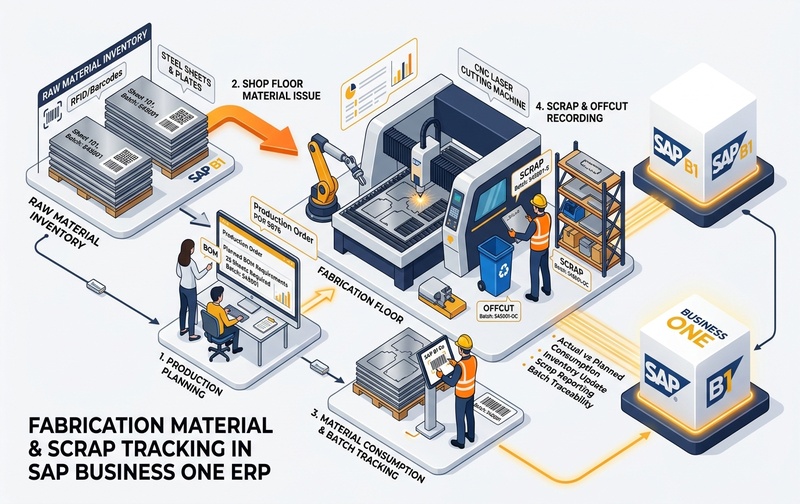
Metal fabrication material consumption and scrap tracking in SAP Business One: Connecting planned BOM component requirements with actual shop-floor issues, scrap recording, and material traceability.
Unplanned Material Consumption
Metal fabrication often involves cutting raw sheets, plates, bars, tubes and other materials into specified dimensions. Cutting patterns, design changes, defective components and production errors can create differences between planned and actual material consumption.
If production teams record material usage manually, inventory may not reflect the quantities consumed on the shop floor. Management may then underestimate material requirements or approve additional purchases without understanding the reason for the variance.
SAP Business One supports inventory and production transactions that can help businesses record material issues against production orders. Accurate item master data, bills of materials and transaction discipline are essential for meaningful consumption analysis.
Inaccurate Manufacturing Cost Estimates
A quotation based on outdated material prices or incomplete production information can reduce the expected margin of a fabrication job.
For example, a project may require additional cutting, welding, finishing or rework that was not included in the original estimate. If these costs are not captured consistently, the business may complete the order without knowing whether the expected margin was achieved.
Manufacturers need a structured method to compare planned production requirements with recorded material and other attributable costs. SAP Business One can provide the underlying production, inventory and financial records for this evaluation. More detailed job-cost reporting may require configuration, reporting tools or an integrated manufacturing extension.
Limited Visibility Across Production Stages
A job may pass through multiple work centres before it is ready for dispatch. If progress is updated only through verbal communication or separate spreadsheets, managers may not know which orders are waiting for materials, which are being processed and which are delayed.
This makes production coordination difficult, particularly when several customer orders compete for the same resources.
A connected ERP environment can improve the availability of order, inventory and production information. Where live machine-level or operation-level tracking is required, businesses should assess whether additional shop-floor applications or integrations are necessary.
How SAP Business One Supports Metal Fabrication Workflows
SAP Business One connects key business functions through a shared system. Its production and inventory capabilities can support manufacturers that need structured records of materials, production orders and finished goods.
The system should be configured around the company’s actual fabrication workflows rather than forcing every operation into a generic production model.
Production Orders and Bills of Materials
A bill of materials (BOM) defines the components and quantities required to manufacture an item. In metal fabrication, a BOM may include raw metal, purchased components, consumables and other materials required for a finished product.
Production orders use this information to organise manufacturing requirements and record relevant production transactions.
For example, a fabrication company producing a customised steel enclosure may define the required sheet metal, hinges, fasteners and other components in its BOM. The production order provides a structured reference for issuing materials and recording the receipt of the completed item.
The accuracy of the result depends on maintaining correct item codes, units of measure, component quantities and production data. Engineering changes and customer-specific specifications must also be reflected in the relevant production records.
Material Issue and Receipt Transactions
Material control requires a reliable record of what enters production and what is completed.
SAP Business One supports transactions such as Issue for Production and Receipt from Production. These transactions help connect inventory movements with production orders.
When material is issued against the appropriate order, the business can maintain a more structured record of material consumption. When completed items are received, inventory records can reflect the resulting production output.
These records are useful only when shop-floor activity is recorded accurately and on time. Delayed postings, incorrect quantities or transactions against the wrong production order can still create discrepancies.
Inventory and Purchasing Coordination
Metal fabrication businesses may hold several material grades, dimensions, thicknesses and specifications. Treating similar-looking materials as interchangeable can create purchasing and production problems.
SAP Business One inventory management can help businesses maintain item-level stock information, warehouse records and inventory transactions. Purchasing information can also be connected with stock requirements and supplier transactions.
A properly designed item master should distinguish materials using meaningful descriptions, codes, units of measure and other relevant attributes. Batch or serial tracking can be configured where traceability requirements justify it and the selected items and processes support that approach.
This helps purchasing, stores and production teams work with more consistent inventory information.
Control Material Waste With Accurate Consumption Records
Material waste is a significant cost concern for fabrication companies because raw materials can represent a substantial portion of production expenditure.
Waste may result from cutting errors, incorrect dimensions, damaged materials, defective components, design changes or inefficient nesting. Some losses are unavoidable, but unexplained differences should be investigated.
| Material Variance Category | Typical Shop-Floor Root Cause | SAP Business One Control Mechanism |
|---|---|---|
| Cutting & Nesting Losses | Unusable sheet remnants or unoptimized cutting patterns on laser/plasma beds. | Define scrap percentages in BOMs and return usable offcuts to inventory as remnant items. |
| Engineering Revisions | Mid-production customer drawing changes requiring scrapped or re-machined parts. | Formal BOM change control and recording variance against updated production order lines. |
| Shop-Floor Scrap | Defective welds, misbends, dimension deviations, or operator errors. | Dedicated scrap issue transactions tied to specific production orders and cost centres. |
| Rework Material Issuance | Secondary grinding, re-coating, or extra fasteners needed to pass QA. | Additional material issues captured against work order to reflect true production cost. |
Compare Planned and Actual Material Usage
The first step is to establish reliable planned material requirements. BOM quantities and production-order information provide a basis for determining what should be consumed.
Production teams should then record actual material issues and any relevant returns or adjustments. Comparing the two records can help identify unusual consumption patterns.
For example, if a job requires 100 kilograms of sheet metal according to its planned component quantities but production records show substantially higher consumption, managers should investigate the difference. The cause could be an engineering change, cutting loss, rework, incorrect issue quantity or an inaccurate BOM.
The ERP system provides transaction information; the business still needs appropriate reports and review procedures to interpret the variance.
Improve Scrap and Rework Visibility
Scrap and rework should not be treated as unexplained inventory differences. They need consistent recording practices and clear responsibility.
A fabrication business can define procedures for recording rejected material, recoverable scrap, damaged components and rework-related consumption. Depending on the required level of detail, these processes may use standard ERP transactions, additional fields, reports or an integrated shop-floor solution.
This information helps production and finance teams understand whether material losses are recurring and whether corrective action is required.
Strengthen Material Traceability
When customers require specific material grades or documentation, manufacturers need to identify which materials were used for particular production orders.
SAP Business One supports batch and serial number management for applicable inventory items. The implementation should determine whether batch management, serial tracking or another traceability method is appropriate for the materials and customer requirements involved.
A consistent approach can make it easier to investigate material discrepancies and retrieve relevant transaction history.
Improve Job-Shop Operations and Production Visibility
Job-shop manufacturers often handle varied customer orders with different specifications, quantities, processes and delivery dates. Their production environment can be more complex than a repetitive manufacturing line.
The challenge is to coordinate multiple jobs without losing visibility into material availability, production status and delivery commitments.
Organise Customer-Specific Production Requirements
A job may require a unique drawing, material specification, dimension, finishing requirement or delivery schedule. These details should be connected to the relevant sales and production records.
SAP Business One can connect sales orders with purchasing, inventory and production processes. Appropriate configuration can help ensure that customer demand is reflected in production planning and material requirements.
Businesses should establish clear procedures for handling revisions. A change in material grade, design or quantity can affect the BOM, purchasing requirements, production cost and delivery schedule.
Monitor Production Order Progress
Production orders provide a structured way to organise manufacturing requirements. Managers can review relevant order information and production transactions to understand what has been issued and received.
However, an ERP production order does not automatically provide real-time visibility into every machine, work centre or operation. Companies requiring detailed operation-level status, machine utilisation, labour attendance or live shop-floor updates should evaluate suitable add-ons or integrations.
This distinction is important when selecting an ERP solution. The implementation scope should clearly identify which requirements are covered by standard SAP Business One functionality and which need additional components.
Coordinate Purchasing With Production Demand
Production delays can occur when the required material is unavailable at the time it is needed. Purchasing teams need visibility into stock levels, open orders and upcoming production requirements.
SAP Business One includes material requirements planning capabilities that can support purchasing and production planning based on relevant demand and supply information.
The quality of the planning output depends on accurate inventory data, BOMs, lead times, order information and planning parameters. MRP recommendations should be reviewed against supplier reliability, material specifications and actual production priorities before purchasing decisions are finalised.
Monitor Manufacturing Costs and Job Profitability
A metal fabrication company needs more than a total production cost to understand whether an order is commercially successful. Management should be able to evaluate the relationship between the original estimate, actual material consumption, production activity and customer revenue.
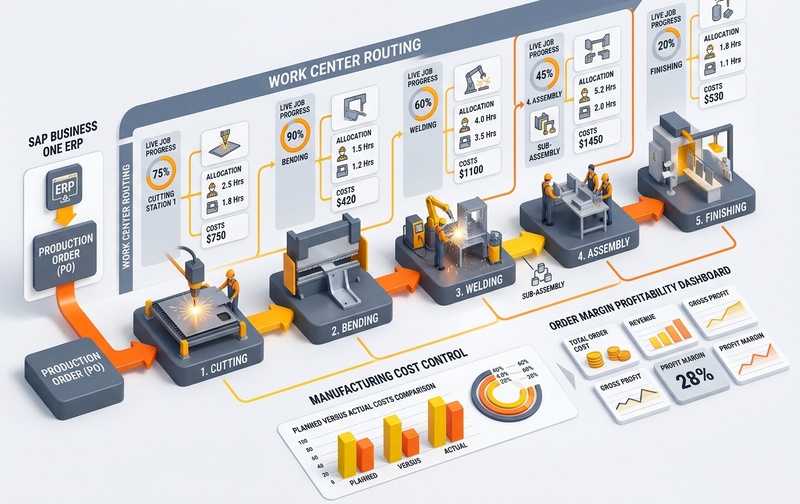
Job-shop production routing and manufacturing cost control in SAP Business One: Tracking work orders across cutting, bending, welding, assembly, and finishing to compare estimated versus actual costs and safeguard job margins.
Review Planned and Actual Costs
A useful cost review begins with a clear estimate of the materials and production resources required for a job.
Actual material issues, production receipts, purchasing prices and relevant financial transactions can then provide information for evaluating cost differences.
SAP Business One supports inventory valuation and financial accounting processes. However, a detailed job-cost model covering labour, machine time, overhead allocation, subcontracting and rework may require additional configuration or a specialised manufacturing solution.
The implementation team should define how each cost category will be captured and allocated before promising detailed job profitability reporting.
Identify Cost Variances Early
Cost differences should be investigated while a job is still in progress, rather than only after delivery.
For example, a fabrication order may consume more material than expected because of a drawing revision. If the change is recorded promptly, management can review its commercial impact and decide whether the customer quotation or delivery commitment needs to be revised.
Regular reporting can help identify orders with unusual material consumption, unexpected purchasing costs or incomplete production transactions.
Support More Informed Quotation Decisions
Historical production and purchasing information can improve future estimates when it is accurate and relevant.
Management can review previous jobs involving similar materials, quantities and production requirements to understand how actual costs compared with estimates.
This does not remove the need for engineering and production judgement. Custom fabrication jobs can differ significantly even when their finished products appear similar. ERP information should support quotation decisions, not replace technical assessment.
Manage Quality, Subcontracting and Production Records
Metal fabrication may involve inspection, coating, heat treatment, galvanising, machining or other external processes. These requirements need to be considered during implementation.
SAP Business One can support purchasing, inventory, production and financial transactions associated with these activities. The exact workflow depends on how the business manages external operations and whether materials are sent to subcontractors.
A configured process should identify what is sent, which supplier is responsible, what quantity is returned and how additional service costs are recorded. Where more detailed operation tracking or quality inspection workflows are needed, an appropriate extension may be required.
Quality procedures should also define how rejected components, rework and non-conforming materials are recorded. A consistent record helps the business investigate recurring problems and evaluate their effect on cost and delivery.
Integrate SAP Business One With Barcode and Shop-Floor Systems
Some fabrication businesses need faster and more accurate recording of material movements than manual ERP entry can provide.
Barcode-supported processes can help identify materials and record selected warehouse or production transactions. Depending on the solution, barcode integration may support activities such as goods receipt, stock transfer, material issue and finished-goods receipt.
The integration must be designed around the company’s transaction requirements. It should define how scanned information maps to SAP Business One item codes, warehouses, bins, batches, production orders and units of measure.
Businesses may also need integrations with CAD applications, production scheduling tools, machine systems, weighing equipment or other operational software. These are not automatically included in every SAP Business One implementation.
Before selecting an integration, companies should confirm the data exchanged, transaction ownership, error-handling process, user permissions and support responsibilities. A reliable integration should reduce duplicate entry without creating a second source of inconsistent information.
Implementation Considerations for Metal Fabrication Companies
The value of SAP Business One depends on implementation quality. A system configured without understanding the company’s manufacturing model can reproduce existing data problems in a new application.
A structured implementation should begin with a review of current operations.
Map Existing Production Processes
Document how customer orders become production requirements. Identify the stages involved, how materials are issued, how completed items are received and how production changes are approved.
This review should include purchasing, stores, production, quality, finance and sales teams. Their requirements may differ, and the implementation must establish how information moves between departments.
Clean Item and BOM Data
Incorrect item descriptions, duplicate material codes, inconsistent units of measure and outdated BOMs can affect inventory and production accuracy.
Before migration or configuration, businesses should review item masters, warehouse structures, supplier information and production data. Engineering and production teams should validate the information that determines material requirements.
Define Costing and Reporting Requirements
Management should decide which costs need to be monitored and how they will be captured.
Material consumption, purchase price differences, subcontracting charges, labour, machine costs, overhead and scrap may require different recording methods. Some requirements may be addressed through standard functionality, while others need configuration, reports or add-ons.
The reporting design should be agreed before implementation so that the system captures the information needed for management decisions.
Train Users and Establish Transaction Controls
An ERP system cannot provide reliable operational information when users do not follow consistent transaction procedures.
Stores personnel need to understand material receipt and issue processes. Production users need to record relevant order transactions. Finance teams need to understand how inventory and production activity affects accounting records.
User permissions, approval procedures and exception reviews should also be established. Training should use realistic fabrication scenarios rather than generic software demonstrations.
When SAP Business One Is Suitable for a Metal Fabrication Business
SAP Business One may be suitable for small and midsize metal fabrication companies that need connected financial, purchasing, inventory, sales and production information.
It can be particularly relevant when a business is experiencing problems such as:
- Material records that do not match physical stock.
- Production orders managed through spreadsheets or disconnected applications.
- Limited visibility into material issues and finished-goods receipts.
- Difficulty comparing estimated and recorded manufacturing costs.
- Delayed purchasing decisions caused by incomplete stock information.
- Inconsistent reporting across stores, production and finance.
- A need to connect ERP transactions with barcode or other operational applications.
Suitability depends on production complexity and the required level of control. Companies with advanced finite-capacity scheduling, detailed routing, machine-level monitoring, complex quality workflows or highly specialised job costing should assess the need for manufacturing add-ons or integrations.
A requirements assessment should distinguish standard SAP Business One capabilities from functionality that must be configured or supplied by an additional solution. This creates a more realistic implementation scope, budget and delivery plan.
Frequently Asked Questions
Improve Production Cost Control With SAP Business One
Metal fabrication companies need accurate material records, reliable production information and better visibility into manufacturing costs to manage changing customer requirements and delivery commitments.
SAP Business One can connect production orders, bills of materials, inventory movements, purchasing and financial records. With the right configuration and integrations, manufacturers can strengthen material control, review production variances and improve operational reporting.
Emerging Alliance can help assess your existing manufacturing processes, SAP Business One requirements, production workflows and integration opportunities. As an SAP Business One implementation partner, the team can evaluate the configuration and extensions needed to support your business requirements.
Request a consultation with Emerging Alliance to assess how SAP Business One can support your metal fabrication operations.