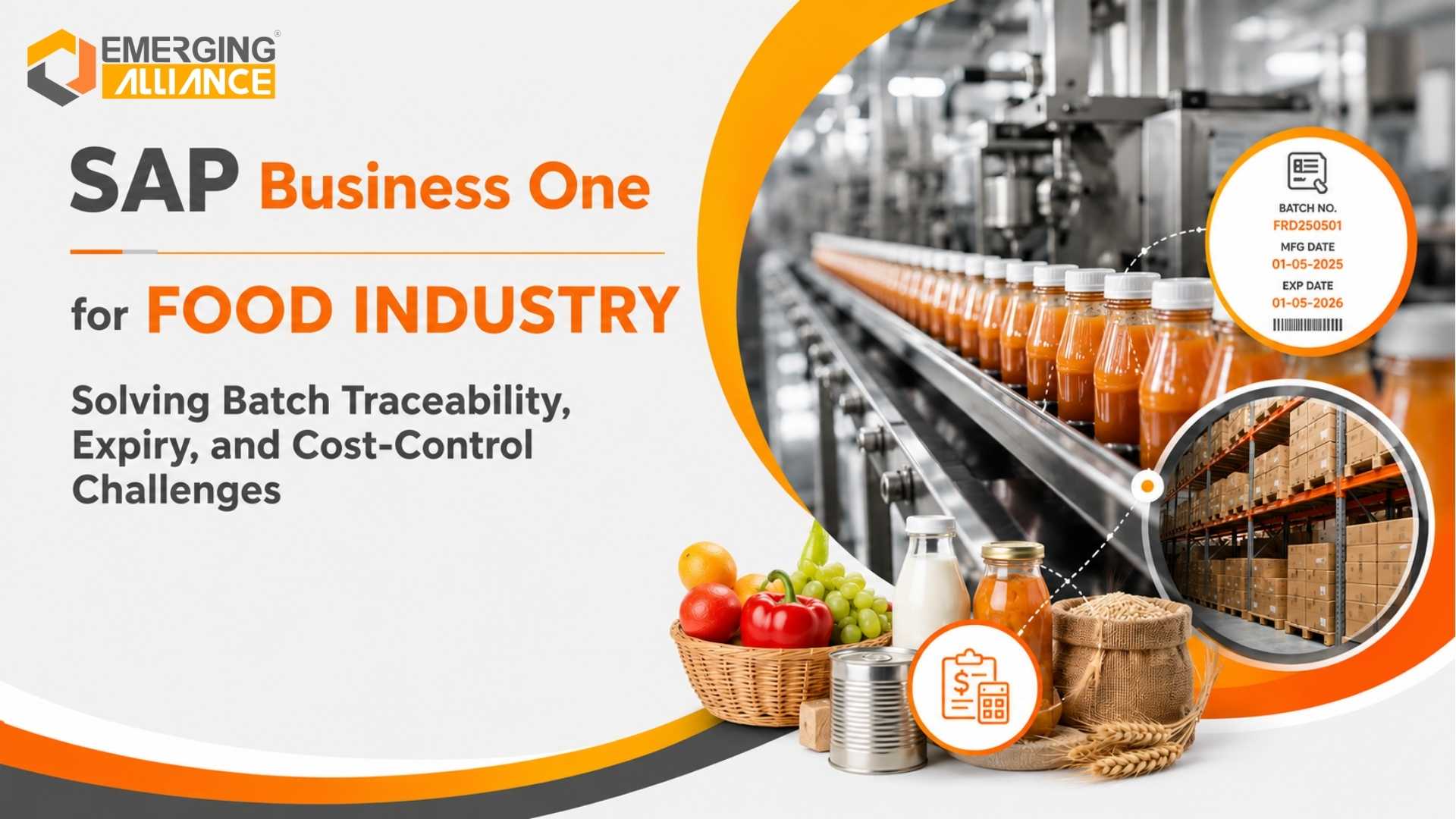
SAP Business One for Food Industry: Solving Batch Traceability, Expiry, and Cost-Control Challenges
Quick Answer
For food manufacturers, processors, distributors, and growing food businesses, the biggest ERP challenge is not simply recording sales or purchasing transactions. It is maintaining control over batches, expiry dates, production costs, inventory movements, quality requirements, and profitability while the business continues to scale. SAP Business One for the food industry brings these processes into one connected ERP environment. It can help businesses manage batch-controlled inventory, track material movements, monitor expiry-sensitive stock, manage production processes, control procurement and warehouse operations, and gain better visibility into costs and margins.
The business impact is significant. Instead of discovering expired inventory after it becomes a loss, management can gain earlier visibility into stock nearing expiry. Instead of manually tracing which raw materials went into a finished product, teams can maintain batch-level information across purchasing, inventory, production, and sales. Instead of calculating product costs across disconnected spreadsheets, finance and operations can work from connected transaction data. For CEOs, CIOs, CTOs, finance heads, and operations leaders, the real value is therefore not “having an ERP.” It is reducing operational blind spots that directly affect margins, compliance, inventory, and customer confidence. If your food business is experiencing inventory write-offs, difficult batch tracing, inconsistent production costing, disconnected systems, or limited management visibility, SAP Business One can provide a structured platform for addressing these gaps.
Why Food Businesses Outgrow Traditional Systems
A food business can appear operationally simple from the outside.
Buy raw materials. Manufacture or process products. Store them. Sell them. Repeat.
In reality, food operations involve significantly more variables. Raw materials may have different shelf lives. Finished goods may require batch tracking. Production may consume multiple ingredients. Products can move through several warehouses. Customers may require specific batches. Expiry dates can influence dispatch decisions. Purchase costs fluctuate. Production costs change with material prices, labour, wastage, and overheads.
When these processes are managed through disconnected accounting software, spreadsheets, warehouse systems, and manual records, information becomes fragmented.
That fragmentation creates a management problem. A CEO may know total inventory value but not how much inventory is approaching expiry. A finance team may know total production expenditure but struggle to determine the actual cost of a particular product batch. An operations manager may know that stock exists but spend hours identifying its exact batch location. A quality team may need information about a product batch but depend on multiple departments to retrieve it. These are not merely administrative inconveniences. They can become direct financial risks.
The Hidden Cost of Poor Batch Traceability
Batch traceability is one of the most important operational requirements for food businesses.
Consider a finished product manufactured using several raw materials. If a quality issue is discovered later, management may need to answer questions such as:
- Which batch was affected?
- When was it produced?
- Which raw-material batches were consumed?
- Which warehouse currently holds the affected stock?
- Which customers received it?
- How much stock remains?
- What quantity has already been sold or dispatched?
If this information exists across spreadsheets and manual records, the investigation can become slow and error-prone. For a growing food business, that creates unnecessary operational exposure.
How SAP Business One Helps Strengthen Batch Traceability
SAP Business One can provide batch-level visibility across relevant inventory transactions and processes.
The objective is to establish a connected chain of information from procurement to inventory, production, and sales.
A Typical Traceability Process Chain:
| Raw Material Purchase | ➔ | Batch Receipt | ➔ | Warehouse Storage | ➔ | Production Consumption | ➔ | Finished-Goods Batch | ➔ | Sales/Dispatch |
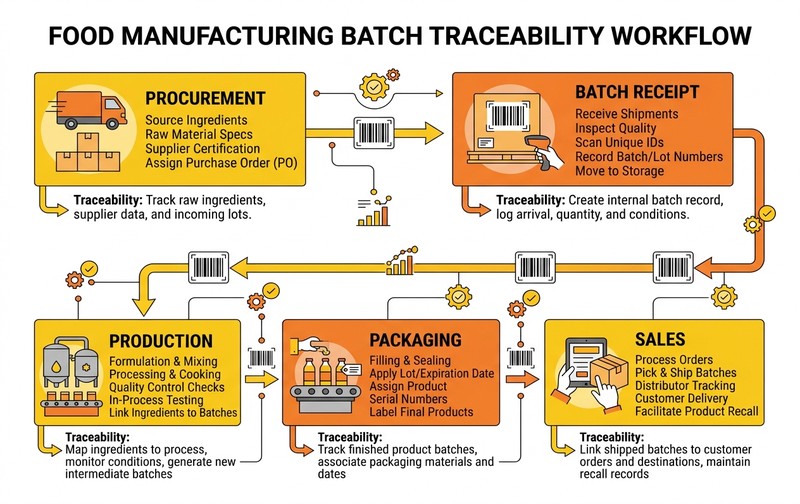
This gives management a clearer view of where materials came from and where finished products went.
Better traceability can also help businesses:
- Investigate product issues faster
- Identify affected inventory
- Reduce manual reconciliation
- Improve warehouse visibility
- Support controlled stock movements
- Strengthen internal accountability
- Improve response time during quality investigations
For decision-makers, the important question is not whether the ERP has a “batch feature.”
The better question is:
Can your business trace the movement of a product or material without depending on multiple spreadsheets and people?
If the answer is no, traceability should be treated as a business-priority gap.
Expiry Management: Preventing Inventory From Turning Into Loss
Expiry-related inventory loss is another major concern for food businesses.
Inventory can have significant financial value while still becoming unusable if it is not consumed or sold within the required period.
This creates a dangerous situation. A warehouse may report healthy inventory levels while a portion of that inventory is already approaching expiry. From a financial perspective, inventory value does not automatically equal recoverable value.
Why Expiry Problems Often Remain Hidden
Expiry management becomes difficult when businesses rely on:
- Manual Excel tracking
- Paper-based warehouse records
- Independent inventory systems
- Incomplete batch information
- Manual stock checks
- Poor communication between sales and warehouse teams
The problem becomes larger as SKU count, warehouse locations, and transaction volume increase. Management may only discover the problem when a product is already difficult to sell or completely unusable.
Using ERP Visibility to Improve Expiry Control
SAP Business One can help businesses maintain batch and expiry-related information at the inventory level and use that information during stock management and operational decision-making.
This creates the foundation for better controls around:
- Batch identification
- Expiry-date visibility
- Stock availability
- Warehouse movement
- Inventory planning
- Sales and dispatch decisions
The goal is not simply to “track expiry.”
The goal is to reduce the probability that valuable inventory reaches expiry unnoticed.
For a CEO or CFO, this translates into a much more meaningful question:
How much inventory value is currently exposed to expiry risk, and can your team identify it early enough to act?
An ERP system can turn that question from a manual investigation into a management visibility exercise.
Production Cost Control: Knowing What Your Products Really Cost
Food businesses operate on margins.
A small change in raw-material pricing, production wastage, packaging costs, or overhead allocation can affect profitability significantly.
Yet many businesses still struggle to calculate reliable product costs because cost information is distributed across procurement, production, inventory, finance, and spreadsheets. This makes cost control reactive.
The Problem With Spreadsheet-Based Production Costing
Suppose the cost of an ingredient increases by 12%.
The purchasing team knows. But does finance immediately know how the increase affects product margins? Does production know which products are now more expensive to manufacture? Does sales know which customer orders have become less profitable? Does management know the expected margin impact?
If these answers require manual calculations, the business lacks real-time cost visibility.
SAP Business One for Production Cost Management
SAP Business One connects purchasing, inventory, production, and financial information within a unified ERP environment.
This allows businesses to build greater visibility around:
- Bill of Materials
- Raw-material consumption
- Production orders
- Inventory costs
- Procurement costs
- Production variances
- Finished-product costing
- Financial impact
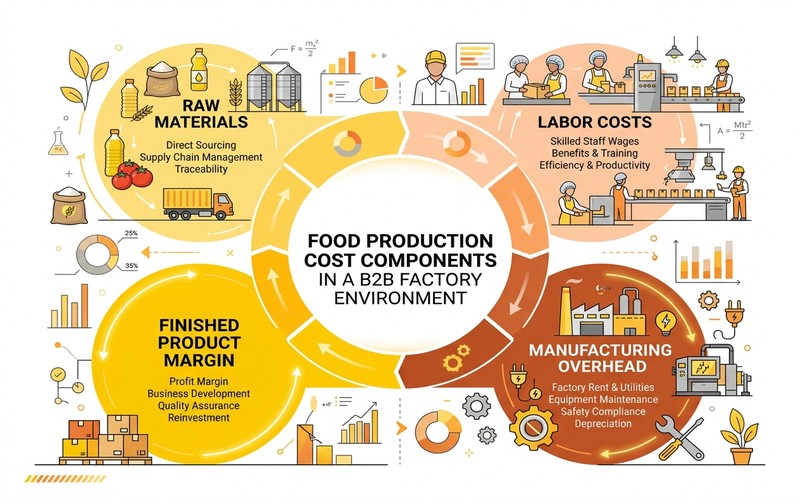
This is particularly valuable for businesses producing multiple SKUs with different recipes, packaging requirements, or production processes.
The objective is not merely accounting accuracy. It is management control over product profitability. When management can compare expected and actual costs more effectively, decisions around pricing, sourcing, production, and product portfolios become more informed.
Food Industry ERP: Connecting Procurement, Production, Inventory, and Finance
One of the biggest problems in growing food companies is that each department may have its own version of operational reality.
Procurement manages suppliers. Warehouse manages stock. Production manages manufacturing. Sales manages orders. Finance manages accounts. Management receives reports from all of them.
The problem occurs when those systems do not communicate effectively. A purchase may change inventory. Inventory affects production. Production changes finished-goods stock. Finished-goods stock affects sales availability. Sales affects receivables and revenue. Every process is connected.
An ERP such as SAP Business One provides the opportunity to connect these workflows rather than treating each department as an isolated system.
The Connected Food Business Model:
| Supplier | ➔ | Purchasing | ➔ | Goods Receipt | ➔ | Batch Inventory | ➔ | Production | ➔ | Finished Goods | ➔ | Warehouse | ➔ | Sales | ➔ | Finance |
Each transaction contributes to a shared information environment.
This gives management a better foundation for answering questions such as:
- What stock do we have?
- Which batches are available?
- What is approaching expiry?
- What materials are required for production?
- What did a product actually cost?
- Which products generate the best margins?
- Which customers owe money?
- Which suppliers are creating cost pressure?
- What is happening across warehouses?
That is the difference between transaction processing and operational visibility.
Inventory Control Beyond “How Much Stock Do We Have?”
Traditional inventory reporting often focuses on quantity.
Food businesses need more than quantity. Management needs to understand what the stock is, which batch it belongs to, where it is located, how long it remains usable, and what financial value is attached to it.
For example: 1000 units of a product are not necessarily equivalent.
- 500 units may have a long remaining shelf life.
- 300 units may expire within two months.
- 200 units may already be committed to customer orders.
Treating all 1000 units as identical can result in poor inventory decisions.
SAP Business One for Smarter Inventory Visibility
SAP Business One can help centralize inventory information across warehouses and transactions.
Depending on the configured business processes, organizations can use ERP information to improve:
This helps move inventory management from a quantity-based approach toward a business-context approach.
Compliance and Traceability: Why Manual Records Become Risky
Food businesses operate in an environment where documentation and traceability matter.
When critical information is maintained manually, businesses face risks such as:
- Incomplete records
- Data duplication
- Human errors
- Delayed retrieval
- Inconsistent reporting
- Poor audit readiness
An ERP does not automatically make a business compliant with every applicable regulation. Compliance depends on the specific country, product category, business process, and system configuration.
However, centralized and structured transaction records can provide a stronger operational foundation for compliance-related processes. For management, this matters because compliance should not depend entirely on whether one employee can locate the correct spreadsheet. A scalable ERP environment makes business information more structured, accessible, and accountable.
The CEO Problem: Limited Visibility Across the Business
For CEOs and business owners, the ERP discussion should go beyond individual features. The real concern is visibility.
As a food business grows, management becomes increasingly dependent on reports from different departments. This creates a dangerous gap between what is happening operationally and when leadership becomes aware of it.
Management should not need five spreadsheets to understand inventory exposure. The finance team should not need multiple reconciliations to understand product costs. Operations should not need manual warehouse checks to understand stock availability. The business should not have to maintain an increasingly complicated collection of disconnected systems simply to keep information moving.
SAP Business One can provide a centralized ERP foundation designed to connect these business processes.
More connected information ➔ faster decisions ➔ better operational control ➔ lower avoidable business risk.
The CTO/CIO Perspective: Reducing System Fragmentation
Technology leaders often inherit another problem as businesses scale: application sprawl.
One system handles accounting. Another handles inventory. Spreadsheets handle production. Emails handle approvals. Separate tools handle operational reporting. Employees manually move information between systems. This architecture can work temporarily. It becomes increasingly difficult to control as transaction volume and business complexity increase.
SAP Business One can provide a unified ERP environment covering core business functions such as financial management, purchasing, sales, inventory, production, and related operational processes.
For technology leadership, the benefit is not simply consolidation. It is establishing a more controlled information architecture for business operations.
The implementation strategy should still be carefully evaluated against the organization’s existing applications, integrations, infrastructure, data requirements, and future growth plans.
The CFO Perspective: From Revenue Reporting to Margin Control
Revenue alone does not tell management whether a food business is becoming more profitable.
A company can increase sales while margins deteriorate because of:
- Increasing raw-material costs
- Production inefficiencies
- Excessive wastage
- Inventory expiry
- Packaging cost increases
- Poor purchasing decisions
- Unprofitable products
- Excess inventory
This is where ERP-driven financial and operational visibility becomes valuable.
When financial information is connected to purchasing, inventory, sales, and production transactions, management can investigate profitability using a more complete operational picture.
The question changes from:
“How much did we sell?” to: “What did we sell, what did it cost us, what inventory risks remain, and where are margins being lost?”
That is a much more useful management question.
When Should a Food Business Consider SAP Business One?
Not every company needs to implement an ERP immediately. But certain warning signs indicate that the existing operating model is becoming difficult to scale.
Consider an ERP evaluation if your business is experiencing several of these problems:
- Batch information is maintained manually
- Expiry tracking depends on spreadsheets
- Production costing takes significant manual effort
- Inventory numbers differ between departments
- Multiple warehouses are difficult to monitor
- Management reports are delayed
- Finance spends excessive time reconciling data
- Production and procurement are poorly connected
- Customer orders are difficult to trace back to batches
- Product profitability is unclear
- Business growth is increasing system complexity
- Employees repeatedly enter the same information into multiple systems
These are not necessarily SAP Business One problems. They are signs of process and information-management limitations that an ERP evaluation can help address.
SAP Business One for Food Industry: What a Successful Implementation Should Solve
The purpose of implementation should never be: “We need SAP Business One because our competitors use ERP.” That is not a sufficient business case.
Instead, the implementation should start with measurable operational problems.
This approach makes ERP implementation a business transformation project rather than simply a software installation.
Why SAP Business One Can Be a Strategic Fit for Growing Food Businesses
The strongest case for SAP Business One is not one individual module. It is the ability to connect multiple business processes.
A food business can start with a specific operational pain point such as inventory control. But the underlying requirement usually extends further. Inventory connects with purchasing. Purchasing connects with suppliers and costs. Production consumes inventory. Production creates finished goods. Finished goods move into sales. Sales creates revenue and receivables. Finance needs visibility across all of it.
A connected ERP environment provides the foundation for these relationships. That makes SAP Business One relevant for growing food manufacturers and distributors that need stronger control without building increasingly complicated manual processes.
The Bigger Business Question: How Much Are Operational Blind Spots Costing You?
Food businesses rarely lose money from one dramatic ERP failure. The losses are often accumulated through smaller problems:
- A batch is difficult to trace.
- A product expires before being sold.
- A raw-material price increase goes unnoticed in product costing.
- A warehouse holds excess inventory.
- A production variance is discovered too late.
- A finance team spends days reconciling information.
- Management receives the right report—but several days after the decision was needed.
Individually, these may appear manageable. Collectively, they can reduce margins and slow growth.
That is why the ERP conversation should not begin with: “Which SAP Business One modules do we need?”
It should begin with: “Where are we losing operational control today?” Once those gaps are identified, the ERP solution can be designed around solving them.
See How SAP Business One Can Address Your Food Business Challenges
If batch traceability, expiry management, production costing, inventory control, or fragmented business information is becoming difficult to manage, the next step should be an evaluation based on your actual processes.
Emerging Alliance can help you assess where SAP Business One for the food industry fits into your current operations and demonstrate how connected ERP workflows can improve visibility across finance, procurement, inventory, production, sales, and management reporting.
Instead of evaluating SAP Business One based on a generic feature list, request a demo based on your actual business scenarios.
FAQs About SAP Business One for Food Industry
Want to see how SAP Business One can solve your food industry’s traceability, expiry, inventory, and cost-control challenges?
Request an SAP Business One Demo with Emerging Alliance and discuss your business requirements with our specialist. Make your next ERP decision around measurable business problems—not software features.