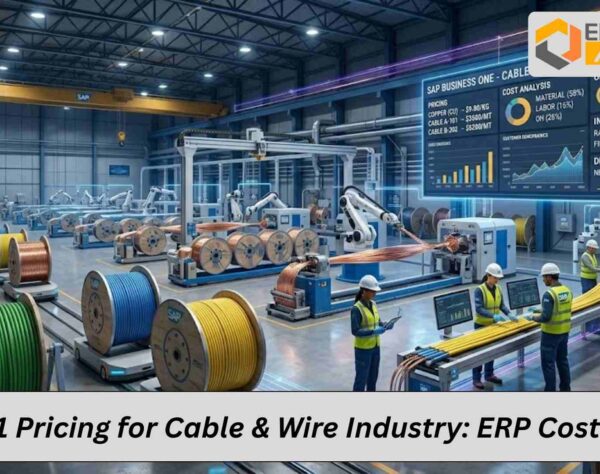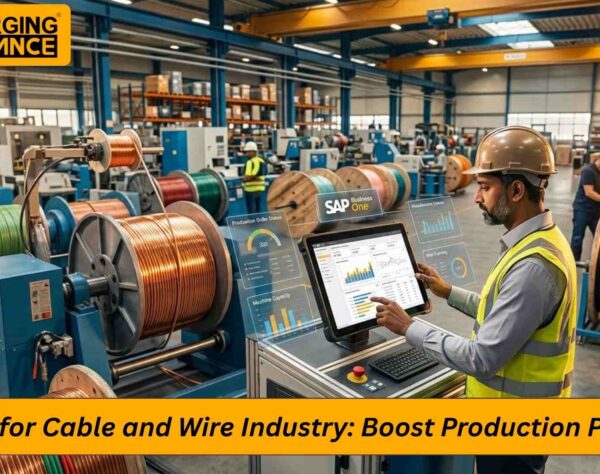
SAP Business One for Cable and Wire Manufacturing: Production, Costing, Traceability and Growth
Quick Answer: Is SAP Business One Suitable for Cable and Wire Manufacturers?
Yes. SAP Business One can be a suitable ERP platform for small and midsize cable and wire manufacturers that need integrated control over production, inventory, procurement, finance, sales, costing, and material planning. While core manufacturing features (such as BOMs, production orders, and MRP) are native, specialized processes like advanced reel tracking, quality test certificates, or shop-floor machine automation may require industry extensions or integrations.
Why Cable and Wire Manufacturing Needs Stronger ERP Control
Cable and wire manufacturing involves much more than converting raw materials into finished products. The typical production cycle is multi-staged and linear, meaning that any inefficiencies in early phases accumulate down the line.
Typical Cable Production Flow
Every stage of the manufacturing process can affect:
- Material consumption
- Production yield
- Scrap
- Work-in-progress
- Machine utilization
- Manufacturing cost
- Product quality
- Delivery performance
When purchasing, production, inventory, sales, and finance operate through disconnected systems or spreadsheets, management may struggle to answer critical questions such as:
- How much raw material is required for upcoming orders?
- Why is actual copper consumption higher than planned?
- Which production orders are generating excessive scrap?
- How much working capital is tied up in WIP?
- Which cable products deliver the strongest margins?
- Can production meet the customer’s committed delivery date?
This is where an integrated ERP such as SAP Business One can create stronger operational and financial visibility, consolidating transactions across all departments into a single, real-time database.
How SAP Business One Supports Cable Manufacturing
SAP Business One brings core business functions into one ERP environment. Instead of maintaining separate systems for finance, procurement, inventory, sales and manufacturing, businesses can use a common transactional foundation.
Bills of Materials (BOMs)
Define multi-level cable structures and component lists representing actual production logic.
Production Orders
Control planned vs actual output, component usage, labor, and production-related costs.
MRP Functionality
Evaluate inventory, forecasts, sales, and BOM requirements to plan future material needs.
Inventory Management
Centralize inventory transactions, warehouse stock, and available-to-promise calculations.
Purchasing & Procurement
Automate supplier management, generate purchase recommendations, and track purchase price variance.
Batch & Serial Tracking
Record and audit complete material genealogy from raw rods to shipped customer drums.
Resource Management
Track and schedule labor capacity, machine availability, operator allocation, and setups.
Sales & Financials
Connect customer order specifications directly to inventory, costs, and profit calculations.
Bills of Materials for Cable Products
A bill of materials defines the components and resources required to manufacture a product. For cable manufacturers, a BOM may contain materials such as:
- copper or aluminium conductor
- insulation compounds (PVC, XLPE)
- steel wire or tapes for armouring
- fillers, sheathing, and packaging materials
Manufacturers can also use multi-level structures where intermediate products become inputs to later manufacturing stages. A structured BOM helps improve material planning, production consistency, purchasing visibility, cost estimation, and production-order accuracy. The BOM should reflect actual manufacturing logic rather than simply serving as a static material list.
Production Orders
Production orders provide the transactional framework for manufacturing products. They can be used to control:
- planned production quantity and required components
- material issues and resource utilization
- receipt of finished goods and actual manufacturing costs
For cable manufacturers, production orders can help create clearer control over what is planned versus what is actually produced. This allows management to quickly identify copper consumption variances, drop in yield, or overrun in labor resources.
Material Requirements Planning
SAP Business One includes Material Requirements Planning (MRP) functionality. MRP can evaluate demand and supply information, including inventory, sales orders, production orders, purchase orders, forecasts and BOM requirements, to identify future material requirements. This helps plan raw material ordering cycles (like copper rods or PVC resins) without stockout risks. However, planning quality depends heavily on master-data discipline (such as accurate BOM weights and supplier lead times).
Managing Raw Materials and Inventory
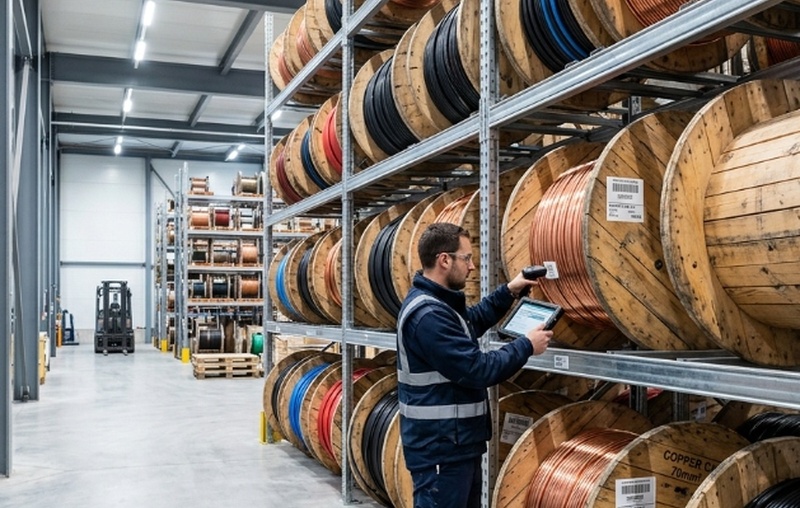
Raw-material inventory is one of the most financially significant areas in cable manufacturing. High-value items such as copper and aluminium need close monitoring because excess inventory ties up working capital while shortages can stop production. SAP Business One can centralize inventory transactions across warehouses and production.
Real-Time Inventory Visibility
ERP visibility helps teams understand stock on hand, committed inventory, available inventory, and open goods on order. Instead of departments maintaining separate versions of inventory information, transactions are reflected through one common system, speeding up procurement and sales order confirmation cycles.
Batch and Serial Number Management
SAP Business One supports batch and serial number management for relevant inventory transactions. This can help manufacturers establish stronger material traceability—recording exactly which supplier batch of raw copper rod entered production, which production order consumed it, and which customer eventually received the finished cable reel.
Cable Reel and Drum Management
Reel and drum control is an important cable-manufacturing requirement. Finished cable may be produced and sold in different lengths and packaged on reels or drums. Standard SAP Business One provides inventory and unit-of-measure capabilities, but sophisticated reel-level tracking (such as managing remnant cable lengths or tracking reusable drum returns) may require custom configuration or an industry extension.
Managing Work-in-Progress Across Manufacturing Stages
Cable manufacturing often creates intermediate products before the final cable is completed. For example, copper rod becomes drawn wire, drawn wire becomes stranded conductor, conductor receives insulation, insulated cores are assembled, and armour and outer sheath are applied. Management needs visibility into how much value and material is currently tied up between these stages. A properly configured ERP environment can help provide better control over intermediate inventory, production stages, material transfers, production orders, and manufacturing costs, making it easier to identify production bottlenecks and unusual accumulation of WIP.
Scrap, Yield and Production Variance
Scrap is not simply a production issue. It is a margin issue. Cable manufacturing can generate scrap through wire drawing losses, conductor breakage, insulation startup loss, extrusion waste, cutting loss, rejected production, incorrect lengths, and damaged material. Manufacturers should therefore track not just production quantity but also yield.
Material Yield
Formula: Finished or usable output ÷ material input × 100. Measures conversion efficiency.
Scrap Percentage
Formula: Scrap quantity ÷ total material input × 100. Pinpoints process loss.
Production Variance
Actual material or production cost compared with planned or standard cost.
These indicators help production managers and CFOs identify where profitability is being lost. SAP Business One can record planned and actual manufacturing transactions, but sophisticated automated yield analysis may require reporting or extensions depending on the desired level of detail.
Production Costing, Scheduling, and Quality Control
Raw-Material Cost Control
Cable manufacturers operate in an environment where material cost can change quickly. ERP visibility becomes particularly important when quoting customers. Suppose a product quotation was prepared when copper cost was significantly lower than its current purchase cost. If sales teams continue using old costing assumptions, revenue may increase while margins decline. An integrated ERP environment allows organizations to connect:
Purchasing ➔ inventory cost ➔ production consumption ➔ product cost ➔ sales ➔ financial margin
This provides management with a stronger foundation for pricing decisions. However, SAP Business One should not be presented as a commodity-price hedging platform. It records and analyzes business transactions; broader commodity-risk management may require separate financial or procurement strategies.
Production Costing and Margin Visibility
Cable manufacturers should understand profitability at more than company level. Decision-makers often need visibility into product-level cost, customer-level margin, production-order variance, and raw-material contribution. SAP Business One combines financial and operational transactions, enabling manufacturers to build stronger cost and profitability reporting.
Production Planning and Resource Management
Production planning should consider more than raw-material availability. Manufacturers must also consider: machine availability, production sequence, operator capacity, setup time, maintenance, customer priorities, and delivery commitments. SAP Business One provides manufacturing resources and planning functionality. However, manufacturers requiring advanced finite-capacity scheduling or sequencing optimization should evaluate whether additional APS or manufacturing extensions are needed.
Quality Management and Traceability

Quality failures in cable manufacturing can result in product rejection, warranty claims, customer complaints, production rework, delivery delays, and compliance risks. Manufacturers should therefore integrate quality information with production wherever possible.
Quality parameters that may need to be recorded include conductor resistance, insulation thickness, outer diameter, elongation, spark test logs, high-voltage test results, and final product approvals. SAP Business One can capture these through user-defined data structures, but automated laboratory testing integrations or dedicated QMS workflows may require specific add-ons.
Standard SAP Business One vs Industry-Specific Extensions
One of the most important ERP evaluation questions is determining which requirements are standard and which require additional development. This evaluation should happen before project scope, budget and timeline are finalized:
| Cable Manufacturing Requirement | SAP Business One Foundation | Additional Configuration / Extension Needed |
|---|---|---|
| Financial accounting | Yes | Usually limited configuration required |
| Purchasing | Yes | Industry-specific approval workflows may vary |
| Inventory management | Yes | Advanced reel/length tracking may require extension |
| BOM | Yes | Specialized engineering logic may require configuration |
| Production orders | Yes | Complex process control may require extensions |
| MRP | Yes | Advanced planning scenarios may require enhancement |
| Batch/serial tracking | Yes | Detailed production genealogy depends on process design |
| Sales order management | Yes | Product configurators may require add-ons |
| Resource management | Yes | Finite scheduling may require APS |
| Scrap recording | Possible | Through production design; advanced yield analytics may require reporting |
| Quality data | Basic | Custom data can be captured; full QMS may require add-ons |
| Machine-level data | No | Not inherently automatic; MES/IoT integration usually required |
| Reel/drum control | Basic | Inventory foundation available; detailed reel management often requires extension |
| Test certificates | Possible | Can be supported through document/process design; automated certificate management may require extension |
ERP Selection and Implementation Roadmap
Key KPIs Cable and Wire Manufacturers Should Track
ERP should do more than process transactions. It should help management measure performance.
- Material Yield: Shows how effectively raw material is converted into usable product.
- Scrap Percentage: Identifies manufacturing loss and opportunities for process improvement.
- Production Variance: Highlights differences between planned and actual production cost or material usage.
- Work-in-Progress Value: Shows how much working capital is tied up in unfinished manufacturing.
- Inventory Turnover: Measures how efficiently inventory is being used.
- On-Time Delivery: Tracks whether customer orders are delivered as promised.
- Purchase Price Variance: Highlights changes between expected and actual material purchasing costs.
- Gross Margin by Product: Helps management identify profitable and unprofitable product lines.
How to Evaluate ERP for Cable and Wire Manufacturing
Before selecting SAP Business One—or any ERP—manufacturers should evaluate the solution against actual production requirements:
- Can the system manage multi-level BOMs, intermediate products, production orders, manufacturing resources, and scrap?
- Can it provide visibility into copper, aluminium, insulation compounds, high-value inventory, and lot or batch traceability?
- Can it support demand planning, MRP, purchasing recommendations, and production requirements?
- Can management understand production cost, material variance, purchase-price variance, and product margin?
- How will the system handle inspections, test results, certificates, and rejected materials?
SAP Business One Implementation Roadmap for Cable Manufacturers
Successful ERP implementation is primarily a business-process transformation project:
- Step 1: Process Discovery – Map existing processes across sales, purchasing, production, quality, inventory, warehouse, and finance.
- Step 2: Requirement Mapping – Classify requirements as standard SAP Business One, configuration, customization, add-ons, or integrations.
- Step 3: Master Data Design – Define item codes, BOMs, units of measure, resources, customers, suppliers, and batch rules.
- Step 4: Solution Configuration – Configure the ERP around agreed business processes. Avoid duplicating inefficient legacy methods.
- Step 5: Testing & Go-Live – Perform scenario testing (Sales order ➔ MRP ➔ purchase ➔ production ➔ finished goods ➔ invoice), train users, and execute stabilization checkpoints.
Conclusion: Building Better Manufacturing Visibility With SAP Business One
Cable and wire manufacturing becomes increasingly difficult to control when production, procurement, inventory, finance and sales operate through disconnected systems. SAP Business One can provide an integrated ERP foundation that connects these functions and gives decision-makers stronger visibility into materials, production orders, inventory, costs and financial performance.
Its core manufacturing capabilities—including BOMs, production orders, resources, inventory and MRP—can support many requirements of small and midsize cable manufacturers. The key is to implement the solution realistically. Industry-specific requirements such as advanced quality management, reel tracking, machine integration or finite scheduling should be identified early and addressed through the right combination of standard SAP Business One functionality, configuration and extensions.
For manufacturers evaluating ERP, the objective should not simply be to replace existing software. The objective should be to create a business system that makes production, costs, inventory, traceability and profitability easier to control as the company grows.
Frequently Asked Questions
Is Your Current ERP Giving You Complete Visibility Into Cable Production and Material Costs?
Assess your current production, BOM, MRP, inventory, costing, traceability and integration requirements before making your next ERP decision. Book a Cable Manufacturing ERP Demo with Emerging Alliance.