
SAP B1 Pharma Compliance: GMP, Batch Traceability & Audit Readiness Guide
SAP B1 Pharma Compliance: GMP, Batch Traceability & Audit Readiness Guide
Quick Answer
SAP B1 Pharma Compliance helps pharmaceutical companies strengthen batch traceability, inventory control, production visibility, approval workflows, and audit readiness using SAP Business One.
SAP B1 can support GMP-oriented pharmaceutical processes through batch and serial number management, production transactions, inventory records, user authorizations, approvals, and forward and reverse traceability.
However, SAP Business One alone does not automatically make a pharmaceutical company GMP, FDA, or 21 CFR Part 11 compliant. Compliance depends on proper system configuration, validation, SOPs, user controls, documentation, integrations, and the company’s overall quality management system.
Advanced pharmaceutical requirements such as quality testing, CAPA, deviations, electronic signatures, LIMS integration, and specialized regulatory workflows may require additional configuration, add-ons, or integrated applications.
Pharmaceutical companies operate in an environment where inventory accuracy alone is not enough.
Every raw material receipt, production batch, quality decision, stock movement, expiry date, approval, and finished-product shipment may need to be accurately recorded and traceable.
This makes ERP design a critical part of pharmaceutical operations.
SAP B1 Pharma Compliance is therefore not simply about implementing SAP Business One.
It is about creating a controlled ERP environment where finance, procurement, inventory, production, sales, warehouse operations, and relevant quality processes work with consistent and traceable data.
For growing pharmaceutical manufacturers and distributors, this can reduce operational fragmentation while improving compliance visibility and scalability.
Why Pharma Compliance Is an ERP Issue, Not Just a Quality Department Issue
Pharmaceutical compliance does not begin and end with the quality team.
Compliance risks can originate anywhere within the operational process.
A purchasing error can result in the receipt of an incorrect or unapproved material.
A wrong batch selection can directly affect manufacturing integrity.
An uncontrolled warehouse movement can create immediate traceability gaps.
An undocumented stock adjustment can create serious questions during an audit.
Incorrect material or finished-product data can compromise downstream distribution.
That means pharmaceutical compliance increasingly depends on the integrity of the complete operational data chain.
A properly designed ERP environment can help connect these processes rather than allowing every department to maintain separate spreadsheets and databases.
What SAP Business One Can Support in Pharmaceutical Operations
SAP Business One provides several standard capabilities that can support controlled pharmaceutical operations.
These capabilities provide a useful ERP foundation for pharmaceutical organizations.
However, specialized pharmaceutical requirements should be identified separately during the implementation fit-gap assessment.
SAP B1 Batch Traceability for Pharmaceutical Companies
Batch traceability is one of the most important ERP requirements in pharmaceutical manufacturing and distribution.
When a quality issue occurs, the company may need to answer questions such as:
Which supplier provided the material?
What supplier batch was received?
When was the material received?
Which production order consumed the material?
Which finished-product batch resulted from it?
How much inventory remains?
Which warehouse handled the batch?
Which customers received affected products?
Which transactions are connected to the batch?
When this information is spread across spreadsheets, warehouse systems, production documents, accounting software, and emails, investigations become slower.
SAP Business One supports batch-managed inventory and transaction-level batch allocation.
It can therefore help connect batch information with purchasing, inventory, production, and sales transactions.
Example Pharma Batch Traceability Flow
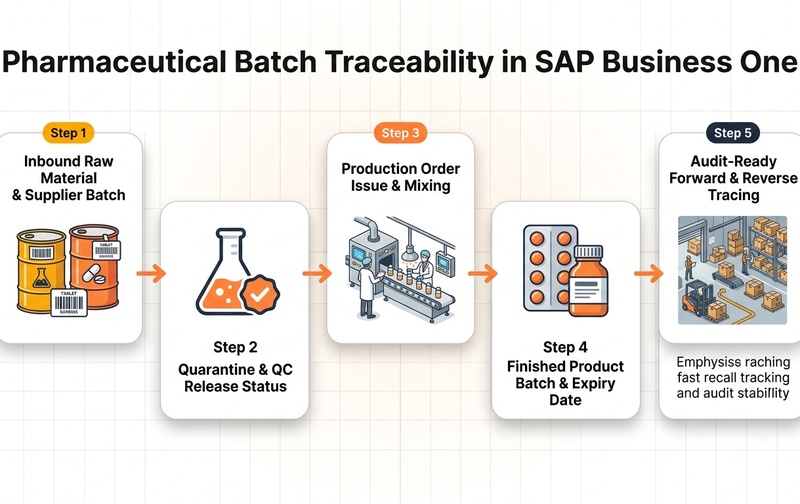
Pharmaceutical Batch Traceability Workflow: End-to-end forward and reverse tracking connecting inbound supplier batches, quality quarantine, production orders, and customer dispatch.
The objective is not merely to record a batch number.
The ERP should preserve the relationship between the batch and every important transaction that creates, consumes, moves, or ships it.
That is what makes batch traceability operationally useful.
How SAP B1 Can Support GMP-Oriented Processes
Good Manufacturing Practice requires pharmaceutical companies to maintain controlled processes, defined responsibilities, reliable records, appropriate authorizations, documentation, and quality oversight.
SAP Business One can support some of these requirements by creating a structured transactional environment.
For example, pharmaceutical organizations can use user authorization controls to limit who can perform specific activities.
Approval procedures can also be configured for selected business documents and transactions.
This can help reduce uncontrolled business processes.
SAP B1 can additionally connect procurement, inventory, production, sales, and financial records within a common ERP environment.
Important Compliance Distinction:
SAP Business One can support GMP-oriented business processes, but SAP Business One itself does not replace GMP procedures, validation activities, SOPs, quality systems, or regulatory responsibilities.
Pharmaceutical companies should therefore evaluate both ERP functionality and compliance-process requirements during solution design.
Native SAP B1 vs Pharma-Specific Requirements
One of the most common pharmaceutical ERP mistakes is assuming every pharma requirement exists as a standard SAP Business One feature.
A more effective implementation separates native functionality from specialized requirements.
This distinction prevents unnecessary customization while ensuring that genuine pharmaceutical requirements are not overlooked.
SAP B1 and 21 CFR Part 11
21 CFR Part 11 is frequently discussed during pharmaceutical ERP projects.
However, implementing an ERP does not automatically create Part 11 compliance.
Pharmaceutical companies first need to identify which electronic records and electronic signatures within their processes are subject to regulatory requirements.
Relevant considerations may include:
System validation
User identification
Access control
Record integrity
Auditability
Electronic signatures
Security
Record retention
Change control
Standard operating procedures
The Central Compliance Question:
Which regulated records will be created, changed, reviewed, approved, stored, or retrieved through SAP Business One?
The answer determines the controls that may be required.
If electronic batch records, laboratory data, controlled quality documents, or regulated electronic signatures are handled outside standard SAP B1 processes, additional validated applications or integrations may be necessary.
Production Control in SAP B1 for Pharmaceutical Manufacturing
Production traceability begins with clearly defined materials and manufacturing transactions.
SAP Business One supports Bills of Materials and production orders.
A production BOM defines the components required to manufacture a finished item.
Production orders can then connect material issues with finished-product receipts.
For pharmaceutical organizations using batch-managed materials, this creates an important relationship between:
This helps businesses understand which materials were consumed during production.
However, pharmaceutical manufacturing can involve requirements beyond standard ERP production functionality.
These may include:
Formula management
Potency calculations
Yield monitoring
Electronic batch records
In-process quality testing
Equipment status
Process parameters
Advanced quality release procedures
Depending on manufacturing complexity, these requirements may require an industry-specific extension, MES, QMS, LIMS, or other integrated system.
Expiry and Shelf-Life Management
Expiry visibility is both a compliance and profitability concern for pharmaceutical companies.
Poor expiry control can lead to:
SAP Business One batch management can maintain batch-related information that helps companies monitor controlled inventory.
This gives pharmaceutical organizations stronger visibility into areas such as:
Batch quantities
Warehouse stock
Expiry-related information
Batch movements
Material consumption
Finished-goods inventory
Customer deliveries
Where FEFO or other expiry-driven selection rules are required, those requirements should be explicitly evaluated during solution design.
How SAP B1 Supports Audit Readiness
Audit readiness is not simply about generating reports before an inspection.
A pharmaceutical company is better prepared when reliable operational information is consistently captured as part of everyday business processes.
SAP Business One can support this by centralizing transactional data.
Instead of reconstructing information from multiple spreadsheets, authorized users can investigate ERP transactions associated with inventory, batches, purchasing, production, and sales.
SAP B1 inventory reporting can also provide visibility into posted inventory movements.
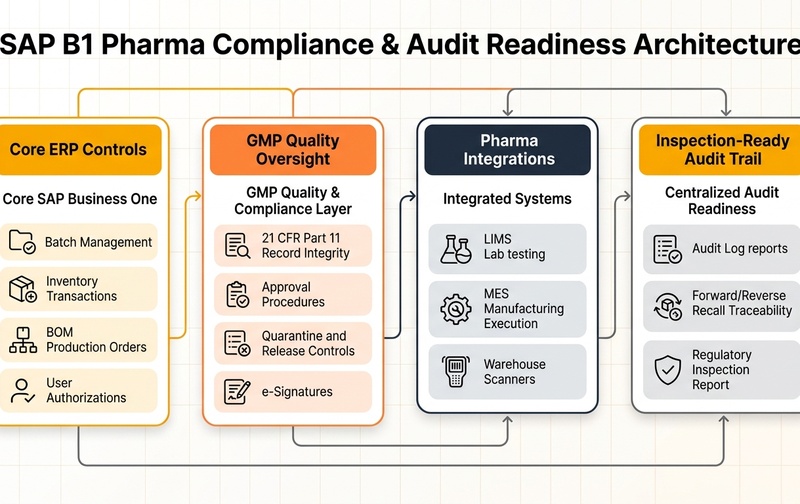
SAP B1 Pharma Compliance & Audit Readiness Architecture: Core ERP controls, GMP quality oversight, integrated laboratory/shop-floor systems, and inspection-ready audit trails.
This does not create automatic regulatory compliance.
It provides something equally important operationally: better availability of structured, traceable information when the business needs to investigate what happened.
Why Spreadsheet-Based Pharma Processes Become Risky
Spreadsheets remain useful tools.
Problems occur when spreadsheets become the primary operational system for managing regulated or traceability-sensitive processes.
Different departments may maintain separate files for:
Over time, several risks emerge:
As transaction volumes, users, warehouses, products, and manufacturing activities grow, this operating model becomes increasingly difficult to control.
An integrated ERP can reduce this fragmentation by providing a common transactional backbone.
SAP B1 for Pharmaceutical Product Recalls
Product recalls require speed.
When a batch is affected, the company may need to determine:
Which raw materials were involved
Which production transactions were associated
Which finished batches were created
How much inventory remains
Which warehouses contain the product
Which customers received the affected batch
Forward and reverse batch traceability can help users investigate these relationships within SAP Business One.
This can significantly improve the speed of ERP-based batch investigations.
However, the complete recall process may also include:
- Quality investigations
- Regulatory reporting
- Customer communication
- Product returns
- Deviation management
- CAPA
- Recall effectiveness checks
SAP B1 should therefore be viewed as part of the overall pharmaceutical recall process rather than the entire recall solution.
What Pharma Companies Should Validate Before Implementing SAP B1
A disciplined validation and scoping roadmap is essential before deployment:
1. Define the Intended Use
Identify exactly which processes SAP Business One will manage. These may include procurement, inventory, finance, production, sales, batch control, warehouse operations, and integrations.
2. Identify Regulated Records
Determine which electronic records are associated with regulatory or internal quality requirements. This helps establish validation and control requirements.
3. Map the Complete Batch Lifecycle
Document how material moves from supplier receipt through production and finished-product shipment. Every important transaction should have a clearly defined system process.
4. Define Quality Status Controls
Determine how materials move between quality statuses:
Then identify whether standard SAP B1 functionality is sufficient or additional capabilities are required.
5. Define Roles and Approvals
Identify who can:
- Create transactions
- Edit transactions
- Approve transactions
- Release documents
- Cancel transactions
- Reverse transactions
Access and approvals should reflect actual business responsibilities.
6. Identify Integration Requirements
Review systems such as:
Each important data element should have a clearly defined system of record.
7. Plan Validation and Change Control
For regulated processes, ERP implementation and compliance validation should not be treated as completely separate activities. Testing, documentation, risk assessment, intended use, user procedures, and change management should be considered during implementation planning.
SAP B1 Pharma Compliance Architecture
A pharmaceutical ERP environment does not necessarily need one application to perform every activity.
A practical architecture can include multiple integrated systems with clearly defined responsibilities.
SAP Business One
Core ERP Foundation
- Finance
- Procurement
- Inventory
- Sales
- Production transactions
- Batch management
- Business approvals
Pharma or Quality Extension
Deeper Quality Capabilities
- Quality inspections
- Test specifications
- Material release controls
- Deviation workflows
- Certificates of Analysis
LIMS
Laboratory Information
- Laboratory samples
- Testing
- Analytical results
- Laboratory workflows
MES
Manufacturing Execution
- Shop-floor execution
- Manufacturing instructions
- Electronic production records
- Manufacturing process controls
The goal is not to implement the maximum number of applications.
Business Benefits Beyond Compliance
Pharmaceutical ERP investments can create benefits beyond regulatory support.
Improves inventory planning and traceability responsiveness across the entire supply chain.
Significantly reduces avoidable stock write-offs and scrap through disciplined shelf-life management.
Improves purchasing decisions, vendor lead-time management, and reorder cycles.
Improves material visibility, WIP tracking, and component consumption accuracy.
Eliminates time-consuming departmental reconciliation work between warehouse and accounting.
Replaces informal email/verbal approvals with transparent, role-based system sign-offs.
Provides executives and operational leaders with real-time, consolidated business intelligence.
For CEOs and CFOs, the ERP investment can therefore contribute to both compliance support and operational scalability.
When Is SAP Business One Suitable for a Pharmaceutical Company?
SAP Business One can be worth evaluating for growing pharmaceutical manufacturers, distributors, contract manufacturers, medical-product organizations, and related businesses that need better integration across operations.
It is particularly relevant when the business struggles with:
However, ERP selection should be based on process complexity rather than company size alone.
Organizations with advanced process manufacturing, highly complex laboratory workflows, extensive electronic batch records, or sophisticated global compliance requirements should conduct a detailed fit-gap analysis before deciding the final system architecture.
Choosing an SAP Business One Partner for Pharmaceutical Compliance
The SAP implementation partner can significantly influence the success of a pharmaceutical ERP project.
A suitable partner should understand the complete operational process:
They should also clearly distinguish between:
During partner evaluation, ask for process demonstrations rather than generic product presentations.
For example:
This type of scenario-based evaluation provides a much clearer understanding of system fit.
How Emerging Alliance Supports SAP B1 for Pharmaceutical Companies
Emerging Alliance helps pharmaceutical businesses evaluate and implement SAP Business One across core operational processes including:
The implementation approach begins by understanding the company’s existing processes, regulatory environment, operational risks, reporting needs, and integration requirements.
Requirements can then be separated into:
This avoids unnecessary customization while ensuring important pharmaceutical requirements are properly addressed.
The objective is to build an SAP environment that improves traceability, operational control, visibility, and scalability.
Conclusion
SAP B1 Pharma Compliance is not achieved by enabling one software feature.
It requires properly designed processes, controls, system configuration, validation, documentation, integrations, and user responsibilities.
SAP Business One can provide a strong ERP foundation through capabilities such as:
- Batch management
- Serial number tracking
- Production transactions
- Inventory records
- Approval workflows
- User authorizations
- Forward and reverse traceability
- Business reporting
Pharma-specific requirements must then be evaluated against the company’s products, regulatory environment, manufacturing complexity, quality system, system integrations, and validation expectations.
When implemented effectively, SAP Business One can help pharmaceutical companies move away from fragmented operational records toward a more integrated and traceable business environment.
For business leaders, this can mean stronger control, easier investigations, better visibility, improved scalability, and greater audit preparedness.