
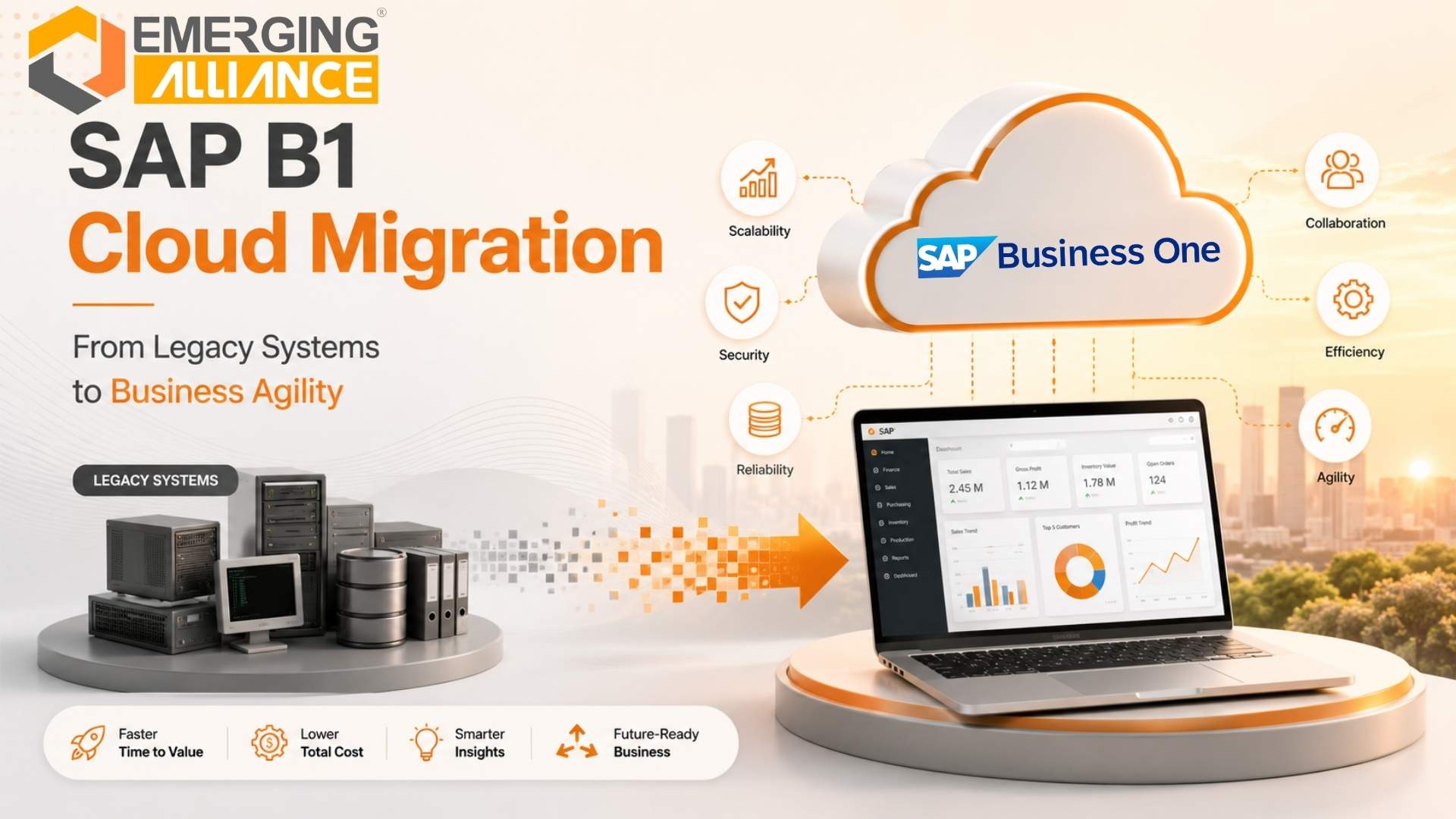
SAP B1 Cloud Migration — From Legacy Systems to Business Agility
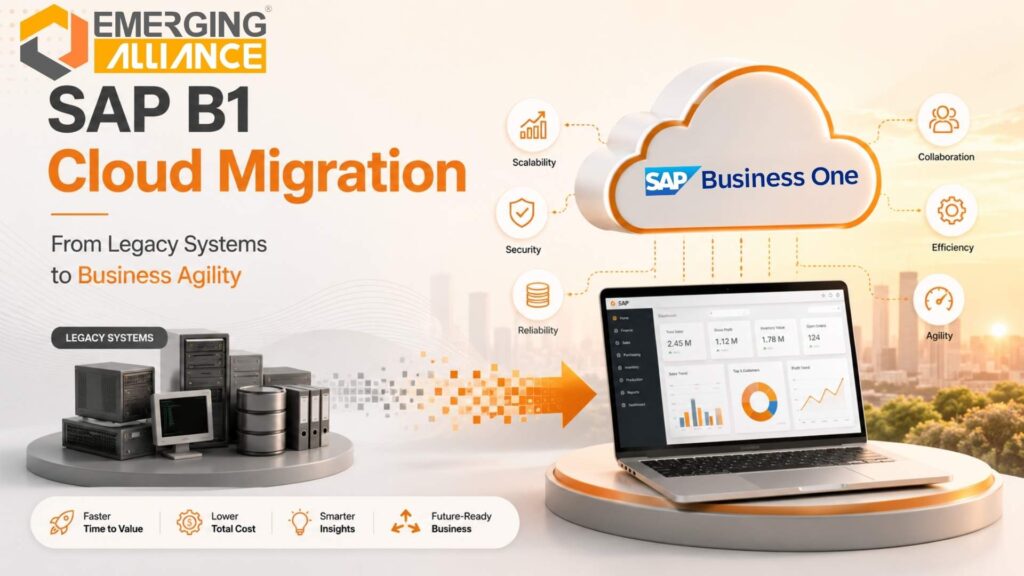
SAP B1 Cloud Migration for Future-Ready Enterprises
Enterprise growth places new demands on ERP systems that legacy infrastructure was never designed to support. Rising maintenance costs, limited accessibility, lengthy upgrade cycles, and increasing infrastructure complexity can gradually impact business agility. This is why SAP B1 Cloud Migration has become a strategic business initiative rather than simply an infrastructure upgrade. Moving an existing SAP Business One on-premise system to the cloud enables organizations to improve operational agility, reduce infrastructure dependency, strengthen business continuity, and prepare for future digital initiatives without replacing the ERP they already trust.
For CEOs, CIOs, CTOs, and Operations Leaders, the objective extends beyond moving workloads to the cloud. It is about building an ERP environment that supports faster decision-making, scalable growth, stronger resilience, and long-term business transformation.
Why Businesses Are Moving Beyond On-Premise ERP Infrastructure
Organizations are moving beyond traditional ERP infrastructure because business growth now demands flexibility, remote accessibility, stronger security, and predictable IT operations. Modern enterprises require systems that scale as quickly as the business itself.
Many organizations continue operating an on-premise SAP B1 system that was designed for a very different business environment. While these deployments often remain stable, they introduce operational challenges as companies expand.
Infrastructure Growth Increases Operational Complexity
As businesses grow, so does the infrastructure required to support ERP.
Additional servers, storage, backups, disaster recovery environments, security updates, and hardware refresh cycles increase both cost and administrative effort. Internal IT teams often become focused on maintaining infrastructure instead of supporting strategic business initiatives.
Over time, ERP infrastructure evolves into a recurring operational expense rather than a competitive advantage.
Limited Flexibility for Modern Workforces
Today’s organizations operate across multiple offices, warehouses, manufacturing facilities, customer locations, and home offices.
Legacy ERP environments frequently require VPN connections, complex network configurations, or limited remote accessibility. These constraints slow collaboration and reduce employee productivity.
Cloud-enabled ERP removes many of these barriers by making secure access available wherever authorized users need it.
Upgrade Cycles Become Increasingly Difficult
Many businesses postpone ERP upgrades because infrastructure dependencies increase project complexity.
Older operating systems, aging servers, database compatibility concerns, and application dependencies all extend implementation timelines and increase business risk.
A modern SAP B1 Cloud solution simplifies future upgrades by providing a more standardized and scalable operating environment.
If your organization is uncertain whether its existing ERP environment is cloud-ready, a structured migration assessment can identify technical dependencies, business risks, and modernization opportunities before any transition begins.
Business Risks of Delaying SAP B1 Cloud Migration
Delaying cloud migration rarely creates immediate disruption, but it steadily increases operational, financial, and technology risks. The longer organizations rely on aging infrastructure, the greater the cost of maintaining business continuity.
Rising Infrastructure and Maintenance Costs
Hardware eventually reaches end-of-life.
Servers require replacement, operating systems lose vendor support, storage capacity must expand, and maintenance contracts continue increasing. These recurring investments often deliver little additional business value.
Cloud infrastructure converts many of these capital expenditures into more predictable operational costs.
Reduced Business Agility
Organizations pursuing acquisitions, opening new branches, expanding internationally, or enabling hybrid work often discover that legacy infrastructure slows execution.
Provisioning new environments, expanding storage, or supporting additional users becomes increasingly time-consuming compared to cloud-based environments designed for elasticity.
Business agility becomes constrained by infrastructure rather than strategy.
Higher Business Continuity Risks
Unexpected hardware failures, natural disasters, cyber incidents, or extended outages can significantly disrupt operations.
Cloud environments typically offer stronger redundancy, automated backups, disaster recovery capabilities, and higher infrastructure resilience than many internally managed environments.
Business continuity becomes significantly more reliable when ERP infrastructure is designed for availability rather than recovery.
Planning a Successful SAP B1 Cloud Migration
Successful SAP B1 Cloud Migration begins with business planning—not technology selection. Organizations that define objectives, assess readiness, and minimize operational disruption achieve faster adoption and better long-term outcomes.
Evaluate the Current ERP Environment
A complete assessment should review:
- Current infrastructure
- SAP Business One version
- Database environment
- Integrations
- Add-ons
- Customizations
- User workloads
- Security requirements
This assessment identifies migration complexity before project execution begins.
Define Business Objectives Before Technology Decisions
Cloud migration should solve measurable business challenges.
Typical objectives include:
- Reducing infrastructure costs
- Improving remote accessibility
- Increasing system availability
- Supporting future expansion
- Simplifying upgrades
- Strengthening cybersecurity
- Improving disaster recovery
Technology decisions become easier when aligned with clear business priorities.
Develop a Phased Migration Strategy
Large ERP environments benefit from structured implementation phases.
A phased approach allows organizations to validate infrastructure, migrate data, test integrations, train users, and minimize business disruption before full production deployment.
Rather than treating migration as a single event, leading organizations manage it as a controlled transformation program.
Many enterprises engage experienced SAP Business One migration services providers early in the planning phase to validate architecture, identify hidden dependencies, and reduce implementation risk before production migration begins.
Choosing the Right Migration Approach
There is no single migration model suitable for every organization. The right approach depends on infrastructure maturity, compliance requirements, business complexity, and long-term growth plans.
Lift-and-Shift Migration
Organizations with stable ERP environments may choose to move existing infrastructure directly into the cloud with minimal application changes.
This approach delivers faster migration while preserving existing business processes.
Optimized Cloud Deployment
Some organizations use migration as an opportunity to modernize databases, improve performance, streamline integrations, and eliminate outdated infrastructure components.
Although planning requirements increase, the long-term operational benefits are often greater.
Fully Managed Cloud Services
Businesses seeking to reduce internal IT overhead frequently choose managed cloud environments supported through SAP Business One migration support services.
This model enables internal IT teams to focus on innovation while infrastructure monitoring, updates, backups, and platform maintenance are managed through specialized expertise.
SAP Business One On-Premise to Cloud Transition Best Practices
A successful SAP Business One On-premise to Cloud transition depends on disciplined planning, governance, and user readiness—not just technical execution. Organizations that treat migration as a business transformation initiative typically achieve faster adoption and lower operational risk.
Prioritize Data Quality Before Migration
Migrating outdated or inaccurate data simply transfers existing problems into a new environment.
Before migration, organizations should review master data, remove duplicate records, archive obsolete information, and validate financial and inventory data. Clean, reliable data improves reporting accuracy and reduces post-migration issues.
Validate Integrations and Add-Ons
Many businesses rely on third-party applications for CRM, manufacturing, logistics, e-commerce, payroll, or business intelligence.
Every integration and custom add-on should be assessed for cloud compatibility. Identifying unsupported components early prevents unexpected disruptions during migration and helps define an appropriate modernization roadmap.
Prepare Users for Operational Change
Cloud migration often changes how employees access and interact with the ERP system.
Providing role-based training, communicating project milestones, and involving key business users throughout testing improves user adoption and reduces resistance after go-live.
Common SAP B1 Cloud Migration Mistakes to Avoid
Most migration challenges stem from inadequate preparation rather than technology limitations. Avoiding a few common mistakes can significantly improve project outcomes.
Treating Migration as an IT-Only Project
ERP supports finance, procurement, manufacturing, sales, customer service, and executive reporting.
Without involvement from business stakeholders, critical workflows, reporting needs, and operational dependencies may be overlooked, leading to delays and reduced adoption.
Underestimating Customizations
Many organizations have customized reports, workflows, or integrations that have evolved over several years.
A detailed review helps determine which customizations remain valuable, which should be updated, and which can be retired. This prevents unnecessary complexity in the new environment.
Skipping Comprehensive Testing
Successful migration requires more than confirming that users can log in.
Businesses should validate financial postings, inventory transactions, production processes, approval workflows, integrations, and reporting before moving into production. Thorough testing minimizes operational disruption and builds confidence across departments.
Strategic Business Value from SAP B1 Cloud Migration
For executive teams, SAP B1 Cloud Migration is measured by business impact—not by the completion of a technical project. The real value lies in improved agility, stronger resilience, and a technology foundation that supports long-term growth.
Lower Total Cost of Ownership
Reducing dependency on physical infrastructure lowers hardware investments, maintenance expenses, and ongoing operational overhead. Predictable cloud operating costs also simplify budgeting and long-term IT planning.
Faster Business Scalability
Whether opening a new branch, expanding internationally, or onboarding additional users, cloud infrastructure enables organizations to scale more efficiently without major hardware investments or lengthy deployment cycles.
Improved Operational Visibility
Cloud-based ERP gives decision-makers secure access to real-time business information from virtually anywhere. Executives can review financial performance, inventory levels, operational KPIs, and business trends without relying on delayed reports.
Stronger Business Continuity and Security
Modern cloud environments provide enhanced backup strategies, disaster recovery capabilities, and security controls that help reduce operational risk. This enables organizations to maintain continuity while meeting growing governance and compliance expectations.
For organizations evaluating SAP B1 to cloud, the objective should be clear: build an ERP platform that supports future business requirements rather than continually adapting legacy infrastructure to modern demands.
Conclusion
Business growth eventually exposes the limitations of legacy ERP infrastructure. Rising maintenance costs, infrastructure complexity, limited flexibility, and increasing operational risks can slow transformation even when core business processes remain stable.
SAP B1 Cloud Migration provides a practical path toward greater scalability, improved resilience, and better operational agility. When planned strategically, migration enables organizations to modernize their ERP environment while protecting existing business processes and preparing for future growth.
Frequently Asked Questions
1. How do I know if my SAP Business One environment is ready for cloud migration?
Cloud readiness depends on your ERP version, database, infrastructure, integrations, customizations, and business processes. A technical and business assessment identifies potential risks, compatibility issues, and the best migration approach before implementation begins.
2. Will SAP B1 Cloud Migration interrupt daily business operations?
A well-planned migration minimizes disruption through phased planning, testing, and scheduled cutover activities. Most organizations can significantly reduce downtime by preparing data, validating integrations, and involving business users throughout the project.
3. Can existing SAP Business One customizations be retained after migration?
In many cases, yes. Existing customizations can often be migrated, although some may require updates for compatibility or improved performance in the cloud environment. Each customization should be evaluated individually during project planning.
4. Is cloud migration more secure than maintaining an on-premise ERP system?
Cloud environments typically provide enterprise-grade security features, including continuous monitoring, automated backups, disaster recovery capabilities, and controlled access management. Security outcomes also depend on proper governance and configuration.
5. What is the difference between moving infrastructure and modernizing the ERP environment?
A simple infrastructure migration relocates the existing system to the cloud with minimal changes. Modernization uses the migration project to optimize databases, integrations, security, and performance for long-term business benefits.
6. How long does a typical SAP Business One cloud migration take?
Project timelines vary based on infrastructure complexity, data volume, integrations, and custom developments. Smaller environments may complete migration within weeks, while larger multi-site deployments generally require more extensive planning and testing.
7. What happens to historical ERP data during migration?
Historical data can usually be migrated along with the production database or archived based on business and compliance requirements. Organizations should define retention policies before the migration begins.
8. Can remote employees securely access SAP Business One after moving to the cloud?
Yes. One of the key advantages of cloud deployment is secure access for authorized users across offices, warehouses, customer sites, or remote work locations without relying on complex legacy infrastructure.
9. Why should organizations use SAP Business One migration services instead of handling migration internally?
Experienced migration specialists bring proven methodologies, technical expertise, and risk mitigation practices that help reduce downtime, resolve compatibility issues, and accelerate project delivery. This is particularly valuable for organizations with complex integrations or business-critical operations.
10. What business benefits should executives expect after SAP B1 Cloud Migration?
Beyond infrastructure modernization, executives typically expect improved scalability, lower operational costs, stronger business continuity, faster access to business information, simplified IT management, and an ERP platform that supports future digital transformation initiatives.
Fill out the form and our experts will contact you shortly