

Rising Dairy Costs? SAP Business One for Smarter Production & Inventory Control
Rising milk procurement costs, fluctuating raw-material prices, production losses, short shelf lives, inventory mismatches, and distribution pressure are making dairy operations increasingly difficult to control.
For growing dairy manufacturers, the problem is rarely one isolated cost. It is the lack of visibility across procurement, production, quality, inventory, sales, and finance.
When these functions operate through separate spreadsheets, accounting software, production records, and manual reports, management may know that costs are increasing without knowing exactly where margins are being lost.
This is where SAP Business One for the dairy industry can provide a more connected operational foundation.
By bringing purchasing, production, inventory, batch information, sales, financials, and reporting into an integrated ERP environment, dairy businesses can gain better control over everyday operations and make decisions using more reliable data.
Quick Answer: How Can SAP Business One Help Dairy Manufacturers Control Rising Costs?
SAP Business One can help growing dairy manufacturers connect procurement, production, inventory, sales, financials, and reporting within one ERP system.
Instead of managing production quantities, stock, purchases, sales, and costs across disconnected systems, dairy businesses can use integrated ERP data to improve material planning, batch visibility, inventory control, production costing, purchasing decisions, and operational reporting.
Dairy-specific requirements such as specialized milk collection, quality testing, route distribution, cold-chain monitoring, or device integration may require additional configuration, integration, or industry-specific extensions depending on the business process.
Why Are Dairy Manufacturing Costs Increasing?
Dairy manufacturing has always operated under tight operational conditions.
Milk is highly time-sensitive. Product shelf lives are limited. Demand changes quickly. Production has to coordinate with procurement, quality, packaging, inventory, and distribution.
As the business grows, even a small operational gap can become expensive.
Common sources of cost pressure include:
Individually, these problems may appear manageable.
Together, they can make it difficult for management to determine the true cost of producing and selling each dairy product.
An ERP system helps by connecting the transactions behind these costs rather than treating every department as an independent operation.
Where Do Dairy Companies Lose Operational Visibility?
The dairy value chain involves many closely connected activities:
If information does not move smoothly across these stages, operational blind spots emerge.
| Dairy Process | Common Visibility Gap | Potential Business Impact |
|---|---|---|
| Procurement | Purchasing data separate from production demand | Overbuying or emergency purchasing |
| Production | Actual consumption not compared with planned consumption | Unexplained material variance |
| Quality | Quality information managed separately | Delays and traceability challenges |
| Inventory | Stock updates are delayed or manual | Shortages or excess inventory |
| Batch Management | Weak connection between batches and transactions | Difficult traceability |
| Finished Goods | Limited shelf-life visibility | Expiry and write-offs |
| Distribution | Dispatch disconnected from inventory | Fulfilment delays |
| Costing | Finance receives operational data late | Delayed margin visibility |
| Reporting | Multiple spreadsheets and manual consolidation | Slow management decisions |
The goal of ERP is therefore not simply to digitize these activities.
What Is ERP for the Dairy Industry?
ERP for the dairy industry is an integrated business-management system that connects processes such as procurement, production, inventory, sales, finance, reporting, and operational control.
For dairy manufacturers, ERP can help management understand how raw materials move through production and become finished products that are stored, sold, and distributed.
A dairy ERP environment may need to support operational requirements such as:
The exact configuration depends on the size, product portfolio, production model, quality requirements, distribution model, and existing IT environment of the dairy company.
Why Consider SAP Business One for the Dairy Industry?
SAP Business One is an ERP platform designed for small and midsize organizations that need integrated control across key business functions.
For a growing dairy company, the value of SAP Business One is not limited to accounting.
It can connect operational and financial processes including:
- Purchasing
- Inventory
- Production
- Sales
- Customer management
- Financial accounting
- Warehouse activities
- Reporting and analytics
This allows operational transactions to flow into a common business system instead of being repeatedly transferred between departments.
For management, this creates a more reliable foundation for answering questions such as:
- What materials are available?
- What needs to be purchased?
- Which production orders are planned?
- How much material was consumed?
- What finished stock is available?
- Which batches are in inventory?
- Which products are approaching expiry?
- What orders need to be fulfilled?
- What is the financial impact of production activity?
- Which products or transactions are affecting profitability?
How SAP Business One Can Improve Dairy Production Control
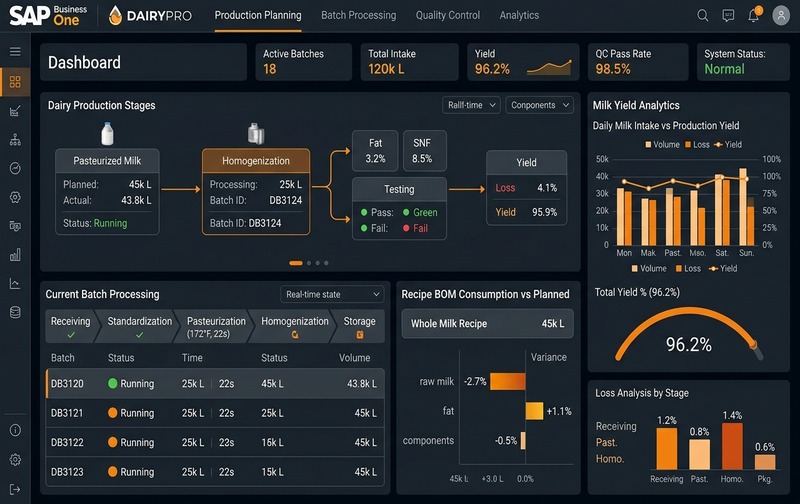
Dairy production and recipe control: SAP Business One connects milk processing, ingredient bills of materials, and batch yield tracking to eliminate unexplained material consumption variance.
1. Production Planning Based on Better Information
Production planning becomes difficult when sales forecasts, available stock, purchase orders, and manufacturing requirements exist in separate files.
SAP Business One can provide a more integrated view of demand, materials, purchasing, inventory, and production information.
This helps planners evaluate production requirements against available resources rather than relying only on manual calculations.
Better planning can help reduce:
- Last-minute material purchases
- Packaging shortages
- Excess production
- Avoidable production delays
- Unnecessary stock accumulation
For dairy manufacturers dealing with short product shelf lives, producing the wrong quantity can be nearly as costly as producing too little.
2. Better Control of Recipes and Material Requirements
Different dairy products have different ingredient, packaging, and production requirements.
A company may manufacture:
Production structures and Bills of Materials can help define what components are required to produce a particular finished product.
When those numbers consistently differ, management can investigate the reason instead of allowing the variance to remain hidden inside overall manufacturing costs.
3. Production Orders and Material Consumption Visibility
When production activities are recorded consistently within ERP, businesses gain better visibility into the relationship between materials issued and products produced.
Management can examine questions such as:
- Were the expected materials issued?
- Was consumption higher than planned?
- Was production output lower than expected?
- Were additional materials required?
- Are certain products showing repeated production variances?
This information is useful when identifying operational leakage.
ERP does not automatically eliminate wastage, but it can make unexplained consumption and production differences easier to identify and investigate.
How SAP Business One Can Improve Dairy Inventory Control
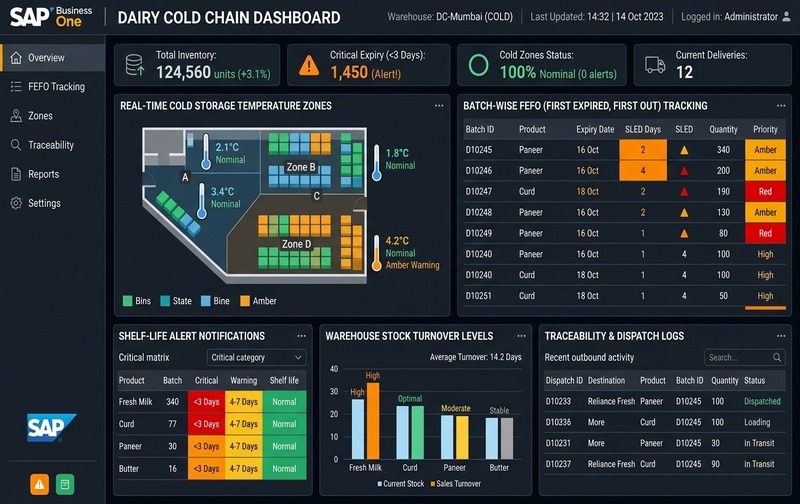
Dairy inventory and expiry control: Centralized batch management with FEFO tracking prevents product spoilage, write-offs, and stock reconciliation differences across dairy cold chains.
4. Centralized Inventory Visibility
One of the most common problems in growing manufacturing companies is disagreement about stock.
The warehouse may report one quantity. Production may maintain another figure. Sales may assume different availability. Finance may receive an updated number later.
An integrated ERP system reduces this fragmentation by maintaining inventory transactions within a common operational environment.
Users can gain better visibility into areas such as:
This can help purchasing, production, sales, and finance work with more consistent information.
5. Batch and Lot Visibility
Batch information is particularly important in food and dairy manufacturing because businesses often need to identify which stock belongs to a particular production or procurement batch.
Where processes are configured appropriately, batch-managed inventory can help businesses improve transaction-level visibility.
A stronger traceability process can help answer questions such as:
- Which batch is this finished product from?
- Where is that batch currently stored?
- Which transaction moved it?
- Which customer or sales transaction received the product?
The effectiveness of traceability depends on correct master data, transaction discipline, process design, and how dairy-specific requirements are implemented.
ERP should therefore be treated as part of a broader traceability process rather than as a replacement for operational controls.
6. Better Shelf-Life and Expiry Awareness
Dairy inventory is fundamentally different from inventory that can remain in a warehouse indefinitely.
Many finished products have short commercial shelf lives.
Poor inventory visibility can lead to:
A properly designed ERP process can provide stronger batch and inventory visibility so teams can make better stock-allocation and replenishment decisions.
Where FEFO—First Expired, First Out—or specialized shelf-life logic is required, the implementation should be designed according to the actual operational requirement rather than assumed to be automatic.
How ERP Can Help Control Dairy Procurement Costs
7. Purchasing Connected With Inventory Requirements
Procurement decisions influence both production continuity and working capital.
When purchasing teams lack reliable stock and demand information, businesses tend to move toward one of two extremes:
Both increase costs.
Integrated purchasing and inventory information allows teams to make purchasing decisions using better visibility into:
- Existing stock
- Open purchase orders
- Production requirements
- Supplier transactions
- Material movement
- Historical purchasing information
This can reduce dependence on manual purchase planning and fragmented spreadsheets.
8. Improved Vendor and Purchase Visibility
ERP can provide a consolidated view of supplier-related transactions.
Instead of searching emails, spreadsheets, purchase registers, and accounting software, teams can access more structured purchasing information.
This is particularly valuable when dairy businesses purchase:
Procurement visibility becomes especially important when commodity or packaging costs change frequently.
Production Costing: Turning Operational Data Into Financial Visibility
Many companies know their selling price.
Fewer have timely visibility into the operational factors affecting their actual production costs.
When procurement, material consumption, production, stock, and finance operate separately, product costing can become delayed or dependent on assumptions.
An integrated ERP system can strengthen the connection between operational activity and financial reporting.
Management can investigate:
This becomes increasingly valuable as the dairy company expands its product portfolio.
A litre of milk, a pack of paneer, a tub of yogurt, and a kilogram of ghee do not have the same production economics.
Management needs visibility at the level where actual business decisions are made.
Can SAP Business One Help Reduce Dairy Wastage?
SAP Business One can help businesses identify and analyse the transactions associated with production and inventory variance, but an ERP system cannot eliminate physical wastage by itself.
Wastage may originate from:
- Raw-material handling
- Production losses
- Incorrect recipes
- Process inefficiencies
- Packaging failures
- Storage conditions
- Demand forecasting
- Expiry
- Returns
- Distribution
The ERP’s role is to improve visibility.
For example, when production quantities, material issues, finished output, inventory movements, and cost information are captured consistently, management has better data for investigating abnormal losses.
Quality and Traceability in Dairy ERP
Quality is closely connected with dairy production, but quality-control processes differ significantly between companies.
Businesses may need to capture information related to:
Some of these processes can require specialized workflows, add-ons, laboratory systems, equipment integration, or customized processes.
For that reason, dairy companies evaluating SAP Business One should map quality requirements during the solution-design stage rather than assuming that every dairy-quality process will exist as standard functionality.
When Does a Dairy Business Need ERP?
A company does not need to wait until operations become unmanageable.
Common warning signs include:
Too Many Excel Sheets
Different teams maintain independent versions of procurement, production, inventory, and sales data.
Repeated Stock Differences
System stock and physical stock regularly disagree.
Delayed Production Reports
Management discovers yesterday’s production issues only after reports are manually consolidated.
No Clear Production Cost
Teams know approximate costs but cannot easily identify the drivers behind margin changes.
Frequent Material Shortages
Production is interrupted because ingredients or packaging are unavailable.
Excess Finished Stock
Products are manufactured without enough connection to demand and inventory.
Increasing Expiry Losses
Short-dated products are discovered too late.
Manual Traceability
Employees need multiple files or several hours to trace a batch.
Duplicate Data Entry
The same information is entered in production records, spreadsheets, accounting systems, and reports.
Management Depends on Individuals
Critical operating knowledge exists with employees rather than within standardized systems.
If several of these problems occur simultaneously, the issue may no longer be a departmental problem.
It may indicate that the business has outgrown disconnected operational systems.
SAP Business One vs Accounting Software for Dairy Manufacturing
Accounting software primarily focuses on recording financial transactions.
A manufacturing ERP connects financial data with wider operational activity.
| Requirement | Basic Accounting Software | Integrated ERP Approach |
|---|---|---|
| Financial accounting | Yes | Yes |
| Purchasing | Basic to moderate | Integrated |
| Inventory | Basic | Operationally connected |
| Production planning | Usually limited | Supported through manufacturing processes |
| Bill of Materials | Often limited | Available |
| Production orders | Usually limited | Available |
| Batch inventory | Varies | Can be managed |
| Warehouse transactions | Basic | Integrated |
| Sales processing | Available | Connected with inventory and finance |
| Production costing visibility | Limited | Stronger operational connection |
| Management reporting | Primarily financial | Operational + financial |
For a dairy manufacturer, this distinction becomes more important as transaction volumes and production complexity increase.
What Dairy-Specific Requirements May Need Additional Integration?
SAP Business One can provide the core ERP backbone, but dairy companies should identify specialized requirements before implementation.
These may include:
Whether these require configuration, an add-on, external application, API integration, or another SAP solution depends on the business environment.
This gap analysis is one of the most important stages in dairy ERP selection.
What Should Dairy Manufacturers Evaluate Before Choosing ERP?
Do not evaluate ERP only by asking: “Does the software have these features?”
Evaluate whether the complete solution can support your actual operating model.
Ask:
- Can it connect purchasing, production, inventory, sales, and finance?
- Can production teams record material consumption accurately?
- Can finished products be connected to batches?
- Can inventory be viewed by warehouse and relevant item dimensions?
- Can production plans be aligned with available materials?
- Can management analyse production and inventory variance?
- Can the system support current and future product lines?
- What dairy-specific workflows need customization?
- What devices or external applications require integration?
- How will historical and master data be migrated?
- How will users be trained?
- Which reports are required by operations, finance, and management?
- Can the ERP support additional plants or warehouses?
- Who will support the solution after go-live?
These questions reveal far more about ERP suitability than a generic feature checklist.
SAP Business One Implementation Roadmap for a Dairy Company
A dairy ERP project should begin with business-process understanding rather than software configuration.
ERP go-live is the beginning of operational improvement—not the end.
Business Benefits of SAP Business One for Dairy Companies
For Owners and CEOs
- Better visibility across operations
- More reliable business data
- Reduced dependency on manual reporting
- Stronger foundation for scaling
For CFOs
- Better inventory-value visibility
- Improved connection between operations and finance
- Stronger purchasing and cost analysis
- Improved margin visibility
For Operations Heads
- Better production visibility
- Clearer material requirements
- Improved coordination across departments
- Faster identification of operational variance
For Production Teams
- Structured production transactions
- Better material-consumption visibility
- Centralized production information
For Warehouse Teams
- Improved stock visibility
- Better inventory tracking
- Reduced reliance on independent spreadsheets
For Sales Teams
- Better stock availability information
- Improved coordination with inventory and fulfilment teams
Is SAP Business One Right for Every Dairy Company?
Not necessarily.
SAP Business One is most relevant when a growing dairy organization needs stronger integration across core business operations and wants to move away from disconnected systems.
A company with highly specialized dairy processes should evaluate whether those requirements can be addressed through:
- Standard SAP Business One capabilities
- Configuration
- SAP partner solutions
- Industry-specific add-ons
- Third-party integrations
- Custom extensions
The correct question is therefore not: “Can SAP Business One run a dairy company?”
That question leads to a much more realistic ERP strategy.
From Rising Dairy Costs to Better Operational Control
Rising dairy costs cannot always be controlled at the source.
Milk prices may increase. Packaging prices may fluctuate. Energy and logistics expenses may rise. Demand can change.
What dairy manufacturers can improve is the visibility and control around how resources are purchased, consumed, produced, stored, sold, and financially measured.
That is where integrated ERP becomes valuable.
SAP Business One can provide a connected foundation for purchasing, production, inventory, sales, finance, and reporting—helping growing dairy businesses replace fragmented information with more structured operational visibility.
For dairy manufacturers evaluating ERP, the priority should not simply be installing software.
Frequently Asked Questions About ERP for the Dairy Industry
Ready to Assess Your Dairy ERP Requirements?
If rising production costs, inventory mismatches, manual reporting, weak batch visibility, or disconnected systems are affecting your dairy operations, the first step is to identify where the operational gaps exist.
Emerging Alliance can help evaluate your dairy procurement, production, inventory, costing, sales, and reporting processes and determine how SAP Business One can fit your operational requirements.