


Fish Processing Cost and Traceability Risks? SAP Business One for Better Operational Control
Quick Answer
SAP Business One for fish processing can help seafood businesses coordinate purchasing, inventory, production, sales and financial records within an integrated ERP system. With appropriate configuration and integrations, processors can improve visibility into raw material usage, processing yields, batch movements and operating costs. The right solution depends on product handling, traceability requirements and existing equipment.
Why Fish Processing Businesses Need Better Operational Control
Fish processing businesses operate under conditions that can make cost control and inventory accuracy difficult. Raw materials are perishable, incoming quantities may vary, processing yields are not always predictable, and finished products may require different storage, packaging and dispatch arrangements.
When purchasing, warehouse, production and finance teams maintain disconnected records, managers may struggle to understand how much usable material remains, where processing losses occur and whether production costs align with actual output.
These gaps affect more than daily operations. They can influence gross margins, order fulfilment, working capital and management decisions.
An integrated ERP system can help connect operational and financial information. SAP Business One provides core capabilities for purchasing, inventory, production, sales and accounting. For fish processors, its suitability depends on how those capabilities are configured for seafood-specific workflows and whether additional integrations are needed.
The objective is not simply to digitize existing paperwork. It is to establish a more reliable view of material movements, production activity, inventory status and business performance.
Raw Material Variations Can Reduce Processing Margins
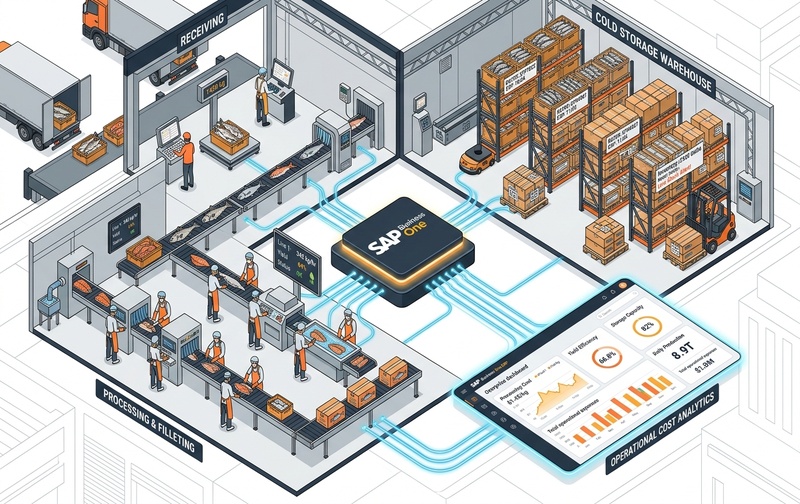
Fish processors may receive different species, grades, sizes and quantities from suppliers. The weight recorded at receiving may also differ from the usable quantity after inspection, trimming, cleaning, filleting or other processing activities.
If these differences are recorded manually or reconciled only at the end of a production shift, the business may find it difficult to identify where material losses occur.
For example, a production manager might know how much raw fish entered a processing run but lack a consolidated record of usable output, by-products, rejected material and finished products. Without consistent production records, the company may find it difficult to compare expected and actual yields.
SAP Business One can provide a central operational record for relevant inventory and production transactions. With suitable item definitions, units of measure, production structures and reporting, teams can record material consumption and output more consistently.
This supports several management priorities:
- Comparing planned material consumption with actual usage.
- Reviewing production output against the quantity of raw material issued.
- Identifying recurring differences between expected and recorded yields.
- Understanding how material usage contributes to product costs.
- Improving the information available for purchasing and production planning.
Actual yield calculations depend on the production process and the way the company captures its measurements. Specialized weighing equipment, automated data collection or production applications may require integration or customization.
Perishable Inventory Requires Accurate, Timely Records
Inventory decisions are particularly important when products have limited usable life or require controlled storage conditions. Excess purchasing can increase spoilage risk, while insufficient stock can interrupt production and delay customer orders.
Inventory inaccuracies can arise when receiving records, warehouse movements, production consumption and dispatch transactions are updated at different times. A system may show stock on hand without providing a sufficiently reliable picture of its location, condition or usability.
SAP Business One can help centralize inventory balances and transaction records across configured warehouses and business processes. Depending on the implementation, businesses can establish appropriate item, batch, warehouse and date-related tracking procedures.
This can support better visibility into:
- Quantities received and issued.
- Stock held in different warehouse locations.
- Material allocated to production or customer orders.
- Recorded batch movements and inventory adjustments.
- Products approaching relevant expiry or use-by dates, where these dates are captured and reported appropriately.
Inventory control should also reflect the processor’s stock-rotation policy, product characteristics and operational procedures. First-expiry-first-out (FEFO) processes, automated alerts, barcode scanning and temperature monitoring may require additional configuration, add-ons or connected systems.
An ERP inventory balance alone does not confirm that seafood has remained within the required temperature range. Temperature sensors and cold-storage monitoring systems must capture that information separately and integrate it where operational visibility is required.
Production Planning Must Reflect Actual Material Availability
Fish processing schedules can change because of variable incoming supply, differences in raw material quality, equipment availability, customer requirements and changing order priorities.
When planning depends on spreadsheets or informal communication, the production team may schedule work using outdated stock figures. This can lead to last-minute changes, idle capacity, unnecessary material movements or missed dispatch commitments.
SAP Business One provides production-related functionality that can help businesses manage configured production orders, material requirements and inventory transactions. Its practical value depends on whether the production model reflects the processor’s actual workflow.
A useful setup should help decision-makers review:
- The materials required for planned production.
- The inventory available for upcoming orders.
- The components issued to production.
- The quantities reported as completed output.
- The differences between planned and actual consumption.
- The relationship between production activity and customer demand.
Fish processing may involve grading, filleting, portioning, freezing, packing and other stages, depending on the operation. These workflows should be mapped before selecting production structures or custom reports.
Where production requires complex routing, live shop-floor updates or specialized yield capture, additional manufacturing applications or integrations may be appropriate.
The key management question is whether the ERP setup can represent the business’s production process accurately enough to support planning and cost review.
Batch Traceability Depends on Consistent Transaction Records
Seafood businesses may need to trace products through supplier receipts, processing activities, storage, packing and dispatch. The required level of traceability depends on the products, markets served, customer contracts and applicable obligations.
When batch identifiers are not recorded consistently, tracing a product can require staff to search across paper documents, spreadsheets, warehouse records and delivery information. That makes investigations slower and increases the risk of incomplete records.
SAP Business One supports batch management for appropriately configured items. When users record relevant transactions correctly, batch information can help connect incoming stock with subsequent inventory movements and business documents.
A traceability workflow should define how the business records:
- Supplier and receipt details.
- Relevant batch or lot identifiers.
- Material issued to a production order.
- Output batches created during processing.
- Warehouse transfers and packing transactions.
- Finished-product deliveries and customer documentation.
The workflow must account for the processor’s actual handling of mixed batches, repacking, splitting and combining materials. These scenarios should be tested during implementation rather than assumed to work automatically.
Where the business needs a consolidated forward-and-backward traceability report, scanning at operational checkpoints or automated label generation, configuration and additional tools may be required.
ERP records can support traceability, but they do not independently guarantee regulatory compliance. The business must establish appropriate procedures, maintain accurate source records and verify that its configured solution meets its specific requirements.
Production Cost Visibility Starts With Reliable Operational Data
A fish processor’s product costs can be affected by raw material prices, processing losses, labour, packaging, utilities, storage, freight and other operating expenses.
When these costs are recorded separately, management may have difficulty understanding why margins change between products, orders or production periods.
SAP Business One can consolidate financial transactions and support inventory valuation and configured production-cost reporting. The level of detail available depends on the costing method, accounting configuration, production setup and quality of operational data.
Management reporting should help answer practical questions:
- How does actual material consumption compare with the production plan?
- Which products or orders have recorded cost variances?
- How do purchasing-price changes affect product margins?
- Are inventory adjustments or processing losses recurring?
- Which products contribute most effectively to profitability?
- Where would more detailed production data improve decisions?
These questions should guide dashboard and report design. A report is useful only when the underlying transactions are accurate and the result helps a manager decide what action to take.
Businesses should also distinguish between costs recorded directly in the ERP and costs calculated through external systems or management assumptions. Any allocation of labour, utilities, refrigeration or other overheads should follow a defined costing approach.
Integrations Connect ERP Records With Processing Operations
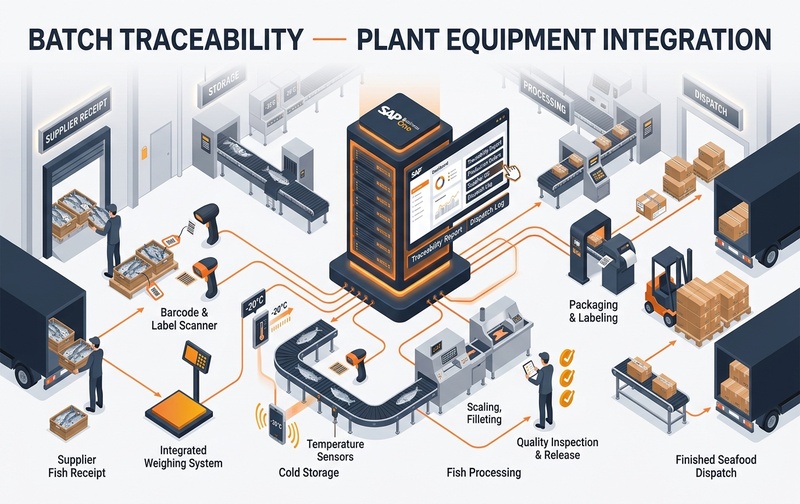
Fish processing environments may already use weighing scales, barcode scanners, label printers, laboratory systems, cold-storage monitoring, transport applications or customer ordering platforms.
If these tools operate independently, employees may need to enter the same information more than once. Duplicate entry creates opportunities for mismatched quantities, incorrect identifiers and delayed updates.
SAP Business One can serve as a central business-data platform, while integrations connect selected operational systems to relevant ERP processes.
Potential integration requirements include:
- Weighing systems: transferring measured quantities into receiving or production records.
- Barcode and label systems: identifying products, batches and warehouse movements.
- Temperature-monitoring systems: collecting cold-storage readings and making relevant information accessible to authorized teams.
- Quality applications: connecting inspection outcomes and product-release information where required.
- Sales and logistics systems: aligning orders, dispatch information and delivery records.
Not every integration is available out of the box. Compatibility, data formats, business rules, exception handling and synchronization frequency must be assessed before implementation.
For example, connecting a scale to an ERP system requires more than transferring a number. The design must define the relevant item, unit of measure, transaction, user authorization and response when the reading cannot be matched to a valid record.
A controlled integration should reduce duplicate work without creating a new source of inconsistent data.
Customization Should Address Specific Operational Gaps
Standard ERP functionality may not cover every requirement of a seafood processing business. However, customization should follow a documented operational need rather than an assumption that every industry process requires a new application.
Before approving development, management should identify the problem, the users affected, the information required and the business result expected.
Examples of requirements that may need additional configuration or development include:
- Yield-variance reports by product or production order.
- Batch genealogy reports connecting incoming material and finished goods.
- Alerts for defined inventory or date-related exceptions.
- Barcode workflows for receiving, production and dispatch.
- Dashboards comparing planned output with recorded production results.
- Connections to existing plant equipment or quality systems.
Each proposed change should have an agreed scope, an accountable business owner and a testing process. The design should also consider how the solution will be supported and maintained after implementation.
The goal is to close meaningful process gaps while keeping the system manageable as the business grows.
How Decision-Makers Can Evaluate SAP Business One for Fish Processing
Selecting an ERP solution requires more than reviewing a list of functions. CEOs, CFOs, operations heads and IT leaders should assess whether the system can support the business’s most important operational and financial decisions.
A practical evaluation should cover five areas.
1. Inventory and traceability requirements
Document how the business receives, identifies, stores, processes and dispatches seafood. Define the batch details, date controls and records needed at each stage.
2. Production and yield measurement
Map the production workflow and identify how material consumption, usable output, by-products, rejects and production variances will be captured.
3. Costing and financial reporting
Determine which direct costs, inventory values and overheads need to be reviewed. Confirm how management will compare planned and actual results.
4. Integration and customization scope
List existing equipment and software, then identify which systems need to exchange data with the ERP. Confirm how errors, duplicate transactions and failed integrations will be handled.
5. Implementation and ongoing support
Review data migration, user training, testing, reporting requirements, system maintenance and responsibility for resolving operational issues.
A structured assessment helps the business distinguish between requirements that can be addressed through standard functionality, those that need configuration and those that require additional development or integration.
It also provides a basis for comparing implementation scope, ongoing costs and expected operational benefits without relying on unsupported promises.
Questions Fish Processors Should Resolve Before Implementation
Before committing to an ERP project, management should establish how success will be measured.
For example, the company may want fewer stock discrepancies, more consistent batch records, better production-cost visibility or less duplicate data entry. Each objective should have a baseline and a defined method for measuring progress.
Decision-makers should also agree on who owns master data, who approves inventory adjustments, how production records are validated and how exceptions are escalated.
These controls matter because an ERP system cannot correct unreliable processes simply by storing their transactions. Accurate data entry, clear responsibilities and appropriate user training remain essential.
A phased implementation may be suitable when several workflows or integrations need to change. The sequence should reflect business priorities, operational risk and the organization’s capacity to test and adopt the new processes.
Frequently Asked Questions
Discuss Your Fish Processing ERP Requirements
Unclear raw material usage, batch records, and production costs can affect traceability and profitability.
Request a consultation with Emerging Alliance to review your fish processing challenges and explore how SAP Business One can support inventory control, traceability, and cost visibility.


