
ERP for Packaging Industry: Closing the Gaps Across Production, Inventory & Cost Control
Quick Answer
An ERP for the packaging industry connects production planning, material management, inventory, costing, sales orders and operational reporting within a unified system. For packaging manufacturers, this can help address gaps caused by disconnected spreadsheets, manual processes, inconsistent inventory data and limited visibility into production costs. SAP Business One can support core manufacturing and business-management processes, while packaging-specific requirements may require configuration, integrations, add-ons or customization depending on the operation.
The right ERP should therefore be evaluated against the manufacturer’s actual workflow—from customer order and material planning through production, inventory, costing, quality and dispatch—not simply by the number of features listed by the software provider.
Why Packaging Manufacturers Outgrow Disconnected Processes
Packaging manufacturing involves more than converting raw materials into finished products.
A typical operation may need to coordinate customer orders, raw-material availability, purchasing, production planning, material consumption, inventory movements, production costs, quality requirements and dispatch. When these processes operate through separate spreadsheets or disconnected applications, information can become difficult to reconcile.
For example, the sales team may have committed to an order while production is still waiting for material availability information. Procurement may have one inventory figure, the warehouse another, and finance may lack timely production-cost information.
An ERP for packaging manufacturing can bring these processes into a connected business workflow.
ERP for Packaging Manufacturing: Connecting Demand With Production
One of the most important ERP requirements for packaging manufacturers is the ability to connect commercial demand with production activity.
The workflow should not stop when a sales order is entered.
Ideally, relevant information should flow through:
This connection gives production and management teams better visibility into the status of an order.
An ERP system can support processes such as:
The exact functionality available depends on the ERP configuration and manufacturing requirements.
SAP Business One for Packaging Industry Operations
SAP Business One provides an ERP foundation that can connect core business processes across sales, purchasing, inventory, production, finance and reporting.
For a packaging manufacturer, the important question is not simply whether SAP Business One contains a particular feature. The more useful question is whether the system can support the company’s complete operational workflow.
Depending on the implementation, SAP Business One can be used to connect areas such as:
- Sales and purchasing: Customer requirements and procurement activities can be managed within the wider ERP environment.
- Inventory: Materials, components and finished products can be tracked through inventory processes.
- Production: Manufacturing processes can be managed using production-related functionality.
- Cost management: Production and inventory information can contribute to greater visibility into manufacturing costs.
- Financial management: Operational transactions can connect with financial processes and reporting.
- Business reporting: Management can analyse information across multiple business functions rather than relying entirely on manually consolidated reports.
Packaging businesses with more specialized requirements may need additional configuration, integrations, industry solutions or custom development.
That distinction should be established during ERP evaluation rather than assumed beforehand.
Packaging Inventory Management: From Raw Materials to Finished Goods
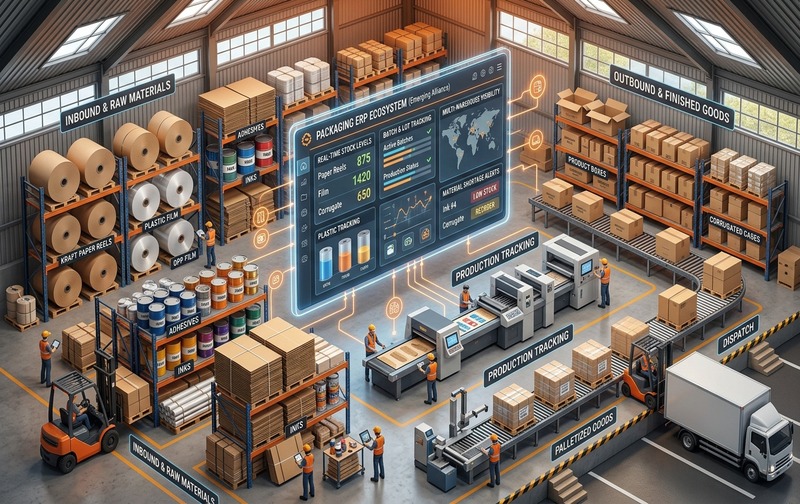
End-to-end packaging inventory visibility: Centralized ERP tracking links raw material availability, work-in-progress consumption, and finished goods dispatch to eliminate stockouts and production delays.
Inventory is one of the areas where packaging manufacturers can experience significant operational complexity.
Depending on the business model, inventory may include:
Managing these materials independently makes it harder to understand actual availability.
An ERP system can create a more connected inventory process by recording purchasing, receipts, consumption, production movements and finished-goods transactions within the same environment.
This is particularly relevant when production depends on the timely availability of several materials.
Instead of asking:
management can ask more operationally useful questions:
- “Which materials are available for the next production orders?”
- “Which customer orders are affected by material shortages?”
- “What materials have been consumed against production?”
- “What finished goods are available for dispatch?”
That shift from basic stock visibility to decision-oriented inventory visibility is an important reason packaging manufacturers evaluate ERP systems.
Controlling Packaging Production Costs and Material Consumption
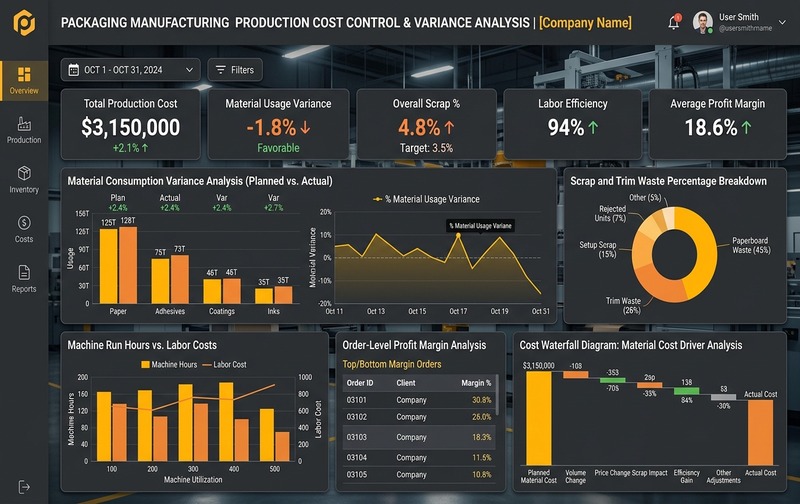
Production cost and variance control: Integrated ERP connects planned bill of materials, actual shop-floor consumption, and finished-goods costing to reveal job-level profitability.
Production cost visibility is another area where disconnected processes can create management challenges.
Packaging costs can depend on material consumption, production quantities, labour, overheads, purchasing costs and production variances.
When production and financial data are separated, management may receive cost information only after considerable manual reconciliation.
An integrated ERP environment can help connect production transactions with inventory and financial information.
This makes it possible to examine areas such as:
- Planned material requirements
- Actual material consumption
- Production quantities
- Inventory movements
- Production costs
- Cost variances
- Finished-goods costs
- Order-level profitability analysis, where configured
Production Planning for Packaging Manufacturing
Packaging production frequently involves multiple orders, materials, specifications and delivery commitments.
Without connected planning information, production teams may have to manually compare:
- Open sales orders
- Current inventory
- Material availability
- Production capacity
- Purchase orders
- Delivery requirements
An ERP-supported planning process can bring these data points together.
For example, when a customer order requires materials that are not currently available, the business can identify the requirement earlier and coordinate purchasing and production planning.
This can reduce the dependence on manually maintained production-planning spreadsheets.
The ERP should nevertheless be evaluated against the company’s actual production model. Different packaging operations may have very different requirements for scheduling, production stages, machine capacity, material characteristics and quality controls.
Managing Production Wastage and Variances
Material wastage can be an important operational consideration in manufacturing.
The key ERP requirement is not simply recording that wastage occurred. Management needs to understand the relationship between:
This allows production teams to investigate discrepancies instead of treating them as isolated inventory adjustments.
An ERP implementation can therefore provide a structured foundation for analysing production consumption and variances.
However, the quality of the resulting information depends on accurate production data, appropriate master data and disciplined transaction recording.
Connecting Sales Orders With Packaging Production
A packaging business may receive customer requirements before production has confirmed material and capacity availability.
This creates a potential disconnect between commercial commitments and operational execution.
A connected ERP workflow can provide visibility from the sales order through the downstream processes.
For example:
This gives management a clearer view of where an order sits in the process.
It also creates a better foundation for reporting on open orders, inventory requirements and production status.
Quality and Traceability Considerations
Quality and traceability requirements vary considerably between packaging manufacturers.
The ERP evaluation should therefore identify exactly what needs to be recorded and reported.
Depending on the business, this may include:
- Material lots
- Batch information
- Production records
- Inspection results
- Quality status
- Non-conforming material
- Finished-product traceability
- Supplier information
These requirements should be mapped before implementation.
Where standard ERP functionality does not fully address a specific workflow, configuration, add-ons or integration may be considered.
This is preferable to assuming that every packaging-specific process is automatically available in the base ERP.
What Should Packaging Manufacturers Evaluate Before Choosing an ERP?
Selecting an ERP should begin with business processes rather than a feature checklist.
A packaging manufacturer should evaluate at least these areas:
This evaluation is more meaningful than selecting an ERP purely because it contains a long list of modules.
SAP Business One Standard Functionality vs Packaging-Specific Requirements
This distinction is particularly important during ERP selection.
A packaging manufacturer should classify requirements into three categories:
Standard functionality
Processes that can be supported using the ERP’s existing capabilities.
Configuration
Processes that can be aligned through system configuration without developing an entirely new application.
Customization or integration
Requirements that need additional development, external systems, specialized add-ons or integration.
For example, a company’s specific production workflow, shop-floor data collection, machine integration or specialized quality process may require additional consideration.
This approach creates a more realistic implementation scope and reduces the risk of treating an ERP product brochure as an implementation blueprint.
When Should a Packaging Manufacturer Consider ERP?
ERP evaluation becomes particularly relevant when business processes are becoming difficult to manage through disconnected systems.
Common indicators include:
These indicators do not automatically mean that SAP Business One is the right choice. They indicate that the organization should formally assess its ERP requirements.
How to Plan an ERP Implementation for Packaging Manufacturing
A successful ERP project starts before software configuration.
The first step should be process mapping.
Document the current workflow from customer enquiry through production and dispatch.
Then identify:
- Current operational gaps
- Required master data
- Production processes
- Inventory structures
- Costing requirements
- Reporting requirements
- Existing software and integrations
- User roles and responsibilities
- Industry-specific requirements
- Future scalability requirements
The implementation team can then map those requirements against SAP Business One functionality.
This creates a clearer implementation scope and helps identify where configuration, customization or integration may be necessary.
Why ERP for Packaging Industry Should Be Evaluated Around Business Fit
An ERP project is a business-process decision as much as a technology decision.
For packaging manufacturers, the evaluation should focus on whether the proposed system can connect the information needed to make operational decisions.
The critical questions are:
- Can production see the information it needs?
- Can purchasing respond to actual material requirements?
- Can inventory reflect operational reality?
- Can management understand production costs?
- Can sales commitments be connected to fulfilment?
- Can required quality information be captured?
- Can reporting reduce manual consolidation?
- Can the system adapt to the company’s future requirements?
When these questions are answered through a structured ERP assessment, the organization has a much clearer basis for deciding whether SAP Business One and the proposed implementation approach fit its operations.
Conclusion
Packaging manufacturers face interconnected operational challenges across production, inventory, material planning, costing, sales orders and reporting. Treating these areas as isolated processes can make it difficult for management to obtain a consistent view of business operations.
An ERP for Packaging Industry can provide a connected foundation for managing these processes. SAP Business One can support core business and manufacturing workflows, while packaging-specific requirements should be assessed individually to determine whether standard functionality, configuration, customization, add-ons or integrations are appropriate.
The objective should not simply be to implement ERP software. It should be to create an operational system that gives the business better visibility from customer demand and material planning through production, inventory, costing and dispatch.
FAQs
See How ERP Can Connect Your Packaging Manufacturing Operations
If your packaging business is facing production bottlenecks, inventory visibility gaps, manual cost tracking or disconnected operational data, an integrated ERP approach can help bring these processes together.
Book a demo to explore how ERP can connect production, inventory and cost control across your packaging manufacturing operations.