

SAP Business One Payroll Mistakes Affecting Business Performance
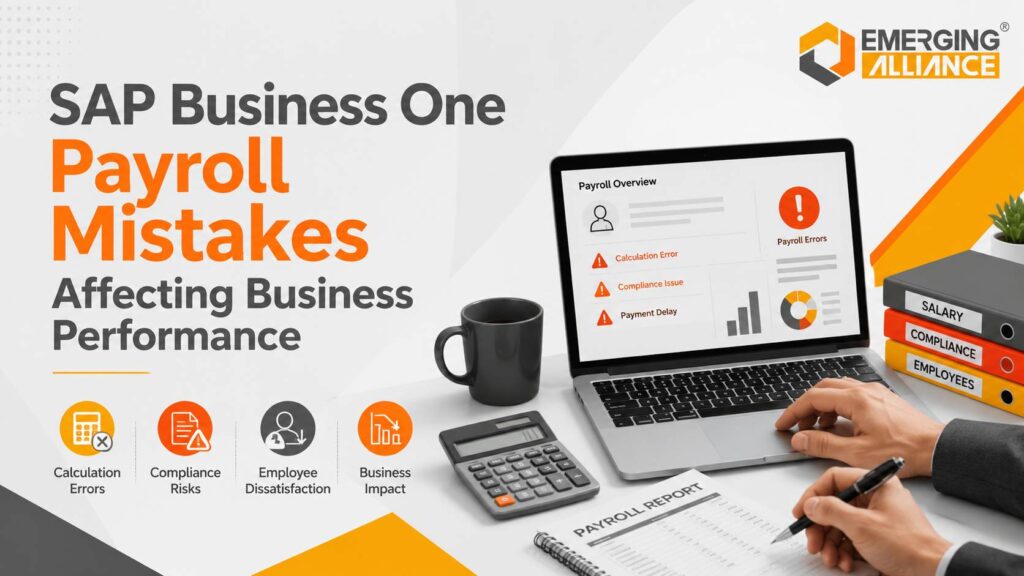
SAP Business One Payroll preventing payroll errors, compliance issues, and rework
Payroll mistakes do more than create incorrect payslips. They can delay salary payments, damage employee trust, increase compliance exposure, distort financial reports, and consume hours of HR and finance time.
These risks become more serious as a business grows. More employees, multiple shifts, variable incentives, overtime rules, leave policies, salary revisions, and statutory obligations make spreadsheet-based payroll increasingly difficult to control.
An integrated SAP Business One Payroll solution helps businesses connect employee data, attendance, leave, salary structures, approvals, statutory calculations, and accounting records within a controlled payroll process.
However, implementing payroll software alone does not guarantee accuracy. Poor master data, disconnected attendance systems, weak approval controls, and outdated statutory configurations can still reduce the value of the system.
This guide explains the most common SAP B1 Payroll mistakes, their effect on business performance, and the practices required to build a reliable and compliant payroll operation.
What Causes Payroll Mistakes in SAP Business One?
Payroll errors usually occur when employee information, attendance records, salary rules, approvals, and compliance updates are not properly integrated or maintained.
The most common causes include:
- Manual calculations outside the ERP
- Incorrect employee master data
- Disconnected attendance and leave systems
- Uncontrolled salary changes
- Outdated statutory rules
- Weak payroll approvals
- Poor reconciliation and reporting
- Inadequate administrator training
A properly configured SAP Business One payroll add-on or integrated HRMS solution reduces these risks by standardizing payroll inputs, calculations, approvals, and reporting.
Why Payroll Accuracy Matters for Business Success
Payroll accuracy affects employee confidence, financial management, regulatory compliance, and operational efficiency.
Employee Trust and Workforce Productivity
Employees expect salaries to be paid accurately and on time. Incorrect deductions, missing overtime, delayed incentives, or unexplained salary changes can quickly damage confidence in the organization.
When payroll problems occur repeatedly, employees spend time raising queries with HR instead of focusing on productive work. Payroll teams must then investigate records, correct calculations, and issue revised payslips.
Reliable employee payroll management improves trust by providing consistent calculations, clear deductions, and timely salary processing.
Financial Control and Reporting Accuracy
Payroll is often one of the largest recurring business expenses. Errors in payroll can affect:
- Departmental cost reports
- Project profitability
- Cash-flow forecasts
- Labour-cost analysis
- Monthly financial closing
- General-ledger accuracy
For example, an incorrect overtime calculation across a large manufacturing workforce may materially overstate labour costs. If the error is discovered after the financial period closes, both payroll and accounting records may require correction.
An integrated SAP payroll solution helps finance teams connect payroll expenses with relevant accounts, departments, branches, projects, or cost centres.
Statutory and Tax Compliance
Payroll teams must calculate, deduct, record, and report statutory obligations according to applicable national and regional requirements.
Depending on the country and employee category, this may include:
- Income-tax deductions
- Social-security contributions
- Provident fund
- Employee insurance
- Professional tax
- Gratuity or end-of-service provisions
- Labour welfare contributions
- Statutory payroll reports
Incorrect calculations or delayed submissions may result in penalties, interest, employee complaints, audit findings, and additional administrative work.
Payroll software supports compliance, but businesses must still keep configurations, rates, employee classifications, and processes current.
Common SAP Business One Payroll Mistakes
1. Calculating Payroll Manually in Spreadsheets
A common mistake is calculating payroll in spreadsheets and entering only the final totals into SAP Business One.
This creates several risks:
- Formula errors
- Duplicate records
- Missing allowances or deductions
- Incorrect overtime calculations
- Version-control problems
- Weak audit trails
- Delayed payroll completion
Consider a distribution company that exports attendance data into Excel, manually adds incentives, and emails the spreadsheet between HR and finance. Multiple versions may exist, making it difficult to determine which file contains the approved payroll.
Payroll automation reduces these risks by applying defined salary rules consistently within a controlled workflow.
2. Maintaining Incorrect Employee Master Data
Every payroll calculation depends on accurate employee records.
Errors may occur when the system contains:
- An outdated salary structure
- Incorrect tax status
- Wrong bank information
- Missing employee category
- Inaccurate joining or exit dates
- Incorrect work location
- Unapproved allowance changes
- Wrong statutory classification
For example, failing to update an employee’s promotion may result in the previous salary being processed. Incorrect location data may also affect regional deductions or payroll policies.
Employee master records should therefore have clear ownership, validation controls, and approval procedures.
3. Disconnecting Attendance and Leave from Payroll
When attendance, overtime, leave, and shift data are maintained in separate systems, payroll teams must manually consolidate the information.
This can lead to:
- Incorrect payable days
- Missing overtime
- Wrong loss-of-pay calculations
- Unapproved leave adjustments
- Shift-allowance errors
- Duplicate data entry
- Employee disputes
A manufacturing company with multiple shifts may struggle to calculate overtime correctly when biometric attendance data is not integrated with payroll.
Connecting attendance and leave management with SAP Business One HRMS allows validated workforce data to flow into payroll calculations more consistently.
4. Processing Payroll Too Close to the Payment Date
Delaying payroll preparation until the final days of the month increases operational risk.
Late processing often results from:
- Delayed attendance closure
- Missing manager approvals
- Unrecorded salary changes
- Incomplete reimbursement data
- Manual spreadsheet consolidation
- Last-minute compliance adjustments
A better approach is to establish a payroll calendar covering data cut-off, validation, exception review, approval, bank-file preparation, accounting posting, and statutory reporting.
This provides sufficient time to resolve exceptions before salaries are released.
5. Using Outdated Tax and Statutory Configurations
Payroll regulations and contribution rules may change periodically. If payroll configurations are not reviewed, the system may continue applying outdated rates, thresholds, exemptions, or reporting formats.
Potential consequences include:
- Under-deduction or over-deduction
- Incorrect employer contributions
- Rejected statutory reports
- Employee tax discrepancies
- Penalties and interest
- Rework during audits
Compliance cannot be treated as a one-time implementation activity. Payroll rules must be reviewed regularly by qualified payroll, finance, tax, or compliance professionals.
6. Allowing Salary Changes Without Approval Controls
Uncontrolled changes to salary structures, incentives, deductions, or bank details create financial and fraud risks.
Without structured approval workflows:
- Unauthorized changes may be processed.
- Salary revisions may lack supporting documents.
- Effective dates may be incorrect.
- Payroll adjustments may not be traceable.
- Audit evidence may be incomplete.
Approval workflows should be based on the nature and value of the change. A bank-account update, salary revision, bonus payment, or retrospective adjustment may require different authorization levels.
7. Failing to Perform Pre-Payroll Validation
Some businesses run payroll without reviewing exception reports or comparing current results with the previous period.
Important checks may include:
- Unusually high or low net salary
- Duplicate employee payments
- Missing bank details
- Negative salary values
- Unexpected overtime
- Large incentive changes
- Unapproved new employees
- Payments to exited employees
- Department-level payroll variance
A pre-payroll validation report can identify issues before salary files and accounting entries are finalized.
8. Relying on Limited Payroll Reporting
Generating payslips is not enough. Management requires payroll reporting that explains labour costs and payroll movements.
Useful reports include:
- Department-wise payroll cost
- Branch-wise payroll expense
- Overtime analysis
- Payroll variance
- Headcount and salary trend
- Leave liability
- Statutory deduction summary
- Employee loan and advance balance
- Payroll-to-general-ledger reconciliation
Without these reports, decision-makers cannot easily identify cost increases, control failures, or workforce trends.
9. Ignoring Payroll Policy Changes
Businesses regularly revise salary structures, incentive rules, leave policies, shift allowances, reimbursement limits, and approval responsibilities.
When these changes are communicated by email but not updated in the payroll system, calculations become inconsistent.
Every approved policy change should have:
- An owner
- An effective date
- System configuration requirements
- Test scenarios
- Approval evidence
- Employee communication
- Post-implementation review
10. Skipping Payroll Testing Before Go-Live
Migrating directly from spreadsheets or legacy software without parallel testing is a significant implementation risk.
Payroll testing should cover:
- Regular salary calculations
- New joiners
- Exits and final settlement
- Overtime
- Unpaid leave
- Bonuses and incentives
- Loans and advances
- Tax deductions
- Statutory contributions
- Retrospective salary changes
- Multiple branches or employee categories
Parallel payroll runs help compare the new system with existing results before full deployment.
Business Risks of Payroll Mistakes
Compliance Penalties and Audit Exposure
Incorrect statutory calculations, missing records, or delayed filings may lead to penalties and audit observations.
The cost is not limited to the penalty itself. Businesses may also need to invest time in record reconstruction, employee communication, consultant support, and corrective filings.
Rework and Higher Administrative Costs
A payroll mistake often affects several teams.
HR verifies employee and attendance data. Finance checks salary amounts and accounting entries. IT investigates system configurations. Managers approve corrections. Employees follow up on payment differences.
This rework increases the real cost of payroll processing.
Employee Dissatisfaction
Salary problems are highly visible to employees.
A single incorrect deduction may create frustration. Repeated errors can damage trust, increase complaints, reduce engagement, and affect employee retention.
Inaccurate Financial Statements
Payroll mistakes can distort expense accounts, cost-centre allocations, accruals, provisions, and profitability reports.
This reduces confidence in management reporting and may delay the financial close.
Reduced Operational Efficiency
When payroll teams repeatedly correct the same problems, they have less time for workforce analysis, policy improvement, employee support, and strategic HR initiatives.
How SAP Business One Payroll Prevents Payroll Challenges
An integrated SAP Business One payroll module or add-on can improve payroll control when it is properly configured and maintained.
Automated Payroll Calculations
Payroll automation applies approved salary rules consistently across employees.
It can support calculations for:
- Basic salary
- Allowances
- Overtime
- Incentives
- Bonuses
- Deductions
- Loans and advances
- Tax
- Statutory contributions
- Loss of pay
- Final settlement
Automation reduces repetitive data entry and calculation inconsistency.
Attendance and Leave Integration
Attendance integration enables validated working days, shifts, overtime, leave, and absence information to flow into payroll.
This reduces manual consolidation and improves employee salary management.
Controlled Employee Data
A centralized employee record helps HR and payroll teams maintain salary structures, bank information, statutory classifications, employment dates, and organizational assignments.
Role-based access and approval workflows strengthen data governance.
Compliance Configuration and Reporting
A compliance-focused payroll implementation supports applicable deductions, employer contributions, statutory reports, and supporting records.
Because regulations vary by location and change over time, businesses should combine system controls with regular expert review.
Payroll Approval Workflows
Defined workflows ensure payroll calculations and changes are reviewed before payment.
Approvals may cover:
- Salary revisions
- Incentive payments
- Overtime
- Payroll adjustments
- Final settlements
- Payroll register
- Bank-transfer file
- Accounting posting
Payroll Reporting and Reconciliation
Real-time payroll reports provide greater visibility into employee costs, deductions, liabilities, and payroll trends.
Integration with finance also supports reconciliation between the payroll register, bank payment file, statutory liabilities, and general ledger.
Best Practices for Successful Payroll Management
Maintain Accurate Employee Records
Assign clear ownership for employee master data and review critical fields regularly.
Any change affecting salary or compliance should require documented approval.
Integrate HR, Attendance, Leave, and Payroll
A connected process reduces duplicate data entry and helps ensure that approved workforce information is used during payroll processing.
Establish a Monthly Payroll Calendar
Define deadlines for:
- Attendance closure
- Leave approval
- Salary revisions
- Reimbursements
- Payroll processing
- Exception review
- Final approval
- Bank payment
- Accounting posting
- Statutory reporting
Review Compliance Configurations Regularly
Monitor applicable payroll and labour-law changes. Test new rates and rules before applying them to live payroll.
Conduct Pre-Payroll and Post-Payroll Audits
Pre-payroll checks prevent incorrect payments. Post-payroll reconciliation confirms that payroll, bank, statutory, and accounting records agree.
Train Payroll Administrators
Administrators should understand both the software and the business rules behind payroll.
Training should cover exception handling, approvals, compliance, reconciliation, access controls, and reporting.
Use Role-Based Access
HR, payroll, finance, IT, and approvers should receive only the access required for their responsibilities.
Sensitive salary and banking information must remain protected.
SAP Business One Payroll Readiness Checklist
Before implementing or optimizing payroll, confirm whether your business has:
- Accurate employee master records
- Documented salary structures
- Approved attendance and leave rules
- Defined payroll cut-off dates
- Updated statutory requirements
- Structured approval workflows
- Role-based system access
- Payroll exception reports
- Payroll-to-finance reconciliation
- Tested bank-payment files
- Parallel-run validation
- Administrator training
- Ongoing support and compliance review
If several items are missing, payroll errors are likely to continue even after new software is introduced.
Why Choose Emerging Alliance for SAP Business One Payroll?
Payroll implementation requires more than system configuration. It requires an understanding of HR processes, salary rules, attendance, finance integration, compliance controls, reporting, and business continuity.
Emerging Alliance helps growing businesses implement and optimize SAP Business One Payroll and HRMS solutions through:
- Experienced SAP Business One consultants
- Payroll and HRMS process assessment
- Employee data and salary-structure planning
- Attendance and leave integration
- Compliance-focused configuration
- Payroll approval workflow design
- Finance and accounting integration
- Payroll testing and parallel runs
- User training
- Post-go-live support and optimization
The objective is not simply to automate salary calculations. It is to build a reliable payroll process that supports compliance, employee confidence, financial visibility, and scalable growth.
Frequently Asked Questions
Does SAP Business One include a standard payroll module?
Payroll capabilities can vary by country, localization, implementation, and add-on provider. Many businesses use an integrated SAP Business One payroll add-on or HRMS solution designed for their local payroll requirements.
How does SAP Business One Payroll improve accuracy?
It standardizes salary rules, integrates employee and attendance data, automates calculations, applies approval controls, and provides exception reports before payroll is finalized.
Can SAP Business One Payroll support statutory compliance?
Yes, a properly localized and maintained payroll solution can support relevant deductions, contributions, records, and reports. Configurations must be reviewed regularly as regulations change.
Can attendance and leave be integrated with SAP B1 Payroll?
Yes. Attendance, shifts, overtime, leave, and loss-of-pay data can be integrated with payroll, depending on the selected HRMS, attendance system, and implementation design.
What are the main risks of manual payroll processing?
Manual payroll increases the risk of calculation errors, duplicate entries, missed deductions, delayed processing, weak audit trails, compliance problems, and payroll rework.
How should businesses prepare for payroll implementation?
Businesses should clean employee data, document salary and leave policies, define approval workflows, confirm compliance requirements, test integrations, conduct parallel payroll runs, and train users.
Why work with an SAP Business One payroll implementation partner?
An experienced partner helps align payroll software with HR policies, attendance processes, statutory requirements, financial accounting, reporting needs, internal controls, and long-term support requirements.
Build a More Accurate and Controlled Payroll Process
Payroll mistakes can affect employee trust, regulatory compliance, financial reporting, and business productivity.
The most effective solution is to replace fragmented payroll activities with an integrated process that connects employee records, attendance, leave, salary rules, approvals, statutory calculations, reporting, and accounting.
A correctly implemented SAP Business One Payroll solution helps businesses reduce manual intervention, identify exceptions earlier, improve salary accuracy, and create a stronger audit trail.
Emerging Alliance can help assess your current payroll process, identify control gaps, and develop a personalized SAP Business One Payroll implementation roadmap.
Book a personalized consultation and live demo to explore a more accurate, compliant, and scalable payroll solution for your business.