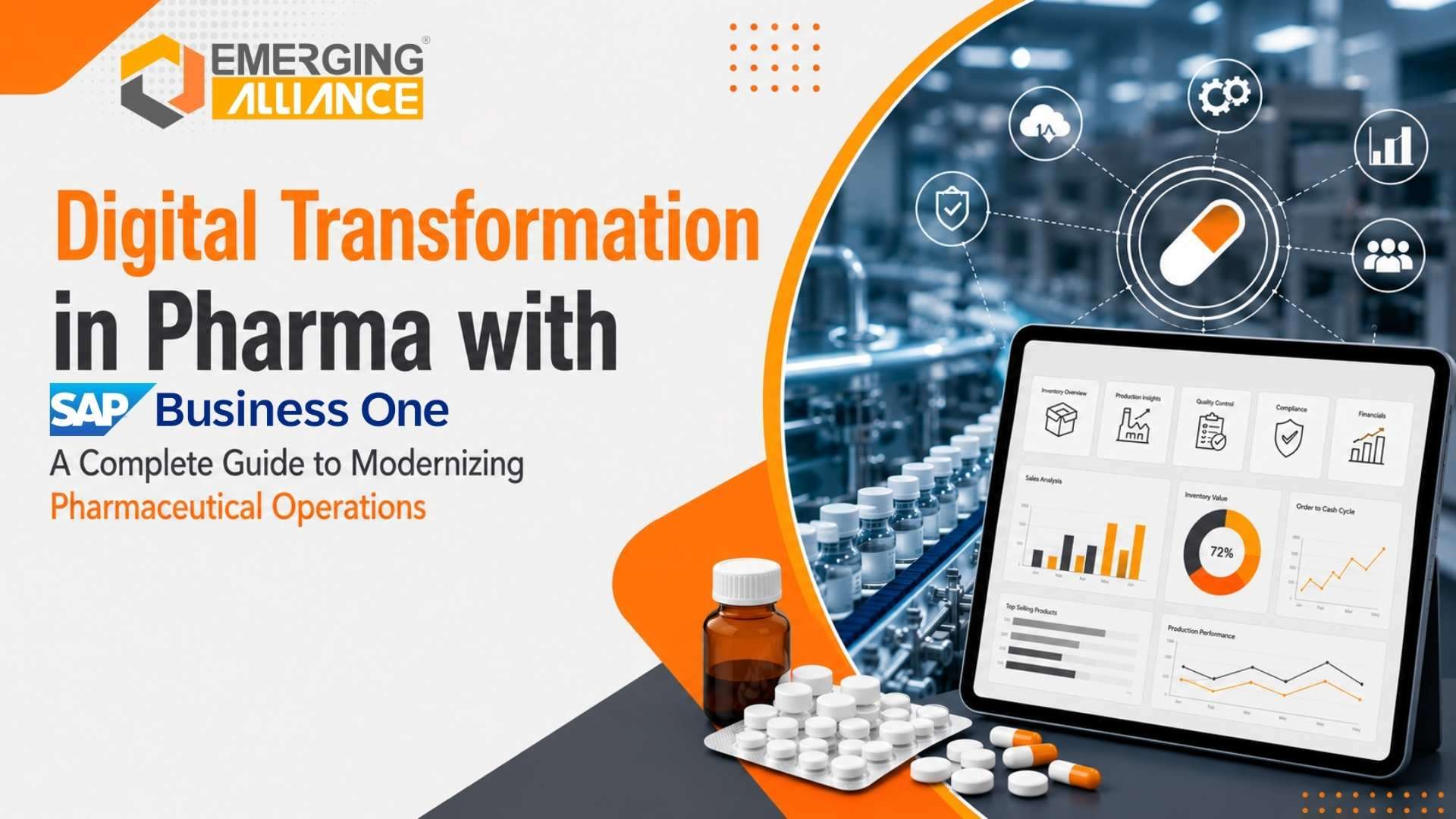
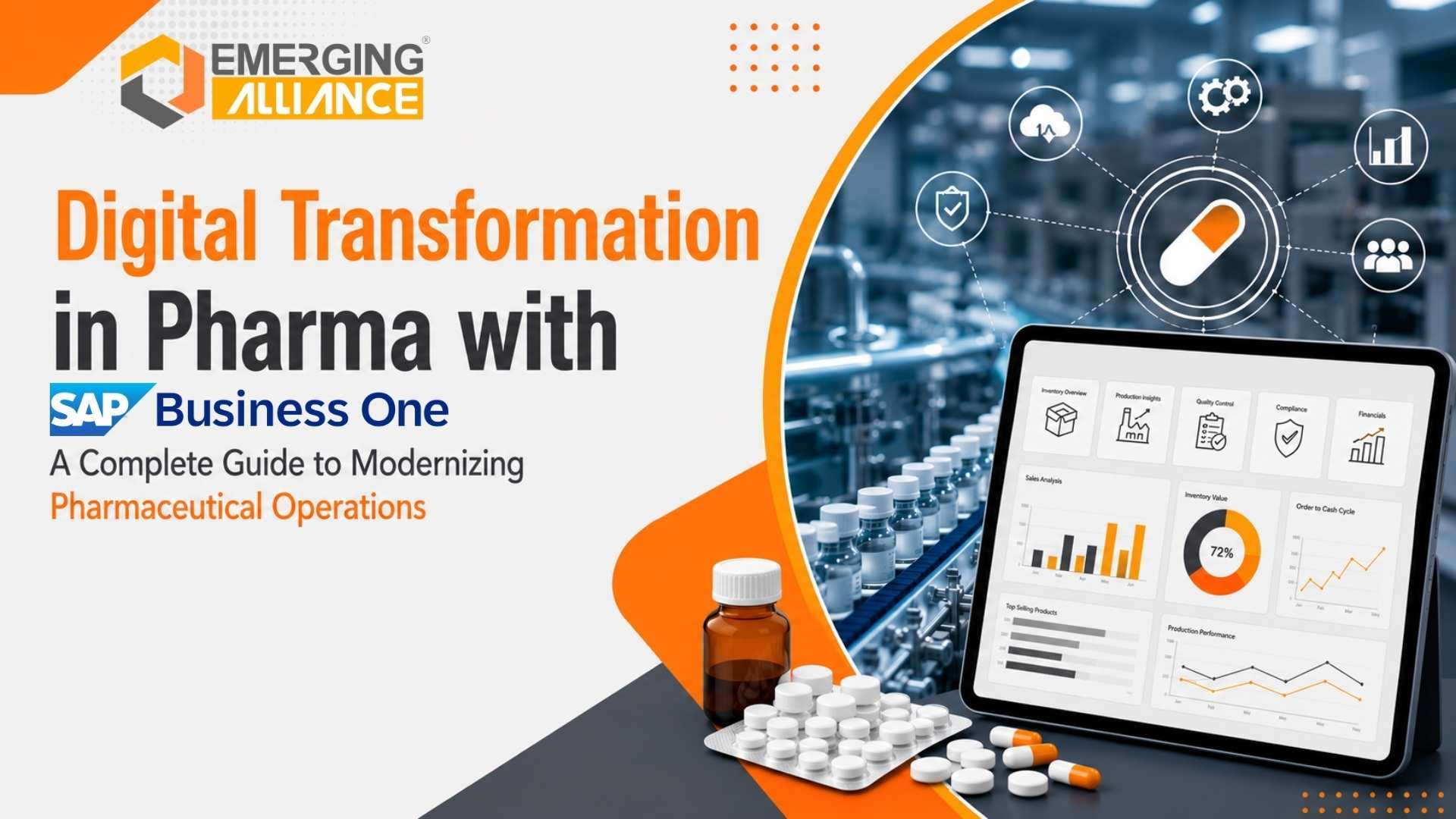
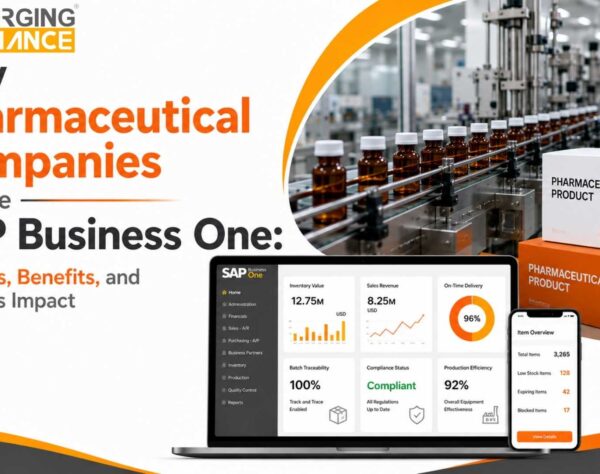
Digital Transformation in Pharma with SAP Business One: A Complete Guide to Modernizing Pharmaceutical Operations
Digital Transformation in Pharma with SAP Business One | Complete Guide
Digital Transformation in Pharma with SAP Business One: A Complete Guide to Modernizing Pharmaceutical Operations
Quick Answer
Digital transformation in pharma with SAP Business One enables pharmaceutical companies to replace manual processes with integrated, data-driven operations. By connecting manufacturing, inventory, compliance, procurement, sales, and finance into a single platform, SAP Business One improves visibility, automation, decision-making, and business agility while supporting regulatory requirements and long-term growth.
Digital transformation in the pharmaceutical industry involves using technology to modernize business processes, improve operational efficiency, enhance compliance, and support data-driven decision-making.
As pharmaceutical companies face increasing regulatory demands, competitive pressures, and customer expectations, traditional manual processes often become obstacles to growth.
SAP Business One helps pharmaceutical organizations accelerate digital transformation by integrating business functions into a single ERP platform that improves visibility, automation, collaboration, and operational control.
Key Industry Facts
Digital transformation is reshaping pharmaceutical operations worldwide.
Manual processes often limit scalability and operational efficiency.
Real-time data improves decision-making across departments.
Automation reduces human error and operational bottlenecks.
Integrated ERP systems improve business visibility.
Digital supply chains respond faster to market changes.
Regulatory compliance benefits from centralized data management.
Digital transformation supports business scalability.
Data-driven organizations outperform those relying on manual processes.
SAP Business One serves as a foundation for pharmaceutical digital transformation.
Strategic Transformation Blueprint
TOPIC
How SAP Business One enables digital transformation in pharmaceutical companies.
THE PROBLEM
Many pharmaceutical organizations continue to rely on disconnected systems, spreadsheets, and manual workflows that limit efficiency, visibility, and scalability.
CAUSES
Legacy business processes
Data silos
Manual record keeping
Limited reporting capabilities
Lack of system integration
Inefficient workflows
CHALLENGES
Operational inefficiencies
Slow decision-making
Compliance management
Inventory visibility
Supply chain complexity
Business scalability
THE IMPACT
Increased operating costs
Reduced productivity
Poor customer experience
Limited business agility
Compliance risks
Missed growth opportunities
THE SOLUTION
SAP Business One provides an integrated digital platform that centralizes business operations, automates workflows, and delivers real-time insights across pharmaceutical organizations.
EXPECTED OUTCOME
Improved operational efficiency
Better decision-making
Enhanced compliance management
Greater business agility
Increased productivity
Sustainable growth
Key Highlights
Accelerates pharmaceutical digital transformation initiatives.
Eliminates operational silos through ERP integration.
Improves visibility with real-time business data.
Automates manual workflows and processes.
Enhances compliance and reporting capabilities.
Creates a scalable foundation for future growth.
Understanding Digital Transformation in the Pharmaceutical Industry
Digital transformation is no longer optional for pharmaceutical companies seeking to remain competitive in a rapidly evolving marketplace.
Organizations must respond to:
Increasing regulatory requirements
Growing customer expectations
Supply chain complexity
Rising operational costs
Demand for real-time information
Digital transformation enables pharmaceutical businesses to modernize operations, improve collaboration, and make better decisions using accurate business data.
Why Traditional Processes Are No Longer Enough
Many pharmaceutical companies still depend on manual workflows and disconnected software applications.
Common limitations include:
Duplicate data entry
Limited visibility
Delayed reporting
Inconsistent information
Inefficient communication
These challenges hinder growth and reduce organizational agility.
As operations become more complex, digital solutions become essential for maintaining efficiency and compliance.
The Role of ERP in Pharmaceutical Digital Transformation
An ERP system serves as the digital backbone of a pharmaceutical organization.
Rather than managing multiple applications separately, ERP technology integrates business processes across departments.
SAP Business One connects:
Manufacturing
Inventory
Procurement
Warehousing
Distribution
Sales
Customer service
Finance
This integration creates a unified business environment that supports transformation initiatives.
How SAP Business One Drives Digital Transformation
Centralized Data Management
One of the biggest barriers to digital transformation is fragmented data.
SAP Business One creates a single source of truth by centralizing business information.
Benefits include:
Improved data accuracy
Better reporting
Reduced duplication
Faster decision-making
Business Process Automation
Automation reduces dependence on manual activities and repetitive tasks.
SAP Business One helps automate:
Purchase orders
Inventory updates
Financial transactions
Reporting processes
Approval workflows
Benefits include:
Increased efficiency
Reduced human error
Faster process execution
Improved productivity
Real-Time Business Visibility
Modern organizations require immediate access to business information.
SAP Business One provides visibility into:
Inventory levels
Production performance
Sales activity
Financial performance
Supply chain operations
Benefits include:
Faster decisions
Improved forecasting
Better risk management
Digital Collaboration Across Departments
Siloed departments often slow business performance.
SAP Business One improves collaboration by connecting teams through shared information and standardized processes.
Departments benefit from:
Improved communication
Better coordination
Faster issue resolution
Greater operational alignment
Digital Transformation in Pharmaceutical Manufacturing
Manufacturing remains a critical focus area for digital transformation.
SAP Business One supports:
Production planning
Material Requirements Planning (MRP)
Production monitoring
Resource allocation
Inventory synchronization
Benefits include:
Improved efficiency
Reduced downtime
Better resource utilization
Increased production visibility
Digital Inventory and Warehouse Management
Inventory visibility is essential for operational excellence.
SAP Business One enables:
Real-time stock tracking
Multi-warehouse management
Inventory forecasting
Batch traceability
Expiry monitoring
Benefits include:
Reduced inventory waste
Improved stock accuracy
Better customer service
Lower carrying costs
Digital Supply Chain Management
Modern pharmaceutical supply chains require agility and visibility.
SAP Business One supports:
Procurement management
Supplier collaboration
Inventory optimization
Distribution planning
Demand forecasting
Benefits include:
Faster response times
Improved supply chain resilience
Better service levels
Reduced operational risk
Compliance in a Digital Environment
Regulatory compliance remains a top priority during digital transformation initiatives.
SAP Business One supports compliance through:
Audit trails
Batch tracking
Documentation management
Process standardization
Reporting capabilities
Benefits include:
Improved audit readiness
Greater transparency
Reduced compliance risk
Business Intelligence and Data-Driven Decision Making
Digital transformation is driven by data.
SAP Business One provides access to business intelligence tools that help leaders analyze:
Sales performance
Operational trends
Inventory metrics
Financial results
Supply chain performance
Benefits include:
Better planning
Faster strategic decisions
Increased business agility
Process & Implementation Steps
Embarking on a digital transformation journey with SAP Business One involves a structured phase of activities to ensure alignment and return on investment:
Step 1.Assess current business processes and digital maturity.
Step 2.Identify operational inefficiencies and transformation goals.
Step 3.Define key performance indicators (KPIs).
Step 4.Implement SAP Business One modules.
Step 5.Integrate departments and workflows.
Step 6.Automate repetitive business processes.
Step 7.Train employees on digital tools and processes.
Step 8.Monitor results and continuously optimize operations.
Key Benefits of ERP Modernization
Improved operational visibility.
Enhanced business agility.
Faster decision-making.
Reduced manual effort.
Better compliance management.
Improved employee productivity.
Greater process consistency.
Enhanced customer experience.
Stronger scalability.
Future-ready business operations.
Real-World Use Cases
Use Case 1: Pharmaceutical Manufacturer
Business Challenge
Manual production planning processes caused delays and inefficiencies.
Solution Implemented
SAP Business One integrated production planning and inventory management.
Outcome Achieved
Improved production visibility and reduced scheduling conflicts.
Use Case 2: Pharmaceutical Distributor
Business Challenge
Limited visibility across inventory and warehouse operations.
Solution Implemented
Real-time inventory management and centralized reporting.
Outcome Achieved
Improved fulfillment performance and inventory accuracy.
Use Case 3: Growing Pharmaceutical SME
Business Challenge
Disconnected systems limited scalability.
Solution Implemented
Company-wide ERP deployment using SAP Business One.
Outcome Achieved
Standardized operations and improved business agility.
Case Study: Scaled Operations & Visibility
Company Background
A growing pharmaceutical company operating across manufacturing and distribution channels struggled with fragmented systems and manual reporting processes.
Business Problem
Operational inefficiencies and limited visibility made it difficult to scale operations effectively.
Challenges
Data silos, Manual workflows, Slow reporting, Inventory inaccuracies, Limited collaboration
Solution & Approach
Implemented SAP Business One as a centralized ERP platform. Approach: Integrated departments, Automated workflows, Established real-time reporting, Standardized business processes.
Lessons Learned
Digital transformation requires process standardization.
Data visibility improves organizational performance.
Faster response times. Improved service reliability.
Scalability Benefits
Supports future growth and expansion.
Implementation Guidelines
Best Practices
Establish clear digital transformation goals.
Standardize business processes before automation.
Prioritize data quality.
Invest in employee training.
Track KPIs consistently.
Continuously optimize workflows.
Common Mistakes to Avoid
Treating ERP implementation as only a technology project.
Ignoring process improvement opportunities.
Neglecting user adoption and training.
Failing to define measurable objectives.
Maintaining unnecessary manual processes.
Overlooking change management.
Key Takeaways
Digital transformation is becoming essential for pharmaceutical success.
ERP systems serve as the foundation for modernization initiatives.
SAP Business One integrates operations into a single platform.
Automation improves productivity and reduces errors.
Real-time visibility enables better business decisions.
Compliance management benefits from digital processes.
Digital transformation supports long-term business growth.
Conclusion
Digital transformation is reshaping the pharmaceutical industry by enabling organizations to operate more efficiently, make better decisions, and respond faster to market demands. Companies that continue relying on disconnected systems and manual processes may struggle to remain competitive in an increasingly digital environment.
SAP Business One provides the foundation for successful pharmaceutical digital transformation by integrating business operations, automating workflows, improving visibility, and supporting compliance. As pharmaceutical companies continue their modernization journeys, SAP Business One helps create a scalable and future-ready business environment.
Frequently Asked Questions
What is digital transformation in the pharmaceutical industry?
+
Digital transformation involves using technology to modernize business processes, improve efficiency, and support data-driven decision-making.
How does SAP Business One support digital transformation?
+
It centralizes operations, automates workflows, improves visibility, and integrates business processes.
Why is digital transformation important for pharmaceutical companies?
+
It helps improve efficiency, compliance, scalability, and competitiveness.
Can SAP Business One automate pharmaceutical business processes?
+
Yes. It automates many operational, inventory, procurement, and financial processes.
How does SAP Business One improve decision-making?
+
It provides real-time data, analytics, and reporting capabilities.
Is SAP Business One suitable for growing pharmaceutical businesses?
+
Yes. It is designed to support small and mid-sized organizations as they scale.
Does digital transformation help with compliance?
+
Yes. Digital systems improve documentation, traceability, and audit readiness.
What are the biggest benefits of digital transformation in pharma?
+
Improved efficiency, visibility, compliance, customer service, and business agility.
Ready to accelerate digital transformation in your pharmaceutical business?
Discover how SAP Business One can help streamline operations, automate workflows, improve compliance, and provide the real-time visibility needed to drive sustainable growth and innovation.
Emerging Alliance - SAP Business One with AI for Pharma
Please fill in the below details, to download Free Guide
Please fill in the below details, to download Free Guide
Please fill in the below details, to download Free Guide
Please fill in the below details, to download the whitepaper
This article delves into the various cost components of an Enterprise Resource Planning (ERP) project and provides tips and advice on accurately creating a budget for your program.
Evaluating and choosing SAP Business One solutions can be challenging with the numerous implementation partners available. This guide offers best practices and key criteria for selecting the right SAP Business One partner.
Create a comprehensive list of SAP Business One requirements for your company using our SAP requirements checklist, perfect for request for proposal (RFP) or request for information (RFI).
Learn how to compare SAP systems & vendors with our ERP selection criteria checklist. The ERP selection criteria checklist is a prebuilt template that allows you to score and rank ERP software against industry best practice standards.