
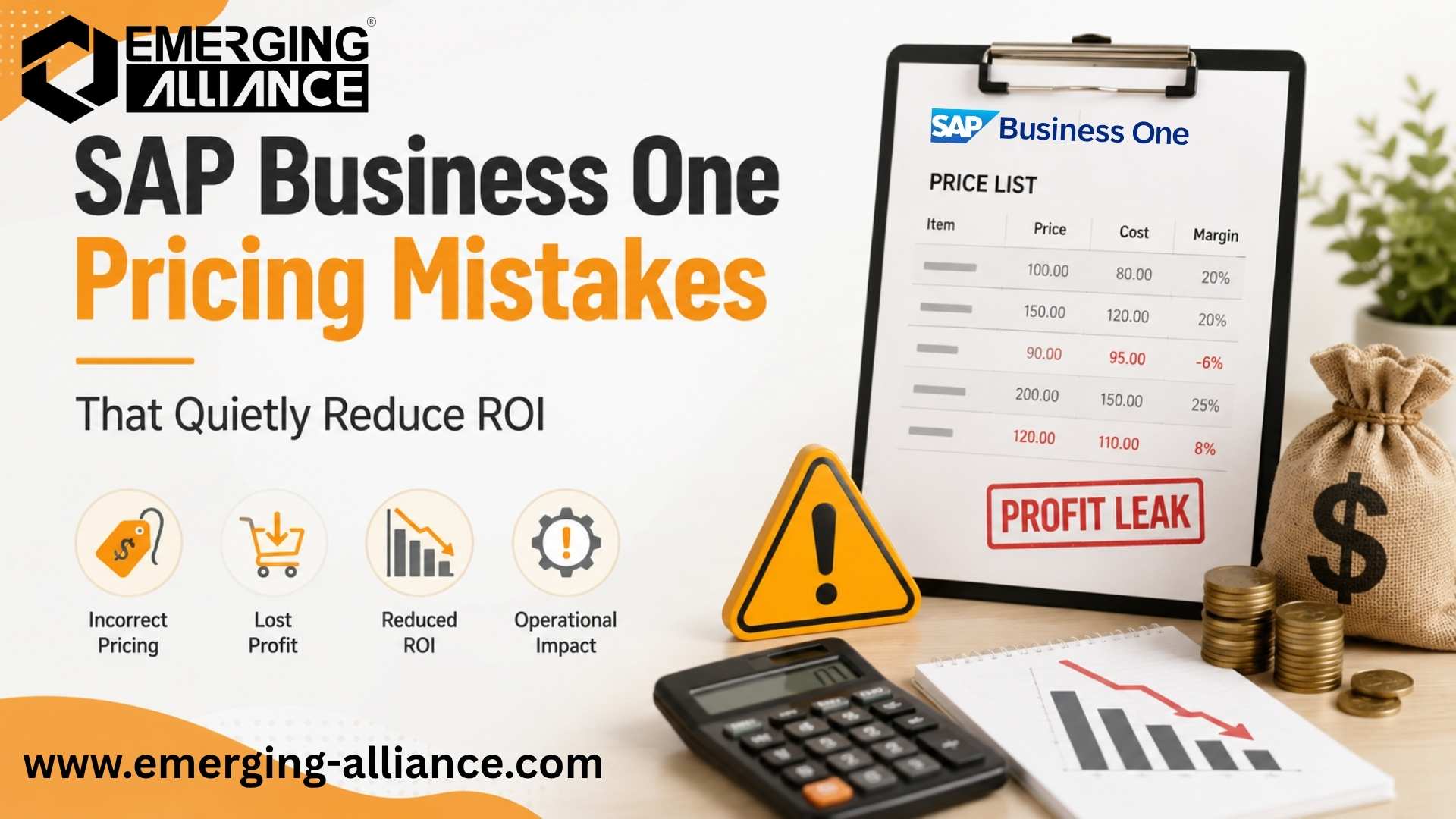
SAP Business One Pricing Mistakes That Quietly Reduce ROI
SAP Business One Pricing Mistakes Every Business Should Avoid
Organizations considering SAP Business One Pricing often focus only on software quotations. They compare license costs, implementation charges, and vendor proposals without examining the long-term business impact.
What initially appears to be a low-cost ERP project can gradually become expensive due to:
- Unused licenses
- Incorrect user classifications
- Excessive customization
- Hidden maintenance costs
- Scalability limitations
- Workflow inefficiencies
- Additional support expenses
ERP failures rarely happen because of technology. They often occur because businesses make pricing decisions based only on initial costs rather than long-term business outcomes.
For CEOs, CIOs, CFOs, and Operations Leaders, the critical question is not:
“What is the SAP software price?”
The real question is:
“Will this investment generate measurable ROI over the next five years?”
SAP Business One Pricing and Total Cost of Ownership
Many organizations evaluate SAP Business One Price in India purely from a licensing perspective.
Typical comparisons include:
- SAP software license cost
- SAP license cost per user in India
- SAP B1 Price in India
- SAP Business One Price List
- SAP Business One Estimate
- Implementation budget
However, software acquisition is only one component of ERP ownership.
Total ownership costs include:
- Software licenses
- SAP B1 implementation
- Infrastructure
- User training
- Support services
- Maintenance expenses
- Upgrades
- Business process optimization
Organizations that consider only initial licensing often experience cost overruns after go-live.
SAP B1 License Cost in India and User Classification Errors
Incorrect licensing is one of the most common reasons ERP budgets increase unexpectedly.
Many companies purchase:
- More users than required
- Higher license categories than necessary
- Duplicate licenses
- Licenses for inactive users
These mistakes increase recurring ERP expenses without improving productivity.
SAP License Cost Per User in India and Usage Alignment
A manufacturing company with 120 users may discover that:
- 20 users require professional access.
- 60 users need limited functionality.
- 40 users only need approval access.
When user roles are aligned correctly, organizations avoid unnecessary software expenditure while maintaining operational efficiency.
Effective licensing optimization can significantly improve ROI over the lifecycle of the ERP system.
SAP Business One Implementation and Hidden Project Costs
Low software prices often hide expensive implementation challenges.
Organizations frequently underestimate:
- Data migration complexity
- Process redesign requirements
- Reporting requirements
- Integration efforts
- User training
- Change management
These areas create project delays and additional expenses.
SAP B1 Consultancy and Business Process Alignment
ERP implementation should not focus solely on technical deployment.
Successful projects require:
- Process mapping
- Workflow optimization
- Inventory controls
- Financial governance
- Reporting structures
- Operational automation
Strong SAP B1 consultancy helps businesses avoid expensive rework after go-live.
SAP Business One Module Selection and Over-Customization
Many companies purchase modules they never fully utilize.
Others rely heavily on customization instead of adopting standard best practices.
Excessive customization creates:
- Upgrade challenges
- Higher maintenance costs
- Increased dependency on developers
- Longer project timelines
- Greater operational complexity
SAP Business One Module Optimization
Organizations should prioritize modules that directly support:
- Finance
- Procurement
- Inventory management
- Production
- Sales
- CRM
- Reporting
Standard functionality often delivers faster ROI with lower ownership costs.
SAP Business One Supports and Long-Term Maintenance Costs
Support quality directly affects ERP performance and business continuity.
Many companies underestimate:
- Annual support expenses
- Upgrade requirements
- Performance monitoring
- User assistance
- Regulatory changes
Poor support can create:
- Downtime
- Reporting delays
- Compliance risks
- Workflow bottlenecks
- Reduced productivity
SAP Business One Maintenance Costs in India
Long-term support planning should include:
- Preventive maintenance
- Version upgrades
- User training
- Performance optimization
- Database health checks
Reliable support protects ERP investments and ensures operational stability.
SAP B1 Cost for Small Business, Medium-Sized Business, and Large Enterprise
ERP requirements vary according to organizational scale.
SAP B1 Cost for a Small Business
Growing businesses require:
- Standard processes
- Lower complexity
- Faster implementation
- Controlled budgets
The focus should be scalability rather than the lowest price.
SAP B1 Cost for a Medium-Sized Business
Mid-market organizations often need:
- Multiple warehouses
- Production planning
- CRM integration
- Advanced reporting
Their pricing model must support future growth.
SAP B1 Cost for a Large Enterprise
Larger organizations require:
- Multi-location operations
- Compliance frameworks
- Workflow automation
- Real-time visibility
Selecting ERP based only on software cost can create limitations during expansion.
SAP Business One Cost Calculator and ROI Evaluation
Smart ERP investments are measured through business outcomes rather than software expenses.
A strategic SAP Business One Cost Calculator should evaluate:
Revenue Impact
- Faster order processing
- Better customer responsiveness
- Reduced revenue leakage
Operational Efficiency
- Automated workflows
- Lower manual effort
- Improved productivity
Inventory Optimization
- Reduced excess stock
- Better demand planning
- Higher inventory accuracy
Financial Visibility
- Real-time reporting
- Faster closing cycles
- Better decision-making
Scalability
- Support for growth
- Multi-entity expansion
- Business continuity
The objective is not minimizing ERP cost.
The objective is maximizing ERP value.
SAP Business One Pricing and Long-Term ROI Strategy
The most successful ERP projects are driven by business objectives rather than software quotations.
Organizations that focus only on SAP software price in India often encounter:
- Operational inefficiencies
- Poor user adoption
- Higher support costs
- Revenue leakage
- Compliance risks
- Limited scalability
Businesses that approach ERP strategically gain:
- Process automation
- Real-time visibility
- Faster decisions
- Improved productivity
- Sustainable growth
- Stronger ROI
ERP should be viewed as a business transformation initiative—not simply a software purchase.
Emerging Alliance Advantages Beyond ERP Implementation
Choosing the right partner is as important as selecting the right ERP platform.
Emerging Alliance helps organizations:
- Optimize SAP Business One Pricing strategies
- Align licenses with actual business needs
- Design scalable architectures
- Eliminate workflow bottlenecks
- Improve operational visibility
- Support long-term digital transformation
Rather than acting only as a software implementation company, Emerging Alliance works as a strategic enterprise transformation partner focused on measurable business outcomes.
Frequently Asked Questions
1. What is included in SAP Business One Price in India?
SAP Business One pricing typically includes software licenses, implementation services, user training, support, and annual maintenance costs.
2. How does SAP B1 cost for a small business differ from larger organizations?
Small businesses usually require fewer users and standard modules, while larger organizations often need additional functionality, integrations, and automation.
3. What factors influence SAP software license cost?
License types, number of users, required modules, deployment options, and implementation complexity affect overall software costs.
4. How can SAP Business One implementation costs be controlled?
Proper planning, process standardization, and experienced SAP B1 consultancy services help prevent project overruns.
5. What are SAP Business One’s maintenance costs in India?
Maintenance expenses generally include support services, upgrades, monitoring, and performance optimization activities.
6. How does a SAP Business One Cost Calculator help decision-makers?
It evaluates licensing, implementation, support, and operational benefits to estimate long-term ROI.
7. Is SAP B1 Pricing suitable for medium-sized businesses?
Yes. SAP Business One is designed for growing businesses requiring integrated operations and scalability.
8. Which SAP Business One Module should organizations prioritize?
Finance, inventory, procurement, sales, and reporting modules are typically the first priorities for most organizations.
9. Why do businesses experience hidden SAP Business One Costs?
Poor planning, unnecessary customization, and incorrect licensing often create additional expenses after deployment.
10. Why is SAP B1 consultancy important for maximizing ROI?
Experienced consultants help align technology with business objectives, improving productivity and reducing operational risks.
Contact Emerging Alliance today and optimize your SAP Business One investment for sustainable growth