
Expiry Risk Is Quietly Destroying Pharma Margins SAP B1 for Pharma Fixes It
SAP B1 for Pharma Industry Gives CIOs Real-Time Control Over Expiry, Compliance, and Margin Leakage
SAP B1 For pharma manufacturers, profitability is no longer determined only by production volume or market demand. The real threat to margins is operational invisibility.
Expired inventory.
Slow-moving batches.
Compliance delays.
Uncontrolled write-offs.
Disconnected warehouse data.
These issues rarely appear as a single crisis. Instead, they silently accumulate across procurement, production, warehousing, and distribution until margins begin collapsing.
Most pharmaceutical companies do not lose profitability because demand disappears.
They lose profitability because their ERP architecture cannot control expiry-sensitive operations in real time.
This is where SAP B1 for Pharma Industry becomes strategically important.
A properly implemented SAP Business One Pharma Solution gives pharmaceutical businesses batch-level intelligence, expiry-driven inventory control, integrated compliance workflows, and real-time operational visibility — enabling leadership teams to shift from reactive firefighting to predictive control.
For CIOs, CTOs, and Operations Heads, this is not simply an ERP upgrade.
It is a margin protection strategy.
Why Expiry Risk Is Becoming a Board-Level Problem in Pharma
Expiry management is no longer a warehouse issue.
It directly impacts:
- Gross margins
- Working capital
- Regulatory exposure
- Distributor relationships
- Forecasting accuracy
- Revenue predictability
The challenge becomes even more severe when organizations operate with:
- Multiple warehouses
- High SKU complexity
- Region-wise compliance requirements
- Batch-sensitive products
- Manual inventory reconciliation
- Delayed reporting cycles
Without a centralized ERP backbone, leadership loses visibility into what inventory is aging, where margin leakage is happening, and which operational inefficiencies are causing avoidable losses.
This is precisely why modern pharmaceutical enterprises are adopting SAP B1 ERP for Pharmaceutical Companies to regain operational governance.
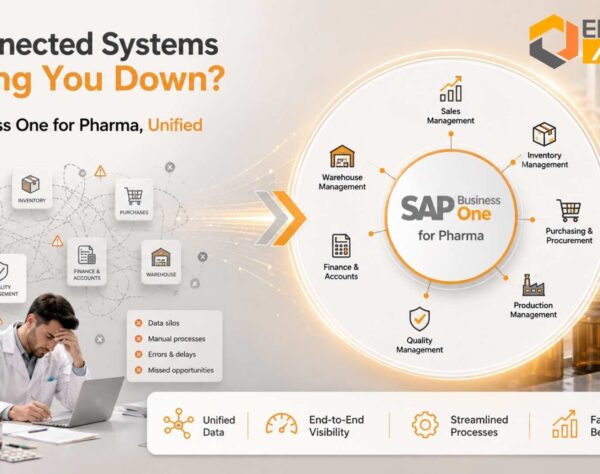
SAP Business One Pharma Solution Eliminates Hidden Inventory Blind Spots
Most pharma companies already collect operational data.
The problem is that the data is fragmented across departments.
Procurement sees one number.
Warehouse teams see another.
Production planning works from assumptions.
Finance receives delayed reporting.
This fragmentation creates dangerous decision latency.
With SAP Business One Pharma Software, inventory management becomes intelligent and synchronized across the organization.
Key capabilities include:
- Real-time batch tracking
- Expiry-date visibility
- FEFO inventory movement
- Batch-wise warehouse visibility
- Automated alerts for aging stock
- Inventory synchronization across locations
Using SAP B1 Batch Tracking, businesses can identify inventory risks before products expire, enabling proactive stock movement and controlled production planning.
Instead of reacting after losses occur, leadership gains predictive operational control.
SAP B1 Inventory Management Pharma Improves Working Capital Efficiency
In pharma, inventory is not static stock.
It is time-sensitive working capital.
When inventory sits too long, businesses face:
- Expired stock write-offs
- Overstocking costs
- Cash flow pressure
- Distribution inefficiencies
- Regulatory disposal costs
This is where SAP B1 Inventory Management Pharma creates measurable financial impact.
The system enables:
- Expiry-prioritized dispatch planning
- Slow-moving inventory analysis
- Batch-level stock aging visibility
- Intelligent replenishment planning
- Demand-linked inventory optimization
With real-time inventory intelligence, businesses reduce unnecessary stock accumulation while improving product availability across the supply chain.
For CFOs and operations leaders, this directly improves inventory turns and protects profitability.
SAP B1 Production Planning Pharma Reduces Overproduction Risk
One of the biggest causes of expiry loss is production misalignment.
Many pharmaceutical manufacturers continue production based on historical assumptions rather than live demand signals.
The result:
- Excess finished goods
- Unbalanced batch production
- Inventory aging
- Forecast distortion
- Margin erosion
Through SAP B1 Production Planning Pharma, organizations can align manufacturing with real-time operational demand.
Capabilities include:
- Demand-driven production planning
- Shelf-life-aware batch sizing
- Production scheduling optimization
- Integrated quality checkpoints
- Real-time raw material tracking
This enables manufacturers to move from volume-focused production toward precision manufacturing.
For modern pharma businesses, this transition is essential for scalable profitability.
SAP B1 Quality Management Pharma Strengthens Compliance Readiness
Regulatory pressure in pharma continues to increase globally.
Compliance failures now impact:
- Product release timelines
- Customer trust
- Market approvals
- Audit exposure
- Financial performance
Traditional disconnected systems make compliance reactive and documentation-heavy.
With SAP B1 Quality Management Pharma, quality processes become embedded directly within operations.
The platform supports:
- Automated validation workflows
- Batch-level audit trails
- Quality inspection checkpoints
- Controlled documentation management
- Compliance-ready reporting
For organizations undergoing SAP B1 Pharma Validation, system integrity and traceability become significantly easier to maintain.
Instead of treating compliance as a separate process, SAP Business One integrates compliance into operational execution itself.
SAP B1 Supply Chain Pharma Creates Real-Time Distribution Visibility
Pharma supply chains are increasingly complex.
Businesses must manage:
- Multiple distributors
- Regional warehousing
- Temperature-sensitive products
- Time-sensitive dispatch
- Compliance-driven logistics
Without integrated visibility, distribution inefficiencies rapidly increase expiry exposure.
With SAP B1 Supply Chain Pharma, organizations gain:
- Real-time stock movement tracking
- Batch-wise dispatch visibility
- Integrated warehouse coordination
- Demand-linked distribution planning
- Faster inventory decision-making
This creates a synchronized supply chain environment where decisions are based on live operational intelligence rather than delayed spreadsheets.
SAP B1 Pharma Integration Connects the Entire Pharma Ecosystem
Modern pharmaceutical businesses operate across multiple systems:
- LIMS
- CRM platforms
- Distributor systems
- Procurement applications
- Financial tools
- Third-party manufacturing systems
Disconnected applications create reporting inconsistencies and operational delays.
With SAP B1 Pharma Integration and SAP B1 Pharma API Integration, organizations can unify their technology ecosystem into a centralized operational framework.
Benefits include:
- Real-time data synchronization
- Reduced manual reconciliation
- Faster reporting cycles
- Unified operational visibility
- Better executive decision-making
For organizations adopting cloud-enabled operations, this architecture becomes critical for scalability.
SAP B1 Pharma Implementation in India Requires Industry Expertise
ERP implementation success in pharma depends heavily on industry-specific execution.
A generic ERP deployment approach often fails because pharmaceutical operations involve:
- Regulatory complexity
- Batch-sensitive inventory
- Validation requirements
- Multi-level approval structures
- Traceability obligations
A successful SAP B1 Pharma Implementation requires:
- Pharma-specific workflow design
- Compliance-focused architecture
- Accurate data migration
- Operational change management
- Scalable reporting frameworks
This is why selecting the right SAP B1 Pharma Partner matters.
As an experienced SAP Business One Partner, Emerging Alliance focuses on designing ERP systems that align directly with pharma business outcomes — not just software deployment.
SAP B1 Pharma Cost Should Be Evaluated Against Margin Recovery
Many organizations evaluate ERP investments only through licensing costs.
That approach is incomplete.
The true business evaluation should include:
- Expiry loss reduction
- Improved batch utilization
- Lower compliance risk
- Faster operational decisions
- Reduced manual dependency
- Improved inventory efficiency
When measured against these operational improvements, SAP B1 Pharma Software delivers long-term financial ROI.
For many pharmaceutical businesses, even a small reduction in expiry losses can offset ERP investment significantly within predictable timelines.
What CIOs Should Evaluate During a SAP Business One Pharma Demo
A pharma ERP demo should validate operational capability — not just user interface quality.
Decision-makers should evaluate whether the platform can handle:
- Batch-level traceability
- Real-time expiry monitoring
- Compliance workflow automation
- Multi-location inventory visibility
- API integration flexibility
- Predictive reporting capabilities
A strong SAP Business One Pharma Demo should demonstrate how the system improves operational control under real-world pharmaceutical complexity.
Why Real-Time Reporting Is Becoming Essential for Pharma Leadership
Delayed visibility creates delayed action.
In pharmaceutical manufacturing, delay directly increases:
- Expiry exposure
- Inventory holding cost
- Compliance risk
- Revenue leakage
With Pharma Real-Time Reporting, leadership teams gain live operational visibility across the enterprise.
This includes:
- Inventory aging dashboards
- Batch expiry alerts
- Production performance insights
- Compliance monitoring
- Warehouse movement visibility
Executives can identify operational risks before they escalate into financial losses.
That is the real strategic value of intelligent ERP architecture.
Why Emerging Alliance Is Positioned as a Strategic SAP B1 Pharma Partner
ERP success in pharma depends less on software selection and more on implementation strategy.
Emerging Alliance approaches SAP B1 Pharma Implementation as a business transformation initiative focused on:
- Reducing expiry-driven margin loss
- Improving operational visibility
- Strengthening compliance readiness
- Optimizing inventory utilization
- Enabling scalable pharma growth
The objective is not simply to deploy ERP software.
The objective is to build a predictive operational system capable of supporting long-term profitability.
Expiry Losses Are Not an Inventory Problem — They’re an ERP Visibility Problem
If your pharmaceutical business is struggling with:
- Expired inventory
- Batch visibility gaps
- Compliance inefficiencies
- Slow reporting cycles
- Inventory write-offs
- Production misalignment
Then the issue is not operational alone.
It is architectural.
The real question is:
Can your current ERP environment provide real-time batch intelligence, expiry-driven inventory control, and compliance automation at scale?
If not, it may be time to evaluate a pharma-focused ERP transformation strategy with SAP Business One Pharma.
FAQs for SAP Business One for pharma
1. How does SAP Business One for pharmaceutical industry reduce expiry losses?
It enables batch-level tracking, FEFO inventory movement, real-time expiry monitoring, and predictive inventory planning to minimize expired stock.
2. Why is SAP B1 for Pharma better than generic ERP systems?
It is designed for batch traceability, compliance workflows, shelf-life management, and pharma-specific operational complexity.
3. Can SAP B1 Pharma Software support multi-location pharmaceutical operations?
Yes. It provides centralized visibility across warehouses, manufacturing plants, and distribution networks.
4. What is SAP B1 Batch Tracking in pharma?
It tracks each pharmaceutical batch throughout procurement, production, warehousing, and distribution for complete traceability.
5. How does SAP B1 Quality Management Pharma improve compliance?
It embeds quality validation checkpoints, audit trails, and documentation workflows directly into operational processes.
6. Can SAP B1 Pharma Integration connect with LIMS and CRM systems?
Yes. Through APIs and integration frameworks, SAP Business One can synchronize with external pharma applications.
7. What industries benefit most from SAP B1 Pharma Solution?
Pharmaceutical manufacturing, nutraceuticals, medical distribution, life sciences, and batch-sensitive manufacturing businesses.
8. What should companies evaluate during a SAP Business One Pharma Demo?
Focus on expiry tracking, batch traceability, real-time dashboards, compliance workflows, and integration flexibility.
9. Is SAP B1 Pharma Implementation suitable for growing pharma companies in India?
Yes. It is scalable and supports operational growth while maintaining compliance and inventory control.
10. How does SAP B1 ERP for Pharmaceutical Companies improve ROI?
It reduces expiry losses, improves inventory efficiency, strengthens compliance, and enhances operational decision-making.
Fill out the form to connect with our experts now