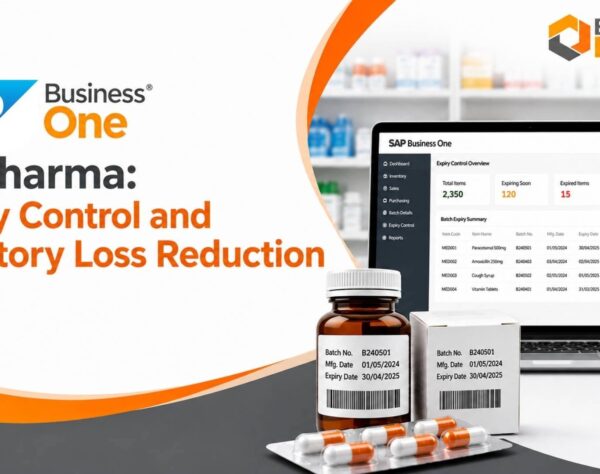
Expired Pharma Inventory Is Draining Profits SAP Business One Fixes It

How SAP Business One for pharma automates expiry tracking and protects margins from inventory losses
For pharmaceutical companies, inventory is not just stock on shelves, it represents regulated products with strict shelf-life, temperature control, and compliance requirements. Yet many organizations continue to manage inventory using fragmented systems, spreadsheets, or manual processes. The result is predictable: expired drugs, unnecessary write-offs, and disrupted supply chains. Even a small lapse in monitoring expiry dates, batch movement, or warehouse conditions can lead to millions in inventory losses over time. For modern pharma businesses operating in a highly regulated and competitive environment, these operational gaps directly impact profitability, compliance readiness, and working capital efficiency. This is where SAP Business One for pharma provides a strategic advantage. By automating expiry tracking, batch management, and inventory visibility, it enables pharmaceutical enterprises to transform inventory control into a data-driven operational capability.
Why Expired Inventory Happens in Pharma Operations
Despite heavy regulatory oversight, many pharmaceutical manufacturers and distributors still struggle with inventory management due to operational limitations.
Several systemic gaps contribute to the problem.
Fragmented Inventory Visibility
Pharmaceutical companies often operate across multiple warehouses, distribution centers, and third-party logistics partners. Without a unified system, decision-makers lack real-time visibility into stock availability, batch details, and expiry timelines.
Manual Tracking and Human Error
Many organizations still rely on spreadsheets or disconnected systems to track batch numbers and expiry dates. Manual processes increase the risk of data entry mistakes, delayed updates, and inaccurate reporting.
Inefficient Stock Rotation
Pharma inventory must follow FEFO (First Expiry First Out) principles. However, when warehouse systems cannot automatically prioritize expiring batches, older inventory often remains unused while newer stock is shipped first.
Lack of Automated Alerts
Without proactive notifications, teams only discover expiry issues after it is too late. This reactive approach leads to avoidable inventory write-offs and operational disruptions.
These challenges highlight why pharmaceutical companies increasingly adopt pharma-specific ERP software such as SAP Business One ERP for Pharmaceutical Industry.
The Real Business Impact of Expired Pharma Inventory
Inventory losses are only one part of the problem. The downstream effects extend across multiple business functions.
Direct Financial Losses
Expired stock leads to immediate write-offs that reduce profitability. For companies managing thousands of SKUs, the cumulative losses can become substantial.
Regulatory and Compliance Risk
Pharmaceutical companies must maintain strict traceability for every batch. Inadequate tracking systems increase the risk of audit issues, regulatory penalties, and product recalls.
Supply Chain Inefficiency
Poor inventory visibility leads to unnecessary purchases, excess safety stock, and distribution delays.
Working Capital Lock-Up
When inventory is poorly managed, valuable capital remains tied up in slow-moving or obsolete products.
For executive leadership teams, solving these challenges is not just an operational improvement, it is a strategic business priority.
Why SAP Business One Is Built for Pharmaceutical Inventory Control
Modern pharmaceutical businesses require pharma-specific ERP software capable of managing batch tracking, expiry monitoring, compliance reporting, and supply chain coordination.
SAP Business One for the pharmaceutical industry addresses these challenges through an integrated ERP platform designed for growing and mid-market pharmaceutical organizations.
Unlike fragmented systems, SAP Business One ERP for the pharma industry connects inventory, finance, production, procurement, and distribution in a unified environment. This enables leadership teams to make faster, data-driven decisions while ensuring regulatory compliance.
Working with an experienced SAP Business One Partner and SAP B1 Pharma Consultant, organizations can configure the platform to align with pharmaceutical operational requirements, including batch traceability, quality management, and cold-chain monitoring.
How SAP Business One Eliminates Expiry and Shelf-Life Risks
Batch and Expiry Date Traceability
SAP B1 Batch Management Pharma enables every pharmaceutical product to be tracked through its entire lifecycle.
Each batch record includes:
- Manufacturing date
- Expiry date
- Supplier and production details
- Quality inspection records
- Distribution tracking
This level of traceability allows companies to quickly identify affected batches during audits or recalls.
Real-Time Inventory Visibility
With SAP B1 Inventory Management Pharma, decision-makers gain real-time visibility across all warehouses and distribution channels.
Executives can instantly view:
- Stock levels by batch
- Expiry timelines
- Location-based inventory availability
- Movement history of pharmaceutical products
This visibility enables faster operational decisions and prevents excess or obsolete inventory accumulation.
Automated Expiry Alerts and Notifications
SAP Business One Pharma Software provides configurable alerts that notify teams when inventory approaches its expiry threshold.
For example:
- Products nearing expiry within 90 days
- Batches requiring urgent dispatch
- Overstock of slow-moving inventory
These alerts enable proactive action before products become unusable.
FEFO-Based Inventory Management
Pharmaceutical supply chains must prioritize First Expiry First Out (FEFO) stock rotation.
With SAP B1 ERP solutions for pharma, warehouse operations can automatically allocate the earliest expiring batch during order fulfillment. This ensures compliance while minimizing the risk of expired inventory.
Advanced Reporting and Analytics
Through integrated dashboards and reporting tools, SAP Pharma ERP systems provide leadership with actionable insights.
Executives can monitor:
- Inventory aging analysis
- Expiry risk forecasting
- Batch movement trends
- Warehouse performance
This analytical visibility transforms inventory management from reactive firefighting into proactive strategy.
Strategic Business Benefits for Pharmaceutical Enterprises
Implementing SAP Business One ERP for Pharmaceutical Industry delivers measurable operational and financial benefits.
Reduced Expired Inventory Losses
Automated tracking and FEFO management significantly lower the risk of unsellable stock.
Improved Regulatory Compliance
Batch traceability and audit-ready reporting simplify regulatory inspections.
Optimized Working Capital
Better inventory visibility prevents overstocking and frees up capital for growth initiatives.
Operational Efficiency
Automation reduces manual effort, allowing teams to focus on higher-value activities.
Scalable Infrastructure for Growth
As pharmaceutical companies expand across markets and product lines, SAP ERP solutions scale seamlessly to support increased operational complexity.
Why Choosing the Right SAP B1 Pharma Partner Matters
Successful ERP transformation in pharmaceutical organizations requires more than software deployment.
A specialized SAP B1 Pharma Partner provides:
- Industry-specific ERP configuration
- Batch and expiry management setup
- Supply chain optimization consulting
- Integration with distribution and production systems
The right implementation partner ensures that SAP Business One Pharma Software aligns with regulatory requirements and operational workflows, enabling organizations to maximize ROI.
Request an SAP Business One Pharma demo today and discover how an intelligent ERP system can protect margins and streamline pharmaceutical supply chains.
FAQs About SAP Business One for Pharma
1. How does SAP Business One improve inventory control in pharmaceutical companies?
SAP Business One improves pharmaceutical inventory control by providing real-time visibility into batch numbers, expiry dates, stock levels, and warehouse locations. It enables automated FEFO stock rotation, proactive expiry alerts, and centralized reporting so pharmaceutical companies can reduce waste, improve compliance, and optimize working capital.
2. How does SAP Business One help prevent expired inventory?
SAP Business One tracks batch numbers and expiry dates in real time and provides automated alerts so teams can act before products expire.
3. Is SAP Business One suitable for pharmaceutical distributors?
Yes. SAP Business One ERP for pharmaceutical companies supports distribution operations, warehouse management, and supply chain coordination.
4. Does SAP Business One support batch tracking?
Yes. SAP B1 Batch Tracking allows complete traceability of pharmaceutical products from production to delivery.
5. Can SAP Business One support FEFO inventory management?
Yes. SAP Business One enables First Expiry First Out stock allocation to ensure older batches are dispatched first.
6. Is SAP Business One compliant with pharmaceutical regulations?
SAP Business One provides audit-ready reporting and batch traceability that help pharmaceutical companies maintain compliance.
7. What are the benefits of SAP Business One pharma implementation?
Key benefits include reduced expiry losses, improved compliance, better inventory visibility, and optimized working capital.
8. Can SAP Business One integrate with pharmaceutical supply chains?
Yes. SAP B1 Supply Chain Pharma capabilities connect procurement, production, inventory, and distribution systems.
9. Who should implement SAP Business One for pharma companies?
Implementation should be handled by experienced SAP Business One Partners with expertise in pharmaceutical industry workflows.
10. How can companies request a SAP Business One pharma demo?
Organizations can connect with a certified SAP Business One Partner to schedule a tailored demonstration based on their operational requirements.
Fill out the form below to get started with Emerging Alliance