

The Operational Visibility Breakdown? How SAP B1 for Pharma Restores Control

SAP B1 for Pharma connects production, quality, and inventory instantly
In the pharmaceutical industry, inventory is not just a financial asset it is a regulatory responsibility. Every batch produced or distributed carries strict expiry timelines, compliance obligations, and traceability requirements. Yet many pharmaceutical companies still rely on spreadsheets, manual monitoring, or fragmented systems to track expiry dates and manage inventory. The result is a dangerous operational gap, expired stock, regulatory risk, inventory losses, and inefficient warehouse operations. For modern pharmaceutical enterprises, the solution lies in adopting SAP B1 for Pharma, a specialized ERP framework that integrates inventory, production, batch tracking, and quality management into a single intelligent platform.
Why Expired Pharmaceutical Inventory Is a Hidden Profit Leak
Expired pharmaceutical inventory represents one of the most preventable yet costly operational failures in pharma manufacturing and distribution.
Unlike other industries, pharmaceutical products have strict shelf-life limitations and regulatory requirements. If expiry monitoring fails, the consequences go far beyond financial losses.
Pharmaceutical companies often face challenges such as:
- Inventory written off due to unnoticed expiry dates
- Manual expiry tracking across spreadsheets and warehouse logs
- Inability to enforce FEFO inventory movement
- Distribution risks caused by outdated stock information
- Delays in product recalls due to weak batch traceability
Without a modern pharmaceutical ERP software system, inventory control becomes reactive instead of predictive.
This is where SAP Business One Pharma Software creates a transformational shift in operational governance.
The Visibility Gap in Pharmaceutical Inventory Operations
Many pharmaceutical organizations operate with disconnected systems across production, quality control, warehouse management, and distribution.
This fragmentation creates a visibility breakdown.
Production teams may not know which batches are approaching expiry. Warehouse managers may lack real-time inventory alerts. Distribution teams may unknowingly ship products nearing expiration.
For executives, this lack of visibility creates multiple business risks:
- Compliance exposure during regulatory audits
- Loss of trust in distribution networks
- Increased operational wastage
- Inefficient stock rotation
- Reduced profitability
Implementing SAP ERP for Pharma Manufacturing addresses this operational gap by creating a unified digital environment where every batch, expiry date, and stock movement is monitored in real time.
How SAP B1 for Pharma Automates Expiry Monitoring
One of the core capabilities of SAP B1 for Pharma is intelligent expiry and shelf-life management.
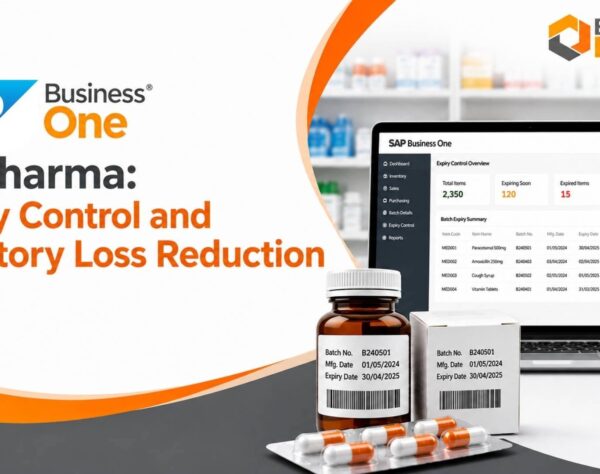
The platform tracks expiry dates automatically at the batch level and generates alerts when products approach expiration.
Instead of manually monitoring stock records, warehouse teams gain real-time dashboards showing:
- Expiry timelines by batch
- Inventory nearing expiry thresholds
- Recommended stock movement priorities
- Batch allocation rules based on FEFO
With SAP B1 Batch Management Pharma, pharmaceutical companies can automatically enforce the First Expiry First Out principle, ensuring that the oldest inventory is always distributed first.
This significantly reduces inventory wastage while improving regulatory compliance
FEFO Inventory Management for Pharmaceutical Warehouses
Pharmaceutical warehouses operate under strict operational discipline. Every batch must be traceable, every movement must be logged, and every shipment must meet regulatory standards.
SAP B1 Inventory Management for Pharma automates these processes by integrating warehouse operations directly with ERP intelligence.
Key warehouse capabilities include:
- Automated FEFO inventory allocation
- Batch and lot traceability across supply chains
- Expiry alerts during picking and packing
- Warehouse dashboard visibility for inventory health
- Integration with barcode systems for real-time tracking
With SAP B1 Supply Chain Pharma integration, warehouse teams no longer rely on manual judgement. The system automatically prioritizes stock movement based on expiry timelines.
This ensures compliance while improving operational efficiency.
Connecting Production, Quality, and Inventory in One System
In pharmaceutical operations, inventory management cannot exist in isolation.
Production planning, quality control, and distribution must all operate within the same ecosystem.
SAP Business One for Pharma Manufacturing provides this unified framework.
Production teams gain visibility into raw material expiry and batch usage. Quality teams can track testing and validation across batches. Inventory teams can monitor stock movement across warehouses.
The result is complete operational synchronization.
Capabilities include:
- SAP B1 Production Planning Pharma integration with batch control
- SAP B1 Quality Management Pharma for regulatory compliance
- End-to-end batch traceability from production to distribution
- Real-time reporting across manufacturing operations
For pharmaceutical executives, this creates a transparent operational environment where decisions are based on real-time data rather than delayed reports.
Real-Time Reporting for Pharma Decision Makers
Operational visibility is one of the most valuable outcomes of implementing SAP Business One Pharma Solution.
Executives and operational leaders gain instant insights into:
- Inventory health and expiry exposure
- Production output and batch status
- Distribution performance
- Quality control metrics
- Compliance readiness
With pharma real-time reporting, leaders can proactively prevent inventory losses rather than reacting to operational issues after they occur.
The system enables better forecasting, improved supply chain planning, and stronger governance across pharmaceutical operations.
Implementation Considerations for SAP B1 Pharma
Deploying SAP B1 Pharma Implementation requires more than installing software.
Pharmaceutical ERP implementations must address industry-specific requirements such as batch validation, expiry control, regulatory compliance, and supply chain integration.
A structured implementation approach typically includes:
- Pharma process analysis
- Batch and expiry configuration
- Warehouse workflow automation
- Integration with existing production systems
- Compliance and validation readiness
Working with an experienced SAP B1 Pharma Consultant ensures that the ERP environment is aligned with pharmaceutical industry regulations and operational practices.
For growing pharmaceutical businesses, SAP B1 Pharma Implementation in India and globally provides a scalable platform capable of supporting manufacturing, distribution, and regulatory growth.
Restoring Control with Modern Pharmaceutical ERP
The pharmaceutical industry is evolving rapidly. Regulatory complexity, global supply chains, and product traceability requirements demand advanced digital infrastructure.
Organizations that continue to rely on fragmented systems will struggle with inventory losses, compliance risks, and operational inefficiencies.
By implementing SAP Business One Pharma Software, pharmaceutical enterprises gain:
- Automated expiry monitoring
- FEFO-based inventory control
- Batch-level traceability
- Integrated production and quality management
- Real-time operational visibility
More importantly, they gain the confidence that their operations are built on a reliable and scalable ERP foundation.
FAQs About SAP B1 for Pharma
1. How does SAP B1 for Pharma reduce expired inventory losses?
SAP B1 for Pharma automatically tracks product expiry dates at the batch level and generates alerts before products reach expiration. This allows warehouse teams to prioritize shipments based on FEFO rules and significantly reduce product wastage.
2. Can SAP Business One support real-time inventory visibility in pharmaceutical warehouses?
Yes. SAP Business One Pharma Software provides real-time dashboards that show batch quantities, expiry timelines, warehouse stock levels, and distribution status, enabling faster operational decisions.
3. How does SAP B1 improve pharmaceutical supply chain control?
SAP B1 integrates procurement, production, warehouse operations, and distribution into a single platform. This integration ensures that batch information, expiry data, and stock movements are synchronized across the entire pharmaceutical supply chain.
4. Is SAP B1 suitable for both pharma manufacturers and distributors?
Yes. SAP Business One for Pharmaceutical Industry supports both manufacturing and distribution models, including batch production, warehouse inventory control, quality checks, and regulated product distribution.
5. What role does batch tracking play in pharmaceutical ERP systems?
Batch tracking ensures complete traceability of pharmaceutical products from raw material procurement to final distribution. SAP B1 Batch Tracking helps organizations quickly identify affected batches during quality issues or product recalls.
6. How does SAP B1 support pharmaceutical quality management?
SAP B1 Quality Management Pharma integrates testing workflows, inspection checkpoints, and documentation processes within the ERP system, helping companies maintain compliance and ensure product quality.
7. Can SAP Business One integrate with pharmaceutical laboratory or external systems?
Yes. Using SAP B1 Pharma API integration, companies can connect SAP Business One with laboratory information systems, third-party logistics platforms, and other operational software.
8. What operational benefits do pharmaceutical companies gain from SAP B1 implementation?
Companies gain automated expiry monitoring, improved batch traceability, optimized warehouse operations, real-time reporting, and stronger compliance across production and distribution processes.
9. Is SAP Business One scalable for growing pharmaceutical companies?
Yes. SAP Business One is designed for mid-market and growing pharmaceutical enterprises. The platform scales as businesses expand into new production facilities, warehouses, or global markets.
10. How can pharmaceutical executives evaluate SAP Business One before implementation?
Organizations can schedule a SAP Business One Pharma Demo to see how batch tracking, expiry monitoring, warehouse automation, and real-time reporting work in a live ERP environment.