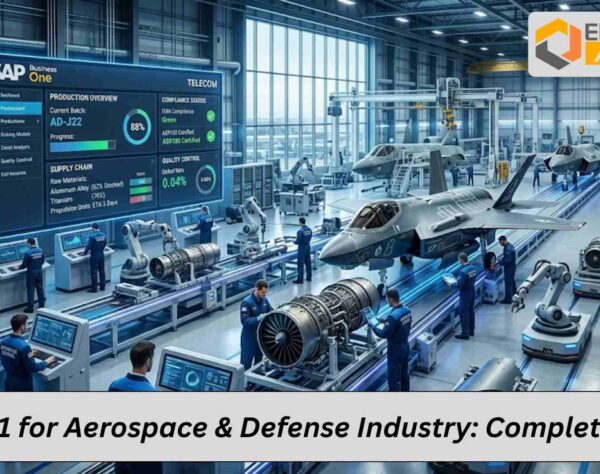


SAP Business One for Aerospace and Defense: Managing Manufacturing, Inventory, and Traceability
Quick Answer
SAP Business One for aerospace and defense helps manufacturers coordinate purchasing, inventory, production, sales, and financial data within a connected ERP environment. It can improve operational visibility for aerospace component manufacturers, defense suppliers, and related businesses. Suitability depends on production complexity, traceability requirements, quality processes, regulatory obligations, and the integrations or industry-specific extensions needed.
Aerospace and Defense Businesses Face Complex Operational Requirements
Aerospace and defense manufacturers work with interconnected processes that leave little room for inconsistent operational records. Component availability, supplier performance, production schedules, material costs, inspection results, and delivery commitments can influence one another. When departments rely on separate spreadsheets or disconnected applications, managers may struggle to establish which information is current and which decisions require immediate attention.
These challenges affect more than production teams. Procurement managers need dependable supplier and purchasing information. Inventory teams must understand material availability and movement. Production managers need visibility into planned and completed work. Finance teams require accurate transaction records and cost information. Senior executives need a consolidated view of operational performance before committing resources or approving corrective action.
Aerospace component manufacturers, precision engineering businesses, equipment suppliers, and defense contractors can experience these difficulties at different levels. A company manufacturing a limited range of machined components may need tighter purchasing and inventory controls. A larger supplier managing several production stages may also need structured planning, detailed reporting, and connections to specialized manufacturing systems.
An ERP system can help establish a common operational record, but implementation must reflect actual business requirements. Selecting software based only on a feature list may leave critical process gaps unresolved.
Decision-makers should therefore assess where information becomes fragmented, which transactions create delays, how inventory and production records are maintained, and what evidence must be available for internal or external review. These findings establish a practical foundation for evaluating SAP Business One.
SAP Business One Connects Manufacturing, Procurement, and Inventory Processes

SAP Business One provides an integrated business management environment for small and midsize organizations. Its core capabilities cover financial management, purchasing, sales, inventory, and production-related processes. Connecting these functions can help businesses reduce dependence on isolated records and improve the consistency of information used across departments.
For an aerospace supplier, the purchasing process may begin with material requirements and continue through supplier orders, goods receipts, inventory updates, and supplier invoices. When these activities are managed through connected transactions, teams can compare what was ordered, what was received, what remains available, and what has been recorded financially.
Production teams can use relevant item, inventory, and production information to coordinate planned requirements with material availability. Managers can examine operational data alongside purchasing commitments and financial results instead of relying entirely on separately maintained spreadsheets.
The value depends on how the system is configured. Item master data, units of measure, warehouses, purchasing rules, bills of materials, production definitions, and transaction procedures must reflect the company’s actual operating model. Inconsistent foundational data can undermine reporting even when the software itself is functioning correctly.
SAP Business One should not automatically be treated as a complete aerospace manufacturing execution platform. Businesses with advanced scheduling, specialized shop-floor control, engineering lifecycle management, or complex subcontracting may need additional applications or integrations.
The evaluation should identify which processes can be supported through standard functionality, which require configuration, and which depend on third-party solutions or custom development. This distinction helps decision-makers understand implementation scope, recurring costs, and long-term support responsibilities.
Inventory Traceability Depends on Accurate Item and Transaction Records
Inventory visibility is particularly important when businesses manage controlled components, raw materials, purchased assemblies, and finished goods across multiple locations or production stages. A stock balance alone may not answer every operational question. Teams may also need to understand where an item came from, how it moved, whether it has been allocated, and which transactions affected its status.
SAP Business One supports inventory management and can work with batch and serial number tracking where appropriately configured. These functions can help businesses maintain records associated with individual items or groups of items. Their usefulness depends on the data captured, the transaction procedures followed, and any additional traceability requirements that apply.
For example, a component manufacturer may need to record receipt of a batch of material, allocate quantities to production, and document the movement of finished components into a designated warehouse. If the business requires links between incoming material batches and specific finished products, the proposed workflow must be evaluated carefully. Standard tracking alone may not provide every required relationship or every level of genealogy.
Aerospace and defense buyers should establish what traceability means for their operations before selecting a solution. Requirements might include supplier lot references, serial numbers, material certificates, inspection records, production orders, customer shipment records, or links between component revisions and completed assemblies.
Where these relationships are essential, the implementation team should demonstrate the actual end-to-end process using representative transactions. A generic inventory screen is not sufficient evidence that a complete traceability requirement has been met.
Accurate item codes, consistent supplier references, disciplined goods receipts, and controlled stock movements remain essential. Businesses should also define who can create, modify, approve, and review relevant records.
The objective is to make traceability operationally reliable rather than assuming that enabling a tracking field automatically satisfies every customer, quality, or regulatory obligation.
Production Planning and Cost Control Require Reliable Operational Data
Production planning becomes difficult when demand, material availability, work orders, purchasing commitments, and capacity information are maintained separately. Managers may discover shortages after schedules have been communicated, while finance teams may receive cost information only after operational decisions have already been made.
SAP Business One includes production-related functionality that can support appropriate manufacturing workflows. Businesses can assess bills of materials, production orders, inventory availability, and associated transaction records to determine whether these capabilities match their planning requirements.
Consider a manufacturer producing precision components for several customers. Production may depend on purchased materials, machining capacity, outsourced operations, inspection stages, and committed delivery dates. If material requirements are inaccurate or stock movements are recorded late, planned production can become unreliable. The resulting disruption may affect machine utilization, labor allocation, delivery performance, and customer communication.
An ERP implementation can improve the information available for these decisions by establishing consistent item records, purchasing processes, production transactions, and inventory updates. However, advanced finite-capacity scheduling, detailed shop-floor dispatching, machine-level monitoring, and specialized manufacturing execution may require additional systems.
Cost control requires similar discipline. Material costs, purchasing prices, production transactions, inventory valuation, and financial postings need to be configured and reviewed according to the business’s accounting and operational requirements. Reports are only as dependable as the transactions and assumptions behind them.
Executives should ask whether the proposed system can provide the cost breakdowns they need, at what level costs can be analyzed, and which calculations depend on extensions or external applications. They should also establish how changes in material prices, scrap, rework, subcontracting, and production quantities will be recorded.
A useful demonstration should follow a realistic production scenario from material purchasing through manufacturing and financial review. This reveals whether the proposed solution supports actual decisions rather than simply displaying isolated features.
Quality Records and Compliance Requirements Need Specific Validation
Aerospace and defense businesses may operate under demanding customer specifications, contractual conditions, quality-management procedures, export restrictions, and industry-specific standards. The requirements differ according to the organization’s role, products, customers, jurisdiction, and contractual obligations.
An ERP platform can contribute to process control by maintaining structured business records and supporting consistent transactions. Nevertheless, the presence of an ERP system does not automatically make an organization compliant with a particular aerospace quality standard, defense requirement, or customer audit procedure.
Businesses should document the evidence they must retain and the controls needed to maintain it. Depending on the operating environment, this may include incoming inspection results, material certification references, nonconformance records, corrective actions, approved supplier information, revision-controlled documents, and product history.
Some records may be maintained in SAP Business One through configured fields, transactions, reports, or attachments. Other requirements may call for a dedicated quality management system, document management platform, manufacturing application, or integration. The specific solution must be validated against the applicable process and evidence requirements.
Access permissions and approval procedures also deserve attention. Companies should establish which employees can create or change important records, how exceptions are escalated, and how changes can be reviewed. Record retention, electronic signatures, audit trails, and controlled document revisions must be evaluated against actual requirements rather than assumed to exist at the necessary level.
Before implementation, prepare a compliance and quality requirements matrix. List each required control, the evidence expected, the responsible business owner, and the proposed system or process that will support it. Mark every requirement as standard, configurable, integration-dependent, customization-dependent, or unresolved.
This approach exposes gaps early and gives management a defensible basis for estimating cost, implementation effort, validation needs, and ongoing ownership.
Aerospace ERP Integrations and Customization Need Clear Scope

Aerospace and defense manufacturers may already use specialist applications for engineering, computer-aided design, product lifecycle management, quality management, warehouse operations, maintenance, production monitoring, or customer collaboration. Replacing all these systems with a single ERP platform may not be necessary or appropriate.
The more practical question is how SAP Business One will exchange information with the applications the business intends to retain. Integration requirements should be defined around specific business events and data relationships, not just a general preference for connected systems.
For example, an engineering application may hold controlled product definitions while the ERP system manages purchasing, inventory, production transactions, and financial records. The project team must decide which application owns each data element, how approved changes are transferred, and how conflicting or incomplete information is handled.
A successful integration plan should define data ownership, transfer frequency, validation rules, error notifications, retry procedures, monitoring responsibilities, and reconciliation methods. It should also address what happens when an external application becomes unavailable or a transaction fails halfway through processing.
Customization may be necessary when standard workflows do not meet a documented business requirement. However, custom fields, approval rules, reports, interfaces, and extensions should have a clear purpose and a named owner. Uncontrolled customization can increase testing effort, upgrade complexity, support costs, and dependency on individual developers.
Businesses should distinguish between requirements that are genuinely essential and preferences that can be met through standard processes. Every proposed extension should be assessed for business value, technical risk, maintenance needs, and compatibility with future system changes.
Emerging Alliance can be considered as an implementation and integration partner for businesses evaluating SAP Business One. The scope discussion should identify the required modules, existing applications, industry-specific processes, and support arrangements before a solution is finalized.
SAP Business One Suitability Depends on Business Complexity
SAP Business One may be suitable for small and midsize aerospace component manufacturers, precision engineering companies, equipment suppliers, and defense supply-chain businesses that need connected operational and financial processes. Suitability depends on the company’s transaction volumes, manufacturing model, reporting requirements, traceability expectations, and technology environment.
Organizations seeking stronger coordination across purchasing, inventory, production, sales, and finance may find value in an integrated ERP platform. Businesses with manageable production workflows and clearly defined requirements may also be able to implement the system with a controlled level of configuration and extension.
However, not every aerospace or defense organization has the same requirements. Businesses operating highly complex assembly programs, advanced engineering change processes, extensive subcontracting networks, strict program-level controls, or sophisticated production scheduling may need specialized applications alongside ERP.
The right decision is not based on industry labels alone. It requires mapping business processes and testing representative scenarios against the proposed solution.
Decision-makers should assess at least five areas: manufacturing complexity, traceability depth, quality and documentation controls, integration dependencies, and expected growth. They should also evaluate reporting requirements, data migration, employee adoption, internal ownership, and the availability of ongoing technical support.
A requirements matrix can help compare standard SAP Business One functionality, configuration, add-ons, integrations, customization, and alternative systems. Any critical requirement without a validated solution should remain an open issue rather than being treated as a future implementation detail.
The outcome should be a clear understanding of functional fit, delivery risk, total cost of ownership, and the additional capabilities required. That provides a more reliable basis for investment than choosing software from a feature comparison alone.
ERP Implementation Risks Should Be Evaluated Before Selection
Even a suitable ERP platform can underperform if implementation planning is incomplete. Aerospace and defense businesses should assess delivery risks before committing to a project schedule or final scope.
Data migration is a common risk. Inconsistent item codes, duplicate suppliers, incomplete opening balances, missing batch or serial references, and outdated bills of materials can affect the reliability of the new environment. Migration should include data cleansing, ownership assignments, reconciliation, and business-user validation.
Process definition is equally important. If purchasing, production, inventory, inspection, and finance teams follow inconsistent procedures, software configuration may reproduce existing problems. Process owners should agree on transaction rules, approvals, exceptions, and reporting definitions before testing begins.
Integration dependencies can also create delays. Interfaces must be tested with realistic volumes, incomplete records, rejected transactions, and system interruptions. A connection that works in a simple demonstration may still fail under actual operating conditions.
User adoption should be planned from the start. Employees need role-specific training, documented procedures, and a clear escalation path. Management should identify who owns master data, resolves exceptions, reviews reports, and approves process changes after launch.
Scope management protects the project from uncontrolled expansion. Requirements should be prioritized according to business impact, contractual obligations, and operational necessity. Changes should be assessed for cost, schedule, testing, support, and upgrade implications before approval.
Before going live, businesses should test end-to-end scenarios covering procurement, goods receipt, inventory allocation, production, quality-related records, shipment, invoicing, and financial reconciliation as applicable. The test plan should include exceptions, not only successful transactions.
An implementation partner should explain its approach to discovery, configuration, integration, migration, testing, training, cutover, and post-launch support. Executives should request clear deliverables, decision responsibilities, risk reporting, and acceptance criteria.
These controls help the business make an informed investment and reduce the chance that important requirements will be discovered only after the system is in use.
Questions Aerospace and Defense Buyers Should Ask Before an ERP Demo
An ERP demonstration should validate business requirements rather than follow a generic product tour. Buyers should prepare representative scenarios and ask the implementation team to explain how each requirement will be met.
Start with inventory. Can the proposed configuration manage the relevant warehouses, item classifications, batch or serial tracking, and transaction history? If the business needs relationships between raw materials and finished components, can the complete process be demonstrated?
Next, examine production. How are bills of materials, production orders, material availability, and production costs managed? Which planning requirements are supported directly, and which need a specialist scheduling or manufacturing application?
Quality and documentation deserve a separate review. Can the proposed workflow capture the required inspection outcomes and references to supporting evidence? Are approvals, record changes, retention, and audit requirements adequately addressed? Where is an external quality system necessary?
Integration questions should identify the source of each critical data element and the direction in which it moves. Ask how failed transactions are reported, corrected, and reconciled. Establish who will maintain each interface after implementation.
Finally, review commercial and operational ownership. What is included in the implementation scope? Which add-ons and customizations involve additional licensing or support? What training is provided, how are upgrades handled, and who responds when a critical process stops working?
A useful demo concludes with a fit-gap assessment. Each requirement should have an identified solution, an owner, an estimated effort, and an agreed next step. This makes it easier for management to compare proposals and decide whether SAP Business One is appropriate for the business.
FAQs
Discuss Your Aerospace ERP Requirements
Evaluate SAP Business One for your aerospace and defense workflows, traceability, inventory controls, and integration needs. Request a demo with Emerging Alliance to assess solution fit and identify required customizations or extensions.