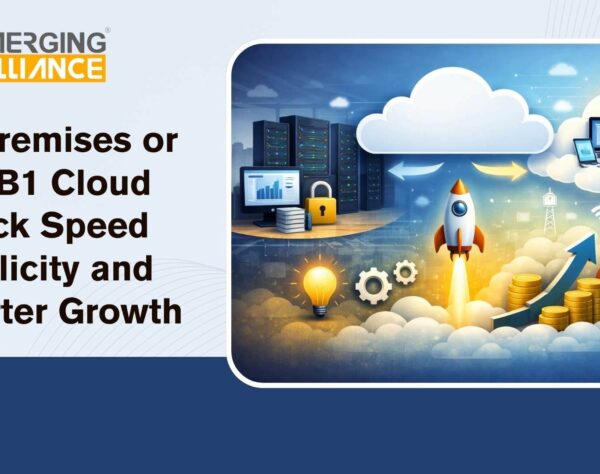


Transform Your Business with SAP B1 Cloud Migration at the Right Time

SAP B1 Cloud Migration is no longer optional for organizations facing internal scalability constraints despite favorable market conditions. For most mid-market and enterprise businesses, growth limitations are not driven by external factors markets are expanding, digital channels are evolving, and customer expectations continue to accelerate. However, the real bottleneck lies within outdated or inflexible IT architecture that cannot support speed, integration, or data-driven decision-making at scale.
Legacy, on-premise ERP environments often operate as silent inhibitors:
- Slowing decision cycles
- Restricting integration with modern platforms
- Increasing operational rigidity
- Creating long-term cost inefficiencies
This is where SAP Business One Cloud Migration transitions from an IT upgrade to a strategic business decision.
Why Timing Matters More Than Technology in SAP B1 Cloud Migration
Cloud migration is not just about if it is about when.
Organizations that delay SAP B1 migration to cloud often face:
- Compounding technical debt
- Rising infrastructure and maintenance costs
- Reduced agility in responding to market shifts
- Increased competitive disadvantage
On the other hand, businesses that migrate at the right time position themselves to:
- Scale without infrastructure constraints
- Enable faster innovation cycles
- Integrate seamlessly with CRM, AI, and digital platforms
- Optimize long-term IT investments
The difference is not technological it is strategic timing.
The Hidden Cost of Staying on On-Premise SAP Business One
Many decision-makers underestimate the true cost of maintaining an on-premise SAP Business One ERP.
1. Innovation Bottlenecks
Legacy environments struggle to integrate with:
- Modern CRM systems
- eCommerce platforms
- AI-driven analytics tools
This limits your ability to innovate at speed.
2. Operational Rigidity
Scaling operations across locations or business units becomes slow and resource-intensive.
3. Rising Total Cost of Ownership (TCO)
Costs accumulate across:
- Hardware upgrades
- AMC and infrastructure maintenance
- IT dependency for minor changes
4. Risk Exposure
Outdated systems increase:
- Security vulnerabilities
- Compliance risks
- Data recovery challenges
Remaining on-premise is no longer a neutral decision it is an active risk.
SAP Business One Cloud Migration: A Platform for Scalable Growth
Migrating to a cloud-based SAP Business One solution redefines how your business operates and scales.
1. Elastic Scalability
Expand operations without re-architecting infrastructure.
2. Seamless Integrations
Enable API-driven connectivity with:
- Salesforce and CRM ecosystems
- eCommerce platforms
- Third-party applications
3. Real-Time Decision Intelligence
Access centralized, real-time data across:
- Finance
- Operations
- Supply chain
4. Built-in Resilience
Cloud environments enhance:
- Data security
- Disaster recovery
- Business continuity
5. Continuous Innovation Enablement
Stay aligned with evolving technologies without disruptive upgrades.
From ERP System to Digital Growth Engine
A successful SAP B1 cloud migration transforms ERP from a transaction system into a growth enabler.
It enables:
- Faster go-to-market execution
- Improved customer experience through connected systems
- Data-driven decision-making at leadership level
- Cross-functional visibility across departments
This is not modernization it is business transformation.
The Role of a Strategic SAP Partner in Cloud Migration
Not all SAP Business One cloud migration projects deliver business value.
The difference lies in execution.
A strategic transformation partner ensures:
- Alignment between ERP and business goals
- Structured SAP B1 migration process with minimal disruption
- Clean data migration and system optimization
- Integration architecture design for future scalability
- Continuous improvement post-migration
This approach shifts the conversation from deployment to outcomes.
Key Considerations Before You Move SAP Business One to the Cloud
Before initiating SAP B1 system migration, leadership teams must evaluate:
Business Readiness
- Are current processes scalable?
- Are inefficiencies being migrated or eliminated?
Integration Landscape
- What systems need to be connected post-migration?
Data Integrity
- Is your master data clean and structured?
Risk Mitigation Strategy
- What is your fallback and recovery plan?
ROI Visibility
- What measurable outcomes define success?
A well-structured migration avoids disruption and accelerates value realization.
SAP B1 Cloud Migration Is Not an IT Decision It’s a Growth Strategy
Organizations that treat SAP Business One cloud ERP as an IT upgrade often miss its full value. In contrast, leaders who view it as a strategic lever achieve:
- Faster expansion into new markets
- Reduced operational complexity
- Improved profitability through optimized processes
- Greater organizational agility
The cloud is not just infrastructure it is a competitive advantage.
FAQs SAP Business One for Cloud Migration
1. How does SAP Business One Cloud Migration impact long-term ROI?
Cloud migration reduces infrastructure costs, improves operational efficiency, and enables faster innovation, leading to measurable long-term ROI.
2. What risks should be considered in SAP B1 cloud migration?
Key risks include data migration errors, integration gaps, and business disruption—these can be mitigated with a structured migration strategy.
3. Can SAP Business One cloud integrate with existing CRM systems?
Yes, SAP Business One cloud solutions support API-based integrations with CRM, eCommerce, and third-party platforms.
4. How long does a typical SAP B1 migration to cloud take?
Timelines vary based on system complexity, but a structured approach ensures minimal disruption and faster deployment.
5. Is SAP Business One cloud secure for enterprise operations?
Cloud environments offer enhanced security protocols, data encryption, and disaster recovery compared to traditional systems.
6. What is the difference between SAP B1 cloud hosting and full cloud transformation?
Hosting moves infrastructure to the cloud, while transformation optimizes processes, integrations, and system architecture.
7. How does cloud migration improve scalability?
Cloud eliminates infrastructure limitations, enabling businesses to expand operations without additional hardware investments.
8. What role does data migration play in SAP B1 cloud implementation?
Clean, structured data ensures accurate reporting, smooth operations, and better decision-making post-migration.
9. Can businesses customize SAP Business One after cloud migration?
Yes, cloud environments support customization and extensions through APIs and integration frameworks.
10. How do we measure success after SAP B1 cloud migration?
Success is measured through improved efficiency, reduced costs, faster decision-making, and enhanced business agility.
Ready to unlock scalable growth with SAP Business One Cloud? If your current ERP is limiting speed, visibility, or innovation, waiting is costing you more than migrating.
With Emerging Alliance, get a tailored SAP B1 Cloud Migration strategy aligned to your business goals. Book a free consultation & demo to evaluate your readiness, risks, and ROI potential.