
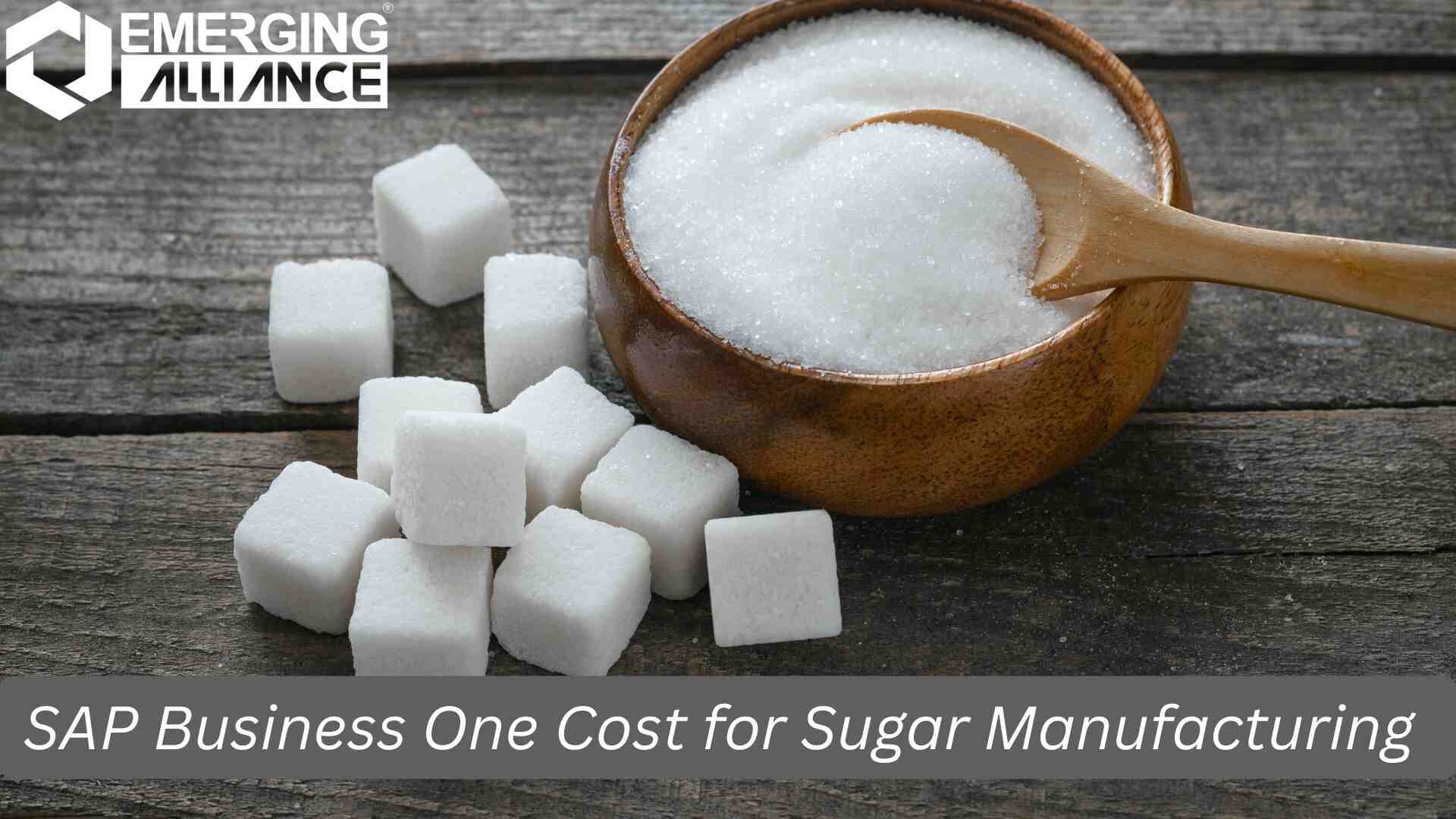
SAP Business One Cost for Sugar Manufacturing
Exploring SAP Business One Cost for Sugar Manufacturing
Implementing an ERP system like SAP Business One can revolutionize operations for sugar mills but a common question is: how much does SAP Business One cost when tailored for sugar manufacturing? In this post, we unpack the full cost structure, helping you budget wisely and avoid surprises down the road.
Understanding the Cost Components of SAP Business One Cost for Sugar Manufacturing
When evaluating SAP Business One cost, it’s not just a one-time fee there are several components to consider. Understanding these is crucial, especially for a complex industry like sugar manufacturing.
License fees – The base cost depends on the type and number of users.
Implementation & customization charges – Industry-specific workflows, manufacturing modules, integrations (e.g. quality control, inventory for raw sugar, by‑products) add to cost.
Maintenance & support (or subscription/hosting) – Ongoing support, updates, and optional cloud‑hosting or infrastructure maintenance.
Hardware or cloud infrastructure (if on-premise) – If hosting locally, server, backup, and database costs must be factored.
Additional modules or add‑ons – For manufacturing, supply‑chain, quality, traceability, reporting, and other sugar‑industry specific needs.
Because of these variables, the total SAP Business One cost for sugar manufacturing can vary widely the quote must reflect all components.
Typical SAP Business One Pricing in India —What Sugar Mills Might Expect
To get a sense of ballpark costs for sugar manufacturing setups in India using SAP B1, here’s a rough guide based on license type and deployment:
Small sugar mills (few users, minimal modules):
- Total cost (licenses + basic setup): ~ ₹8–12 lakhs.
Medium-sized plants (multiple departments — finance, production, inventory, supply chain, quality):
- Total setup cost: ₹14–75 lakhs.
Large / complex sugar manufacturing operations (many users, advanced modules, add-ons):
- Costs may scale to ₹25 lakhs up to ₹1 crore+, depending on scale, integration, and customization needs.
License‑level breakdown (per user, on‑premise in India):
- Professional License: ~ ₹1,36,620 per user one-time.
- Limited License (for role-based access): ~ ₹70,840 per user one-time.
- If using subscription/cloud model, monthly fees per user are significantly lower, but recurring.
Thus, a small sugar mill with under 5 users might just need a “starter or limited license + basic modules,” while a full-scale manufacturing plant must budget for professional licenses, advanced modules, and implementation services.
What Drives Cost Up for Sugar Manufacturing Industries
In a sugar manufacturing context, certain factors will influence costs more heavily than in a generic business.
Complex manufacturing workflows: Sugar processing — raw material intake, crushing, boiling, crystallization, by‑product management — requires specialized manufacturing and inventory modules. These bespoke workflows often need customization or add-ons, increasing implementation effort and cost.
Inventory & batch management: Handling raw sugar, molasses, by‑products, quality checks, storage — ERP must handle batch tracking, expiry dates, stock movement. That demands robust configuration and possibly third-party add-ons.
Quality control, compliance & traceability: Agricultural and food‑processing regulations may require detailed traceability, reporting, and compliance modules. That adds to both license and implementation complexity.
Multi‑site or multi‑unit operations: If the mill has multiple plants, warehouses, supply‑chain nodes, logistics and distribution modules become essential — increasing user counts, licenses, and infrastructure.
User count across functions: From procurement, finance, lab, maintenance, warehousing, sales — sugar manufacturing touches many functions. More users = higher license and maintenance costs.
Customization & Integration: Integration with mills’ SCADA systems, warehouse management, legacy systems, payroll, compliance modules — these need consulting, configuration, testing, training, which can significantly bump up cost.
Pros and Cost Benefits — Why SAP B1 Might Be Cost‑Effective for Sugar Mills
Despite the upfront costs, implementing SAP Business One can yield long‑term savings and operational benefits for sugar manufacturing.
Unified operations: Combines finance, manufacturing, inventory, supply‑chain, quality, and reporting — reducing the need for multiple disparate systems.
Reduced manual errors & better traceability: Automation of batch tracking, inventory, quality checks helps in compliance and reduces wastage — important in raw‑material intensive industries like sugar.
Scalable for growth: As the business grows — more plants, warehouses, divisions — SAP B1 can scale with additional licenses instead of deploying a new system.
Better decision‑making: Real‑time data across production, inventory, sales helps management plan procurement, production cycles, cash flow, reducing over‑stocking or shortages.
Cost optimisation over time: Though initial cost is considerable, the consolidated system reduces overhead, duplicated effort, and long-term maintenance costs compared to several smaller systems.
How to Estimate SAP Business One Cost for Your Sugar Mill — Practical Steps
If you’re considering SAP B1 for a sugar mill, use this checklist to estimate costs more accurately:
- List all user roles — Finance, Production, Inventory, Quality, Warehouse, Sales, Management. Distinguish between “full access” (Professional) vs “role-based” (Limited) access.
- Define modules required — manufacturing, inventory, quality, traceability, batch tracking, supply‑chain, sales, finance.
- Decide deployment type — on‑premise (buy licenses + hardware) or cloud/subscription (lower upfront, recurring fees).
- Plan for customization & integration — with machines, legacy systems, reporting tools, compliance setups.
- Estimate training and change management — your staff must adapt to the ERP workflows; factor in training costs and time.
- Include maintenance and upgrades — for on‑premise: expect annual maintenance (~15–20% of license cost). For cloud: subscription may include maintenance.
- Account for growth — if you plan to expand (more warehouses, new by‑products, distribution), leave room for additional licenses or modules.
Using this approach will give you a realistic total cost of ownership (TCO) over 3–5 years rather than just upfront cost.
Common Misconceptions and Hidden Cost Pitfalls
Sometimes sugar mills choose ERP based on low quotes — but low initial quotes may hide future burdens.
- Under‑quoting of users or roles: Quoting for fewer users than actual count can lead to additional license purchases later — expensive and disruptive.
- Skipping manufacturing or quality modules: Choosing only core accounting or inventory may save cost now, but fails to solve critical manufacturing needs.
- Ignoring maintenance or upgrade costs: On‑premise setups must budget for annual maintenance and server upkeep; cloud subscriptions roll this in but remain recurring.
- Underestimating customization needs: Sugar manufacturing is specialized — a “standard” ERP setup may not cover batch tracking, compliance, traceability — leading to additional customization charges.
- Neglecting training and change management: Implementing ERP isn’t plug-and-play — staff training, process change, data migration can take time and money.
Avoiding these pitfalls means asking for a detailed cost breakdown from the ERP vendor/partner before signing any agreemenT.
What to Expect for Sugar‑Manufacturing in Next 3–5 Years (TCO Insight)
When you plan for SAP B1 over 3–5 years for a sugar mill:
- Initial license + setup + customization (Year 0)
- Annual maintenance or subscription fees (Years 1–5)
- Occasional customization or additional modules if business expands
- Training costs for new staff or on new modules
As a result, while the one-time cost might seem high, the return on investment (ROI) through efficiencies, reduced wastage, better planning, compliance — can outweigh costs over time.
Why SAP Business One is the Smart Choice for Sugar Manufacturing
Implementing SAP Business One in sugar manufacturing is a strategic investment. When you consider licensing, deployment, modules, customization, and ongoing maintenance, SAP B1 emerges as a cost-effective ERP solution that streamlines operations, enhances traceability, and supports scalable growth.
Before selecting licenses and modules, carefully map your user roles, workflows, and future expansion plans to ensure the system fully meets your sugar mill or plantation needs. For a tailored, precise quote for your sugar production setup, consult an SAP B1 expert to get started.
Emerging Alliance empowers sugar manufacturers with smart, scalable ERP solutions. We specialize in implementing SAP Business One to streamline operations and boost efficiency.Our expert team ensures seamless deployment, customization, and ongoing support. Partner with us to modernize your sugar mill and achieve real-time traceability and growth.
FAQs – SAP Business One Cost for Sugar Manufacturing
How much does SAP Business One cost for sugar manufacturing companies?
The cost varies based on the number of users, modules selected, deployment type (on-premise or cloud), and implementation services. Typical ranges start from $3,000–$5,000 per user for a basic setup.
Are there additional costs beyond the SAP B1 license?
Yes. Additional costs include implementation, customization, training, support, and potential third-party integrations. Sugar manufacturing processes may require specialized modules, affecting total cost.
Does SAP B1 offer subscription-based pricing for sugar manufacturers?
Yes, SAP Business One Cloud provides subscription-based pricing, usually monthly per user, which can be more budget-friendly for smaller sugar companies.
How does company size impact SAP Business One pricing for sugar production?
Larger companies with more users, multiple production sites, or complex supply chains typically incur higher license and implementation costs. Small and mid-sized plants pay less.
Can SAP Business One costs be reduced with a phased implementation?
Absolutely. Sugar companies can implement core modules first (like inventory and production) and add finance, quality, or analytics modules later to manage costs.
Is there a difference in cost between on-premise and cloud SAP B1 for sugar manufacturers?
On-premise requires higher upfront costs for hardware and licenses, while cloud subscription spreads payments over time, often with lower initial investment.
Do SAP B1 costs include customization for sugar production processes?
Basic pricing covers standard ERP functions. Customization for sugar-specific processes, formula tracking, or regulatory compliance is additional.
Are maintenance and support costs included in SAP B1 pricing?
Standard support may be included for the first year, but ongoing maintenance and premium support contracts usually come at an extra cost.
How can a sugar manufacturing company calculate ROI for SAP Business One?
ROI depends on improved production efficiency, reduced wastage, better inventory management, regulatory compliance, and faster decision-making. Comparing cost vs operational savings is key.
Where can sugar manufacturers get an accurate SAP B1 cost estimate?
Contact certified SAP partners or resellers, like Emerging Alliance, who can evaluate your business requirements and provide a customized cost proposal.