
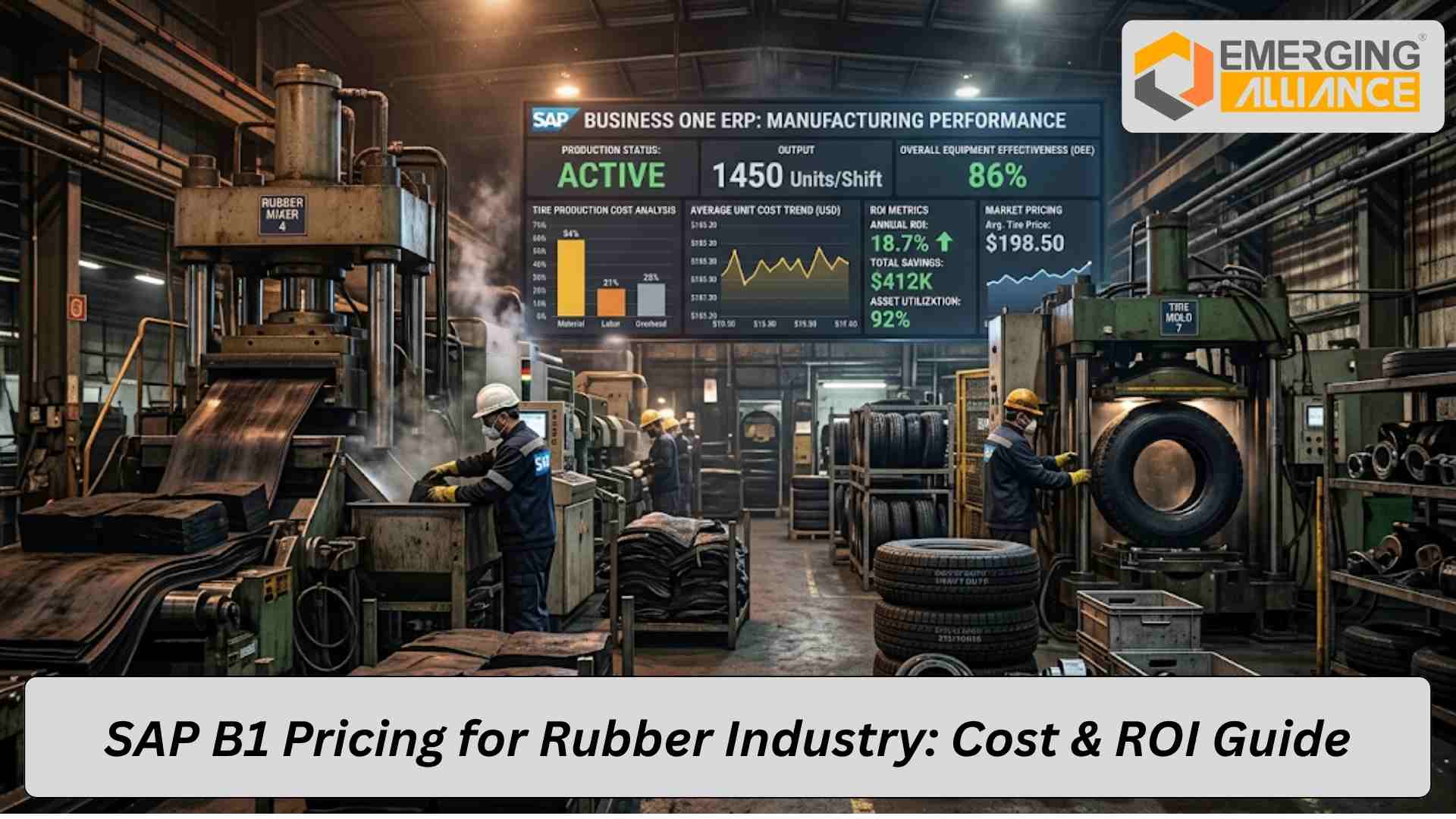
SAP B1 Pricing for Rubber Industry: Cost & ROI Guide
SAP B1 Pricing for Rubber Industry: Cost, Modules & ROI Guide
The rubber manufacturing industry operates in a highly competitive and cost-sensitive environment where efficiency, quality control, and real-time data are critical. Understanding SAP B1 Pricing for Rubber Industry is essential for businesses planning to implement a scalable ERP solution that improves operations while controlling costs.
Overview
pricing structure
SAP Business One pricing typically depends on licensing type, number of users, and deployment model such as cloud or on-premise.
cost components
The total cost includes software licenses, implementation, customization, training, and ongoing support.
deployment options
Businesses can choose between cloud-based subscription models or one-time on-premise licensing.
industry relevance
Rubber manufacturers benefit from tailored ERP features designed for batch processing, inventory control, and compliance.
Modules
production management
This module helps track raw materials, monitor batch production, and ensure consistent product quality.
inventory control
Real-time inventory tracking reduces waste and ensures optimal stock levels for rubber compounds.
sales and distribution
It manages orders, pricing, and customer relationships effectively.
financial management
Automates accounting, reporting, and compliance with tax regulations.
quality control
Ensures products meet industry standards through inspection and traceability features.
Cost Breakdown
license cost
SAP B1 offers Professional and Limited user licenses, priced based on functionality and usage.
implementation cost
This includes system setup, data migration, and integration with existing processes.
customization cost
Rubber businesses may require specific features like formulation management and batch tracking.
training cost
Employees need proper training to maximize ERP utilization and efficiency.
maintenance cost
Ongoing support, updates, and system maintenance ensure smooth performance.
Deployment Options
cloud ERP benefits
Cloud deployment reduces upfront costs and provides flexibility with subscription-based pricing.
on-premise ERP benefits
Offers full control over data and infrastructure, suitable for companies with IT resources.
hybrid approach
Combines the advantages of both models for better scalability and control.
ROI Analysis
cost reduction
ERP automation minimizes manual errors and reduces operational costs.
improved productivity
Streamlined workflows increase efficiency across departments.
better decision making
Real-time insights help managers make informed business decisions.
inventory optimization
Avoids overstocking and stockouts, improving cash flow.
compliance and reporting
Ensures regulatory compliance with accurate documentation and reporting.
SAP B1 Pricing for Rubber Industry Benefits
centralized system
All business processes are integrated into one platform for better visibility.
scalability
Supports business growth without major system changes.
data accuracy
Reduces duplication and improves data consistency.
customer satisfaction
Faster order processing and delivery improve customer experience.
SAP B1 Pricing for Rubber Industry Implementation Tips
choose the right partner
Selecting an experienced SAP partner ensures smooth implementation.
define clear goals
Identify business requirements before starting the ERP project.
employee training
Invest in training to ensure successful adoption.
phased implementation
Roll out modules step-by-step to reduce risk.
Conclusion: SAP B1 Pricing for Rubber Industry
SAP B1 pricing for the rubber industry depends on several key factors, including the selected modules, deployment model (cloud or on-premise), number of users, and level of customization required. While the initial investment may vary, choosing the right ERP configuration ensures long-term value and scalability.
By implementing SAP Business One, rubber manufacturers can streamline operations, enhance production planning, improve inventory control, and gain real-time business insights. This ultimately leads to increased efficiency, reduced operational costs, and smarter, data-driven decision-making that supports sustainable growth.
At Emerging Alliance, we specialize in delivering tailored SAP Business One solutions for the rubber industry. Our expert team ensures seamless implementation, cost-effective pricing, and ongoing support to help your business achieve maximum ROI. Partner with Emerging Alliance to transform your operations and stay ahead in a competitive market.
Common Questions About SAP B1 Cost and ROI for Rubber Manufacturers
1. What are the key cost components in SAP B1 pricing for the rubber industry?
SAP Business One pricing for rubber manufacturers includes user-based licensing (Professional and Limited), deployment infrastructure (cloud or on-premise), implementation services (configuration, data migration, and testing), and industry-specific customizations such as formulation management, batch traceability, and quality compliance. Total Cost of Ownership (TCO) also includes annual maintenance, upgrades, and ongoing support.
2. How does SAP B1 pricing vary for small vs mid-sized rubber manufacturers?
Small manufacturers typically adopt subscription-based models with essential modules, resulting in lower upfront costs. Mid-sized and large manufacturers require advanced production planning, quality control, and multi-location management, increasing overall investment based on operational complexity.
3. What factors significantly influence SAP B1 pricing in rubber manufacturing?
Pricing is influenced by the number of users, level of customization (compound formulation, curing processes), production complexity, integration with third-party systems, deployment type, and compliance requirements. Additional modules like MRP and analytics also impact cost.
4. How does SAP B1 support batch production and formulation management?
SAP B1 enables precise batch management and formulation control by defining Bills of Materials (BOM) with ingredient ratios, tracking raw materials, and maintaining consistency across production batches. It also supports version control for formulations and quality validation.
5. What role do ERP modules play in SAP B1 pricing?
Core modules such as production, inventory, finance, and sales form the base system, while additional modules like quality control, maintenance, and advanced analytics increase overall pricing. Selecting the right module combination is critical for cost optimization.
6. What hidden or indirect costs should rubber manufacturers consider?
Hidden costs may include legacy data migration, customization for rubber-specific workflows, employee training, infrastructure setup (for on-premise), integration with machinery or external systems, and ongoing support or cloud subscription fees.
7. How does SAP B1 improve ROI for rubber manufacturing businesses?
SAP B1 improves ROI by reducing material wastage, optimizing production efficiency, automating workflows, and providing real-time insights into operations. Better inventory control and cost tracking lead to improved profitability over time.
8. Is cloud deployment more cost-effective for rubber manufacturers?
Cloud deployment reduces initial capital expenditure, eliminates hardware costs, and offers scalability. However, long-term subscription costs should be evaluated against on-premise deployment depending on business size and IT strategy.
9. What is the typical implementation timeline and its impact on cost?
Implementation timelines range from 2 to 6 months for small to mid-sized manufacturers and can extend further for complex operations. Delays due to customization, integration, or data migration can increase costs, making proper planning essential.
10. What strategies can rubber manufacturers use to optimize SAP B1 costs?
Cost optimization strategies include phased implementation, selecting essential modules first, minimizing unnecessary customization, optimizing license usage, and partnering with experienced SAP consultants to ensure efficient deployment and faster ROI.