

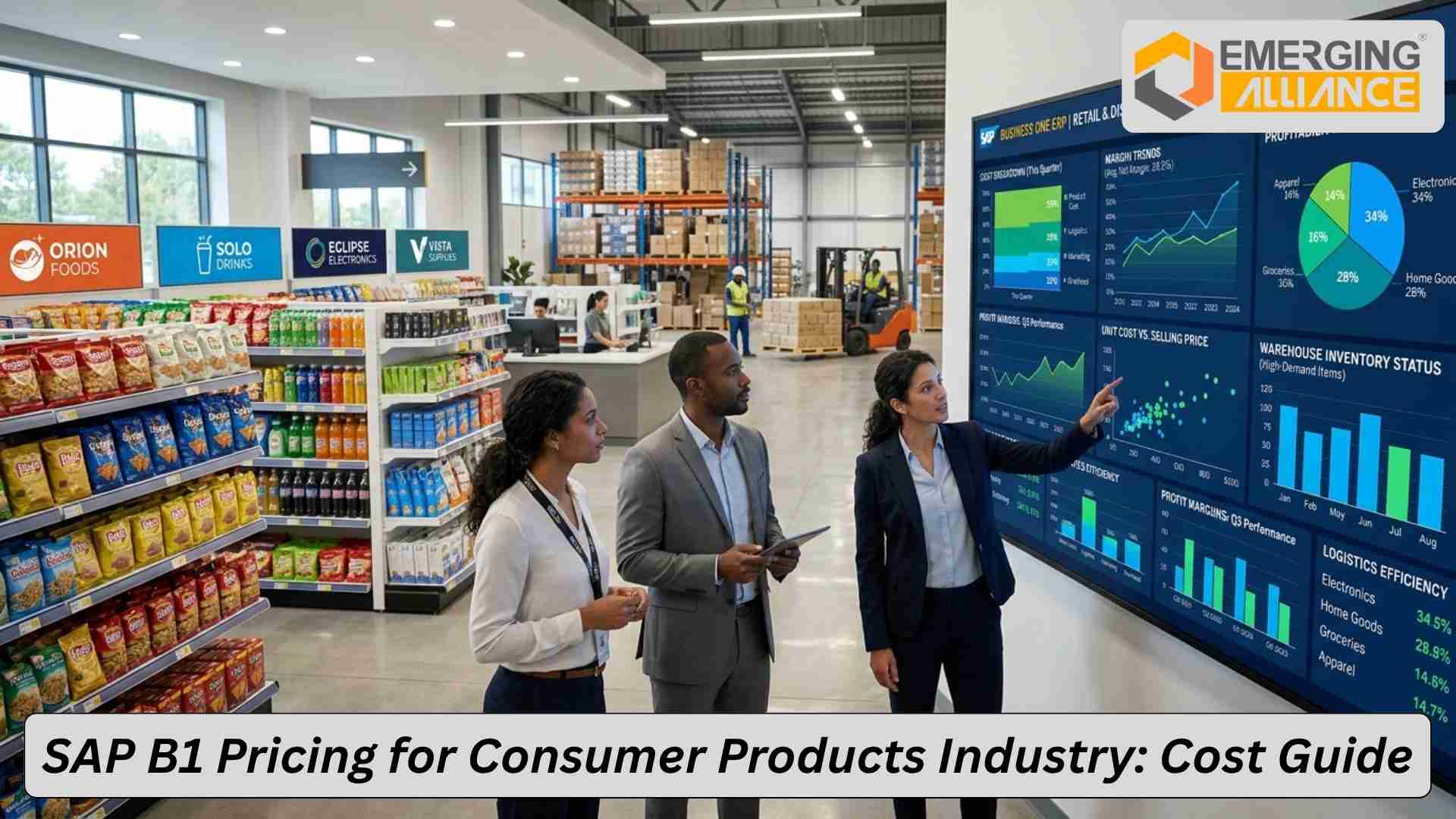
SAP B1 Pricing for Consumer Products Industry: Cost Guide
SAP B1 Pricing for Consumer Products Industry: Complete ERP Cost Guide
Consumer products companies operate in a fast-moving environment where demand fluctuates, inventory must be managed precisely, and margins are tight. Many businesses struggle with disconnected systems that lead to inefficiencies and delays. This is where SAP B1 Pricing for Consumer Products Industry becomes an important consideration. Understanding ERP costs helps businesses plan better and choose the right solution for long-term growth.
Overview
ERP cost structure
SAP Business One pricing typically includes software licensing, implementation, and ongoing maintenance. The pricing varies based on business size and requirements.
Flexible deployment options
Businesses can choose between cloud-based and on-premise deployment depending on budget and IT infrastructure.
Scalable solution
The system grows with your business, making it suitable for both small and mid-sized consumer product companies.
Cost Components
License cost
SAP B1 offers two main license types: Professional and Limited. Professional licenses provide full access, while limited licenses are role-based.
Implementation cost
This includes system setup, customization, and data migration. Costs depend on project complexity.
Add-ons and customization
Industry-specific add-ons may increase overall cost but improve functionality.
Training and support
Employee training and ongoing support are essential for smooth operations and long-term success.
Deployment Options
Cloud ERP pricing
Cloud deployment involves subscription-based pricing with lower upfront costs.
On-premise pricing
Requires higher initial investment but offers complete control over data and infrastructure.
Hybrid model
Some businesses choose a hybrid approach to balance flexibility and control.
Key Features
Inventory management
Track stock levels in real time and reduce overstocking or stockouts.
Sales and distribution
Manage orders, pricing, and customer relationships efficiently.
Financial management
Automate accounting, reporting, and compliance processes.
Production planning
Optimize manufacturing schedules and resource utilization.
Benefits
Improved efficiency
Automation reduces manual work and speeds up processes.
Better decision-making
Real-time insights help managers make informed decisions.
Cost control
Identify unnecessary expenses and improve profit margins.
Enhanced customer satisfaction
Faster order processing and accurate deliveries improve customer experience.
Factors Affecting Cost
Company size
Larger organizations require more users and advanced features, increasing cost.
Business complexity
More complex operations require additional customization and integration.
Number of users
Pricing increases with the number of licenses required.
Integration requirements
Connecting with other systems may add to implementation cost.
SAP B1 Pricing for Consumer Products Industry ROI Analysis
Reduced operational costs
Automation reduces labor and operational expenses.
Increased productivity
Employees can focus on strategic tasks instead of manual processes.
Faster time to market
Efficient processes help launch products quickly.
Scalable growth
Businesses can expand without changing systems.
SAP B1 Pricing for Consumer Products Industry Comparison with Other ERPs
Affordability
Compared to large enterprise ERP systems, SAP B1 is more cost-effective.
Ease of use
User-friendly interface reduces training time.
Industry relevance
Designed specifically for small and medium-sized businesses.
Customization flexibility
Supports industry-specific requirements through add-ons.
SAP B1 Pricing for Consumer Products Industry Implementation Tips
Choose the right partner
Selecting an experienced implementation partner ensures success.
Define clear objectives
Set goals before implementation to measure success.
Train your team
Ensure employees understand how to use the system effectively.
Plan for scalability
Choose features that support future growth.
Conclusion: SAP B1 Pricing for Consumer Products Industry
Understanding SAP B1 pricing for the consumer products industry is essential for making a smart ERP investment. By evaluating key cost components—such as licensing, implementation, customization, and ongoing support—businesses can select a solution that perfectly aligns with their budget and operational goals.
Whether you choose cloud or on-premise deployment, SAP Business One offers the flexibility and scalability needed to thrive in a competitive market. With the right partner like Emerging Alliance, your ERP investment becomes a strategic advantage—driving efficiency, smarter decision-making, and long-term business growth.
Ultimately, consumer product companies that leverage SAP B1 with the right guidance can stay agile, reduce costs, and gain a powerful competitive edge.
Frequently Asked Questions About SAP B1 Pricing for Consumer Products Industry
1. What are the key cost components of SAP B1 for the consumer products industry?
SAP B1 pricing includes user-based licensing (Professional and Limited), implementation services (configuration, data migration, and testing), industry-specific customizations (batch management, SKU tracking, formula management), deployment infrastructure (cloud or on-premise), and annual maintenance or support fees. The total cost is influenced by the scale of operations and integration complexity.
2. How does SAP B1 pricing vary between small and mid-sized consumer product companies?
Small companies typically adopt cloud subscription models with core modules, resulting in lower upfront investment. Mid-sized companies often require advanced modules for production planning, multi-warehouse inventory, CRM, and analytics, increasing the overall TCO (Total Cost of Ownership).
3. What factors significantly impact SAP B1 pricing in consumer products?
Key factors include the number of users, deployment type (cloud vs on-premise), level of customization (e.g., formula tracking, batch expiry monitoring), multi-location operations, integration with third-party systems (logistics, e-commerce, POS), and compliance requirements for labeling and safety standards.
4. Can SAP B1 handle complex inventory and batch management?
Yes, SAP B1 supports real-time inventory tracking, batch and serial number management, automated reordering, and expiration monitoring. It is particularly useful for consumer products with short shelf-life, multiple SKUs, and high-volume distribution.
5. How does SAP B1 improve ROI for consumer product companies?
ROI is realized through reduced inventory wastage, optimized production and distribution, faster order fulfillment, and improved financial visibility. Most companies observe measurable efficiency gains and cost savings within 12–18 months post-implementation.
6. Is cloud deployment more cost-effective than on-premise for consumer products?
Cloud deployment minimizes upfront infrastructure costs, supports subscription-based payment models, and enables rapid scaling. On-premise deployment may be preferred for companies with strict data security requirements or complex legacy system integrations, though it involves higher initial capital expenditure.
7. How long does SAP B1 implementation typically take?
Implementation timelines range from 4 to 12 weeks for small companies and 3–6 months for mid-sized companies with complex operations, multi-warehouse setups, or extensive integrations.
8. Does SAP B1 require technical expertise for consumer product companies?
While SAP B1 is user-friendly, proper training in inventory management, production planning, and reporting is recommended. Partner-led implementation ensures knowledge transfer and smooth adoption.
9. Can SAP B1 integrate with existing systems?
Yes, SAP B1 integrates with ERP, CRM, e-commerce platforms, logistics software, and other third-party applications, providing a unified operational view across sales, inventory, and finance.
10. What strategies can consumer product companies use to optimize SAP B1 costs?
Strategies include phased implementation starting with critical modules, choosing the right mix of Professional and Limited licenses, minimizing excessive customization, leveraging cloud deployment, and engaging experienced SAP partners to reduce implementation delays and maximize ROI.