
SAP B1 Pricing for Automotive Industry: ERP Cost Guide
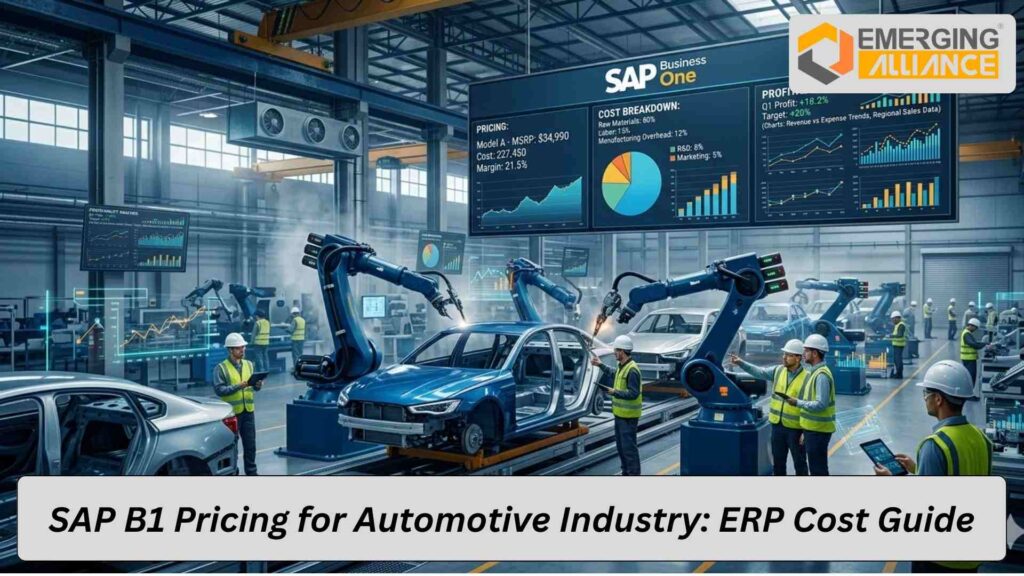
SAP B1 Pricing for Automotive Industry: ERP Cost Guide for Smarter Operations
The automotive sector is evolving rapidly, with increasing demand for precision manufacturing, supply chain efficiency, and real-time decision-making. Businesses in this industry often struggle with managing production costs, inventory, vendor coordination, and compliance. This is where SAP B1 Pricing for Automotive Industry becomes a critical consideration, helping companies adopt a robust ERP solution while understanding the cost implications.
In this guide, we break down pricing, components, and value to help automotive businesses make informed ERP investment decisions.
Overview
pricing structure
SAP Business One pricing is flexible and depends on several components such as licensing, deployment type, and customization needs. Automotive companies can choose between cloud-based or on-premise models based on operational scale.
license types
- Professional License – Full access for managers and decision-makers
- Limited License – Restricted access for specific roles like logistics or finance
- Indirect Access – For integrations with other systems
deployment options
- Cloud ERP – Lower upfront cost, subscription-based
- On-premise ERP – Higher initial investment but full control
Understanding these elements helps businesses estimate the total ERP cost effectively.
Cost Components
software licensing cost
Licensing is one of the primary expenses. It varies based on the number of users and type of access required.
implementation cost
This includes system setup, configuration, data migration, and testing. Automotive companies with complex workflows may incur higher costs.
customization cost
Automotive businesses often need tailored modules for production planning, quality control, and supplier management.
training and support
Employee training and ongoing support ensure smooth ERP adoption and system efficiency.
maintenance cost
Annual maintenance typically includes updates, security patches, and technical support.
Factors Affecting Cost
business size and complexity
Larger automotive companies with multiple plants and warehouses will require more extensive ERP setups.
number of users
The cost increases with the number of users accessing the system.
integration requirements
Integration with manufacturing systems, CRM, or third-party tools adds to the cost.
industry-specific customization
Automotive workflows such as batch tracking, compliance, and quality checks may require additional development.
Benefits
real-time data visibility
ERP systems provide instant access to production, inventory, and financial data.
improved supply chain management
Automotive companies can track suppliers, shipments, and inventory efficiently.
cost control and optimization
Accurate data helps reduce wastage and improve budgeting.
regulatory compliance
Automotive businesses must adhere to strict regulations, and ERP ensures compliance through automated reporting.
scalability
SAP B1 grows with your business, supporting expansion without system limitations.
Automotive Industry vs Traditional Systems
manual processes vs automation
Traditional systems rely on spreadsheets and disconnected tools, leading to inefficiencies.
data accuracy
ERP eliminates duplication and reduces errors.
operational efficiency
Automated workflows save time and improve productivity.
decision-making capability
Real-time insights enable faster and smarter decisions.
SAP B1 Pricing for Automotive Industry ROI Analysis
initial investment vs long-term gain
While ERP implementation requires upfront investment, the long-term benefits outweigh the costs.
productivity improvement
Automation reduces manual work and increases efficiency.
inventory optimization
Better inventory tracking reduces overstocking and shortages.
revenue growth
Improved operations lead to higher customer satisfaction and increased sales.
SAP B1 Pricing for Automotive Industry Implementation Tips
choose the right partner
Selecting an experienced ERP partner ensures smooth implementation.
define clear objectives
Identify business goals before implementing ERP.
plan budget carefully
Include hidden costs like training and maintenance.
train employees effectively
Proper training ensures better adoption and usage.
monitor performance regularly
Evaluate system performance and optimize processes continuously.
Conclusion: Maximizing Value from SAP B1 Pricing for Automotive Industry
SAP B1 Pricing for Automotive Industry is not just about the initial investment—it’s about unlocking long-term business value. From streamlining operations to enabling smarter, data-driven decisions, the right ERP strategy can significantly transform your automotive business performance.
By understanding pricing components, key cost drivers, and expected ROI, businesses can make confident, growth-focused decisions. This is where Emerging Alliance stands out as your trusted SAP Business One partner. With deep industry expertise and a customer-centric approach, Emerging Alliance helps automotive companies implement the right solution at the right cost—ensuring maximum return on investment.
Partnering with Emerging Alliance means more than just ERP implementation—it’s about building a future-ready, efficient, and scalable automotive business that thrives in a competitive market.
Frequently Asked Questions About SAP B1 Pricing for Automotive Industry
1. What are the key cost components in SAP B1 pricing for the automotive industry?
SAP Business One pricing for automotive companies includes user-based licensing (Professional and Limited), deployment costs (cloud or on-premise), implementation services (configuration, data migration, and testing), and industry-specific customizations such as production planning, supplier integration, and quality management. Total Cost of Ownership (TCO) also includes annual maintenance, upgrades, and ongoing support.
2. How does SAP B1 pricing vary across automotive OEMs, suppliers, and distributors?
Pricing differs significantly based on business type. OEMs and Tier-1 suppliers require advanced modules for production planning, quality control, and supply chain integration, leading to higher costs. Distributors and dealers may require fewer modules, resulting in comparatively lower implementation and licensing expenses.
3. What factors significantly influence SAP B1 pricing in automotive businesses?
Key factors include the number of users, complexity of manufacturing processes, level of customization (such as just-in-time production or vendor scheduling), integration with third-party systems (MES, PLM, CRM), deployment model, and regulatory compliance requirements.
4. How does SAP B1 support complex automotive manufacturing processes?
SAP B1 manages multi-level Bill of Materials (BOM), routing, and production workflows, supporting discrete manufacturing environments. It enables real-time production tracking, shop floor control, and synchronization with supply chain activities to ensure efficient manufacturing operations.
5. What is the role of licensing in SAP B1 pricing?
Licensing plays a critical role in overall cost. Professional licenses provide full system access for managers and decision-makers, while Limited licenses offer role-based access for departments like finance, logistics, or sales. Optimizing license allocation helps control overall ERP investment.
6. What hidden or indirect costs should automotive companies consider?
Hidden costs may include integration with legacy systems, customization for automotive-specific workflows, data migration, employee training, infrastructure setup (for on-premise), and ongoing support or cloud subscription fees. Proper planning helps avoid budget overruns.
7. How does SAP B1 integrate with automotive manufacturing and supply chain systems?
SAP B1 integrates with Manufacturing Execution Systems (MES), Product Lifecycle Management (PLM), supplier portals, and logistics platforms. This ensures seamless data flow across production, procurement, and distribution, enabling real-time visibility and coordination.
8. Is cloud deployment more cost-effective for automotive companies?
Cloud deployment reduces initial capital expenditure, eliminates infrastructure costs, and provides scalability for growing operations. However, long-term subscription costs should be evaluated against on-premise deployment based on business size and IT strategy.
9. What is the typical implementation timeline and its impact on cost?
Implementation timelines typically range from 3 to 6 months for mid-sized automotive companies and can extend to 9–12 months for complex operations. Delays due to customization or integration can increase costs, making structured planning and phased implementation essential.
10. What strategies can automotive companies use to optimize SAP B1 costs?
Cost optimization strategies include adopting phased implementation, selecting only essential modules initially, minimizing heavy customization, leveraging standard SAP functionalities, optimizing user license mix, and partnering with experienced SAP consultants to ensure efficient deployment and faster ROI.