
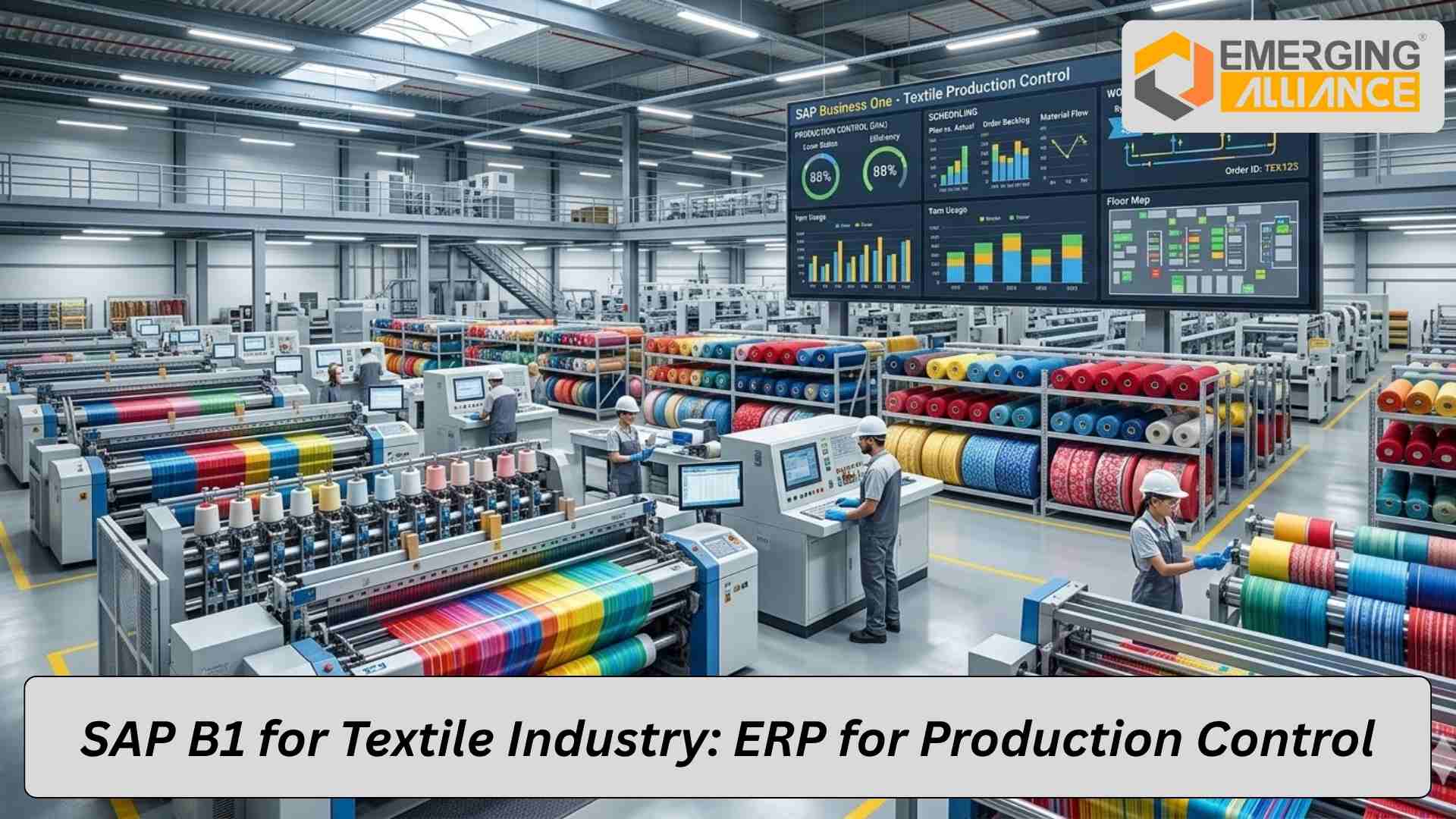
SAP B1 for Textile Industry: ERP for Production Control
SAP B1 for Textile Industry: Production & Inventory ERP
The textile industry is one of the most dynamic and complex sectors, involving multiple processes such as spinning, weaving, dyeing, and distribution. Managing these operations efficiently can be challenging without a centralized system. This is where SAP B1 for Textile Industry becomes essential, offering a powerful ERP solution that integrates production, inventory, and financial processes into one platform.
Production Management
real-time production tracking
Textile manufacturers often struggle with monitoring production stages. SAP B1 enables real-time tracking of each process, from raw material input to finished goods.
bill of materials accuracy
Managing multiple product variations requires precise BOM handling. The system ensures accurate material planning and reduces wastage.
production scheduling optimization
With automated scheduling, businesses can plan workloads effectively, reducing downtime and improving efficiency.
Inventory Control
raw material visibility
Tracking yarn, dyes, and fabrics becomes easier with centralized inventory management.
warehouse management
Multiple warehouses can be managed seamlessly, ensuring stock availability across locations.
stock optimization
SAP B1 minimizes overstocking and understocking through demand forecasting and inventory alerts.
Supply Chain Efficiency
vendor management
Maintain supplier data, track performance, and ensure timely procurement of materials.
order fulfillment
Automated workflows help process customer orders quickly and accurately.
logistics coordination
Streamline shipping and delivery operations with integrated logistics tracking.
Quality Control
batch tracking
Monitor quality at every stage of production with batch-wise tracking.
defect management
Identify and resolve defects early to maintain product standards.
compliance support
Ensure adherence to industry regulations and quality standards.
Financial Management
cost control
Track production costs in real time to improve profitability.
financial reporting
Generate detailed reports for better decision-making.
budget management
Plan and control expenses effectively with integrated financial tools.
Benefits for Businesses
improved efficiency
Automation reduces manual work and speeds up operations.
better decision making
Access to real-time data helps in making informed business decisions.
scalability
The system grows with your business, supporting expansion.
SAP B1 for Textile Industry – Practical Use Cases
small textile manufacturers
Gain control over inventory and production without heavy investment.
medium enterprises
Improve coordination between departments and optimize workflows.
large textile businesses
Manage complex operations and multiple locations efficiently.
SAP B1 for Textile Industry – Implementation Strategy
needs assessment
Understand business requirements before implementation.
customization planning
Tailor the ERP system to suit textile-specific processes.
training and adoption
Ensure employees are trained to use the system effectively.
Conclusion: Transforming Textile Operations with SAP B1
SAP B1 for Textile Industry offers a powerful and integrated ERP solution designed to streamline production, inventory, and financial management. By unifying all core business processes into a single platform, textile companies gain real-time visibility, improved operational control, and data-driven decision-making capabilities. This not only enhances efficiency but also reduces costs and minimizes errors across the value chain.
With its scalability and industry-specific functionalities, SAP Business One empowers textile businesses to adapt to market demands, maintain quality standards, and drive sustainable long-term growth.
With the expertise of Emerging Alliance, businesses can unlock the full potential of SAP Business One through tailored implementation, seamless integration, and ongoing support. As a trusted technology partner, Emerging Alliance ensures that textile enterprises not only adopt ERP successfully but also leverage it for continuous innovation, adaptability to market trends, and sustainable long-term growth.
Frequently Asked Questions About SAP Business One for Textile Industry
1. How does SAP B1 support end-to-end textile manufacturing operations?
SAP Business One enables end-to-end textile process management by integrating spinning, weaving, dyeing, finishing, inventory, procurement, and financial operations into a single platform. It ensures seamless coordination across production stages while improving visibility and control over the entire value chain.
2. How scalable is SAP B1 for small and mid-sized textile businesses?
SAP B1 is highly scalable, allowing small textile units to start with core modules such as inventory and finance, and expand into advanced functionalities like production planning, quality control, and analytics as the business grows.
3. How does SAP B1 optimize textile inventory management?
SAP B1 provides real-time tracking of raw materials (yarn, fibers), work-in-progress (WIP), and finished goods. It supports batch tracking, lot management, and demand forecasting, helping reduce excess stock, minimize wastage, and ensure accurate inventory control.
4. Can SAP B1 handle complex textile production workflows?
Yes. SAP B1 supports multi-stage production processes including spinning, knitting, weaving, dyeing, printing, and finishing. It manages multi-level Bill of Materials (BOM), routing, and work orders to ensure efficient production execution.
5. How does SAP B1 improve cost control in textile manufacturing?
SAP B1 tracks material consumption, labor costs, machine utilization, and overheads at each production stage. It provides real-time cost analysis and variance reporting, enabling textile manufacturers to control expenses and improve profitability.
6. How does SAP B1 support quality control and compliance in textiles?
The system enables quality inspections at different production stages, tracks defects, and ensures compliance with industry standards. Batch traceability and testing records help maintain product consistency and meet customer requirements.
7. What deployment options are available for textile businesses?
SAP B1 supports both cloud and on-premise deployment. Cloud deployment offers flexibility, scalability, and lower upfront costs, while on-premise deployment provides greater control over data and infrastructure.
8. How does SAP B1 integrate with textile machinery and external systems?
SAP B1 can integrate with textile machinery, IoT devices, and third-party applications such as CRM, accounting, and supply chain systems. This enables real-time data capture from production floors and improves decision-making.
9. What is the typical implementation timeline for textile companies?
Implementation timelines typically range from 3 to 6 months for small to mid-sized textile businesses and can extend to 6–9 months for complex operations involving multiple production units and integrations.
10. What factors influence SAP B1 cost for textile industry?
Cost depends on the number of users, modules selected, customization requirements (such as process-specific workflows), integration needs, and deployment type. Additional factors include training, data migration, and ongoing support services.