

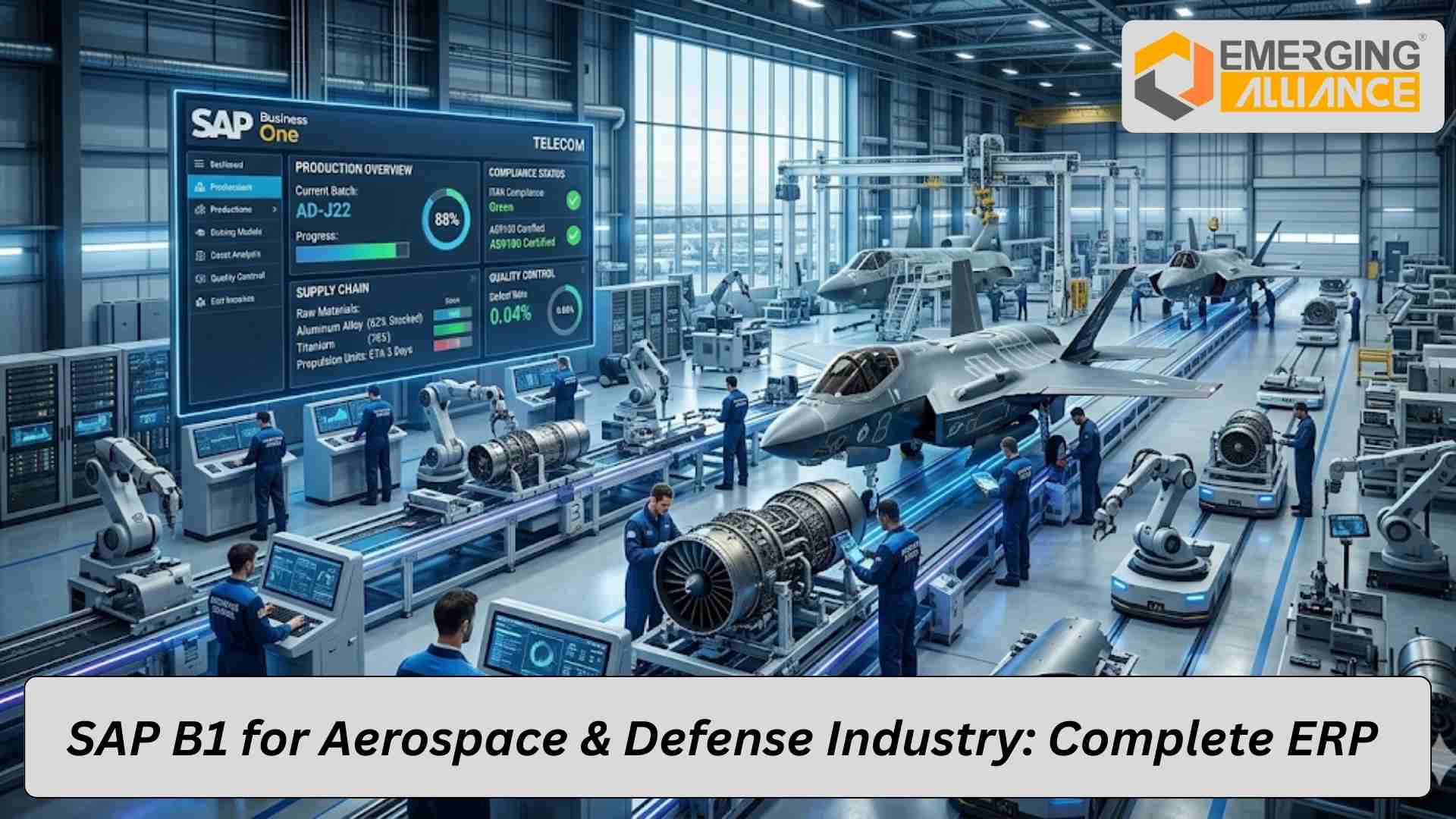
SAP B1 for Aerospace & Defense Industry: Complete ERP
SAP B1 for Aerospace & Defense Industry: Complete ERP Solutions Guide
The aerospace and defense sector operates under extreme precision, strict regulations, and complex supply chains. Managing production timelines, compliance requirements, and cost control manually can lead to inefficiencies and risks. This is where SAP B1 for Aerospace & Defense Industry becomes a powerful ERP solution, enabling businesses to streamline operations, maintain compliance, and improve decision-making through real-time data.
Industry Challenges
Regulatory compliance
Aerospace and defense companies must comply with strict standards such as AS9100 and government regulations.
Complex supply chains
Multiple vendors, global sourcing, and long procurement cycles make supply chain visibility critical.
Production precision
Manufacturing components requires zero-error tolerance and accurate tracking of materials and processes.
Cost management
Projects often involve high-value contracts where cost overruns can impact profitability.
Traceability requirements
Complete traceability of materials and components is essential for safety and audits.
Key Features
Integrated operations
SAP Business One integrates finance, procurement, inventory, and production into one system.
Real-time analytics
Gain insights into production, costs, and supply chain performance instantly.
Batch and serial tracking
Track every component throughout the manufacturing lifecycle.
Quality control management
Ensure strict quality checks at every stage of production.
Document management
Store and manage compliance documents, certifications, and contracts centrally.
Production Planning
Advanced scheduling
Plan production based on real-time demand and resource availability.
Material requirement planning
Ensure the right materials are available at the right time to avoid delays.
Work order management
Track every stage of manufacturing with detailed work orders.
Capacity planning
Optimize machine and labor utilization efficiently.
With SAP B1 for Aerospace & Defense Industry, manufacturers can reduce downtime and improve operational efficiency significantly.
Inventory Management
Real-time inventory tracking
Monitor stock levels across multiple warehouses.
Lot traceability
Track materials from procurement to final product delivery.
Automated stock replenishment
Avoid shortages and overstocking with automated alerts.
Warehouse management
Improve picking, packing, and shipping processes.
Efficient inventory control ensures uninterrupted production and compliance with industry standards.
Compliance & Quality
Regulatory compliance support
Maintain records required for audits and certifications.
Quality assurance processes
Implement quality checks at every stage of production.
Audit trails
Track every transaction and change within the system.
Risk management
Identify and mitigate risks proactively.
This ERP for aerospace manufacturing ensures companies stay compliant while maintaining high-quality standards.
Financial Management
Cost tracking
Monitor project costs in real time.
Budget control
Set budgets and track deviations easily.
Financial reporting
Generate detailed financial reports for better decision-making.
Multi-currency support
Handle international transactions seamlessly.
By integrating financial data, businesses gain complete visibility into profitability.
SAP B1 for Aerospace & Defense Industry: Supply Chain Optimization
Vendor management
Evaluate supplier performance and reliability.
Procurement automation
Streamline purchasing processes.
Demand forecasting
Predict future demand using historical data.
Logistics tracking
Monitor shipments and deliveries in real time.
A strong supply chain ensures timely project completion and customer satisfaction.
SAP B1 for Aerospace & Defense Industry: Benefits
Improved efficiency
Automate processes and reduce manual errors.
Better decision-making
Access real-time data and analytics.
Enhanced compliance
Meet regulatory requirements easily.
Scalability
Grow operations without system limitations.
Cost reduction
Optimize resources and reduce waste.
SAP B1 for Aerospace & Defense Industry: Implementation Tips
Define business requirements
Identify key challenges and goals before implementation.
Choose the right partner
Work with experienced SAP implementation experts.
Train employees
Ensure staff understands the system for maximum efficiency.
Customize workflows
Adapt the ERP system to match business processes.
Monitor performance
Continuously evaluate system performance and optimize usage.
Conclusion: SAP Business One for Aerospace & Defense Industry
SAP Business One for the Aerospace & Defense industry stands out as a robust and intelligent ERP solution designed to meet the sector’s most demanding challenges—from complex manufacturing and stringent compliance to dynamic supply chain operations. By unifying all critical business functions into a single, streamlined platform, it drives operational excellence, improves product quality, and delivers real-time insights for smarter decision-making.
At Emerging Alliance, we specialize in implementing SAP Business One solutions tailored to the unique needs of aerospace and defense organizations. With our deep industry expertise and customer-centric approach, we help businesses accelerate digital transformation, optimize performance, and unlock sustainable growth. Partner with Emerging Alliance to elevate your operations and stay ahead in an increasingly competitive and regulated landscape.
Frequently Asked Questions About SAP Business One for Aerospace & Defense
1. What determines SAP B1 pricing for telecommunications companies?
SAP Business One pricing in telecom depends on multiple factors: number and type of user licenses (Professional vs Limited), deployment model (cloud vs on-premise), level of industry-specific customization (billing, subscription management, network analytics), integration with legacy systems (CRM, OSS/BSS, ERP), data migration requirements, and ongoing support and maintenance costs. Total Cost of Ownership (TCO) must also account for upgrades, training, and regulatory compliance features.
2. How does SAP B1 handle complex telecom billing and subscription models?
SAP B1 can be customized to manage recurring billing, multi-tier subscription plans, usage-based charging, and postpaid/prepaid services. Its integration with OSS/BSS systems ensures seamless invoicing, accurate revenue recognition, and real-time financial reconciliation, reducing errors and enhancing cash flow visibility.
3. How scalable is SAP B1 for small and mid-sized telecom operators?
SAP B1 is highly scalable, allowing small telecom operators to start with essential modules such as finance, CRM, and inventory, and gradually expand to billing, network management, and analytics. Its modular architecture supports multi-location operations, increasing user count, and handling high transaction volumes as the business grows.
4. What role does deployment choice play in SAP B1 pricing for telecom?
Cloud deployment offers lower upfront costs, automatic updates, and remote access for distributed telecom operations, making it ideal for startups and regional operators. On-premise deployment, while requiring higher capital expenditure, provides greater control over sensitive network and subscriber data, which can be critical for regulatory compliance in the telecom sector.
5. How does SAP B1 integrate with existing telecom systems?
SAP B1 can integrate with CRM platforms, network management systems, OSS/BSS solutions, and third-party ERP tools via APIs or middleware. This ensures seamless data flow between subscriber management, network usage, inventory, and finance, enabling real-time reporting and consolidated decision-making.
6. What factors affect SAP B1 implementation complexity in telecom?
Implementation complexity depends on the size of the operator, number of users, complexity of billing models, legacy system integration, regulatory reporting needs, multi-location operations, and custom workflows. Advanced telecom operations may require additional modules for SLA tracking, contract management, and service provisioning automation.
7. Can SAP B1 support regulatory compliance and audit requirements?
Yes. SAP B1 enables audit-ready reporting for financials, taxation, and telecom-specific compliance such as TRAI regulations. It maintains detailed logs for subscriber billing, revenue recognition, and inventory movements, helping operators meet legal requirements and internal governance standards.
8. How does SAP B1 improve operational efficiency in telecom companies?
SAP B1 centralizes subscriber, network, finance, and inventory data in real-time, reducing manual data entry, eliminating duplicate processes, and providing actionable insights. It supports automated workflows for billing, order management, and procurement, improving resource utilization and lowering operational costs.
9. What is the typical timeline for SAP B1 implementation in telecom?
Implementation generally ranges from 3–6 months for small to mid-sized operators, but can extend to 9–12 months for large enterprises with multi-region operations, complex billing systems, and extensive integrations. Phased rollouts and change management strategies help ensure minimal disruption.
10. What strategic benefits do telecom companies gain from SAP B1?
Telecom companies benefit from SAP B1 by gaining real-time operational visibility, accurate revenue tracking, better customer experience through faster and error-free billing, improved compliance, and data-driven decision-making. It also supports digital transformation initiatives by integrating network operations, CRM, and financial processes into a unified platform.