
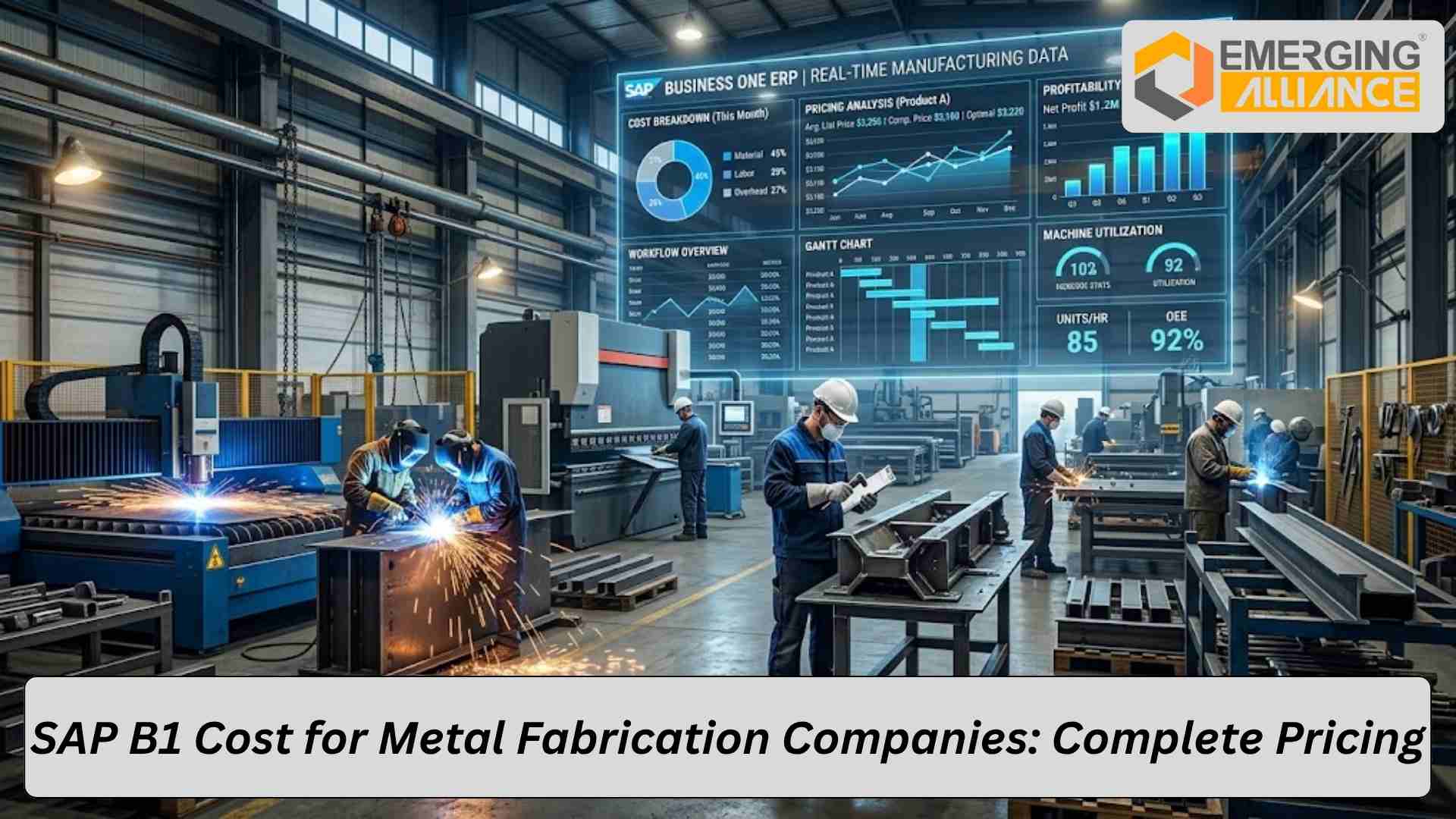
SAP B1 Cost for Metal Fabrication Companies: Complete Pricing
SAP B1 Cost for Metal Fabrication Companies: Complete Pricing Guide
\The metal fabrication industry operates in a fast-paced environment where precision, cost control, and operational efficiency are critical. Many companies struggle with disconnected systems, manual processes, and lack of real-time insights. This is where SAP B1 Cost for Metal Fabrication Companies becomes an important consideration, helping businesses invest in the right ERP solution while maximizing returns.
Understanding pricing is not just about cost—it’s about value, scalability, and long-term growth.
Why Pricing Matters
Cost visibility
Knowing the total ERP investment helps businesses plan budgets effectively and avoid unexpected expenses.
Strategic investment
ERP is not just software but a long-term asset that improves productivity and profitability.
Competitive advantage
Companies that invest wisely in ERP gain better control over production, inventory, and customer management.
Pricing Components
License cost
SAP Business One offers two types of licenses: Professional and Limited. Professional licenses provide full access, while limited licenses are role-based and more affordable.
Implementation cost
This includes system setup, customization, data migration, and training.
Customization cost
Metal fabrication companies often require tailored workflows for production, costing, and quality control.
Support and maintenance
Ongoing support ensures smooth system performance and updates.
Infrastructure cost
Businesses can choose between on-premise servers or cloud-based deployment, affecting overall pricing.
Estimated Pricing in India
Basic pricing range
SAP B1 typically starts from ₹1.5 lakh to ₹3 lakh per user for licenses.
Implementation range
Implementation costs can range from ₹3 lakh to ₹15 lakh depending on complexity.
Cloud subscription
Monthly cloud pricing may range between ₹3,000 to ₹8,000 per user.
Customization budget
Advanced customizations may increase total investment based on business needs.
Key Features Included
Production planning
Helps manage fabrication processes, job work, and scheduling efficiently.
Inventory management
Tracks raw materials, finished goods, and scrap in real time.
Costing and budgeting
Provides accurate cost calculations for materials, labor, and overheads.
Sales and customer management
Improves order tracking and customer communication.
Financial management
Offers real-time financial reporting and compliance support.
Benefits vs Cost
Improved efficiency
Automation reduces manual work and errors.
Better decision making
Real-time data helps management make informed decisions.
Reduced operational costs
Optimized inventory and production planning lower expenses.
Scalability
The system grows with your business needs.
SAP B1 Cost for Metal Fabrication Companies – Factors Affecting Pricing
Company size
Larger companies require more users and advanced features.
Business complexity
Complex workflows increase customization and implementation costs.
Deployment type
Cloud solutions are subscription-based, while on-premise requires upfront investment.
Integration needs
Connecting with other systems like CRM or MES can increase costs.
SAP B1 Cost for Metal Fabrication Companies – How to Optimize Investment
Choose the right license mix
Combine professional and limited licenses to reduce cost.
Prioritize essential features
Avoid unnecessary customization in the initial phase.
Opt for cloud deployment
Reduce infrastructure and maintenance expenses.
Work with experienced partners
Ensure smooth implementation and better ROI.
SAP B1 Cost for Metal Fabrication Companies – ROI and Long-Term Value
Faster production cycles
Streamlined workflows improve turnaround time.
Inventory optimization
Reduces overstocking and stock shortages.
Accurate costing
Helps maintain profit margins.
Business growth support
ERP enables expansion with better control and visibility.
Conclusion: SAP B1 Cost for Metal Fabrication Companies
Investing in the right ERP system is a crucial step for metal fabrication companies aiming to stay competitive and efficient. Understanding SAP B1 cost helps businesses make informed decisions about pricing, features, and long-term value.
With the right implementation partner like Emerging Alliance, companies can unlock the full potential of SAP Business One. From cost optimization and seamless deployment to ongoing support, Emerging Alliance ensures a smooth ERP journey tailored to your business needs.
By choosing SAP Business One with Emerging Alliance, metal fabrication companies can streamline operations, boost productivity, and achieve a strong return on investment (ROI) while building a scalable foundation for future growth.
Frequently Asked Questions About SAP B1 Cost for Metal Fabrication Companies
1. What is the average SAP B1 cost for metal fabrication companies?
The average SAP Business One cost for metal fabrication companies typically ranges from ₹1.5 lakh to ₹3 lakh per user for licensing, depending on the user type (Professional or Limited). In addition, implementation, customization, and integration costs can significantly increase the total investment based on production complexity and business scale.
2. How scalable is SAP B1 for small and mid-sized fabrication businesses?
SAP B1 is designed for scalability, allowing small fabrication units to start with core modules such as finance and inventory, and expand into advanced capabilities like production planning, job costing, and analytics as operations grow.
3. What are the key factors influencing SAP B1 pricing in metal fabrication?
Pricing is influenced by multiple factors including number of users, complexity of manufacturing processes (job work, custom fabrication), level of customization, integration with CAD/CAM or CNC systems, deployment model, and multi-location requirements.
4. How does deployment choice impact SAP B1 cost structure?
Cloud deployment reduces upfront capital expenditure and offers subscription-based pricing, making it ideal for growing businesses. On-premise deployment requires higher initial investment in infrastructure but provides greater control over system configuration and data security.
5. What is the typical SAP B1 implementation timeline in fabrication industries?
Implementation timelines range from 1 to 3 months for small fabrication units and 3 to 6 months for mid-sized businesses with complex workflows, integrations, and customization requirements.
6. How does SAP B1 support advanced production planning in metal fabrication?
SAP B1 enables real-time production planning with features such as multi-level BOM, routing, work order management, and finite capacity scheduling. This ensures optimal resource utilization, reduced bottlenecks, and improved production efficiency.
7. How does SAP B1 enhance inventory management for fabrication companies?
SAP B1 provides real-time inventory tracking with batch and serial number management, ensuring accurate control over raw materials, work-in-progress, and finished goods. It also supports demand forecasting and automated replenishment.
8. Is customization necessary for metal fabrication businesses?
Customization is often required to align SAP B1 with specific fabrication workflows such as job-based production, subcontracting, and shop floor operations. However, excessive customization should be avoided to control costs and simplify maintenance.
9. What is the expected ROI of SAP B1 for fabrication companies?
ROI is achieved through reduced material wastage, improved production efficiency, accurate job costing, and better decision-making. Most companies experience measurable cost savings and productivity improvements within the first 12–18 months of implementation.
10. What strategies can reduce SAP B1 implementation costs without affecting performance?
Cost optimization strategies include phased implementation, selecting only essential modules, optimizing the mix of Professional and Limited licenses, minimizing heavy customization, and partnering with experienced SAP consultants to ensure efficient deployment and faster ROI.