
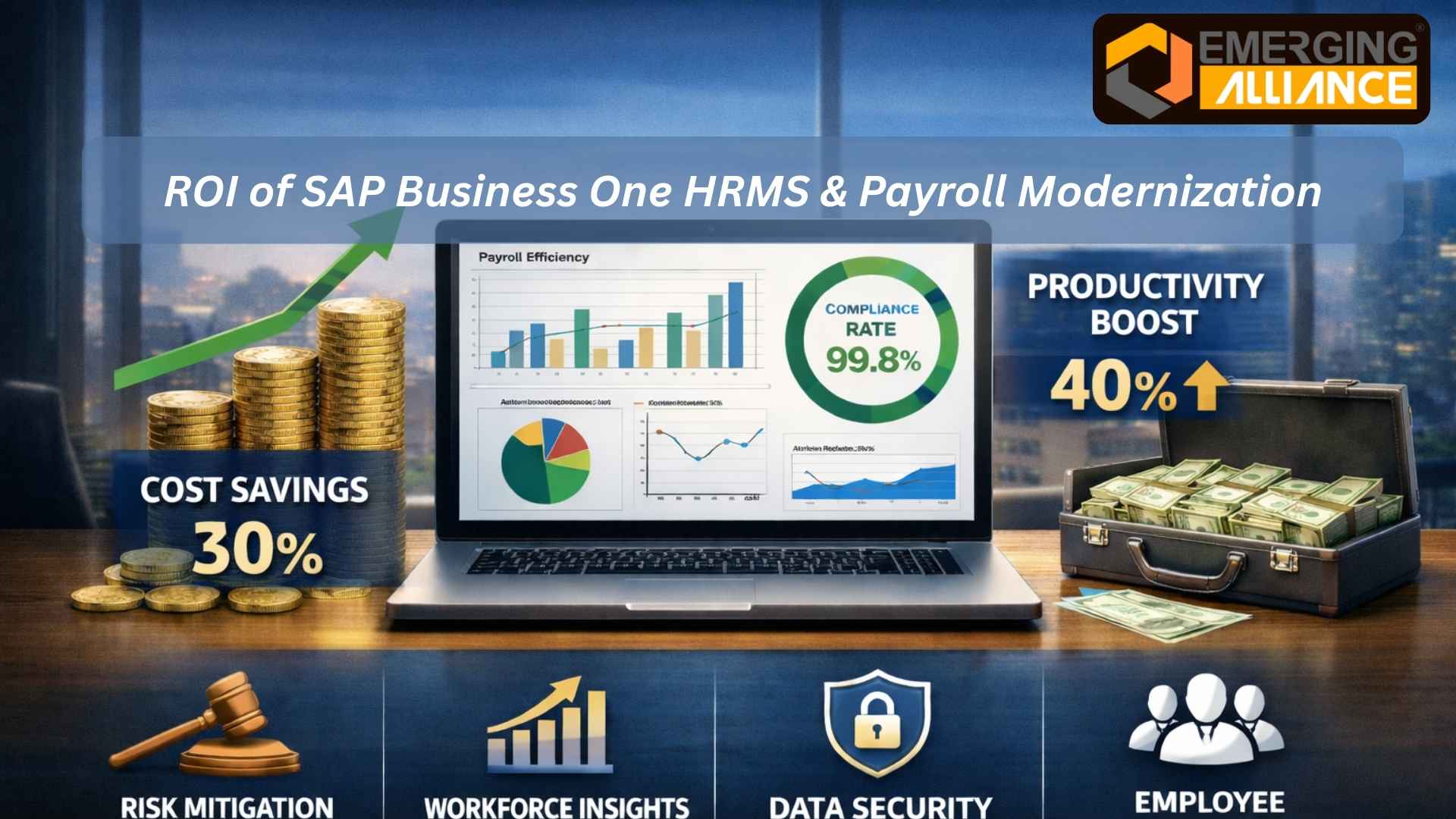
ROI of SAP Business One HRMS & Payroll Modernization
Maximizing Efficiency and Cost Savings Through Modern HR and Payroll Solutions
In many mid-market and enterprise environments, payroll continues to function as a routine back-office activity processed monthly, reviewed during audits, and seldom evaluated as a strategic lever. This operating model is structurally inefficient and financially costly. Beneath routine payroll execution lies systemic weaknesses manual calculation cycles, fragmented HR platforms, and partial ERP integration. These conditions create measurable risk in the form of compliance exposure, margin erosion, limited workforce cost visibility, excessive administrative overhead, and restricted executive insight into labor economics. Modernizing SAP Business One HRMS & Payroll is not a pay slip automation exercise. It is a structural shift toward embedding workforce governance into the financial core of the organization. leading transformation mandates, the critical question is not whether payroll can be automated. The question is: what quantifiable ROI can be realized when HR and payroll are fully integrated within SAP Business One’s financial architecture?
The Strategic Problem Payroll Is a Financial System Not an HR Tool
Across industries — manufacturing, pharma, IT services, distribution, retail — workforce costs represent one of the largest controllable expenses.
Yet many organizations still rely on:
- Standalone payroll software SAP tools
- External software as a service payroll platforms
- Manual spreadsheets for reporting
- Delayed integration with SAP B1 accounting
This creates structural inefficiencies that compound over time.
Industry Challenges Limiting ROI in SAP Business One HRMS & Payroll
1. Compliance and Statutory Risk
Payroll errors are not just operational issues — they are regulatory liabilities.
Disconnected systems increase exposure to:
- Tax miscalculations
- Regional statutory non-compliance
- Audit inconsistencies
- Penalty risk
Without a structured SAP Business One payroll module, compliance becomes reactive instead of controlled.
2. Payroll Errors and Rework
Manual reconciliation between HR systems and SAP B1 accounting leads to:
- Duplicate data entry
- Correction cycles
- Delayed financial closing
- Employee disputes
Every correction consumes administrative bandwidth and reduces productivity.
3. Disconnected Systems and Poor Workforce Visibility
When HR data with SAP Business One is fragmented:
- Workforce cost forecasting becomes inaccurate
- Department-level profitability cannot be analyzed precisely
- Headcount decisions lack financial context
Executives cannot optimize margin without integrated visibility.
4. High Administrative Overhead
Manual reporting, fragmented approvals, and parallel systems increase HR workload.
Modern enterprises require automation — not additional manual controls.
What SAP B1-HRMS & Payroll Modernization Actually Delivers
A properly architected SAP B1 HRMS transforms payroll into a finance-aligned control system.
Core Capabilities of SAP B1-HRMS & Payroll
- Automated payroll processing
- Integrated statutory compliance
- Cost center and project allocation
- Real-time workforce analytics
- Secure role-based access
- Employee self-service portals
The SAP B1 payroll module integrates directly with SAP B1 accounting, eliminating reconciliation gaps.
This is not just payrolling software for SAP Business One — it is ERP-level workforce governance.
How to Quantify the ROI of SAP B1 HRMS & Payroll Solutions
Executives should evaluate ROI across five strategic dimensions:
1. Zero-Defect Payroll Accuracy
Automation reduces dependency on manual calculations, lowering correction cycles and compliance risk.
2. Faster Financial Close
Because payroll integrates with SAP B1 accounting:
- Entries auto-post
- Reconciliation time drops
- Month-end closing accelerates
Time saved equals operational cost reduction.
3. Improved Workforce Cost Transparency
With full HR and payroll integration with SAP B1, leadership gains:
- Department-level payroll visibility
- Cost per revenue employee analysis
- Overtime cost tracking
- Incentive payout evaluation
This enables informed headcount and budgeting decisions.
4. Reduced Administrative Overhead
By consolidating into a unified payroll/HR Management ERP, HR teams:
- Eliminate duplicate data entry
- Automate approvals
- Reduce manual reporting
This improves productivity without increasing headcount.
5. Stronger Compliance and Audit Readiness
Built-in controls and structured workflows reduce regulatory exposure.
For industries like pharma, where payroll software for pharma industry use cases require traceability, ERP integration strengthens audit posture.
Common Reasons SAP Business One HRMS & Payroll Modernization Fails
1. Viewing Payroll as a Tactical Upgrade
Modernization must align with enterprise finance strategy — not just HR needs.
2. Choosing the Wrong SAP Business One Payroll Add On
Not all add-ons provide deep financial integration.
Evaluate:
- GL auto-posting capability
- Cost center mapping
- Workflow configurability
- Security architecture
3. Weak SAP B1 HRMS Implementation Planning
Implementation requires:
- Process diagnostics
- Compliance configuration
- Role-based access design
- Change management
Without governance design, ROI stalls.
ERP-Integrated SAP Business One Payroll vs Standalone SaaS Payroll
When organizations “evaluate the Workday company SAP Business One on payroll” or compare SaaS payroll systems, they often overlook integration cost.
Standalone payroll tools create:
- Financial data silos
- Reporting delays
- Increased reconciliation effort
ERP-integrated payroll ensures one version of truth.
Over time, integration depth drives ROI — not subscription pricing.
Why the Right SAP B1 HRMS & Payroll Consulting Partner Drives ROI
Technology alone does not deliver transformation.
A strategic partner should:
- Assess payroll maturity and integration gaps
- Align HR modules with financial objectives
- Configure modules of HR management ERP for scalability
- Secure sensitive employee data
- Provide long-term optimization support
Implementation vendors deploy software.
Transformation partners engineer governance.
The ROI of SAP B1-HRMS & Payroll depends on execution precision.
Signs It’s Time to Modernize Your SAP Business One HRMS & Payroll
If your organization experiences:
- Payroll reconciliation delays
- Limited workforce cost visibility
- Audit complexity
- Growing headcount without system scalability
Then payroll modernization is no longer optional.
It is a financial strategy.
Book a 30-min call to unlock ROI from SAP B1 HRMS & Payroll modernization – WhatsApp: 90039 40560
FAQs For SAP Business One HRMS & Payroll
1. What is SAP B1-HRMS & Payroll?
An integrated HR and payroll solution embedded within SAP Business One.
2. How does SAP B1 payroll module improve ROI?
By automating payroll, reducing errors, and integrating directly with SAP B1 accounting.
3. Is SAP Business One HRMS scalable for global enterprises?
Yes, it supports multi-entity and multi-location workforce structures.
4. Can SAP B1 payroll management reduce compliance risk?
Yes, through automated statutory configuration and structured audit controls.
5. What industries benefit from SAP B1 HR module?
Manufacturing, pharma, retail, IT services, and distribution sectors.
6. Does SAP B1 employee management system improve visibility?
Yes, it provides real-time workforce analytics inside ERP.
7. How long does SAP B1 HRMS implementation take?
Depends on workforce complexity and compliance requirements.
8. Is SAP Business One payroll module better than standalone payroll software?
For ERP-centric organizations, integrated payroll provides stronger governance and reporting alignment.
9. How secure is SAP Business One HR software?
Role-based permissions and ERP-level security controls protect sensitive data.
10. How do we assess the best HRMS for SAP B1?
Through a structured evaluation of integration depth, compliance needs, and scalability goals.