
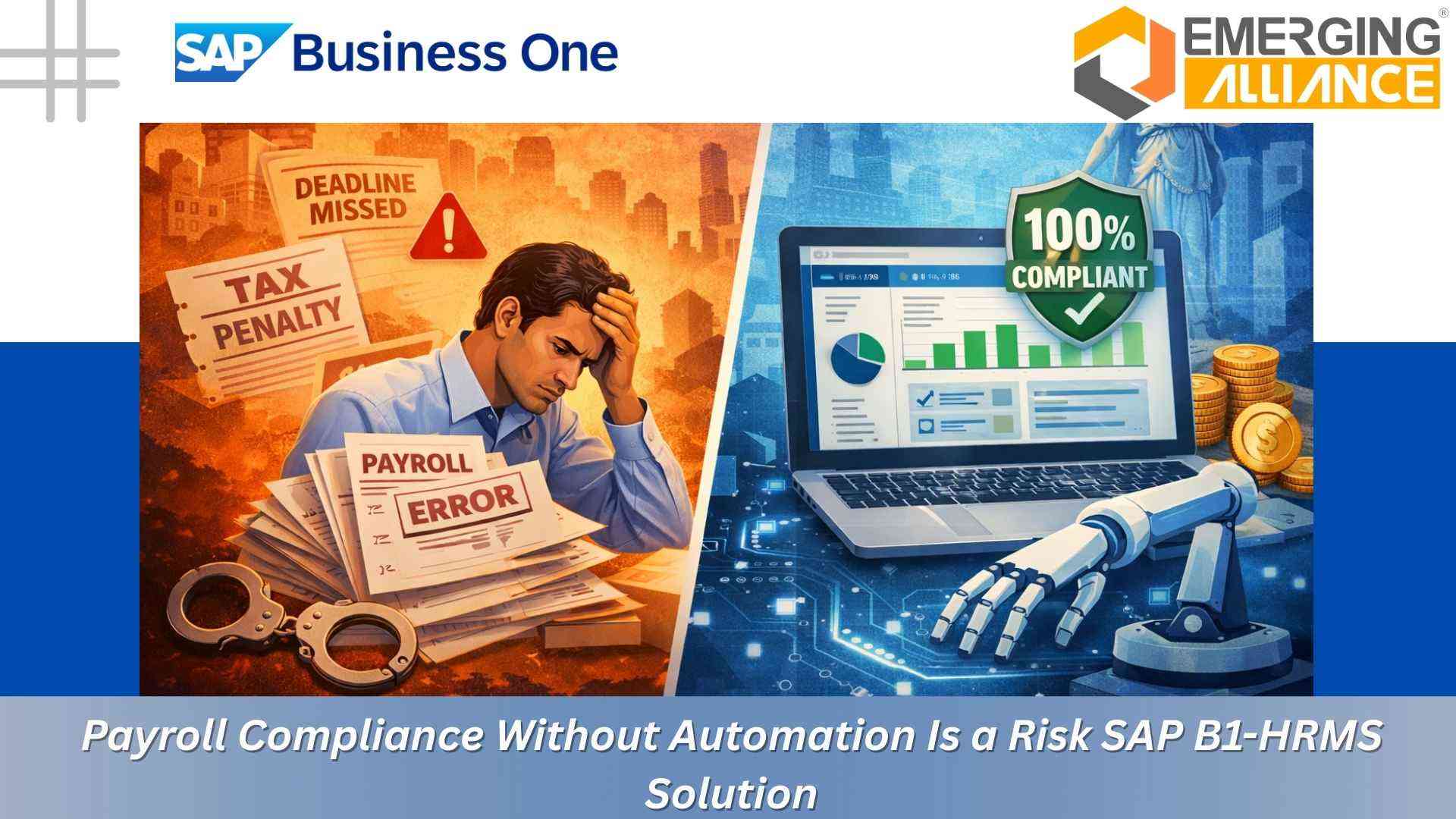
Payroll Compliance Without Automation Is a Risk SAP B1-HRMS Solution
Digitize payroll operations and eliminate statutory reporting errors with SAP Business One HRMS
Your payroll might be leaking money silently. In many organizations, payroll is still managed through spreadsheets, disconnected HR tools, and manual validation processes instead of structured systems like SAP B1-HRMS with payroll. While these approaches may appear functional, they often hide serious compliance gaps and financial risks that impact profitability, operational efficiency, and regulatory readiness. Payroll is not just an HR activity it is a critical financial and compliance function tied directly to revenue protection and enterprise governance.
When payroll operations rely on manual processes, organizations often face:
- Overpayments or underpayments to employees
- Duplicate or ghost employees in payroll records
- Incorrect tax, PF, or ESI calculations
- Payroll reconciliation delays with finance systems
These inefficiencies create financial leakages and compliance exposure that many organizations only discover during audits or regulatory reviews.
This is where SAP B1-HRMS becomes essential. By integrating HR and payroll operations directly within the SAP Business One ERP ecosystem, organizations can transform payroll into a controlled, automated, and compliance-ready process.
The Real Cost of Manual Payroll Operations
Many organizations underestimate the financial impact of payroll inefficiencies. Even small payroll inaccuracies, when multiplied across hundreds or thousands of employees, can quickly escalate into substantial revenue loss.
Common financial risks include:
Overpayments and Underpayments
Manual calculations and spreadsheet-driven payroll systems often result in incorrect salary calculations, allowances, or deductions. Over time, these errors directly affect operating margins and employee trust.
Ghost Employees and Duplicate Records
Without automated validation, payroll systems can contain duplicate or inactive employee records. These “ghost employees” create unnecessary payroll expenses and expose organizations to compliance risks.
Incorrect Tax and Statutory Calculations
Payroll compliance involves multiple statutory obligations including taxes, PF, ESI, and other regulatory deductions. Incorrect calculations can lead to penalties, legal exposure, and regulatory scrutiny.
Payroll Reconciliation Delays
When HR systems are disconnected from finance platforms, payroll teams spend significant time reconciling payroll entries with accounting systems. This slows financial closing cycles and reduces operational visibility.
For enterprises operating across multiple regions or subsidiaries, these issues multiply quickly.
Why CIOs and CXOs Are Prioritizing Payroll Automation
Enterprise leaders increasingly recognize that payroll is not just an HR function—it is a core financial and compliance process.
Modern organizations are therefore shifting toward integrated ERP-based payroll platforms such as SAP Business One HRMS.
By embedding payroll into the ERP environment, organizations gain:
- Real-time payroll validation
- Automated compliance reporting
- Integrated finance and HR data
- Centralized employee management
- Reduced operational risk
With SAP B1 Payroll, payroll processes become data-driven, automated, and audit-ready.
How SAP B1-HRMS Eliminates Payroll Errors and Financial Leakages
SAP B1-HRMS extends the capabilities of SAP Business One by introducing a fully integrated HR and payroll management system designed for modern enterprises.
Instead of relying on disconnected tools, organizations can manage employee data, payroll calculations, compliance reporting, and financial integration within a single platform.
Key capabilities include:
Automated Payroll Processing
The SAP B1 payroll module automates salary calculations, allowances, deductions, and statutory compliance requirements.
This ensures payroll accuracy while reducing the manual workload of HR and finance teams.
Real-Time Payroll Validation
Automated validation workflows prevent errors such as duplicate employees, incorrect salary structures, or invalid deductions.
This significantly reduces payroll reconciliation delays.
Integrated HR and Finance Data
Through HR and payroll integration with SAP B1, payroll entries automatically sync with financial records.
This eliminates manual journal entries and improves financial reporting accuracy.
Compliance-Ready Payroll Calculations
The system ensures accurate calculations for taxes, PF, ESI, and other statutory requirements.
Organizations can generate compliance reports instantly, reducing audit risk.
Centralized Employee Management
The SAP B1 employee management system provides a unified platform for managing employee records, payroll data, and HR workflows.
This improves data accuracy and operational visibility.
Strategic Payroll Governance Through ERP Integration
One of the biggest advantages of HRMS for SAP Business One is the seamless integration between HR operations and financial systems.
Traditional payroll systems often operate in isolation from accounting platforms. This creates delays in reconciliation, inaccurate financial reporting, and limited operational visibility.
With SAP Business One HRMS, payroll becomes part of the broader enterprise ecosystem.
This allows organizations to:
- Align payroll with financial reporting cycles
- Monitor payroll expenses in real time
- Track workforce costs across departments
- Generate financial insights from HR data
By integrating HR data with SAP Business One, organizations gain a powerful platform for managing both employee operations and financial performance.
Payroll Optimization Through SAP B1-HRMS Services
Beyond implementation, organizations can further enhance payroll performance through specialized services such as:
Payroll Audit and Optimization
Payroll audits identify financial leakages, duplicate employee records, and calculation errors.
These insights help organizations improve payroll governance and cost control.
SAP B1-HRMS Implementation
A structured SAP B1 HRMS implementation ensures seamless integration with existing ERP workflows.
This enables organizations to digitize payroll operations without disrupting business processes.
Automated Payroll Validation Workflows
Automated approval and validation workflows reduce the risk of payroll errors and ensure consistent compliance with regulatory requirements.
These workflows help organizations maintain accurate and audit-ready payroll records.
The ROI of Payroll Automation with SAP Business One HRMS
For enterprise leaders, payroll automation is not just about efficiency—it is about protecting revenue and improving operational governance.
Organizations implementing SAP Business One Payroll typically experience:
- Significant reduction in payroll errors
- Lower compliance risk and audit exposure
- Faster payroll processing cycles
- Improved HR productivity
- Better workforce cost visibility
More importantly, payroll automation eliminates financial leakages caused by manual processes.
By transforming payroll into a controlled and automated system, organizations strengthen financial discipline while improving employee satisfaction.
Ready to Eliminate Payroll Risks?
If your organization still relies on manual payroll processes, the financial and compliance risks may already be affecting your operations.
SAP B1-HRMS provides the automation, visibility, and governance required to transform payroll into a reliable enterprise system.
FAQ About SAP Business One HRMS & Payroll
1. How does SAP B1-HRMS help eliminate payroll inefficiencies?
SAP B1-HRMS automates payroll calculations, employee data validation, and statutory deductions. This reduces manual intervention, eliminates payroll errors, and improves processing efficiency.
2. Can SAP B1-HRMS detect duplicate or ghost employees in payroll?
Yes. The system uses centralized employee records and validation workflows to identify duplicate employee profiles or inactive records, preventing unauthorized payroll payments.
3. Does SAP Business One HRMS support real-time payroll verification?
Yes. SAP Business One HRMS provides real-time payroll validation, ensuring payroll calculations are verified before processing and reducing reconciliation delays.
4. How does SAP B1 payroll improve financial control for CXOs?
The SAP B1 payroll module integrates directly with financial accounting, enabling leaders to monitor payroll costs, workforce expenses, and compliance metrics in real time.
5. Can SAP B1-HRMS integrate employee payroll data with SAP B1 accounting?
Yes. Payroll entries automatically synchronize with SAP B1 accounting modules, ensuring accurate financial reporting and eliminating manual journal entries.
6. Is SAP B1-HRMS suitable for organizations operating across multiple locations?
Yes. SAP B1-HRMS supports centralized payroll management for organizations operating across multiple branches or geographic regions.
7. How does SAP B1-HRMS improve payroll audit readiness?
The platform maintains detailed payroll records, automated calculations, and compliance documentation, making audits faster and more transparent.
8. Can SAP Business One HRMS improve workforce analytics?
Yes. The system provides workforce insights such as payroll cost distribution, employee productivity indicators, and departmental HR analytics.
9. How does SAP B1 payroll automation improve employee satisfaction?
Automated payroll processing ensures employees receive accurate salaries on time, improving trust, transparency, and overall employee experience.
10. What strategic benefits do CIOs gain from implementing SAP B1-HRMS?
CIOs benefit from centralized HR data, improved compliance visibility, reduced operational risk, and a scalable HR platform aligned with digital transformation goals.
Request a demo today to see how SAP Business One HRMS can help your organization eliminate payroll errors, improve compliance, and protect revenue.
Fill out the form below to get started with Emerging Alliance