
How SAP B1 for Healthcare Protects Profits Through Inventory Control

SAP B1 for Healthcare prevents losses and strengthens visibility
Healthcare organizations operate in a high-stakes environment where operational efficiency directly affects both patient outcomes and financial stability. Hospitals, clinics, and diagnostic centers manage thousands of medical supplies, pharmaceuticals, and equipment items daily. Without precise inventory visibility, organizations risk expired medications, stock shortages, and unnecessary procurement costs. This is where SAP B1 for Healthcare becomes a powerful operational backbone. By integrating inventory management, financial oversight, and clinical operations into a unified platform, healthcare institutions gain the visibility required to protect margins while maintaining excellent patient care standards.
For modern healthcare providers, inventory management is no longer just a logistics task it is a financial strategy. When implemented correctly, SAP Business One ERP for Healthcare Industry environments provide real-time insight into stock movement, procurement patterns, and clinical usage.
Modern Hospital Operations with SAP Business One ERP for Healthcare Industry
Healthcare organizations increasingly rely on integrated ERP platforms to manage operations beyond clinical systems. A modern Healthcare Enterprise Resource Planning (ERP) environment centralizes procurement, finance, inventory, and reporting processes.
Using SAP Business One ERP for healthcare providers, hospitals and clinics gain operational clarity across departments. The system allows administrators to monitor supply levels, equipment availability, and procurement cycles in a unified interface.
Key operational advantages include:
- Integrated Inventory and supply chain for hospitals
- Streamlined Financial management in healthcare
- Automated workflows that Automate healthcare workflows
- Centralized data for Healthcare administrators ERP solutions
With proper deployment, healthcare facilities can also Improve patient care with SAP B1 by ensuring critical supplies are always available when required.
Emerging Alliance specializes in configuring SAP Business One healthcare software solutions that align ERP operations with clinical priorities.
Inventory Control Using Healthcare-Focused SAP Business One Modules
Inventory mismanagement is one of the most common sources of hidden losses in medical institutions. Expired medications, duplicate orders, and misplaced supplies create silent financial leakage.
The SAP Business One Healthcare Modules framework addresses these issues by introducing structured inventory governance.
Within these Healthcare-specific SAP Business One modules, organizations can manage:
- Batch and serial tracking for pharmaceuticals
- Expiry monitoring and automated alerts
- Centralized procurement tracking
- Multi-location inventory visibility
- Real-time supply consumption tracking
These capabilities transform the ERP into a robust Medical supply chain management software platform.
When properly deployed, SAP Business One with Add-ons for the Healthcare Industry expands functionality to support specialized clinical supply chains such as surgical inventories and diagnostic equipment tracking.
Emerging Alliance engineers tailored configurations that match the operational complexity of small and medium-sized healthcare organizations.
Financial Protection Through SAP B1 for Healthcare Accounting Systems
Healthcare organizations operate under strict financial controls, regulatory compliance requirements, and cost pressures. Without accurate financial visibility, inventory inefficiencies quickly translate into revenue leakage.
Using SAP B1 for healthcare accounting, institutions gain complete financial oversight of procurement, stock movement, and supply consumption.
Key financial capabilities include:
- Real-time cost tracking for clinical supplies
- Procurement budgeting and expense monitoring
- Integrated Healthcare Financial Management dashboards
- Automated invoice matching and purchase approvals
- Financial reports tailored for healthcare administrators
These capabilities ensure that financial management in healthcare remains closely aligned with operational activities.
By integrating finance with inventory and procurement processes, healthcare institutions gain a holistic system that protects profits while maintaining operational compliance.
SAP Business One Cloud for Healthcare and Operational Visibility
Healthcare technology infrastructure is rapidly moving toward cloud-based platforms. A modern SAP Business One cloud for healthcare deployment enables organizations to operate with greater flexibility and scalability.
Cloud ERP environments deliver:
- Secure remote access for administrators
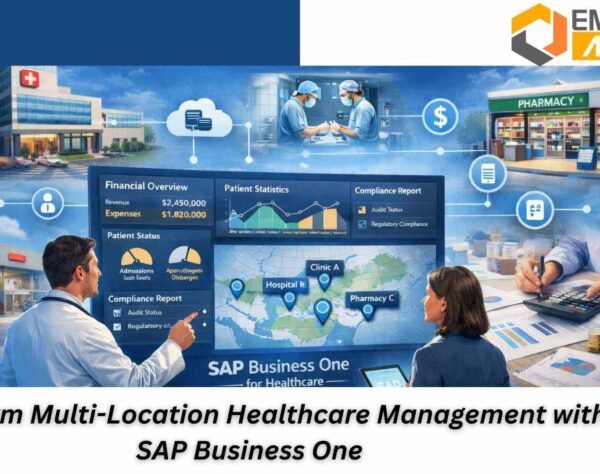
- Centralized data across multiple clinics or hospitals
- Improved disaster recovery capabilities
- Lower infrastructure maintenance costs
A Cloud-based healthcare ERP also enables faster system upgrades and continuous innovation.
When combined with advanced reporting tools, healthcare institutions can unlock Data analytics in healthcare ERP, enabling administrators to analyze inventory consumption trends, forecast procurement needs, and optimize supply utilization.
This visibility strengthens operational control and supports the Healthcare Industry’s Future, where data-driven decisions become central to hospital management.
Implementing SAP Business One for Medical Institutions
Successful ERP adoption requires more than software deployment. It demands deep industry knowledge, structured planning, and experienced implementation partners.
Implementing SAP Business One within healthcare organizations typically includes several phases:
- Operational workflow assessment
- ERP configuration aligned with medical supply chains
- Financial system integration
- Clinical inventory data migration
- User training and process standardization
Through structured SAP B1 implementation for medical institutions, hospitals can deploy ERP environments that support both operational efficiency and regulatory compliance.
Emerging Alliance offers specialized SAP B1 consultants for healthcare industry projects, ensuring that ERP architecture reflects real healthcare workflows.
The result is a fully integrated Healthcare Industry with SAP Business One ecosystem that supports administrators, finance teams, and medical staff simultaneously.
Using Data Analytics in Healthcare ERP to Prevent Inventory Loss
Modern healthcare organizations generate enormous amounts of operational data. Without structured analytics, this information remains underutilized.
Using Data analytics in healthcare ERP, administrators can identify patterns that reveal operational inefficiencies.
Analytics tools allow hospitals to monitor:
- Inventory turnover rates
- Departmental supply consumption
- Procurement cycle delays
- High-cost medical supply trends
- Supplier performance
These insights strengthen decision-making and enable hospitals to proactively manage resources.
When combined with Real-time analytics for hospitals and advanced Healthcare reporting tools, leadership teams gain unprecedented operational visibility. This strategic insight allows organizations to Improve patient care with SAP B1 while simultaneously protecting profitability.
FAQs About SAP Business One for Healthcare
1. How does SAP Business One ERP support hospital inventory management?
A healthcare-focused SAP environment tracks pharmaceuticals, equipment, and medical supplies through integrated Inventory and supply chain for hospitals systems, preventing shortages and overstocking.
2. Why do healthcare administrators adopt ERP platforms?
Modern Healthcare administrators ERP solutions centralize finance, procurement, and operations, enabling hospitals to operate with greater efficiency and transparency.
3. Can ERP systems improve clinical supply availability?
Yes. Hospitals can Improve patient care with SAP B1 by ensuring essential medical supplies are always available through automated procurement and inventory monitoring.
4. What role does financial management play in healthcare ERP?
ERP platforms strengthen Healthcare Financial Management by linking procurement, inventory, and accounting into a unified financial oversight system.
5. Is SAP Business One suitable for mid-sized hospitals?
Yes. The platform is ideal for small and medium-sized healthcare organizations seeking enterprise-grade ERP capabilities without excessive system complexity.
6. How do healthcare modules improve operational control?
Specialized Healthcare-specific SAP Business One modules allow organizations to manage clinical inventories, procurement cycles, and regulatory compliance requirements.
7. What benefits come from implementing SAP Business One in hospitals?
Through Implementing SAP Business One, healthcare institutions gain automation, financial control, and integrated supply chain management.
8. How does cloud ERP benefit healthcare organizations?
A SAP Business One cloud for healthcare deployment enables remote access, stronger security, and centralized operational data.
9. Can healthcare ERP systems provide operational analytics?
Yes. Advanced Data analytics in healthcare ERP provide insight into inventory consumption, procurement patterns, and hospital financial performance.
10. Why work with specialized ERP consultants for healthcare?
Experienced SAP B1 consultants for healthcare industry ensure ERP implementations align with real clinical workflows and healthcare compliance requirements.
Connect with Emerging Alliance today to explore how intelligent ERP infrastructure can protect margins, automate healthcare workflows, and strengthen operational visibility across your entire healthcare ecosystem.