

Future-Ready Healthcare Operations with SAP B1 Automation

Transform workflows using SAP B1 Healthcare today
Healthcare organizations today are no longer evaluated only on clinical outcomes they are judged on operational efficiency, financial discipline, and decision agility. As Healthcare providers scale across locations, services, and regulatory environments, traditional systems fail to keep pace. Disconnected tools, spreadsheet-driven workflows, and delayed reporting are not just inefficiencies they are strategic risks. This is where SAP B1 Healthcare emerges as a critical enabler. By combining Healthcare Enterprise Resource Planning (ERP) with automation, analytics, and integration, organizations can move from reactive operations to predictive, data-driven management.
For mid-sized healthcare institutions and growing enterprises, SAP Business One ERP for Healthcare industry is not just an IT upgrade it is a foundation for long-term scalability and resilience.
Role of Strategic Automation in Modern Healthcare Operations
Even high-performing healthcare organizations face structural inefficiencies that limit growth and profitability.
Fragmented Systems and Data Silos
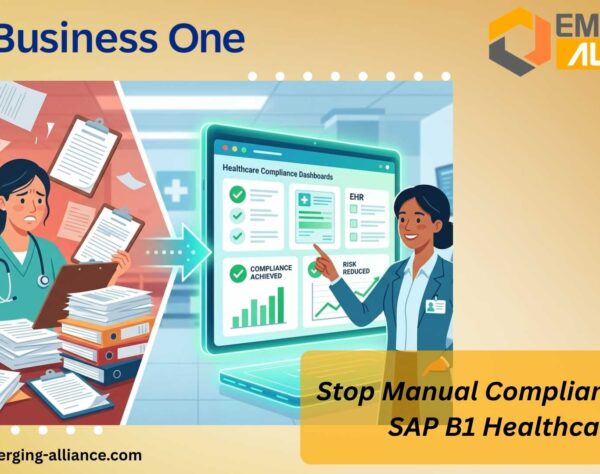
Multiple applications for billing, inventory, finance, and patient management create disconnected workflows. Without unified visibility, leadership decisions rely on incomplete data.
Manual and Error-Prone Processes
From invoicing to stock tracking, manual intervention increases risk. Inaccuracies in Healthcare Financial Management or inventory can directly impact revenue and compliance.
Lack of Real-Time Insights
Delayed reporting restricts decision-making. Executives lack access to real-time analytics for hospitals, making it difficult to optimize operations proactively.
Compliance and Audit Complexity
Regulatory pressure continues to rise. Maintaining accurate records across systems makes audits time-consuming and risky.
Inefficient Inventory Management
Healthcare supply chains are sensitive. Without intelligent tracking via SAP Business One’s inventory management module, organizations face stockouts, expiries, and unnecessary capital lock-in.
These are not isolated issues they are systemic challenges that require a unified solution.
How SAP B1 Healthcare Automation Redefines Operations
SAP Business One ERP For Healthcare Sector addresses these challenges by integrating core functions into a single, intelligent platform. More importantly, it introduces automation across operational and financial workflows.
Unified Platform for End-to-End Visibility
With SAP Business One Healthcare Modules, organizations gain centralized control over finance, procurement, inventory, and operations. This eliminates silos and ensures a single source of truth.
Intelligent Financial Management
Using SAP Business One’s financial management solutions, healthcare organizations can automate billing cycles, track revenue streams, and maintain compliance-ready financial records.
This directly strengthens Healthcare Financial Management while reducing manual dependency.
Automated Inventory & Supply Chain
The SAP Business One’s inventory management module enables real-time tracking of medical supplies, batch control, and expiry management critical for patient safety and cost optimization.
Seamless Integration with Healthcare Systems
Through SAP B1 healthcare system integration, organizations can connect ERP with EHR, LIS, and other clinical platforms. This ensures data consistency across clinical and administrative functions.
Real-Time Analytics & Reporting
With built-in dashboards and Healthcare reporting tools, decision-makers gain instant visibility into operations, finances, and performance metrics driving faster, data-backed decisions.
Scalable Architecture with Add-ons
SAP Business One with Add-ons for the Healthcare Industry allows customization for specialized needs, from medical practice management to advanced compliance tracking.
Cloud-Enabled Flexibility
As a cloud-based healthcare ERP, SAP B1 supports multi-location scalability, remote access, and reduced IT overhead ideal for expanding healthcare networks.
From Operational Burden to Strategic Advantage
The impact of Implementing SAP Business One goes beyond automation it transforms how healthcare organizations operate and scale.
Reduced Administrative Overhead
Automation of routine tasks such as billing, reporting, and procurement significantly reduces administrative workload.
Improved Accuracy and Risk Reduction
Eliminating manual processes reduces errors in financials, inventory, and patient-related records critical for compliance and trust.
Enhanced Decision-Making
With real-time analytics for hospitals, leadership teams can respond proactively to operational challenges and market changes.
Stronger Patient Experience
Efficient backend operations translate into better service delivery, faster billing cycles, and improved patient satisfaction key to sustainable growth.
Financial Visibility and Control
With SAP B1 for healthcare accounting, organizations gain clarity on margins, costs, and profitability across departments.
Scalable Growth Model
Whether expanding to new locations or adding new services, SAP B1 implementation ensures that systems scale without operational breakdown.
Future-Proofing the Organization
As the Healthcare Industry’s Future becomes increasingly digital, organizations using SAP ERP for Healthcare are better positioned to adapt, innovate, and lead.
Strategic Implementation: The Key to Future-Ready Operations
Technology alone does not drive transformation execution does. Successful SAP B1 healthcare implementation services require:
- Deep understanding of healthcare workflows
- Customization using Healthcare-specific SAP Business One modules
- Seamless integration across systems
- Continuous optimization post-deployment
Choosing the right SAP B1 healthcare solution provider ensures that ERP aligns with business outcomes not just technical requirements.
A strategic partner focuses on:
- Process-first transformation
- Measurable ROI and performance improvement
- Long-term scalability and governance
This is the difference between deploying software and enabling transformation.
Conclusion: Building Future-Ready Healthcare Enterprises
Healthcare leaders today face a critical inflection point. Operational inefficiencies, regulatory pressures, and scalability challenges cannot be addressed with fragmented systems.
SAP Business One healthcare software solutions provide a unified, intelligent foundation to automate operations, enhance visibility, and drive sustainable growth.
Organizations that invest in Healthcare ERP solutions today are not just solving current inefficiencies they are building future-ready enterprises.
Transform Your Healthcare Operations with Emerging Alliance
If your organization is navigating operational complexity, compliance pressure, or growth challenges, it’s time to evaluate a smarter approach. Connect with the experts at Emerging Alliance to explore how SAP B1 Healthcare can transform your operations.
FAQs About SAP Business One for Healthcare industry
1. How does SAP B1 Healthcare improve operational efficiency?
It automates administrative workflows, integrates systems, and provides real-time insights, reducing manual effort and delays.
2. Can SAP Business One integrate with existing healthcare systems?
Yes, through SAP B1 healthcare system integration, it connects with EHR, LIS, and other platforms.
3. Is SAP Business One suitable for medium-sized healthcare organizations?
Yes, it is designed for medium-sized healthcare providers and growing enterprises.
4. How does SAP B1 support compliance in healthcare?
It ensures accurate record-keeping, audit trails, and standardized processes for regulatory adherence.
5. What financial benefits can be expected from SAP B1 implementation?
Improved cost control, reduced errors, better cash flow visibility, and optimized resource utilization.
6. Does SAP Business One support multi-location healthcare operations?
Yes, especially as a cloud-based healthcare ERP, it supports centralized control across locations.
7. How does SAP B1 manage healthcare inventory effectively?
Using batch tracking, expiry management, and real-time monitoring through SAP Business One’s inventory management module.
8. What role do add-ons play in SAP B1 Healthcare?
They enable customization for specific needs like patient care management and advanced reporting.
9. How long does SAP B1 implementation take in healthcare?
Timelines vary based on complexity, integrations, and customization requirements.
10. Why choose a specialized SAP B1 healthcare solution provider?
Because healthcare-specific expertise ensures better alignment with industry workflows and compliance needs.
Fill out the form above to get a tailored roadmap aligned to your business goals, compliance requirements, and growth strategy.