
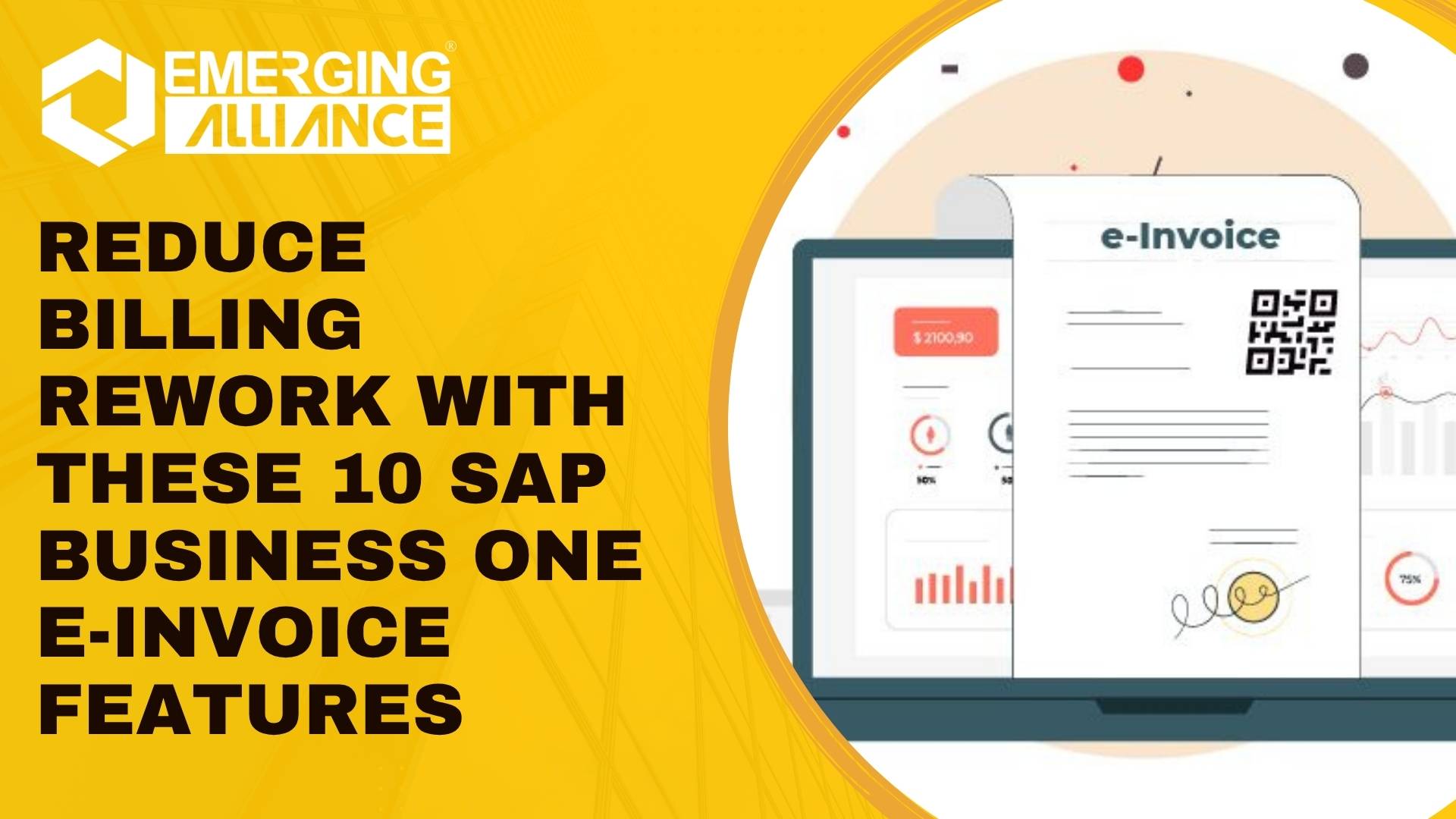
Reduce Billing Rework with These 10 SAP Business One E-Invoice Features
Reduce GST errors and accelerate billing with SAP Business One E-Invoice
Manual billing processes often lead to GST mismatches, invoice errors, reconciliation delays, and approval bottlenecks that impact revenue flow and compliance readiness. For growing enterprises, these issues increase across multi-branch and high-volume operations. SAP Business One E-Invoice helps automate invoicing, GST validation, and real-time processing to reduce billing rework and improve financial accuracy.
As a strategic transformation partner, Emerging Alliance helps enterprises build scalable, compliance-ready finance automation ecosystems with SAP-driven workflows.
Why Billing Rework Becomes a Major Enterprise Risk
Billing errors are not just finance issues. They create operational disruption across departments.
Incorrect GST calculations, invoice mismatches, delayed approvals, and manual reconciliation affect:
- Cash flow predictability
- Vendor and customer trust
- Compliance readiness
- Audit preparation
- Accounts receivable cycles
- Finance team productivity
- Executive reporting accuracy
In many organizations, finance teams still depend on spreadsheets, disconnected billing systems, or semi-manual workflows. As invoice volumes increase, these systems struggle to support enterprise-scale operations.
A modern SAP Business One e-invoicing framework helps eliminate these bottlenecks through centralized invoice lifecycle management, automated GST validation, and real-time processing.
1. Automated GST Validation Reduces Invoice Errors
One of the biggest causes of billing rework is incorrect GST data.
A robust SAP B1 GST e-invoice system validates invoice information before submission, helping enterprises reduce rejection rates and correction cycles.
Key capabilities include:
- Real-time GST validation
- Automated tax calculation
- Duplicate invoice detection
- HSN/SAC verification
- Invoice structure validation
- Compliance-ready invoice formatting
This creates a stronger foundation for digital tax compliance while improving financial data accuracy across departments.
Organizations handling large B2B invoice volumes especially benefit from automated invoice generation and validation workflows.
2. Real-Time Invoice Exchange Accelerates Billing Cycles
Delayed invoice processing often slows down revenue recognition and payment collection.
A modern SAP Business One e-invoice solution enables real-time invoice exchange between ERP systems, tax portals, vendors, and customers.
Benefits include:
- Faster invoice submission
- Reduced manual intervention
- Immediate status monitoring
- Improved accounts receivable automation
- Faster customer acknowledgement
With real-time e-invoice processing, finance teams gain better operational visibility and fewer approval bottlenecks.
For enterprises operating across multiple branches, centralized invoice tracking becomes significantly easier.
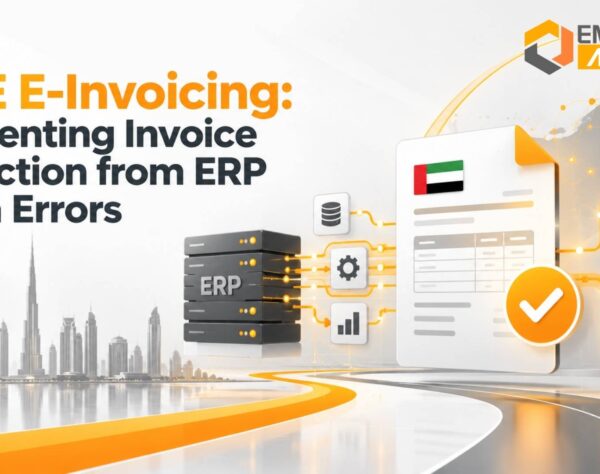
3. SAP B1 E-Invoice Integration Eliminates Data Silos
Disconnected finance systems create reconciliation gaps and duplicate work.
Through intelligent SAP B1 e-invoice integration, enterprises can connect invoicing workflows directly with:
- ERP finance modules
- Inventory systems
- Procurement workflows
- Customer management systems
- Tax reporting platforms
- Banking integrations
This creates a unified finance workflow automation environment where invoice data moves securely across business functions.
Instead of correcting errors after submission, organizations can prevent inconsistencies at the source.
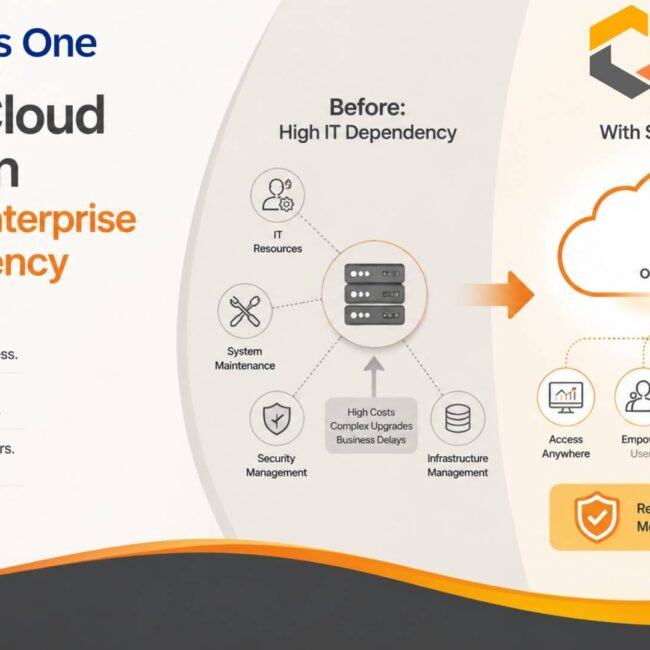
4. Cloud-Based SAP B1 E-Invoicing Improves Scalability
As enterprises grow, invoice complexity increases.
Traditional on-premise processes often struggle to support:
- Multi-location operations
- Remote finance teams
- High invoice volumes
- Cross-functional approvals
- Regulatory updates
A cloud-based SAP B1 e-invoicing environment enables scalable billing operations with centralized control and real-time accessibility.
Enterprises gain:
- Faster deployment flexibility
- Easier regulatory updates
- Secure invoice exchange
- Simplified document access
- Reduced infrastructure dependency
This is especially valuable for organizations planning digital finance transformation initiatives.
5. Intelligent Invoice Automation Reduces Manual Dependency
Finance leaders increasingly prioritize operational efficiency over headcount expansion.
A powerful SAP Business One invoice automation tool streamlines repetitive finance activities including:
- Invoice generation
- Approval routing
- Tax reconciliation
- Status tracking
- Exception handling
- Document synchronization
This improves finance process optimization while reducing dependency on manual intervention.
Operational scenario:
A manufacturing enterprise processing thousands of monthly invoices often faces delayed approvals and reconciliation backlogs. With intelligent billing automation integrated into SAP workflows, invoice approval automation and GST workflow automation can significantly reduce processing delays.
The result is improved turnaround time and lower administrative overhead.
6. SAP B1 Tax Automation Strengthens Compliance Readiness
Regulatory requirements continue to evolve rapidly.
Without centralized compliance workflows, enterprises face increased exposure to:
- Filing delays
- Audit complications
- Tax mismatches
- Documentation gaps
- Penalty risks
An advanced SAP B1 tax automation framework helps finance teams maintain compliance-ready invoicing processes.
Core capabilities include:
- Automated GST reporting
- Electronic tax documentation
- Tax filing automation SAP B1 workflows
- Real-time GST validation
- Audit-ready invoice storage
- Automated tax reconciliation
This supports stronger ERP compliance management while simplifying audit preparation.
7. Real-Time Tracking Improves Invoice Visibility
Lack of invoice visibility creates operational uncertainty for finance teams and leadership.
A modern SAP B1 electronic invoicing system provides centralized invoice status monitoring across the invoice lifecycle.
Decision-makers can track:
- Submitted invoices
- Pending approvals
- Rejected invoices
- Compliance status
- Customer acknowledgements
- Payment progress
This improves enterprise-wide financial visibility and supports faster decision-making.
For CFOs and finance controllers, real-time tracking e-invoices provide stronger operational governance and reporting confidence.
8. API-Based E-Invoicing Enables Flexible Enterprise Integration
Modern enterprises rarely operate within a single software environment.
Using SAP B1 API for e-invoicing, organizations can integrate invoicing workflows with third-party platforms and enterprise applications.
This supports:
- API-based invoice integration
- ERP-integrated invoicing
- Multi-platform finance synchronization
- Digital billing ecosystem expansion
- Secure data exchange
A flexible integration architecture becomes essential for enterprises pursuing scalable automation strategies.
9. SAP B1 Accounting Automation Improves Financial Accuracy
Manual accounting processes increase the risk of mismatched records and delayed reconciliation.
With SAP B1 accounting automation, invoice data can automatically synchronize with finance ledgers and reporting systems.
Advantages include:
- Reduced manual journal entries
- Faster reconciliation
- Improved financial data accuracy
- Better reporting consistency
- Reduced revenue leakage risk
Integrated finance workflows create stronger operational alignment between billing, taxation, and accounting functions.
10. E-Invoicing Addon for SAP B1 Supports Long-Term Digital Transformation
Enterprises today require more than compliance tools.
They need scalable finance infrastructure capable of supporting:
- Growth expansion
- Process standardization
- Cross-functional automation
- Digital governance
- Real-time analytics
An advanced E-Invoicing Addon for SAP B1 acts as a strategic foundation for broader enterprise automation initiatives.
Rather than treating invoicing as an isolated finance task, organizations can transform it into an intelligent operational workflow integrated across the business.
This is where strategic implementation expertise becomes critical.
Why Enterprises Choose Emerging Alliance for SAP Business One E-Invoice Transformation
Successful e-invoicing implementation requires more than technical deployment.
Enterprises need a transformation partner capable of aligning finance operations, compliance management, process automation, and long-term scalability.
Emerging Alliance helps organizations design and implement enterprise-grade SAP Business One digital finance ecosystems that support operational efficiency and sustainable growth.
The focus goes beyond implementation:
- Enterprise workflow optimization
- Compliance strategy alignment
- Finance process automation
- Scalable ERP architecture
- API-driven integrations
- Intelligent reporting frameworks
- Multi-branch operational visibility
For decision-makers evaluating digital finance modernization, this strategic approach reduces implementation risk while accelerating ROI realization.
Transform Billing Operations into a Competitive Advantage
Modern enterprises cannot afford finance inefficiencies caused by disconnected billing systems and manual compliance processes.
A scalable SAP Business One E-Invoice strategy helps organizations:
- Reduce invoice rework
- Improve GST compliance automation
- Accelerate billing cycles
- Increase financial visibility
- Strengthen audit readiness
- Eliminate workflow bottlenecks
- Improve enterprise scalability
Organizations that modernize invoicing workflows today position themselves for stronger operational agility tomorrow.
To evaluate the right SAP-driven invoicing strategy for your enterprise, connect with Emerging Alliance for a consultation and solution assessment tailored to your finance operations.
Frequently Asked Questions
1. How does SAP Business One E-Invoice reduce billing rework?
SAP Business One E-Invoice automates GST validation, invoice processing, and approval workflows to minimize manual corrections, duplicate entries, and compliance-related billing delays.
2. How does SAP B1 electronic invoicing improve GST compliance?
A SAP B1 electronic invoicing framework automates GST validation, invoice formatting, tax reconciliation, and reporting workflows to reduce compliance risks and filing errors.
3. Can SAP B1 e-invoice integration connect with third-party systems?
Yes. Modern SAP B1 e-invoice integration solutions support API-based integrations with procurement systems, tax platforms, banking systems, CRMs, and finance applications.
4. Is cloud-based SAP B1 e-invoicing suitable for multi-branch enterprises?
Yes. Cloud-based SAP B1 e-invoicing supports centralized invoice tracking, remote accessibility, and scalable finance workflows across distributed business operations.
5. How does SAP Business One invoice automation reduce billing rework?
A SAP Business One invoice automation tool automates validation, approvals, reconciliation, and reporting processes, minimizing manual corrections and duplicate entries.
6. What industries benefit most from SAP B1 GST e-invoice solutions?
Manufacturing, distribution, retail, healthcare, logistics, professional services, and multi-location enterprises benefit significantly from automated GST invoice workflows.
7. Does SAP B1 tax automation support audit readiness?
Yes. SAP B1 tax automation helps maintain audit-ready invoicing records through automated documentation, reporting, and compliance-ready workflows.
8. How scalable is an SAP Business One cloud e-invoice system?
A SAP Business One cloud e-invoice system is highly scalable and supports growing invoice volumes, multi-entity finance operations, and enterprise expansion initiatives.
9. What challenges occur during migration to e-invoicing software for SAP B1?
Common challenges include legacy data inconsistencies, workflow redesign, integration complexity, and user adoption. Strategic implementation planning helps reduce migration risks.
10. How can enterprises measure ROI from SAP electronic invoicing?
ROI is typically measured through reduced billing errors, faster invoice processing, lower compliance risk, improved receivables management, and increased finance productivity.