
SAP Business One Pricing Mistakes That Quietly Reduce ROI in 2026

Protect margins and scale smarter with the right SAP Business One Pricing strategy
In 2026, ERP investments are being evaluated far beyond software acquisition cost. CEOs, CFOs, CIOs, and transformation leaders are now measuring ERP success based on operational visibility, scalability, process automation, compliance readiness, and long-term margin protection. This is where SAP Business One Pricing becomes strategically important.
Many enterprises focus only on initial software quotations while overlooking the larger operational impact of ERP licensing models, deployment architecture, integration expenses, infrastructure planning, customization overhead, and scalability limitations. The result is often silent ROI erosion that appears months after implementation.
Businesses may invest in an ERP platform expecting efficiency gains, yet experience increasing operational bottlenecks, unused licenses, fragmented workflows, reporting delays, and growing maintenance costs.
For modern enterprises, the real challenge is not simply selecting ERP software. It is building a pricing and deployment strategy that aligns with operational growth, governance requirements, and enterprise scalability.
Current Industry Challenge: ERP Pricing Decisions Are Becoming Operational Decisions
Across manufacturing, distribution, pharmaceuticals, retail, engineering, and service industries, organizations are modernizing business operations to improve responsiveness and cost control.
However, many companies still approach ERP budgeting using outdated assumptions:
- Choosing the lowest upfront ERP cost
- Over-purchasing user licenses without utilization analysis
- Ignoring long-term support and optimization costs
- Selecting deployment models that restrict scalability
- Underestimating integration and reporting requirements
This creates a dangerous disconnect between ERP investment and operational outcomes.
In many enterprises, ERP inefficiencies do not appear immediately. They emerge gradually through:
- Slow reporting cycles
- Manual approval dependencies
- Duplicate data handling
- Inventory visibility gaps
- Compliance exposure
- Workflow fragmentation
- Higher operational overhead
The problem is not necessarily the ERP platform itself. The problem is often how the pricing structure and deployment strategy were originally designed.
Hidden Operational Risks Behind Poor SAP B1 Pricing Decisions
Overlicensed ERP Environments Increase Enterprise Waste
One of the most common mistakes in SAP B1 Pricing planning is purchasing licenses based on projected expansion without operational role mapping.
This creates situations where:
- Premium licenses are assigned to low-usage employees
- Temporary users retain long-term access
- Departments operate with underutilized ERP capabilities
- Businesses continue paying unnecessary maintenance costs
Over time, these inefficiencies quietly increase ERP ownership cost without improving operational performance.
For finance leaders, this directly affects EBITDA optimization and technology ROI.
Underlicensed Operations Create Workflow Bottlenecks
The opposite problem is equally dangerous.
Many organizations attempt to reduce initial ERP investment by restricting licenses too aggressively. This creates approval dependencies, reporting delays, and operational bottlenecks.
In real-world enterprise environments, this often leads to:
- Shared user accounts
- Offline reporting processes
- Spreadsheet-based workarounds
- Delayed inventory updates
- Inconsistent operational visibility
As enterprises scale, these limitations reduce decision velocity and create governance risks.
SAP Business One On-Premise vs SAP Business One On-Cloud Misalignment
Another major pricing mistake involves selecting deployment models without evaluating long-term operational impact.
Some organizations continue operating outdated SAP Business One On-Premise environments despite requiring remote access, multi-location collaboration, and real-time enterprise visibility.
Others move toward SAP Business One On-Cloud deployments without evaluating infrastructure readiness, integration dependencies, or data governance requirements.
The right ERP deployment decision should align with:
- Business expansion plans
- IT governance strategy
- Remote workforce requirements
- Compliance obligations
- Reporting expectations
- Multi-entity operations
Without strategic alignment, ERP infrastructure costs can increase while operational efficiency declines.
Why Traditional ERP Costing Models Fail Modern Enterprises
Traditional ERP pricing models were built around static business environments.
Modern enterprises operate differently.
Organizations today require:
- Real-time ERP reporting systems
- Automated approvals
- Cloud-based collaboration
- Scalable user expansion
- Mobile accessibility
- Cross-functional visibility
- Faster compliance reporting
- Integration with external platforms
Legacy ERP budgeting approaches fail because they treat ERP as a software expense instead of an operational control layer.
This becomes especially problematic when businesses evaluate only:
- SAP Software Price
- SAP Software License Cost
- SAP License Cost Per User in India
- Initial implementation expenses
without evaluating long-term operational architecture.
The real ERP investment includes:
- Process redesign
- Reporting automation
- Workflow optimization
- Integration scalability
- Infrastructure performance
- Security governance
- Operational continuity
This is why pricing decisions directly influence enterprise scalability.
How SAP Business One Pricing Solves Enterprise Scalability Challenges
A properly structured SAP Business One Pricing strategy enables organizations to scale operations without uncontrolled ERP expansion costs.
The goal is not simply reducing software expense.
The goal is maximizing operational efficiency per ERP investment.
Role-Based SAP B1 Licensing Improves Cost Efficiency
Modern enterprises require modular ERP access structures.
With strategic SAP B1 Licensing Cost planning, businesses can align user access based on operational responsibilities instead of blanket licensing structures.
This creates:
- Better license utilization
- Reduced unnecessary ERP expenditure
- Controlled access governance
- Improved audit readiness
- Lower long-term maintenance cost
For enterprises operating across departments, warehouses, manufacturing plants, or regional offices, this becomes operationally critical.
Cloud ERP Pricing Models Improve Scalability
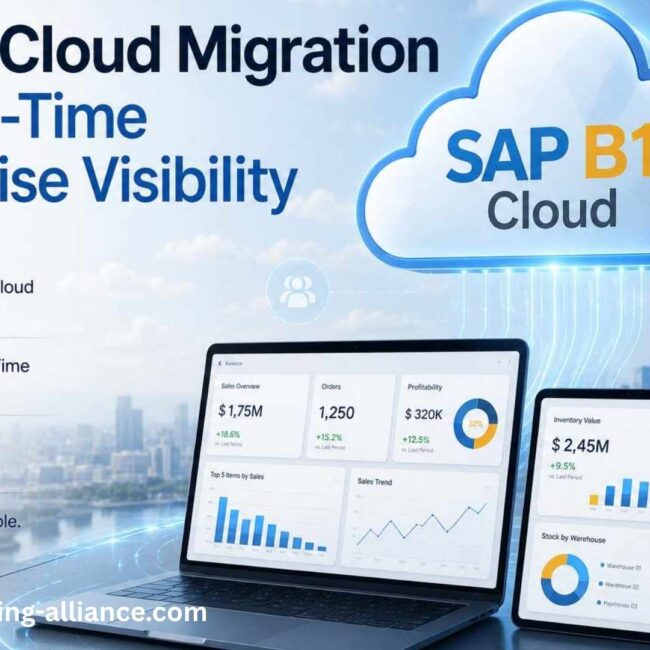
A well-designed cloud ERP pricing model provides flexibility for growing businesses.
Organizations adopting scalable SaaS ERP pricing structures benefit from:
- Faster deployment
- Reduced infrastructure dependency
- Easier remote accessibility
- Lower hardware management burden
- Improved disaster recovery readiness
- Better multi-location collaboration
This is particularly valuable for enterprises planning expansion across India, the Middle East, or global operations.
HANA vs MSSQL Pricing Impacts Reporting Performance
Another important strategic consideration is database architecture.
Many businesses underestimate the operational impact of HANA vs MSSQL pricing decisions.
While both environments support enterprise operations, reporting complexity, analytics expectations, and transaction volume significantly influence platform suitability.
For enterprises relying on:
- Real-time dashboards
- Advanced analytics
- Large transaction environments
- Faster reporting cycles
database architecture directly affects operational responsiveness.
ERP pricing should therefore be aligned with long-term reporting expectations rather than immediate infrastructure savings.
Key Business Benefits of Optimized SAP Business One Cost Planning
Better Operational Visibility
A properly optimized ERP environment improves enterprise-wide transparency across:
- Finance
- Inventory
- Procurement
- Manufacturing
- Sales
- Distribution
- Compliance reporting
Leadership teams gain faster access to operational intelligence without dependency on disconnected reporting systems.
Reduced Revenue Leakage
Poor ERP visibility often creates hidden financial leakage through:
- Inventory discrepancies
- Delayed invoicing
- Uncontrolled approvals
- Duplicate procurement
- Inaccurate reporting
A strategically designed ERP architecture helps eliminate operational blind spots that reduce profitability.
Faster Enterprise Decision-Making
Modern businesses cannot rely on delayed reporting cycles.
Optimized SAP Business One Software in India deployments support:
- Real-time KPI monitoring
- Faster approval workflows
- Automated business processes
- Better executive reporting
- Improved forecasting accuracy
This directly improves operational agility.
Improved Compliance Readiness
As compliance environments become stricter across industries, ERP governance becomes increasingly important.
Businesses require:
- Audit-ready workflows
- Role-based access control
- Traceable approvals
- Centralized documentation
- Real-time reporting visibility
ERP pricing decisions that ignore governance requirements often create future compliance exposure.
ROI & Operational Impact of Strategic ERP Pricing
The real value of ERP investment is not determined by software acquisition cost alone.
It is measured through:
- Faster operational execution
- Reduced manual dependency
- Lower reporting delays
- Better inventory accuracy
- Improved decision velocity
- Reduced technology fragmentation
- Higher process automation
When ERP pricing aligns with operational objectives, businesses experience more predictable scaling and stronger technology ROI.
In contrast, poor ERP planning often results in continuous corrective spending:
- Additional licenses
- Infrastructure upgrades
- Reporting redesign
- Workflow corrections
- Emergency integrations
- Performance optimization projects
Strategic ERP planning prevents these hidden expansion costs.
Why Enterprises Choose Emerging Alliance
Emerging Alliance helps enterprises approach ERP transformation strategically rather than transactionally.
Instead of focusing only on software implementation, Emerging Alliance evaluates:
- Business process maturity
- Operational bottlenecks
- Reporting architecture
- Scalability requirements
- Deployment strategy
- License optimization
- Integration readiness
- Long-term ROI alignment
This consultative approach helps enterprises design ERP ecosystems that support sustainable growth instead of creating future operational limitations.
As an experienced SAP transformation partner, Emerging Alliance supports organizations across manufacturing, pharma, engineering, distribution, retail, and service industries with scalable ERP modernization strategies.
FAQs About SAP Business One Pricing
1. What affects SAP B1 Price in India for growing enterprises?
Several factors influence ERP pricing, including deployment model, number of users, database selection, integrations, reporting requirements, customization scope, and support expectations.
2. How does SAP Business One Pricing work for cloud deployments?
Cloud ERP pricing is typically structured around subscription-based licensing, infrastructure usage, user access levels, and managed support services.
3. What is the difference between SAP Business One On-Premise and On-Cloud pricing?
On-premise deployments usually involve higher infrastructure ownership costs, while cloud deployments focus more on recurring subscription and managed hosting expenses.
4. How can enterprises reduce SAP Software License Cost without affecting operations?
Organizations can optimize ERP expenditure through role-based licensing, user utilization reviews, workflow redesign, and operational access mapping.
5. Is SAP Business One suitable for manufacturing and distribution companies?
Yes. SAP Business One supports manufacturing, distribution, engineering, pharma, retail, and service businesses requiring integrated operational visibility and process automation.
6. What are the hidden costs businesses overlook during ERP implementation?
Many organizations underestimate integration expenses, customization requirements, infrastructure upgrades, reporting redesign, user training, and long-term maintenance costs.
7. How important is scalability when evaluating ERP software pricing for SMEs?
Scalability is critical because ERP environments must support future expansion without creating operational bottlenecks or uncontrolled technology costs.
8. Does SAP Business One support automation and real-time reporting?
Yes. SAP Business One enables workflow automation, centralized reporting, approval management, inventory visibility, and real-time operational dashboards.
9. How do ERP integrations affect SAP Business One Cost?
Integrations with CRM platforms, ecommerce systems, warehouses, third-party applications, and analytics tools can influence overall ERP ownership cost and implementation complexity.
10. Why should enterprises work with SAP Business One Implementation Partners in India?
Experienced implementation partners help businesses align ERP architecture with operational goals, scalability planning, compliance readiness, and long-term ROI optimization.
Connect with Emerging Alliance for a strategic ERP consultation to evaluate