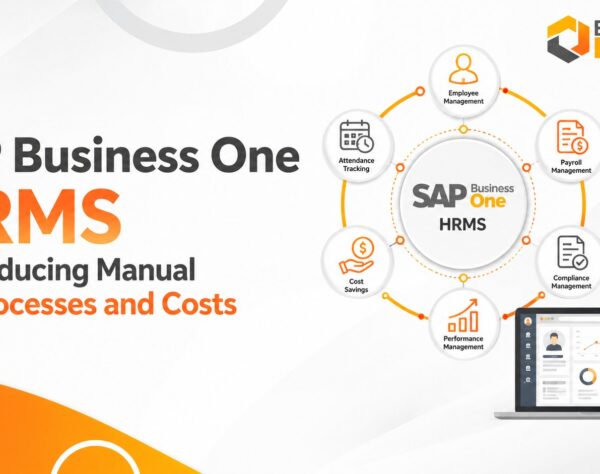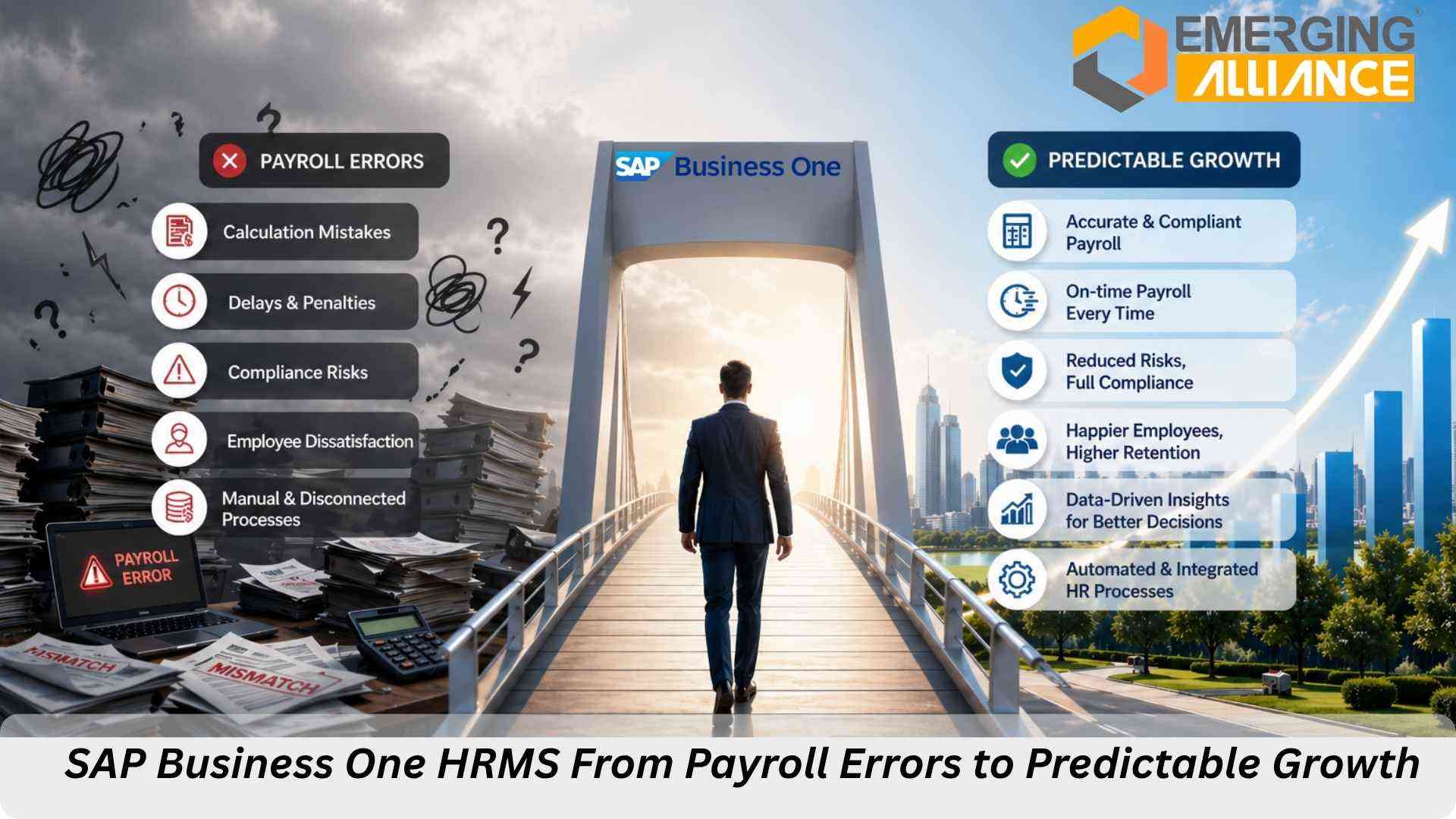
SAP Business One HRMS From Payroll Errors to Predictable Growth
SAP B1 HRMS helps businesses eliminate payroll risk, improve compliance, and gain real-time workforce control
Payroll errors in SAP Business One HRMS environments rarely originate within payroll—they stem from disconnected systems, fragmented data, and manual processes across HR and finance.
As organizations grow, these gaps create operational instability:
- Incorrect salary calculations
- Delayed payroll closures
- Compliance exposure
- Employee dissatisfaction
- Audit risks
- Poor workforce cost visibility
For leadership teams, payroll instability is not simply an HR issue—it becomes a financial and governance issue.
This is where SAP Business One HRMS changes the operating model.
Instead of managing payroll as an isolated process, organizations gain a fully integrated framework where employee management, payroll processing, approvals, attendance, compliance, and finance operate inside a connected ERP environment.
Emerging Alliance helps businesses implement SAP Business One HR software that transforms payroll from a reactive process into a predictable and scalable business function.
How SAP Business One HRMS eliminates payroll inefficiencies
Most businesses operate payroll using disconnected applications.
HR teams maintain employee data separately.
Finance teams reconcile payroll separately.
Attendance systems operate independently.
Compliance calculations happen manually.
This creates duplication, delays, and inconsistency.
A centralized SAP B1 HR module removes this fragmentation by connecting workforce operations directly with core ERP processes.
With integrated HR and Payroll administration module capabilities, organizations can:
- Automate payroll calculations
- Eliminate duplicate data entry
- Reduce manual reconciliation
- Maintain centralized employee records
- Improve payroll processing speed
- Standardize approvals across departments
The result is operational consistency across the organization.
SAP Business One HRMS improves payroll accuracy and compliance visibility
Payroll accuracy is not only about employee satisfaction.
It directly impacts:
- Financial reporting
- Statutory compliance
- Audit readiness
- Cost forecasting
- Cash flow planning
A properly configured SAP Business One payroll module ensures that payroll data flows directly into financial systems without manual intervention.
This allows organizations to maintain:
- Real-time payroll accounting
- Accurate employee cost allocation
- Automated statutory deductions
- Centralized compliance records
- Audit-ready payroll documentation
With HR and payroll integration with SAP B1, leadership teams gain visibility into workforce costs in real time instead of waiting for month-end reconciliation.
Key SAP Business One HRMS features that support scalable workforce management
Growing businesses need payroll systems that scale with operational complexity.
A modern payroll/HR Management ERP built on SAP Business One typically includes:
Employee lifecycle management
The SAP B1 employee management system supports:
- Employee onboarding
- Role-based access
- Shift management
- Attendance integration
- Leave tracking
- Exit management
Payroll automation
The SAP B1 payroll management framework helps automate:
- Salary processing
- Overtime calculations
- Incentive structures
- Reimbursements
- Tax calculations
- Compliance deductions
Workflow approvals
Organizations can configure approval hierarchies for:
- Leave requests
- Payroll approvals
- Reimbursements
- Employee claims
- Salary revisions
Compliance support
For regulated sectors like pharmaceuticals and manufacturing, the platform supports:
- Statutory compliance tracking
- Audit logs
- Payroll traceability
- Employee documentation control
This makes payroll software for pharma industry environments significantly more manageable and audit-ready.
Why SAP Business One HRMS matters for CFOs and CIOs
Payroll directly affects financial planning.
When payroll systems are disconnected from ERP systems, leadership loses visibility into workforce economics.
With SAP Business One for accounting and managing HR data, organizations gain:
- Real-time workforce cost visibility
- Better budgeting accuracy
- Faster payroll closures
- Improved forecasting
- Reduced compliance risk
- Better audit preparedness
For CFOs, this means stronger financial control.
For CIOs, it means fewer disconnected systems and better enterprise-wide data consistency.
For CEOs and COOs, it creates operational predictability.
SAP Business One HRMS deployment strategy for long-term ROI
ERP value is determined by implementation quality.
Many organizations fail to realize HRMS ROI because payroll deployment is treated as a technical setup instead of an operational transformation initiative.
A successful SAP B1 HRMS implementation should include:
Payroll process mapping
Identify:
- Existing bottlenecks
- Manual dependencies
- Compliance risks
- Approval delays
- Reporting gaps
Financial integration alignment
Ensure payroll integrates directly with:
- General ledger
- Cost centers
- Department allocation
- Financial reporting structures
Compliance framework configuration
Configure:
- Statutory calculations
- Regional payroll requirements
- Audit workflows
- Employee data governance
Scalability planning
Design the system for:
- Multi-location operations
- Business expansion
- New workforce categories
- Regulatory changes
Emerging Alliance focuses on building scalable sap and payroll ecosystems that continue supporting operational growth long after implementation.
How SAP Business One HRMS supports multi-location and enterprise growth
Payroll complexity grows faster than employee count.
As organizations expand across locations and departments, manual payroll structures become difficult to sustain.
A scalable payroll software for SAP Business One supports:
- Multi-branch payroll operations
- Region-specific compliance structures
- Centralized workforce governance
- Standardized payroll workflows
- Unified reporting across business units
Organizations can also leverage software as a service payroll deployment models for improved flexibility and operational accessibility.
This allows leadership teams to maintain centralized control without slowing business growth.
Why Emerging Alliance approaches SAP Business One HRMS differently
Most ERP vendors focus only on deployment.
Emerging Alliance focuses on operational transformation.
Our approach to Best HRMS for SAP B1 implementations includes:
- Payroll process redesign
- Financial integration optimization
- Compliance architecture planning
- Workforce governance frameworks
- Executive-level reporting visibility
- Long-term scalability alignment
We do not treat payroll as an isolated HR activity.
We treat it as a business-critical control system.
Common warning signs your business needs SAP Business One HRMS
Your organization may already be experiencing hidden payroll inefficiencies if:
- Payroll depends heavily on spreadsheets
- HR and finance teams reconcile data manually
- Payroll approvals are delayed
- Employee records are inconsistent
- Audit preparation takes excessive time
- Compliance tracking is fragmented
- Leadership lacks workforce cost visibility
- Multi-location payroll processing feels unmanageable
These issues rarely remain operational problems alone.
Over time, they become financial and governance risks.
High-Impact FAQs on SAP Business One HRMS
1. How does SAP Business One HRMS improve payroll accuracy?
It integrates employee records, attendance, approvals, and financial systems into one ERP environment, reducing manual errors and duplication.
2. What makes SAP B1 payroll management suitable for growing businesses?
Its scalable architecture supports multi-location payroll, compliance automation, and centralized workforce governance.
3. Can SAP Business One HR software support compliance-heavy industries?
Yes. Industries like pharmaceuticals and manufacturing can configure payroll compliance, audit tracking, and employee governance workflows.
4. How does HR and payroll integration with SAP B1 improve financial reporting?
Payroll entries synchronize directly with accounting systems, ensuring accurate workforce cost visibility in real time.
5. What are the key modules of HR management ERP in SAP Business One?
Core modules include employee management, attendance, payroll processing, approvals, leave management, and compliance tracking.
6. Is SAP business one payroll add on necessary?
Some industries benefit from specialized payroll add-ons for advanced compliance, taxation, or operational requirements.
7. How does SAP Business One support workforce scalability?
It standardizes payroll and HR workflows across locations while maintaining centralized operational control.
8. Why do CFOs prefer integrated payroll systems?
Integrated payroll improves forecasting accuracy, financial visibility, and audit readiness while reducing reconciliation effort.
9. Can software as a service payroll integrate with SAP Business One?
Yes. Hybrid and cloud-based payroll deployment models can integrate effectively with SAP Business One ERP environments.
10. What should organizations evaluate before SAP B1 HRMS implementation?
Businesses should assess integration depth, compliance requirements, scalability, workflow complexity, and long-term operational ROI.
Fill out the form to connect with our experts now
Emerging Alliance experts to assess how SAP Business One HRMS can streamline payroll accuracy, enhance operational visibility, and strengthen workforce governance in your organization.