
Why 70% of Family Businesses Fail During Transition
Why 70% of Family Businesses Fail During Transition
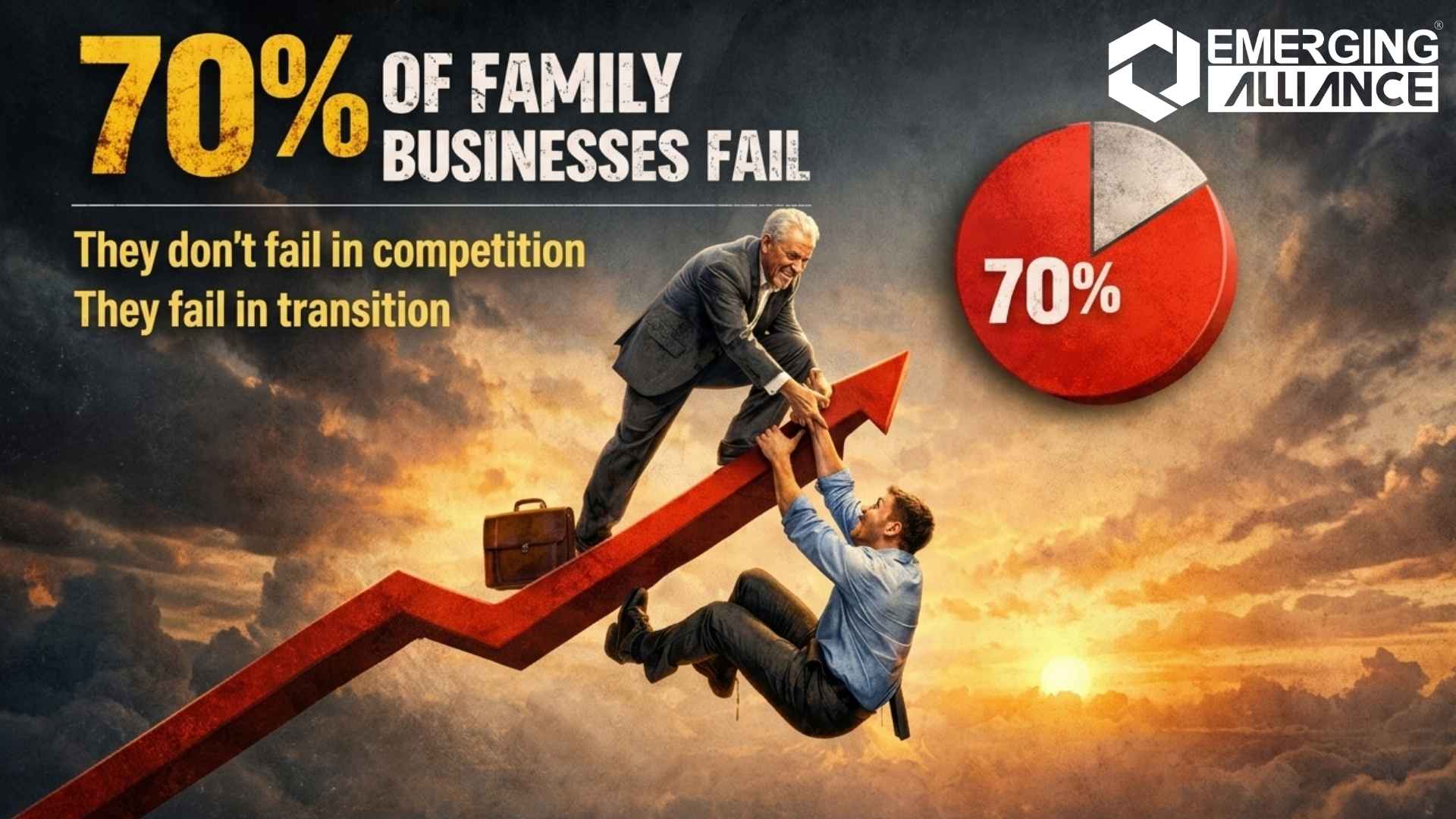
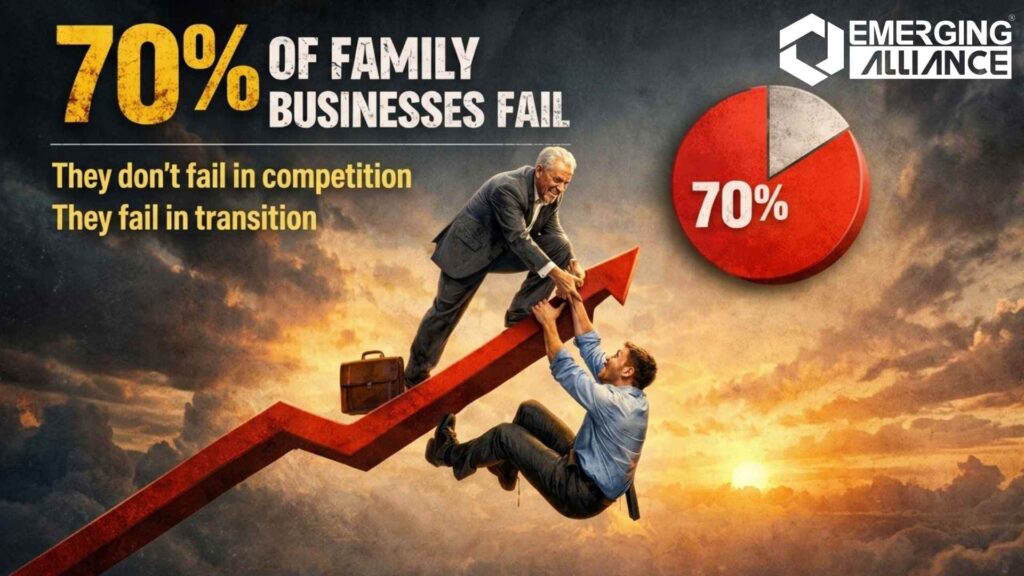
Family-run businesses don’t usually fail because of competition They fail during transition. When leadership moves from founder to next generation, most businesses struggle not due to lack of capability, but because the business was never designed to operate without the founder.
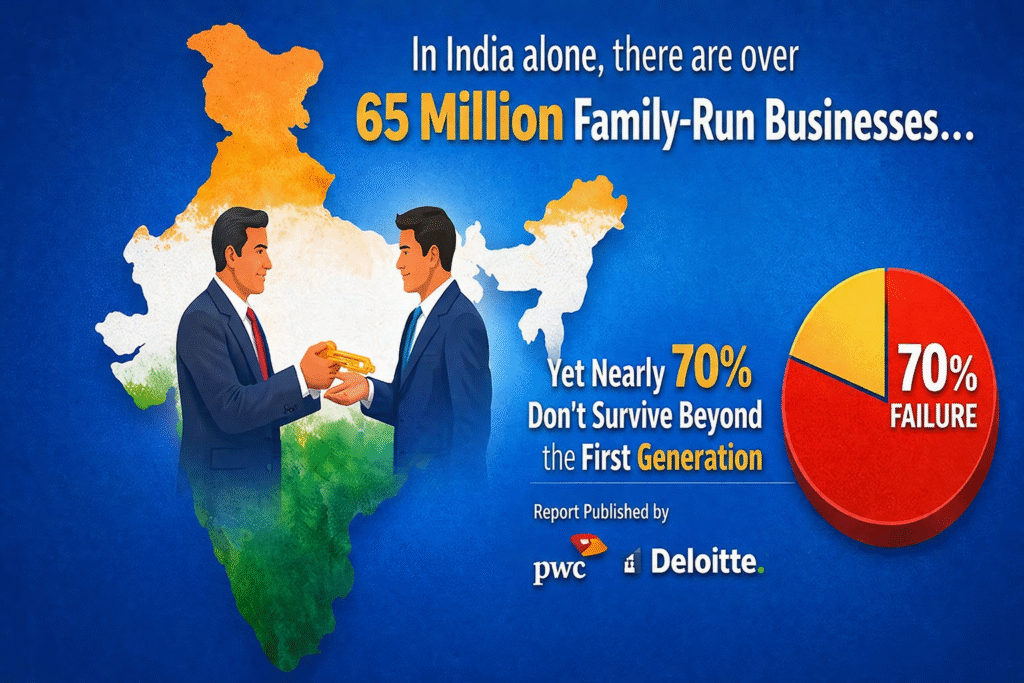
In India alone, there are over 65 million family-run businesses, yet nearly 70% do not survive beyond the first generation (PwC, Deloitte).

If you are a promoter, CEO, or second-generation leader, this article will help you understand:
- Why transitions fail
- What structural gaps exist
- And how to build a scalable, system-driven business
Built by Founders. Now What?
Across India and globally, thousands of successful businesses were built by founders in the 1980s, 90s, and early 2000s.
These businesses were driven by:
- Strong relationships
- Deep experience
- Instinct-based decisions
The founder handled everything:
- Sales decisions
- Supplier negotiations
- Production approvals
- Cash flow monitoring
- Customer relationships
But today, a shift is happening:
A transition is underway where founders are stepping back while the next generation focuses on scaling and modernizing the business.
The challenge: The business is still running on memory, experience, and informal processes and that model does not scale.
Why do family businesses struggle during transition?
Family businesses struggle during transition because critical business knowledge, decisions, and processes are dependent on the founder rather than structured systems.
In many companies, the founder becomes the central operating system:
They know:
- Which customers delay payments
- Which products are profitable
- Which suppliers are reliable
- Which employees can be trusted
But when the founder steps back, the next generation faces:
- Lack of clarity on profitability
- Inconsistent data across departments
- Working capital issues
- Decision-making confusion
This is not a leadership problem. This is a system design problem.
It’s Not Leadership problem . It’s Structure problem
Most founder-led businesses grow organically, not structurally.
Typical realities:
- Processes evolve informally
- Systems are fragmented
- Departments operate in silos
- Data exists in Excel, emails, and individual memory
As long as the founder is present, everything works.
Because the founder connects all the dots.
But when leadership changes:
The business exposes a critical weakness: It is not systemized.
And without systems, scale becomes unpredictable and risky.
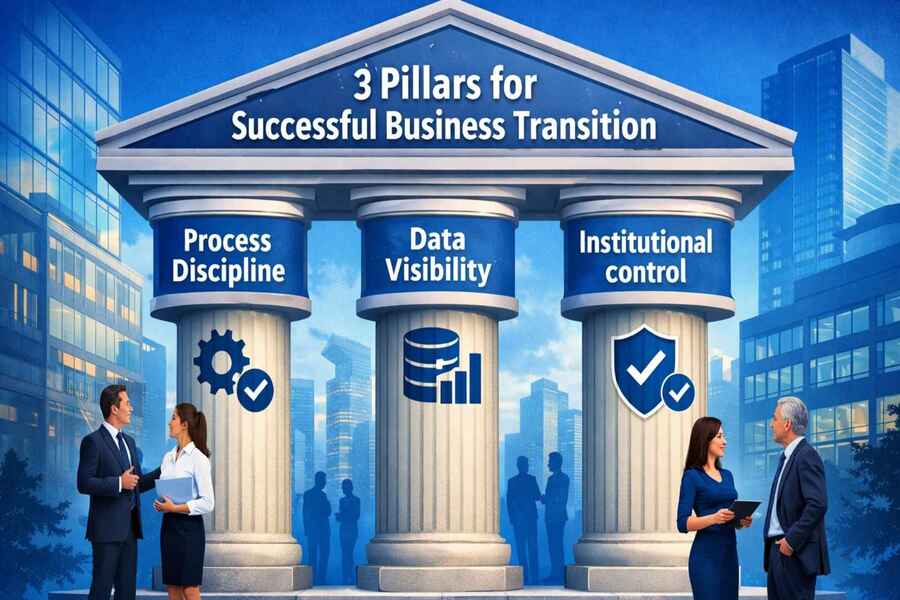
3 Pillars for Successful Business Transition
To successfully transition a family business, three foundational pillars must exist:
1. Process Discipline
What processes should business build?
Every key function must be standardized:
- Sales workflows
- Procurement cycles
- Inventory management
- Production processes
- Financial operations
Not based on memory.
But based on defined, repeatable workflows.
2. Data Visibility
What data should leaders see in real time?
Leaders must have real-time visibility into profitability, customer performance, working capital, and operational efficiency.
Key questions leadership should answer instantly:
- Profitability per product
- High-margin customers
- Working capital bottlenecks
- Operational efficiency
Without data, decisions become assumptions.
3. Institutional Control
What controls should Family Run Business establish ?
- Approval hierarchies must be defined
- Financial controls must be transparent
- Operations must be visible across departments
👉 The business must run on systems, not individuals.
Result: When these 3 pillars exist:
The business becomes institutionalized.
And that is what enables:
- Smooth leadership transition
- Scalable growth
- Reduced dependency on individuals
Example : Model Auto – A Typical Family Business Transition Challenge
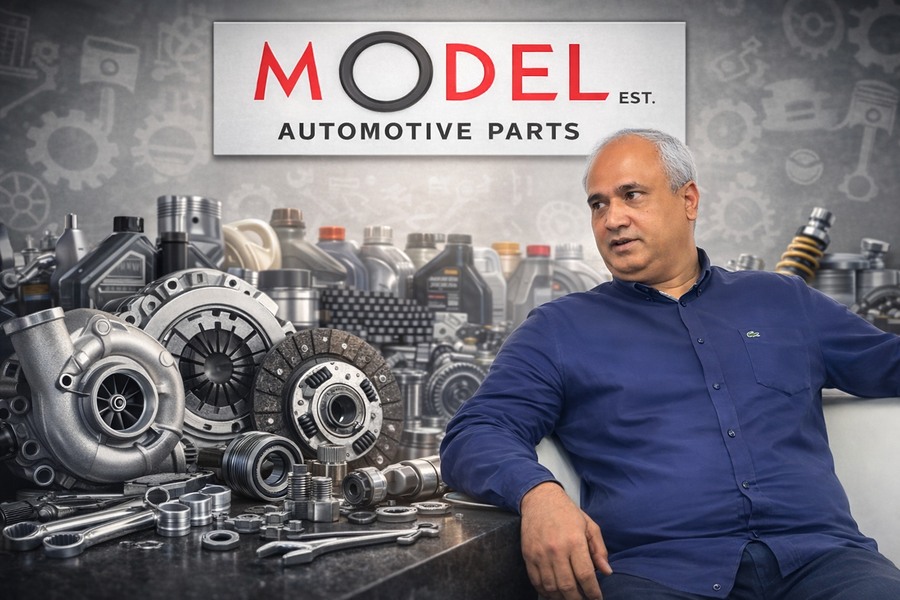
Let’s take a real-world example.
A large trading and distribution company—Model Automotive Parts.
- Founder: Mr. Abdul Hai
- 25+ years of successful growth
The business ran on:
Personal relationships, experience-based pricing, and memory-driven inventory planning collectively enable businesses to strengthen customer trust, optimize pricing strategies, and improve inventory efficiency.
Then the next generation stepped in.
They wanted:
- Dashboards
- Analytics
- Structured decision-making
But the business was not built for visibility.
Result: Years were spent reconstructing operational clarity.
What changed?
By implementing structured systems like SAP, the company built:
- Process discipline
- Data visibility
- Institutional control
This story is not unique. It is extremely common.
The Institutionalization Shift
How do successful family businesses transition?
Successful family businesses transition by institutionalizing operations moving from founder-driven decisions to process-driven systems.
They move from:
- Founder-driven decisions → Process-driven management
- Fragmented data → Integrated information
- Department silos → Unified visibility
This is where enterprise systems like SAP S/4HANA and SAP Business One play a critical role.
The goal is not technology. The goal is business continuity.
How Do You Know It’s Working?
When institutionalization is successful, you will observe:
- Ordinary teams delivering extraordinary outcomes
- Leadership focusing on growth instead of monitoring
- Real-time dashboards and insights
- Full operational visibility
- Data-driven decisions instead of assumptions
- Faster expansion into new markets and opportunities
Key Takeaways
- Transition is not an event—it is a structured transformation
- Growth without systems leads to operational chaos
- The next generation’s role is not just growth—it is institutionalization
If you are a promoter, CEO, or next-generation leader, ask yourself:
If the founder steps away tomorrow… Will the business run exactly the same way?
If the answer is uncertain, it may be time to rethink your structure.
At Emerging Alliance, we help family-run businesses transition from founder-driven operations to system-driven enterprises using structured frameworks and SAP-led transformations.
We’re happy to engage in a one-on-one discussion to evaluate your current setup and define a roadmap for transition.
Click NOW to claim your FREE SAP readiness assessment and protect your business transition!
FAQ
1. Why do most family-run businesses fail during generational transition?
Most family-run businesses fail during transition because the organization is built around the founder’s knowledge, relationships, and decision-making rather than structured systems. Over time, critical business intelligence—such as pricing logic, supplier trust, customer behavior, and financial controls—remains undocumented and person-dependent. When the next generation takes over, they inherit operations without clarity, consistency, or visibility. This leads to conflicting data, delayed decisions, and operational inefficiencies. The real issue is not leadership capability, but the absence of institutionalized processes that allow the business to function independently of individuals.
2. What are the biggest structural gaps in founder-led businesses?
The biggest structural gaps in founder-led businesses typically include lack of standardized processes, fragmented data systems, and absence of integrated decision-making frameworks. Departments often operate in silos with their own data sources, leading to inconsistencies in reporting and analysis. Financial visibility is limited, making it difficult to track profitability at product or customer level. Additionally, approvals and controls are informal and dependent on individuals rather than systems. These gaps remain hidden as long as the founder is actively managing operations but become critical risks during leadership transition or scaling efforts.
3. How can family businesses prepare for a successful generational transition?
Family businesses can prepare for a successful transition by focusing on institutionalization rather than just leadership change. This involves defining clear processes across all business functions, implementing systems that provide real-time data visibility, and establishing governance structures for decision-making and financial control. The goal is to shift from intuition-based management to data-driven operations. Businesses should also invest in aligning the next generation with these systems, ensuring they have access to accurate insights and structured workflows. Transition should be treated as a phased transformation initiative rather than a one-time event.
4. What role does ERP systems like SAP play in business transition?
ERP systems like SAP play a critical role in enabling business transition by integrating all core functions—finance, sales, procurement, inventory, production, and operations—into a single unified platform. This eliminates data silos and ensures that all stakeholders operate from a single source of truth. SAP provides real-time dashboards, standardized workflows, and automated controls, allowing leadership to make informed decisions quickly. More importantly, it reduces dependency on individual knowledge by embedding processes into the system, making the organization scalable, transparent, and resilient during leadership changes.
5. How do you know if your business is ready for the next generation to take over?
A business is ready for generational transition when it can operate consistently without relying on any single individual for critical decisions. Key indicators include availability of real-time data across functions, clearly defined and documented processes, and system-driven approvals and controls. Leadership should be able to access insights on profitability, working capital, and operational performance instantly. If the organization can maintain stability, performance, and decision-making continuity even in the absence of the founder, it indicates a high level of institutional maturity and readiness for transition.