
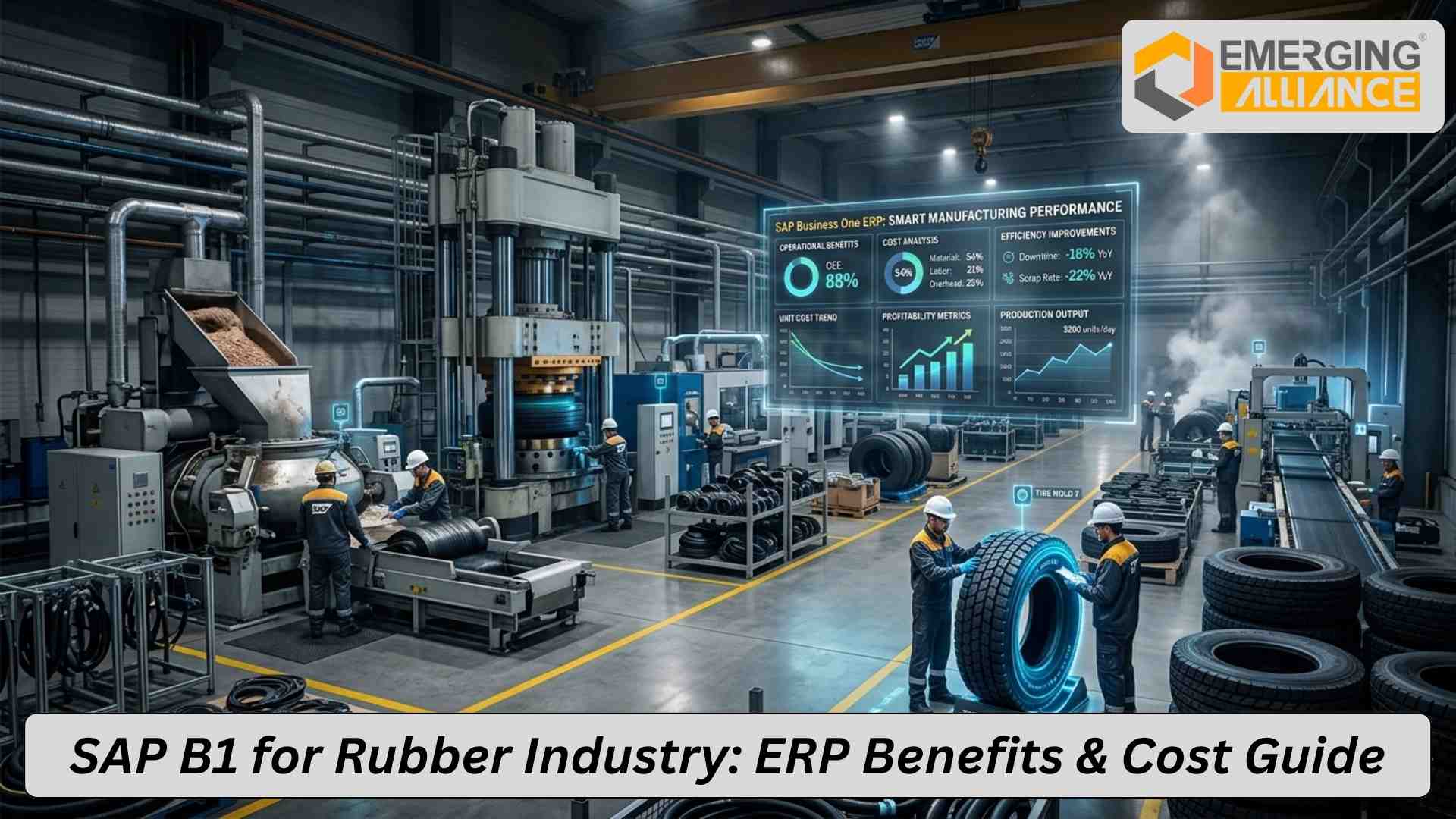
SAP B1 for Rubber Industry: ERP Benefits & Cost Guide
SAP B1 for Rubber Industry: Transform Manufacturing Operations
Rubber manufacturers operate in a highly demanding environment where raw-material volatility, production complexity, batch traceability, quality requirements, and margin pressure must be managed simultaneously. When production, inventory, procurement, sales, and finance operate through disconnected systems, businesses often experience material shortages, inaccurate costing, delayed reporting, excess inventory, and limited visibility into production performance. SAP B1 for Rubber Industry helps manufacturers connect core business functions through a central ERP environment. It can support production planning, Bills of Materials, inventory control, batch management, purchasing, sales, finance, and management reporting.
However, every rubber manufacturing business has different requirements. Advanced formulation control, laboratory inspections, real-time machine data, shop-floor execution, and specialised quality workflows may require configuration, integrations, or industry-specific add-ons.
This guide explains the benefits, capabilities, implementation costs, ROI factors, and selection considerations involved in adopting SAP Business One for rubber manufacturing.
SAP Business One for Rubber Manufacturing
SAP Business One is an integrated ERP solution designed for small and midsize businesses. It connects finance, purchasing, inventory, sales, customer management, production, Material Requirements Planning, and reporting within a single system.
For rubber manufacturers, this integrated approach can improve visibility across:
- Raw-material procurement
- Compound and component planning
- Bills of Materials
- Production orders
- Batch-controlled inventory
- Material consumption
- Finished-goods availability
- Sales commitments
- Production costs
- Financial performance
Instead of relying on separate spreadsheets and departmental software, management teams gain a shared source of operational and financial information.
The result is better coordination, faster reporting, and stronger control across the manufacturing lifecycle.
Rubber Manufacturing Challenges Requiring ERP Control
Rubber manufacturing involves multiple production variables that can directly affect product quality, delivery performance, and profitability.
A suitable ERP environment should address the operational challenges below.
Raw-Material Price Volatility
Rubber manufacturers frequently purchase natural rubber, synthetic polymers, carbon black, chemicals, oils, additives, fillers, and packaging materials.
Price fluctuations in these materials can significantly affect product margins.
Without integrated purchasing, inventory, and costing data, businesses may struggle to understand the true cost impact of raw-material changes.
Formulation and Material Complexity
Rubber products may require different compounds, components, specifications, and production steps.
Maintaining formulation-related information manually can create risks such as:
- Incorrect component selection
- Outdated Bills of Materials
- Inconsistent material consumption
- Poor version control
- Production delays
- Costing discrepancies
SAP Business One supports production Bills of Materials and production-order structures. More advanced recipe or formulation governance may require additional configuration or a specialised manufacturing extension.
Batch Traceability
Manufacturers need to understand which materials were used, when they were received, where they were consumed, and which finished goods were produced.
Weak traceability can complicate:
- Quality investigations
- Customer complaints
- Product recalls
- Audit preparation
- Supplier analysis
- Batch-level reporting
Batch-managed inventory in SAP Business One can strengthen traceability across purchasing, inventory, production, and sales transactions.
Scrap, Rework, and Yield Loss
Material waste, rejected output, process variations, and rework can reduce margins.
When scrap and yield data are maintained outside the ERP system, management may not receive timely information about production losses.
A structured ERP process can help manufacturers compare:
- Planned material consumption
- Actual material consumption
- Planned output
- Actual output
- Production-order cost
- Material variance
- Resource cost
- Finished-goods value
Production Scheduling
Production delays often occur because material planning, purchasing, machine availability, and customer commitments are not aligned.
Material Requirements Planning can help manufacturers evaluate demand, inventory, open purchase orders, production orders, lead times, and future requirements.
This enables more informed production and procurement planning.
Inaccurate Product Costing
Rubber-product profitability depends on more than raw materials.
Manufacturers may need to account for:
- Material costs
- Labour
- Machine or resource costs
- Processing overheads
- Scrap
- Packaging
- Subcontracting
- Freight
- Storage
- Rework
When these costs are tracked separately, management may not know which products, customers, or orders are truly profitable.
Core SAP B1 Capabilities for Rubber Manufacturers
Production Planning and MRP
Material Requirements Planning helps manufacturers identify what materials are required, in what quantities, and by what date.
The planning process can consider:
- Sales orders
- Sales forecasts
- Current inventory
- Open purchase orders
- Open production orders
- Bills of Materials
- Lead times
- Minimum stock levels
This can reduce emergency purchases, production interruptions, and excess inventory.
Business Value
- Better material availability
- Improved procurement planning
- Reduced production delays
- Lower dependency on manual calculations
- Stronger alignment between demand and supply
Bills of Materials and Product Structures
Bills of Materials define the components, resources, and quantities required to manufacture a product.
For rubber manufacturers, BOMs can help structure:
- Raw materials
- Chemicals
- Additives
- Fillers
- Packaging materials
- Labour or resource requirements
- Processing stages
- Intermediate products
Maintaining controlled BOM structures improves consistency and provides a stronger foundation for production planning and costing.
Businesses with complex compound formulations, multiple formula versions, laboratory specifications, or approval-controlled recipes may need specialised configuration or an add-on.
Production Order Management
Production orders allow manufacturers to plan, release, execute, and close manufacturing activity.
A production order can provide visibility into:
- Planned production quantity
- Component requirements
- Resource requirements
- Material issues
- Finished-goods receipts
- Production-order status
- Production cost
- Variances
This gives operations and finance teams a shared view of manufacturing activity.
Business Value
- Better production coordination
- Improved material-consumption visibility
- More accurate production costing
- Clearer work-order status
- Faster production reporting
Batch and Lot Traceability
Batch traceability is especially important when raw materials, compounds, intermediate items, or finished goods must be tracked through the supply chain.
SAP Business One can support batch-managed inventory across relevant purchasing, production, inventory, and sales transactions.
This may help manufacturers identify:
- Which supplier batch was received
- Where the material was stored
- Which production order consumed it
- Which finished batch was produced
- Which customer received the finished product
Business Value
- Faster traceability investigations
- Improved recall readiness
- Better supplier-quality analysis
- Stronger customer documentation
- Improved audit support
The exact traceability design should be defined during implementation because requirements differ by product, industry segment, and customer.
Inventory and Warehouse Management
Rubber manufacturers may manage a wide range of materials across multiple warehouses, locations, or production stages.
SAP Business One supports centralised inventory management for:
- Raw materials
- Work-in-progress items
- Intermediate products
- Finished goods
- Packaging materials
- Consumables
- Spare parts
- Returns
The system can provide visibility into inventory quantities, committed stock, ordered stock, warehouse movements, and item valuation.
Business Value
- Reduced inventory uncertainty
- Better warehouse visibility
- Improved stock availability
- Lower risk of excess purchasing
- Stronger inventory valuation
Warehouse scanning, advanced bin processes, weighing-system integration, or specialised warehouse automation may require additional tools or integrations.
Procurement and Supplier Management
Purchasing delays can directly affect production schedules.
SAP Business One connects purchasing with inventory, demand planning, supplier records, goods receipts, accounts payable, and reporting.
Manufacturers can manage:
- Purchase requests
- Purchase quotations
- Purchase orders
- Goods receipts
- Supplier invoices
- Supplier returns
- Payment processes
- Purchasing analysis
Business Value
- Better supplier coordination
- Improved purchase visibility
- Reduced manual reconciliation
- Faster procurement decisions
- Stronger cost control
Supplier performance reports can also help evaluate pricing, delivery reliability, and purchasing history.
Production Costing and Financial Control
A major advantage of an integrated ERP is the connection between operational transactions and financial reporting.
SAP Business One can bring together:
- Purchasing costs
- Inventory valuation
- Material consumption
- Production receipts
- Resource-related costs
- Sales revenue
- Accounts payable
- Accounts receivable
- General ledger reporting
This gives finance teams clearer visibility into how manufacturing activity affects profitability and working capital.
Business Value
- Improved product-cost visibility
- Faster financial reporting
- Better margin analysis
- Stronger working-capital control
- Reduced spreadsheet dependency
The final costing design depends on the business model, valuation method, production process, and management-reporting requirements.
Sales, Dispatch, and Customer Management
Sales teams need accurate information about stock, delivery dates, pricing, credit limits, and order status.
SAP Business One connects sales activity with inventory, production, purchasing, dispatch, invoicing, and customer accounts.
Manufacturers can manage:
- Sales quotations
- Sales orders
- Delivery documents
- Customer invoices
- Returns
- Credit limits
- Pricing
- Customer balances
- Order history
Business Value
- More reliable delivery commitments
- Better order visibility
- Faster invoicing
- Improved customer communication
- Stronger sales coordination
Dashboards and Management Reporting
ERP value depends on the quality and accessibility of business information.
SAP Business One provides reporting and analytics capabilities across operational and financial areas.
Management teams can track indicators such as:
- Inventory levels
- Open production orders
- Purchase commitments
- Sales orders
- Accounts receivable
- Accounts payable
- Cash flow
- Sales performance
- Product margins
- Production costs
- Stock movement
Additional dashboards or business-intelligence integrations may be used when businesses require highly specialised operational analytics.
Standard SAP B1 and Industry-Specific Extensions
SAP Business One provides the ERP foundation for core business processes. Rubber manufacturers should still evaluate where specialised extensions are required.
| Rubber Manufacturing Requirement | Standard SAP Business One | May Require Configuration or Add-On |
| Bills of Materials | Supported | Advanced formula governance |
| Production orders | Supported | Detailed operator execution |
| Material Requirements Planning | Supported | Advanced finite-capacity scheduling |
| Batch management | Supported | Custom batch genealogy dashboards |
| Inventory management | Supported | Automated weighing integration |
| Production costing | Supported | Advanced yield and variance analytics |
| Purchasing and supplier management | Supported | Supplier-quality workflows |
| Financial management | Supported | Industry-specific profitability models |
| Quality documentation | Partially configurable | Inspection plans and laboratory workflows |
| Machine data capture | Integration possible | MES or IoT connector |
| Shop-floor terminals | Integration possible | Manufacturing execution add-on |
| Preventive maintenance | Limited in standard ERP | Plant maintenance solution |
| Barcode processes | Possible through extensions | Mobile warehouse solution |
This distinction is important because businesses should not assume that every manufacturing requirement is included as a standard feature.
A detailed process assessment helps determine:
- What can be managed through standard SAP Business One
- What can be addressed through configuration
- What requires an add-on
- What requires third-party integration
- What should remain outside the initial implementation scope
SAP B1 Implementation Costs for Rubber Companies
There is no universal implementation price for SAP Business One.
The total investment depends on business size, process complexity, user requirements, deployment model, integration scope, and the level of industry-specific functionality required.
The main cost components are outlined below.
Software Licenses
Licence requirements depend on:
- Number of users
- User roles
- Functional access
- Deployment model
- Database environment
- Add-on requirements
Businesses should avoid purchasing identical licence types for every employee without first reviewing actual system usage.
Implementation and Configuration
Implementation costs may include:
- Process workshops
- Requirements analysis
- Solution design
- System configuration
- Chart-of-accounts setup
- Warehouse setup
- Item-master design
- BOM configuration
- Production setup
- Financial configuration
- Reporting
- Testing
- Go-live support
The greater the process complexity, the more effort may be required.
Data Migration
Data migration can include:
- Customer records
- Supplier records
- Item masters
- Warehouse balances
- Bills of Materials
- Price lists
- Opening balances
- Outstanding transactions
- Batch information
- Historical data
Poor data quality can increase implementation time and risk.
Customization and Add-Ons
Rubber manufacturers may require specialised functionality for:
- Formulation control
- Quality inspections
- Laboratory integration
- Weighing scales
- Barcode scanning
- Machine integration
- Shop-floor data collection
- Advanced production scheduling
- Maintenance management
- Industry-specific reports
These requirements should be identified before the budget is finalised.
Integration Costs
SAP Business One may need to connect with:
- Weighing systems
- Production machinery
- Manufacturing Execution Systems
- Laboratory systems
- CRM platforms
- E-commerce platforms
- Logistics providers
- Payroll systems
- Banking systems
- Business-intelligence tools
Integration complexity depends on data availability, system compatibility, transaction volume, and process design.
Training and Change Management
ERP adoption depends on how well users understand the new processes.
Training may be required for:
- Production teams
- Warehouse users
- Purchasing teams
- Sales teams
- Finance users
- Managers
- System administrators
Change management should also address process ownership, approval responsibilities, data discipline, and reporting standards.
Infrastructure or Cloud Hosting
Businesses may choose an on-premise or hosted deployment model depending on their technology strategy.
Costs can include:
- Server infrastructure
- Cloud hosting
- Database licensing
- Backup
- Security
- Network requirements
- Disaster recovery
- System monitoring
Support and Continuous Optimization
Post-go-live support may include:
- User assistance
- Issue resolution
- System monitoring
- Report development
- Workflow improvement
- Version upgrades
- Integration support
- Add-on maintenance
- User training
- Process optimisation
Support should be treated as part of the long-term ERP investment rather than an optional expense.
Factors Affecting SAP B1 ROI
ERP ROI should not be measured only through licence and implementation costs.
The business case should evaluate how improved processes affect productivity, control, working capital, and profitability.
Material-Wastage Reduction
Improved visibility into planned and actual material consumption can help identify avoidable losses.
Better Yield Analysis
Comparing material input with finished output can reveal yield variations and process inefficiencies.
Reduced Inventory Holding
Improved planning can help reduce unnecessary raw-material and finished-goods inventory.
Fewer Production Delays
Better coordination between sales, purchasing, inventory, and production can reduce shortages and schedule interruptions.
Faster Financial Closing
Integrated operational and financial transactions reduce manual reconciliation and spreadsheet consolidation.
Improved Traceability
Structured batch management can reduce the time required to investigate quality complaints or product-history questions.
Better Pricing Decisions
More accurate cost information can help sales and finance teams evaluate prices and customer profitability.
Lower Administrative Effort
Automation and shared data can reduce duplicate entry, manual reporting, and repetitive coordination.
SAP B1 Implementation Roadmap for Rubber Manufacturers
A phased implementation approach reduces disruption and improves user adoption.
1. Process Discovery
Document the current workflows across:
- Sales
- Planning
- Production
- Procurement
- Warehouse
- Quality
- Finance
- Dispatch
- Management reporting
Identify delays, manual dependencies, duplicate entry, and control gaps.
2. Requirement Mapping
Classify requirements into:
- Standard SAP Business One
- Configuration
- Customisation
- Add-on
- Integration
- Future phase
This prevents unnecessary development and scope expansion.
3. Solution Design
Define:
- Organisation structure
- Warehouse structure
- Item coding
- Batch strategy
- BOM design
- Production process
- Approval workflows
- Financial structure
- Reporting requirements
- User roles
4. Data Preparation
Clean and validate:
- Item masters
- Customer masters
- Supplier masters
- BOMs
- Stock balances
- Batch data
- Price lists
- Financial balances
- Open transactions
5. Configuration and Development
Configure the agreed processes and develop only the essential extensions.
Customisation should solve a clear business requirement rather than reproduce every feature of the legacy system.
6. Testing
Testing should cover:
- Purchasing
- Production
- Inventory
- Batch traceability
- Sales
- Returns
- Finance
- Reporting
- Integrations
- User authorisations
End-to-end scenarios are more valuable than testing each department in isolation.
7. User Training
Train users according to their actual roles and transactions.
Practical, process-based training improves confidence and reduces errors after go-live.
8. Go-Live and Optimization
After go-live, review:
- User adoption
- Data accuracy
- Transaction delays
- Reporting gaps
- Production variances
- Inventory differences
- Support requests
- Process-improvement opportunities
ERP optimization should continue after implementation.
Common SAP B1 Implementation Mistakes
Replicating Every Legacy Process
An ERP implementation should improve processes, not reproduce outdated manual workflows.
Underestimating Data Quality
Incorrect item records, duplicated suppliers, outdated BOMs, and inaccurate inventory can undermine the new system.
Ignoring Production Users
ERP design should involve production, warehouse, planning, purchasing, finance, sales, and management stakeholders.
Over-Customizing the System
Excessive customisation can increase costs, testing effort, upgrade complexity, and support dependency.
Treating Training as a Final Activity
Training should begin before go-live and continue through role-based practice and post-launch support.
Skipping Post-Go-Live Optimization
The initial go-live is the beginning of ERP adoption, not the end of the project.
Building a Scalable Rubber Manufacturing Operation
SAP Business One can provide a strong ERP foundation for rubber manufacturers seeking better control over production, materials, costs, inventory, sales, and finance.
Its greatest value comes from connecting operational and financial data in one environment.
However, successful implementation requires more than selecting software.
Manufacturers must clearly define:
- Production requirements
- Traceability expectations
- Costing methods
- Quality processes
- Integration needs
- Reporting priorities
- User responsibilities
- Implementation success metrics
The right solution should combine standard SAP Business One capabilities with carefully selected configuration, add-ons, and integrations.
This approach helps manufacturers avoid unnecessary customisation while addressing the operational requirements that directly affect quality, productivity, and profitability.
Plan Your SAP B1 Implementation with Emerging Alliance
Emerging Alliance helps manufacturing businesses evaluate, implement, integrate, and optimize SAP Business One.
Our consultants work with business, production, finance, warehouse, and technology teams to identify process gaps, define the right ERP scope, and build a practical implementation roadmap.
A requirements assessment can help you determine:
- Which processes fit standard SAP Business One
- Which requirements need configuration
- Which add-ons or integrations are necessary
- What cost factors should be included
- How ERP ROI should be measured
- Which implementation risks should be addressed
Frequently Asked Questions
Is SAP Business One suitable for rubber manufacturers?
Yes. SAP Business One can support small and midsize rubber manufacturers that require integrated production, inventory, purchasing, sales, finance, and reporting. Advanced formulation, quality, machine, or shop-floor requirements may require specialised extensions.
Can SAP B1 manage rubber formulations?
SAP Business One supports Bills of Materials and production structures. Businesses requiring advanced formulation versioning, laboratory specifications, controlled recipe approvals, or intellectual-property restrictions may need additional configuration or an industry add-on.
Can SAP B1 track rubber-production batches?
Yes. SAP Business One supports batch-managed inventory across relevant purchasing, inventory, production, and sales transactions. The implementation team must design the batch process according to the manufacturer’s traceability requirements.
Does SAP B1 support production planning?
Yes. Material Requirements Planning can consider demand, inventory, open purchase orders, production orders, Bills of Materials, and lead times to support procurement and production planning.
Can SAP B1 calculate production costs?
SAP Business One can capture material consumption, resource-related costs, production receipts, and production-order values. The costing model must be designed according to the organisation’s valuation method and management-reporting requirements.
Does SAP B1 include quality management?
SAP Business One can support batch tracking, approvals, documentation, inventory controls, and quality-related reporting. Advanced inspection plans, laboratory workflows, sample management, and non-conformance control may require specialised functionality.
Can SAP B1 connect with rubber-production machinery?
Yes, integration is possible through supported interfaces, middleware, IoT solutions, MES platforms, or manufacturing add-ons. The exact approach depends on the machinery, communication protocol, and required data.
What affects SAP B1 implementation cost?
The main cost factors include licences, user count, deployment model, process complexity, data migration, configuration, customisation, add-ons, integrations, training, and ongoing support.
How long does SAP B1 implementation take?
The timeline depends on scope, locations, users, data quality, integrations, customisations, and decision-making speed. A focused implementation may take a few months, while a complex multi-location project can take longer.
How can rubber manufacturers measure ERP ROI?
ROI can be measured through lower material wastage, better yield control, reduced inventory, fewer production delays, faster reporting, improved traceability, lower manual effort, and better profitability visibility.
Book a SAP Business One consultation to evaluate your rubber manufacturing requirements and create a practical ERP roadmap.