
SAP B1 for Metal Fabrication Industry Production Planning ERP
SAP B1 for Metal Fabrication Industry: Production Planning ERP for Smarter Manufacturing
The metal fabrication industry demands precision, efficiency, and tight control over production processes. Many businesses still rely on disconnected systems that lead to delays, wastage, and inaccurate planning. This is where SAP B1 for Metal Fabrication Industry becomes a powerful solution. By integrating production planning, inventory, and financial management into one platform, businesses can streamline operations and gain real-time visibility.
Production Planning ERP Overview
Integrated ERP system
SAP Business One is designed to unify all business processes into a single system. For metal fabrication companies, this means managing production schedules, raw materials, and financials seamlessly.
Centralized data management
All departments—from procurement to production—work with the same real-time data, eliminating errors caused by manual entry.
Real-time decision making
Managers can track production progress, identify bottlenecks, and make informed decisions instantly.
Production Planning ERP Benefits
Improved production scheduling
SAP B1 allows businesses to plan production efficiently by aligning demand, resources, and timelines.
Reduced material wastage
With accurate forecasting and inventory tracking, raw material usage is optimized.
Enhanced cost control
Businesses can monitor costs at every stage of production and identify areas for savings.
Better customer satisfaction
On-time delivery and consistent product quality improve customer trust and retention.
Planning ERP Features
Production planning tools
Plan and manage production orders with real-time updates and automated workflows.
Inventory management system
Track raw materials, work-in-progress, and finished goods across multiple locations.
Bill of materials (BOM)
Define product structures and ensure accurate material requirements for every project.
Shop floor control
Monitor machine usage, labor efficiency, and production progress directly from the shop floor.
Financial integration
Automatically link production data with accounting for accurate financial reporting.
Planning ERP Use Cases
Custom fabrication projects
Manage unique customer orders with flexible production planning and tracking.
Batch production management
Handle multiple production batches efficiently while maintaining quality consistency.
Multi-location operations
Coordinate production across different plants with centralized visibility.
SAP B1 for Metal Fabrication Industry Production Planning ERP Challenges Solved
Manual process inefficiencies
Eliminates reliance on spreadsheets and disconnected systems.
Lack of visibility
Provides real-time insights into production and inventory.
Production delays
Improves scheduling accuracy to avoid bottlenecks.
Cost overruns
Tracks expenses at every stage to maintain budget control.
SAP B1 for Metal Fabrication Industry Production Planning ERP Implementation Tips
Define clear business goals
Understand what you want to achieve—whether it’s cost reduction, efficiency, or scalability.
Choose the right partner
Work with experienced ERP consultants for smooth implementation.
Train your team
Ensure employees understand how to use the system effectively.
Start with core modules
Begin with essential features like production and inventory, then expand gradually.
SAP B1 for Metal Fabrication Industry Production Planning ERP Best Practices
Automate repetitive tasks
Reduce manual work by automating scheduling and reporting.
Monitor KPIs regularly
Track production efficiency, machine utilization, and order fulfillment rates.
Optimize inventory levels
Avoid overstocking or stockouts with accurate demand forecasting.
Continuous system improvement
Regularly update processes and workflows to maximize ERP benefits.
Conclusion: Driving Growth with SAP B1 for Metal Fabrication Industry
SAP B1 for the Metal Fabrication Industry stands out as a robust, all-in-one ERP solution built to tackle the complex challenges of production planning, inventory control, and cost management. By bringing all core business functions into a single, unified platform, it enables manufacturers to streamline operations, reduce manual errors, and gain real-time visibility across every stage of the business.
With enhanced efficiency, optimized resource utilization, and intelligent, data-driven decision-making, companies can significantly boost productivity and scale with confidence in an increasingly competitive landscape.
At Emerging Alliance, we go beyond implementation—we partner with you to unlock the full potential of SAP Business One. With deep industry expertise and a customer-first approach, Emerging Alliance ensures seamless deployment, tailored customization, and continuous support to help your metal fabrication business achieve sustainable growth and long-term success.
Frequently Asked Questions About SAP B1 for Metal Fabrication Industry
1. How does SAP B1 support complex manufacturing models like engineer-to-order (ETO) and make-to-order (MTO) in metal fabrication?
SAP Business One enables ETO and MTO manufacturing by dynamically linking sales orders with production processes. It allows real-time BOM configuration, routing adjustments, and engineering change management, ensuring that custom fabrication orders are executed accurately while maintaining cost and timeline control.
2. How does SAP B1 enhance advanced production planning and finite capacity scheduling?
SAP B1 integrates production planning with finite capacity scheduling by analyzing machine availability, labor shifts, and work center loads. This helps optimize job sequencing, reduce bottlenecks, and improve throughput while ensuring efficient utilization of fabrication resources.
3. What role does SAP B1 play in multi-level BOM and routing management?
SAP B1 supports complex, multi-level Bill of Materials (BOM) structures with nested components and sub-assemblies. It also manages routing operations across multiple work centers, enabling precise tracking of fabrication stages such as cutting, welding, machining, and finishing.
4. How does SAP B1 improve material planning and procurement in volatile metal markets?
Through its Material Requirements Planning (MRP) engine, SAP B1 analyzes demand forecasts, sales orders, and current inventory to generate procurement plans. This helps businesses optimize purchasing cycles, reduce excess stock, and mitigate the impact of fluctuating raw material prices.
5. How does SAP B1 enable real-time shop floor visibility and performance tracking?
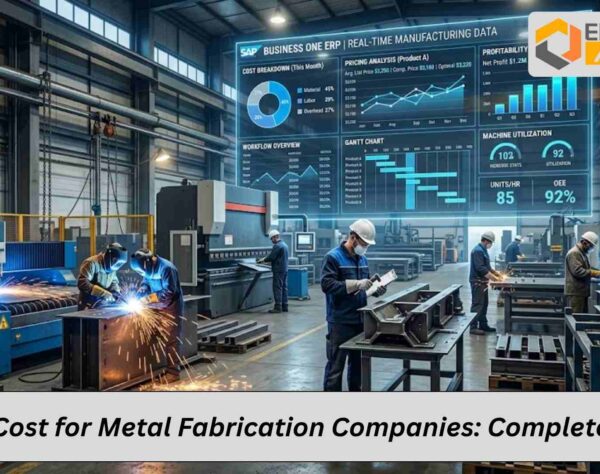
SAP B1 provides real-time dashboards and production reports that track machine utilization, job progress, downtime, and output efficiency. This visibility allows managers to make immediate adjustments and improve operational performance.
6. How does SAP B1 manage job costing and profitability in fabrication projects?
SAP B1 captures detailed cost elements including raw materials, labor hours, machine usage, and overheads at each production stage. It supports variance analysis and real-time profitability tracking at job, project, and customer levels, enabling better financial control and pricing strategies.
7. How does SAP B1 integrate with CAD/CAM systems and CNC machinery?
SAP B1 can integrate with CAD/CAM software and CNC machines through APIs and middleware, enabling seamless data exchange between design and production. This reduces manual data entry, improves accuracy, and accelerates the transition from design to manufacturing.
8. How does SAP B1 ensure traceability and quality compliance in metal fabrication?
The system provides end-to-end traceability by linking raw material batches (heat numbers), production processes, and finished goods. It also supports quality inspections, non-conformance tracking, and compliance documentation to meet industry standards.
9. How does SAP B1 support multi-plant and multi-location fabrication operations?
SAP B1 enables centralized management of multiple plants and warehouses, allowing real-time inventory visibility, inter-plant transfers, and consolidated reporting. This ensures operational consistency and better coordination across locations.
10. What strategic advantages does SAP B1 offer for digital transformation in metal fabrication?
SAP B1 acts as a digital backbone by integrating production, supply chain, and financial processes into a single platform. It supports Industry 4.0 initiatives through IoT integration, real-time analytics, and automation, enabling data-driven decision-making and long-term scalability.