
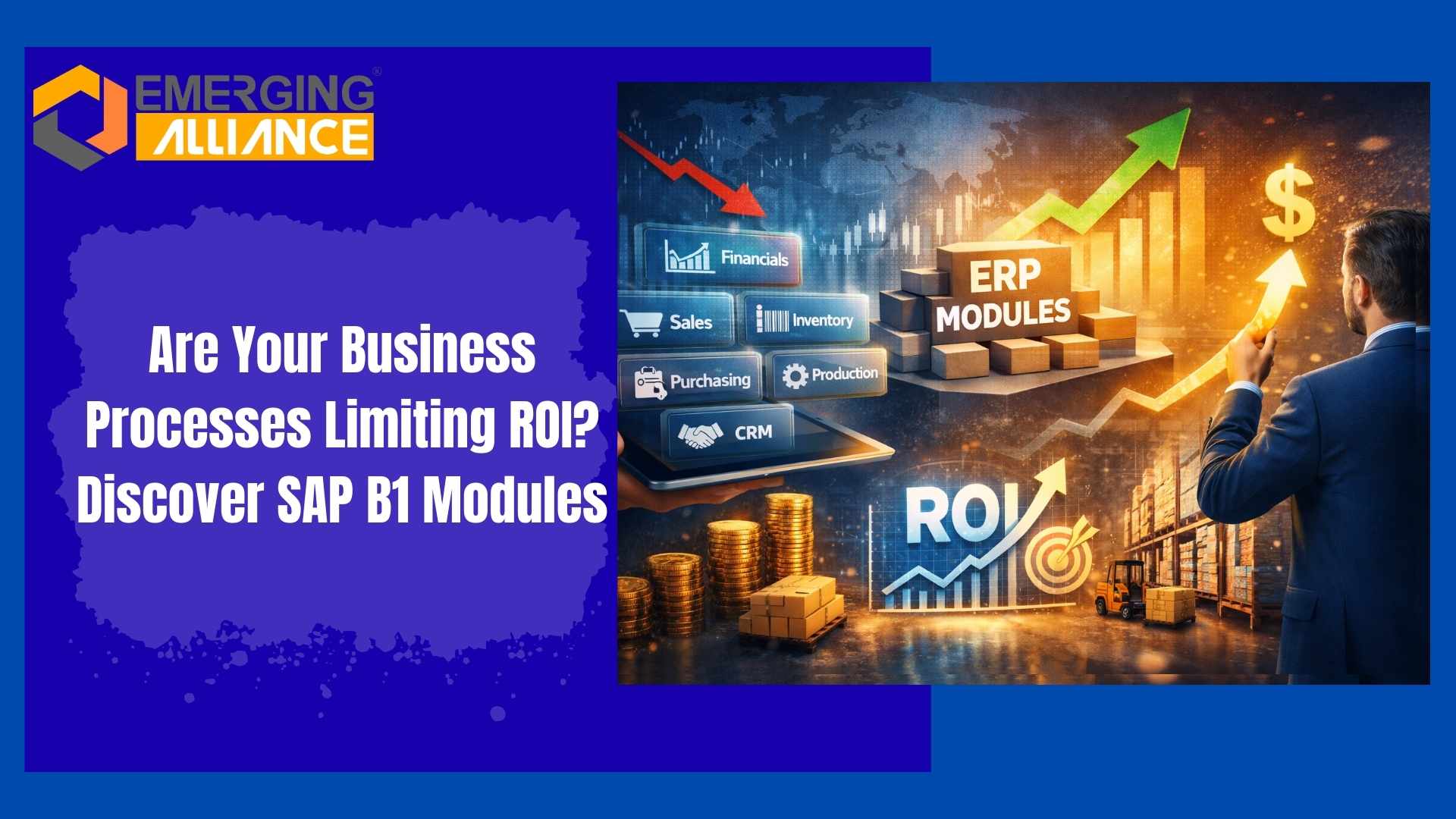
Are Your Business Processes Limiting ROI? Discover SAP B1 Modules
How SAP B1 finance and ERP modules unlock performance and cost control
Enterprise leaders often invest in ERP expecting streamlined operations, real-time insights, and measurable ROI. Yet many organizations still struggle with fragmented processes, delayed reporting, and manual workarounds even after implementing ERP. The problem is rarely the ERP platform itself. In most cases, the real issue lies in how ERP modules are structured, integrated, and utilized. This is where SAP B1 Modules (SAP Business One Modules) play a critical role. Designed specifically for growing enterprises, these modules unify finance, supply chain, sales, and analytics into a single platform that enables data-driven leadership decisions.
understanding the right combination of SAP B1 ERP modules can be the difference between an ERP system that simply records data and one that creates measurable business value.
Why ERP ROI Often Falls Short in Growing Enterprises
Many organizations adopt ERP expecting immediate transformation. However, ERP ROI often falls short because of structural gaps within the system architecture.
The most common challenges include:
Fragmented systems
Departments often rely on disconnected tools for finance, CRM, inventory, and reporting. This creates data silos and slows decision-making.
Limited reporting visibility
Executives cannot access real-time insights because operational data is scattered across systems or requires manual consolidation.
Manual operational workflows
Processes like purchase approvals, financial reconciliations, and inventory updates continue to rely on manual intervention.
Weak inventory and supply chain control
Without integrated inventory intelligence, companies face overstocking, stockouts, and procurement inefficiencies.
The result is an ERP environment that fails to unlock the strategic value expected by executive leadership.
To overcome this, enterprises must deploy ERP modules that integrate finance, operations, and analytics into a unified architecture.
SAP B1 Modules a Strategic ERP Framework for Enterprise Control
SAP Business One modules are designed to support end-to-end business management across finance, supply chain, production, customer management, and analytics.
Instead of relying on multiple disconnected tools, organizations can operate on a single integrated ERP platform.
Below are the key SAP B1 ERP modules that enable enterprise-level control and efficiency.
SAP B1 Finance Module the Core of Financial Governance
The SAP B1 finance module provides centralized financial management across the organization.
It enables businesses to manage:
- General ledger and financial accounting
- Accounts payable and receivable
- Budgeting and cost control
- Tax and compliance reporting
- Financial forecasting and cash flow visibility
For executive teams, the SAP B1 finance module provides real-time financial transparency, allowing faster decisions based on accurate data.
This module plays a vital role in cost optimization and profitability management, especially for multi-entity businesses.
SAP Business One Sales and CRM Modules
Customer relationships drive revenue growth, and SAP Business One integrates sales management directly within the ERP environment.
The SAP Business One sales module and CRM modules allow organizations to manage:
- Sales pipelines and opportunities
- Customer accounts and interactions
- Quotation and order management
- Customer service operations
- Sales performance analytics
By connecting CRM with finance and inventory data, organizations gain a 360-degree view of customer activity and revenue performance.
SAP B1 Inventory Management and Supply Chain Modules
Inventory mismanagement is one of the biggest cost drivers in growing enterprises.
The SAP B1 inventory management and supply chain module provides:
- Real-time inventory tracking
- Warehouse management
- Procurement and supplier management
- Automated stock replenishment
- Batch and serial number tracking
This enables companies to reduce operational waste, improve stock accuracy, and maintain better control over procurement and logistics operations.
SAP B1 Quality Management Module
Quality control is critical for industries like manufacturing, pharmaceuticals, electronics, and food processing.
The SAP B1 quality management module enables organizations to:
- Define quality inspection processes
- Track defects and non-conformance
- Monitor supplier quality performance
- Maintain compliance with regulatory standards
This ensures consistent product quality while reducing operational risks.
How the Right SAP B1 Modules Drive ERP ROI
When implemented strategically, SAP B1 modules enable measurable business outcomes.
Organizations typically see improvements across four major areas.
1. Operational Efficiency
Automated workflows eliminate manual tasks across finance, procurement, and sales operations.
This improves productivity and reduces operational delays.
2. Cost Optimization
Integrated financial and supply chain modules enable tighter cost control and better resource allocation.
Businesses gain visibility into operational spending and margin performance.
3. Real-Time Decision Making
Executives gain immediate access to accurate data across departments, enabling faster and more confident strategic decisions.
4. Scalable Business Architecture
SAP B1 modules allow organizations to expand operations without rebuilding their ERP infrastructure.
The platform supports:
- Multi-location operations
- Multi-currency financial management
- Global compliance requirements
- Cloud-based ERP scalability
Why Strategic SAP B1 Implementation Matters
Choosing the right ERP modules is only part of the equation.
The real value of ERP emerges when modules are aligned with business strategy and operational workflows.
A strategic implementation partner can help organizations:
- Identify the right combination of SAP B1 modules
- Optimize business processes before deployment
- Integrate ERP with CRM, analytics, and external platforms
- Configure modules for industry-specific requirements
- Ensure long-term scalability and system performance
This approach transforms ERP implementation into a digital transformation initiative rather than a simple technology deployment.
Transform ERP into a Strategic Growth Platform
For technology leaders, the question is no longer whether to implement ERP but whether the current ERP architecture is delivering real business value.
With the right combination of SAP Business One modules, organizations can transform their ERP environment into a platform that drives operational efficiency, financial control, and long-term scalability.
When implemented correctly, SAP B1 ERP modules enable businesses to maximize ROI while gaining the agility required to compete in a rapidly evolving digital economy.
FAQs About SAP B1 modules
1. How do SAP B1 modules help unify fragmented business systems?
SAP B1 modules connect finance, inventory, sales, procurement, and operations within a single ERP platform. This integration eliminates data silos, improves data accuracy, and enables real-time visibility across the entire business, allowing leadership teams to make faster and more informed decisions.
2. Which are the key modules of SAP Business One?
Key SAP Business One modules include finance, sales and CRM, purchasing, inventory management, production, service management, and analytics.
3. How do SAP B1 modules improve ERP ROI?
SAP B1 modules improve ROI by automating processes, integrating data across departments, improving reporting visibility, and enabling faster decision-making.
4. What is the SAP B1 finance module used for?
The SAP B1 finance module manages accounting, financial reporting, budgeting, tax compliance, and cash flow visibility.
5. Is SAP Business One suitable for manufacturing companies?
Yes. SAP Business One includes manufacturing modules that support production planning, BOM management, and shop floor control.
6. Can SAP Business One integrate with CRM systems?
Yes. SAP Business One can integrate with CRM platforms and includes its own sales and CRM modules for customer management.
7. What industries benefit from SAP B1 modules?
Manufacturing, distribution, retail, healthcare, and service industries commonly use SAP Business One modules.
8. Can SAP B1 modules support real-time analytics?
Yes. SAP Business One provides dashboards, reports, and analytics tools that enable real-time operational insights.
9. Is SAP Business One available for cloud deployment?
Yes. SAP Business One can be deployed on cloud infrastructure, providing flexibility and scalability for growing businesses.
10. How long does SAP Business One implementation take?
Implementation timelines vary based on business complexity, but many mid-sized organizations go live within a few months.
Get an SAP Business One demo! Fill out the form below to see how the right ERP modules can boost your business with Emerging Alliance.