

SAP B1 Pricing Challenges: Why Your Business Could Be Losing Revenue Without Real-Time Insights

CEOs Must Understand SAP B1 Pricing to Stop Hidden Costs and Optimize Profitability
In today’s data-driven economy, enterprise software decisions directly influence margins, scalability, and long-term growth. For many growing organizations, SAP Business One is positioned as a powerful ERP solution—but misunderstanding its pricing dynamics can quietly drain revenue. Without real-time insights into costs, licenses, and implementation models, businesses often overspend, underutilize features, or fail to optimize return on investment. This article breaks down the real challenges behind SAP B1 pricing decisions and explains why clarity is critical for CEOs and finance leaders.
Understanding SAP Business One Cost Models, Licensing, and User-Based Pricing
One of the most common mistakes companies make is assuming SAP uses a single, simple price tag. In reality, SAP Business One pricing is influenced by multiple factors, including license type, deployment method, and user count.
The sap license framework includes professional and limited user options, each affecting the sap license cost per user. When organizations underestimate how many users need full access, the total sap licensing cost rises quickly. This is especially true for firms upgrading from the sap business one starter package, which may no longer meet operational needs as the company grows.
Failing to align license selection with actual usage patterns often leads to paying more for unused functionality—an invisible but serious profit leak.
How SAP Business One Implementation Costs Increase Total ERP Investment
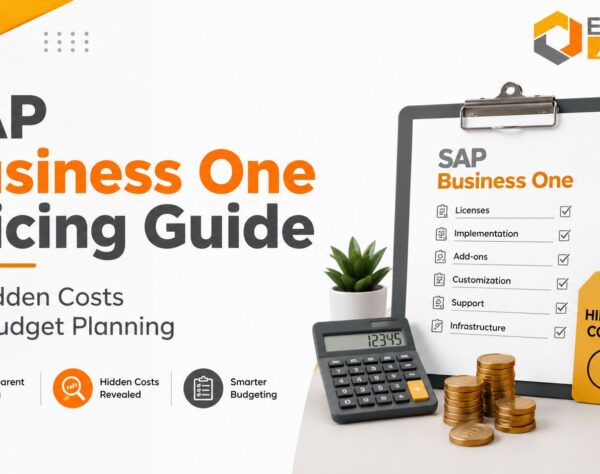
Beyond licenses, sap business one implementation cost plays a major role in total ownership. Implementation is not just installation—it includes configuration, data migration, training, and customization. These elements define the real sap implementation cost and often exceed expectations.
Many CFOs focus on the sap business one price or sap business one software price while overlooking consulting fees. When combined with integration work and third-party add-ons, the cost of sap business one can rival larger ERP systems if poorly planned.
This is why understanding the broader cost of erp software—not just SAP’s sticker price—is essential before committing.
SAP Business One Cloud vs On-Premise Deployment and Their Pricing Impact
A frequent executive question is: is sap business one cloud based? The answer is yes—SAP Business One supports both on-premise and cloud deployment, each with distinct financial implications.
Sap business one cloud pricing typically follows a subscription model, reducing upfront capital expenditure but increasing long-term operating costs. On-premise setups require higher initial investment in infrastructure, licenses, and IT support, influencing the overall sap erp software cost.
Companies comparing sap business one cloud cost with traditional deployment must assess scalability, security, and internal IT capability—not just monthly fees.
Understanding SAP HANA Licensing and Its Impact on SAP Business One Costs
Another hidden driver of expense is the database layer. Many organizations choose SAP HANA for performance and analytics, but sap hana pricing and sap hana license cost significantly affect the total ERP budget.
While HANA unlocks real-time reporting and predictive insights, its licensing model can raise the sap erp price beyond initial forecasts. Businesses that do not require advanced analytics may find themselves over-investing in technology they rarely use.
Aligning database choice with business objectives is crucial to controlling the sap software cost.
Evaluating SAP ERP Affordability for Growing and Small Businesses
SAP markets Business One as an ERP for SMBs, yet the sap erp for small business cost can still feel overwhelming without proper planning. When evaluating the sap business one erp price, leaders must consider scalability, user growth, and future upgrades.
Compared to generic accounting tools, sap erp accounting software delivers stronger controls and visibility—but at a higher entry point. Without real-time insight into utilization, companies may question whether the cost of sap erp aligns with value delivered.
This is where alternatives or integrations—such as industry-specific solutions or even comparisons with platforms like Odoo for Manufacture of Machinery—enter strategic discussions.
How Real-Time SAP B1 Cost Insights Help Eliminate Revenue Leakage
The biggest pricing challenge isn’t the numbers—it’s visibility. Without dashboards tracking license usage, module adoption, and operational efficiency, businesses lose money through inefficiencies.
Real-time reporting helps leadership monitor:
- Actual ROI from sap business one features
- User activity versus sap b1 license cost
- Ongoing sap software price justification
Organizations that actively measure these metrics often supported by an SAP B1 Pricing Plan Calculator—are far better positioned to optimize their SAP Business One cost and renegotiate contracts before expenses spiral.
Achieving Profitability Through Clear SAP Business One Cost Visibility
Understanding SAP Business One is not just about software—it’s about financial discipline. When CEOs gain clarity into sap one business price, licensing models, and implementation realities, they transform ERP from a cost center into a profit enabler.
The companies that win are those that treat ERP pricing as a living strategy, not a one-time purchase.
FAQs About SAP B1 Pricing
1. How does industry pricing affect SAP B1 adoption decisions?
Industry pricing models influence how SAP B1 licenses and modules are selected, especially in manufacturing, distribution, and services.
2. What pricing factors matter most for SAP B1 in mid-sized companies?
User roles, deployment method, and database choice usually drive SAP B1 cost structures.
3. How can manufacturing firms manage SAP B1 pricing efficiently?
Manufacturers should align modules with production needs and compare alternatives like Odoo for Manufacture of Machinery when appropriate.
4. Does SAP B1 pricing change as a company scales?
Yes, additional users, licenses, and integrations can significantly increase long-term ERP pricing.
5. What role does cloud pricing play in SAP B1 budgeting?
Cloud subscriptions shift ERP pricing from capital expense to operational expense, impacting cash flow.
6. How do licensing models influence SAP B1 pricing transparency?
Complex license tiers often hide underused access, increasing total ERP spend.
7. Is SAP B1 pricing suitable for regulated industries?
Industries with compliance needs often benefit from SAP B1, but must budget carefully for add-ons.
8. How can real-time analytics improve SAP B1 pricing ROI?
Analytics reveal underutilized licenses and processes, helping optimize ERP investment.
9. What pricing risks do CEOs overlook in SAP B1 projects?
Implementation overruns and database licensing are the most common hidden risks.
10. Can SAP B1 pricing compete with newer ERP platforms?
SAP B1 remains competitive when pricing is actively managed and aligned with business strategy.