

Oil and Gas ERP Challenges: How SAP Business One Improves Cost and Operational Control
Quick Answer
SAP Business One for the oil and gas industry can help small and midsize oil and gas businesses improve inventory visibility, procurement control, financial reporting, and coordination across business functions. Its suitability depends on operational complexity, deployment scope, integration requirements, and the need for specialized industry capabilities. A structured evaluation helps businesses identify where standard ERP functionality is sufficient and where additional solutions are required.
Oil and Gas Operational Challenges That Limit Cost Control
Oil and gas businesses operate in an environment where inventory availability, procurement decisions, equipment-related expenditure, supplier coordination, and financial visibility can directly affect operating costs. Even companies with established processes can experience control gaps when departments work with disconnected systems, spreadsheets, and manually maintained records.
These gaps become more difficult to manage as operations expand across warehouses, locations, projects, suppliers, and business units. Management may receive financial reports without having enough detail to understand the transactions, inventory movements, or purchasing decisions behind the numbers.
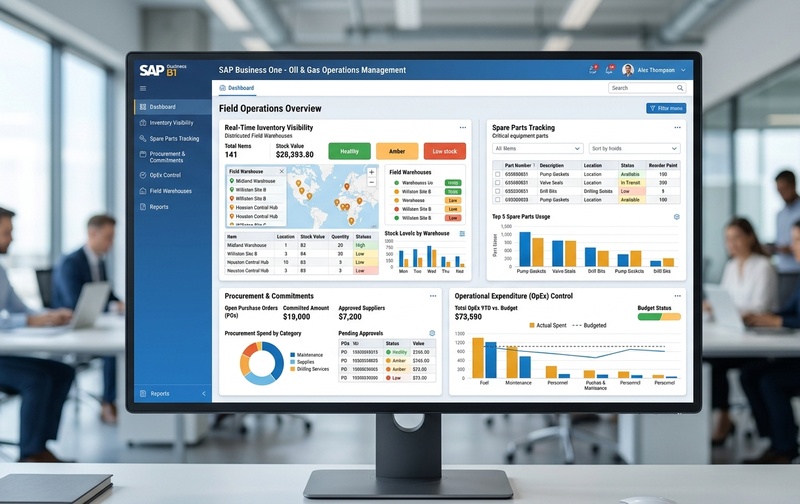
Operational control in oil and gas ERP: Managing multi-warehouse inventory, spare parts availability, and purchasing commitments within SAP Business One.
Common operational challenges include:
- Inconsistent stock records across warehouses and storage locations.
- Delays in identifying spare parts and materials required for operations.
- Limited visibility into purchase commitments, supplier costs, and outstanding orders.
- Manual reconciliation between inventory, purchasing, sales, and accounting records.
- Delayed reporting on expenses, cash flow, and operational performance.
- Difficulty consolidating information from legacy applications and separate business systems.
- Limited traceability when records are maintained across multiple spreadsheets or databases.
| Operational Challenge | Root Operational Weakness | SAP Business One Impact |
|---|---|---|
| Inconsistent stock records across warehouses | Decentralized warehouse entries and untracked material movements across multiple field sites. | Real-time multi-warehouse inventory visibility, automated stock valuation, and standardized transfer workflows. |
| Delays in identifying spare parts and materials | Unorganized item master records, lack of min/max reorder rules, and fragmented supplier records. | Structured item classification, automated reorder level alerts, and synchronized purchasing history. |
| Limited visibility into purchase commitments | Unapproved purchase requests and offline purchase orders escaping central financial tracking. | Enforced approval hierarchies, live purchase commitment tracking, and budget variance controls. |
| Manual cross-system reconciliation | Disconnected standalone spreadsheets for purchasing, warehouse logbooks, and GL accounts. | Seamless transactional posting linking POs, Goods Receipts (GRPO), AP Invoices, and General Ledger. |
| Delayed reporting on expenses and cash flow | Manual batch-processing of monthly supplier invoices and delayed operational expense booking. | On-demand financial reporting, real-time cash flow forecasting, and project-based expenditure analytics. |
| Difficulty consolidating legacy applications | Disparate software tools for operations, logistics, and accounting with no automated data flow. | Centralized ERP architecture connecting master data, transaction history, and operational reporting. |
| Limited audit traceability across spreadsheets | Scattered spreadsheet adjustments with no user activity logs or document relationship maps. | End-to-end Relationship Map, user authorization stamps, and comprehensive transaction audit trails. |
The business impact is not limited to administrative effort. Inaccurate inventory records can complicate purchasing decisions. Poor visibility into commitments can weaken budget control. Delayed financial information can make it harder for executives to identify cost variations and respond before they become larger problems.
An ERP evaluation should therefore begin with the operational controls the business needs, rather than a list of software features.
How SAP Business One Supports Oil and Gas Business Operations
SAP Business One is an ERP system designed to integrate core business processes, including financial management, purchasing, inventory, sales, and reporting. For suitable oil and gas companies, this integrated structure can reduce dependence on disconnected records and improve the consistency of operational and financial information.
The objective is to establish a more reliable view of business transactions, from purchasing and stock movements to supplier liabilities and financial reporting.
Inventory and Spare Parts Visibility
Inventory control can be particularly important when a business manages equipment components, consumables, maintenance materials, safety supplies, or other operational stock. Inaccurate records can create uncertainty about what is available, where it is stored, and whether replenishment is necessary.
SAP Business One provides inventory management capabilities that can help businesses maintain item records, track stock movements, manage warehouse information, and review inventory valuation. When processes are configured appropriately, purchasing and inventory transactions can also support more consistent records across departments.
Oil and gas businesses should evaluate whether the proposed configuration supports their actual requirements for:
- Item master data and inventory classification.
- Warehouse-level stock visibility.
- Goods receipts, issues, transfers, and adjustments.
- Reorder planning and replenishment controls.
- Inventory valuation and reconciliation.
- Spare-parts availability and purchasing coordination.
- Batch or serial-number traceability where applicable.
The objective is not simply to record stock. It is to establish dependable inventory information that supports purchasing, operations, and financial decisions.
Businesses with complex materials traceability, specialized oilfield inventory workflows, or advanced equipment tracking should confirm whether standard functionality meets their needs or whether an add-on, integration, or customization is required.
Procurement and Supplier Control
Procurement decisions affect material availability, working capital, and the cost of running operations. When purchase requests, supplier quotations, purchase orders, goods receipts, and invoices are managed through disconnected processes, it becomes harder to identify discrepancies or understand the full purchasing commitment.
SAP Business One supports purchasing transactions and supplier-related records within the wider ERP environment. With suitable workflows and authorization controls, companies can improve the consistency of purchasing documentation and strengthen coordination between procurement, inventory, and finance teams.
A procurement evaluation should examine whether the system can support the organization’s requirements for:
- Purchase requests and purchase orders.
- Supplier master data and purchasing history.
- Approval procedures for selected transactions.
- Purchase-order and goods-receipt matching.
- Supplier invoice processing and accounts payable.
- Purchase-price review and expenditure reporting.
- Exception handling for discrepancies or incomplete documentation.
For executives, the value lies in improved visibility over purchasing commitments and the ability to investigate differences between expected and actual costs.
Supplier performance scorecards, complex contract management, specialized sourcing, and advanced procurement automation may require additional capabilities. These requirements should be documented before the implementation scope is finalized.
Financial Management and Cost Reporting
Oil and gas companies need financial information that supports decisions about expenditure, profitability, cash flow, and budget performance. When operational and accounting records are disconnected, finance teams may spend significant time reconciling transactions before management can review the results.
SAP Business One integrates financial management with relevant purchasing, sales, and inventory transactions. Depending on configuration and reporting design, this can help finance teams review general ledger activity, accounts payable, accounts receivable, cash flow, and inventory-related financial information within a common system.
The implementation should define the financial controls management expects, including:
- Consistent chart-of-accounts and financial master data.
- Approval and authorization responsibilities.
- Accurate posting of operational transactions.
- Period-end reconciliation procedures.
- Cost-centre or project reporting where configured.
- Management reports and variance analysis.
- Audit trails and access controls.
Businesses should also identify how they intend to analyse costs by project, operating location, department, equipment category, or business unit. The availability of a particular reporting dimension depends on the configuration and may require additional reporting or customization.
An ERP system can improve the availability and consistency of financial data, but it cannot compensate for poorly defined accounting policies, incomplete transaction entry, or weak internal controls.
Multi-Warehouse and Multi-Location Operations
Businesses managing multiple warehouses or operating locations need reliable processes for stock transfers, goods receipts, inventory adjustments, and financial reconciliation. When every location maintains separate records, head office may struggle to establish a consistent view of available inventory and purchasing requirements.
SAP Business One supports warehouse management within its inventory capabilities. Businesses should assess how warehouse structures, user responsibilities, transaction approvals, and reporting requirements will be configured.
Before implementation, document the number of locations, expected transaction volumes, stock-transfer procedures, reporting requirements, and any need for mobile scanning or third-party warehouse systems.
If operations require advanced warehouse execution, specialized field inventory, or connectivity to remote operational environments, validate those requirements separately. Standard warehouse functionality should not automatically be treated as a complete replacement for a specialized warehouse management system.
Managing Equipment, Maintenance, and Operational Data
Equipment availability and maintenance coordination can be critical in oil and gas operations. However, the requirements vary considerably between businesses involved in distribution, trading, equipment supply, service operations, and asset-intensive upstream or downstream activities.
SAP Business One can provide supporting business records for purchasing, inventory, service processes, and financial transactions, depending on the selected configuration. This can help businesses connect relevant materials and financial information with broader business operations.
That does not mean every equipment-management or maintenance requirement is covered natively.
Companies should distinguish between three levels of capability:
- Core ERP processes: Purchasing, inventory transactions, financial postings, and other standard business processes supported by the selected SAP Business One configuration.
- Configured workflows and reporting: Business-specific approvals, reports, alerts, and transaction controls designed around documented requirements.
- Additional industry capabilities: Advanced maintenance scheduling, specialized asset-management workflows, field-service applications, operational technology connectivity, or other functions that may require third-party software, integrations, or custom development.
During solution evaluation, ask the implementation partner to demonstrate the actual workflow rather than confirm capability in general terms. A demonstration should use realistic business scenarios, including the relevant master data, transaction steps, approvals, exceptions, and final reports.
This approach reduces the risk of discovering after implementation that an important operational requirement was assumed to be included but was never properly scoped.
Improving Financial Visibility and Compliance Controls
Financial visibility depends on the quality of transaction records and the controls surrounding them. For oil and gas businesses, management may need to review purchasing expenditure, inventory valuation, supplier liabilities, cash flow, and other financial indicators across business operations.
An integrated ERP environment can help reduce the need to reconcile separate operational and accounting records manually. The extent of the improvement depends on how the system is configured and how consistently employees follow the agreed processes.
Access controls are equally important. Employees should have system permissions aligned with their responsibilities, and sensitive transactions should follow appropriate authorization procedures. Periodic reviews of user access, approval rules, and transaction exceptions help maintain accountability.
Compliance requirements must be assessed according to the company’s country, operating model, legal obligations, and reporting needs. For Indian businesses, this may include relevant tax configuration, GST processes, statutory reporting, and supporting documentation. Other jurisdictions may impose different tax, environmental, industry, or reporting requirements.
SAP Business One should not be presented as automatically ensuring regulatory compliance. The organization and implementation partner must validate the applicable requirements, configure the relevant processes, and confirm whether localizations, third-party applications, or professional advice are necessary.
A practical implementation plan should identify the controls required, who owns each control, how exceptions are handled, and what evidence must be retained.
SAP Business One Integration and Customization Requirements
Many oil and gas businesses already use applications for payroll, banking, reporting, logistics, maintenance, customer management, or other operational functions. Replacing every existing system may be unnecessary, but leaving critical information disconnected can undermine the value of an ERP implementation.
Integration planning should therefore be part of the initial solution assessment.
Integrating Existing Business Systems
The implementation team should identify which applications must exchange data with SAP Business One and why each connection is required.
For every integration, document the systems involved, data exchanged, transfer frequency, ownership, error-handling process, security requirements, and reconciliation procedure.
Potential integration areas include:
- Banking and payment processes.
- Tax or electronic-invoicing applications, where applicable.
- Customer relationship management systems.
- Logistics and delivery applications.
- Reporting and business intelligence tools.
- Maintenance or specialized industry systems.
- Barcode-scanning or warehouse applications.
Not every business needs every integration. Prioritize the connections that address a verified operational problem or mandatory business requirement.
The technical approach should also be validated. Integration may involve supported interfaces, partner solutions, middleware, or custom development, depending on the applications and requirements involved.
Migrating Legacy Data
Data migration affects the reliability of the new ERP environment. Moving inaccurate or inconsistent records into a new system can recreate the same operational problems the business is trying to resolve.
A migration plan should cover customer and supplier records, item master data, opening balances, inventory quantities, outstanding transactions, and historical information required for business or compliance purposes.
Before migration, define data ownership, remove duplicates, correct invalid records, map legacy fields to the target structure, and establish validation rules. Test migrations should be reconciled against the source system before the final cutover.
Management should also agree on which historical records need to be transferred and which can remain accessible through a controlled legacy archive. Migrating every historical transaction is not always necessary or cost-effective.
A successful migration is measured by the accuracy, completeness, and usability of the resulting records—not merely by whether the data transfer finishes.
Identifying Add-Ons and Custom Development
Custom development can be appropriate when a genuine business requirement cannot be met efficiently through standard functionality or a suitable existing solution. However, unnecessary customization can increase implementation effort, testing requirements, support complexity, and future upgrade considerations.
Each proposed customization should have a documented business case. The evaluation should explain the current problem, the expected benefit, alternative approaches, implementation cost, ownership, and ongoing maintenance responsibilities.
Where an add-on is proposed, confirm its compatibility with the intended SAP Business One version and deployment model. Review vendor support, licensing, security, integration dependencies, and the process for future updates.
The preferred solution is not necessarily the one with the largest number of features. It is the one that satisfies essential requirements with an appropriate balance of control, cost, maintainability, and usability.
Evaluating SAP Business One for Oil and Gas Companies
Selecting an ERP system requires more than confirming that it can manage accounting and inventory. Decision-makers must understand whether the solution fits their business model, process complexity, reporting needs, and planned growth.
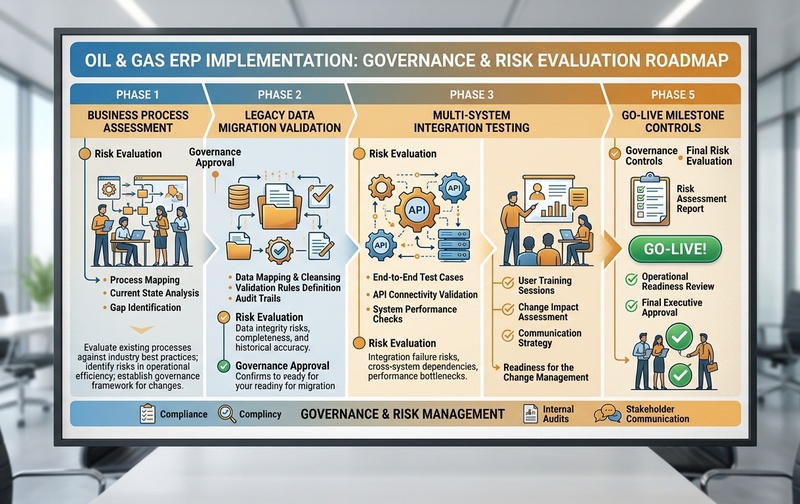
Structured implementation roadmap for oil and gas ERP: Business process evaluation, migration validation, system integration, and go-live governance.
Business Size and Process Suitability
SAP Business One may be suitable for small and midsize oil and gas businesses that need integrated financial management, purchasing, inventory, sales, and operational reporting.
Suitability should be evaluated against the company’s actual requirements. A business focused on equipment distribution or materials supply may have a different scope from an organization managing complex upstream production, refinery operations, or highly specialized asset-intensive processes.
During evaluation, assess:
- The complexity of operational and financial workflows.
- The number of entities, warehouses, and locations.
- Required industry-specific functions.
- Transaction volumes and reporting expectations.
- Existing systems that must remain in use.
- Integration, customization, and security requirements.
- Local statutory and tax obligations.
- Internal resources available for implementation and ongoing support.
Businesses with highly specialized operational requirements should compare the total solution scope against their needs instead of assuming that a general-purpose ERP system alone will cover every industry process.
Implementation Scope and Budget Planning
ERP implementation costs depend on several variables, including licensing or subscription arrangements, user requirements, deployment model, implementation services, data migration, integration, customization, training, and ongoing support.
A reliable budget should separate initial project expenditure from recurring costs. It should also account for internal staff time, testing, temporary productivity impacts, and the resources needed to maintain the system after go-live.
Request an itemized proposal that identifies included services, exclusions, assumptions, third-party costs, change-request procedures, and support arrangements. Ask the partner to explain how each major cost relates to a defined business requirement.
Avoid comparing proposals solely by their headline price. A lower initial quotation may exclude essential integrations, data cleanup, training, or reporting work that later increases the total cost.
The decision should be based on the expected business outcome, implementation risk, and total cost of ownership over an appropriate planning period.
Questions to Ask an SAP Business One Partner
Before selecting an implementation partner, decision-makers should ask:
- Which of our requirements can be met through standard SAP Business One functionality?
- Which requirements need configuration, add-ons, integration, or custom development?
- How will inventory, purchasing, and financial controls work in our actual business scenarios?
- What data-cleaning, migration, and reconciliation activities are included?
- How will user permissions, approvals, and audit requirements be addressed?
- Which implementation deliverables, testing activities, and training sessions are included?
- What are the expected project milestones, dependencies, and customer responsibilities?
- How will support, system updates, integration failures, and future changes be managed?
Ask the partner to demonstrate critical workflows using representative examples from your business. Request clear answers about limitations and dependencies as well as capabilities.
Implementation Risks That Oil and Gas Businesses Should Address
ERP projects can encounter problems when requirements are incomplete, data quality is poor, stakeholders are not aligned, or implementation responsibilities are unclear. Identifying these risks early helps organizations plan a more controlled rollout.
- Unclear requirements: Document current processes, business exceptions, approval responsibilities, and reporting needs before finalizing the design.
- Poor data quality: Assign owners for master data, reconcile critical balances, and validate test migrations before cutover.
- Excessive customization: Prioritize standard processes where appropriate and require a documented justification for each customization.
- Integration failures: Define interface ownership, error handling, reconciliation, security, and testing responsibilities for every connection.
- Insufficient user adoption: Provide role-based training, process documentation, and a clear method for resolving issues after launch.
- Weak project governance: Establish accountable business owners, decision-making responsibilities, milestone reviews, and change-control procedures.
- Unrealistic timelines: Build the project plan around the agreed scope, data readiness, integration dependencies, testing requirements, and staff availability.
| Implementation Risk | Operational Impact | Recommended Mitigation Action |
|---|---|---|
| Unclear requirements | Scope creep, costly mid-project rework, and misaligned functional expectations. | Document current processes, business exceptions, approval responsibilities, and reporting needs before finalizing the design. |
| Poor data quality | Carrying duplicate items, erroneous opening balances, and flawed vendor data into the new ERP. | Assign owners for master data, reconcile critical balances, and validate test migrations before cutover. |
| Excessive customization | Inflated development costs, testing bottlenecks, and complicated future upgrade paths. | Prioritize standard processes where appropriate and require a documented justification for each customization. |
| Integration failures | Data transmission errors, broken banking links, or delayed e-invoicing synchronization. | Define interface ownership, error handling, reconciliation, security, and testing responsibilities for every connection. |
| Insufficient user adoption | Operational friction, user resistance, and reverting to offline spreadsheets after launch. | Provide role-based training, process documentation, and a clear method for resolving issues after launch. |
| Weak project governance | Decision paralysis, unmanaged change requests, and milestone delays. | Establish accountable business owners, decision-making responsibilities, milestone reviews, and change-control procedures. |
| Unrealistic timelines | Rushed testing, inadequate user acceptance, and unexpected post-cutover disruptions. | Build the project plan around the agreed scope, data readiness, integration dependencies, testing requirements, and staff availability. |
A phased implementation may be appropriate when business units, locations, or processes can be separated safely. The decision should reflect operational dependencies and risk, rather than a blanket preference for either a phased or single-stage rollout.
Go-live should follow defined acceptance criteria. These may include reconciled opening balances, verified inventory records, successful integration testing, trained users, approved access controls, and documented support arrangements.
Frequently Asked Questions About SAP Business One for Oil and Gas
Evaluate ERP for Your Oil and Gas Operations
Discuss your inventory, procurement, financial reporting, and operational control requirements with the Emerging Alliance team. Identify the capabilities needed, clarify integration and customization requirements, and assess an implementation scope aligned with your business.
Request an SAP Business One Demo