SAP B1 for Sugar Industry: The Sweet Taste of Success in India
Quick Answer
SAP Business One for the Sugar Industry is a specialized ERP solution that streamlines sugarcane procurement, automates weighbridge operations, optimizes crushing and refining cycles, tracks inventory by-products (molasses, bagasse, ethanol), and manages farmer billing and payouts from a single integrated platform.
Why Sugar Manufacturers Need Better Systems
Why Sugar Manufacturers Need Specialized ERP Software
The sugar manufacturing industry in India operates at a staggering scale, contributing significantly to both agricultural livelihood and industrial manufacturing. However, sugar mills face highly volatile sugarcane costs, strict government-notified prices (such as the Fair and Remunerative Price – FRP, and State Advised Price – SAP), tight crushing windows, and rapid raw material perishability. Once sugarcane is harvested, it must be crushed within 24 hours to prevent sucrose degradation—making efficient scheduling a matter of survival.
Standard accounting packages or generic ERP solutions fail to address these unique operational realities. Sugar millers need a specialized ERP platform to integrate physical weighbridges, automate sugarcane receipt generation, calculate complex grower payments, and monitor quality control parameters (like polarization percentage and recovery rates) in real time.
Understanding SAP Business One for the Sugar Industry
SAP Business One (SAP B1) delivers a centralized business management platform designed specifically for growing sugar manufacturing and refining enterprises. It links administrative operations, agricultural sourcing, quality laboratory outputs, and mill floor processes. By providing a single source of truth, SAP Business One enables operational leaders to manage the sugarcane lifecycle from sourcing to bagging and distribution, ensuring profitability, cost control, and optimized capacity utilization.
How SAP Business One Connects Sugar Operations
Key Manufacturing Challenges in the Sugar Industry
Managing sugar operations in India involves navigating a set of difficult regulatory, logistical, and production hurdles:
Volatile Sourcing and Regulatory Payouts
Sugarcane is procured from thousands of individual farmers. Calculating the net cane weight (gross minus tare weight) and applying the government-stipulated Fair and Remunerative Price (FRP) based on sugar recovery percentage is complex. Manual entry errors lead to farmer disputes, delays, and non-compliance penalties.
Time-Sensitive Sourcing & Logistics
Harvested sugarcane suffers from rapid sucrose inversion. If cane sits in transit or queues for too long, recovery yields drop. Mills must coordinate tight harvesting and transport schedules to match daily crushing capacities.
By-Product Inventory and Co-Generation
Sugar mills derive significant revenue from by-products like bagasse (used for power generation) and molasses (sold or distilled into ethanol). Disconnected systems fail to trace these by-product yields, leading to storage leakage, missed revenue, or fuel inefficiencies in co-generation plants.
Quality Grading & Lab Tracking
Sugar crystals must be checked, sorted, and bagged according to standardized commercial grades (Large, Medium, Small) and color profiles. Operating without tight laboratory integrations risks selling premium grade sugar at base prices or releasing batches that do not meet commercial food safety standards.
Core SAP Business One Features for Sugar Manufacturers
To directly address these operational pain points, SAP Business One provides target modules tailored for agricultural processing and refining:
Weighbridge & Cane Receipt Integration
Automate sugarcane weighing by directly integrating weighbridge scale hardware with SAP Business One. The system captures tare/gross weights, calculates the net sugarcane quantity, and prints the grower’s Cane Receipt (CR) slip instantly, eliminating manual ticket manipulation and data errors.
Cane Payment & FRP Calculator
Directly links weight data with agricultural registries to compute grower billing. The ERP calculates payments based on the crushing date, polarization tests, quality deductions, and statutory FRP/SAP rates, streamlining payout scheduling and ensuring transparent billing.
Refining & Distillery Production Control
Manage multi-stage Bills of Materials (BOMs) for crushing, clarification, evaporation, crystallization, and centrifugation. Track material movements to ensure bagasse and molasses yields are routed automatically to co-generation and distillery modules for ethanol processing.
Grade Sorting & Batch Lot Control
Log laboratory findings (sugar recovery rates, moisture levels, polarization) and associate them with production batches. The system locks batches until QA signs off, enabling clear lot classification into commercial grades (L/M/S) and ensuring compliance with regulatory bodies.
Everything Managed from One ERP Platform
Sugarcane Sourcing and Payment Automation
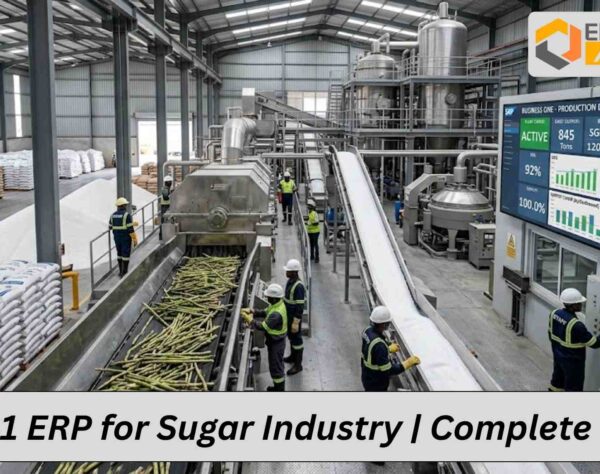
Effective procurement is key to a sugar mill’s profitability. SAP Business One coordinates farmer scheduling and transport, reducing the queues of sugarcane trucks at the gates and ensuring the raw material is processed while fresh. Weighbridge hardware records gross weight, and after crushing, tare weight is calculated automatically to define the final net weight. This data is securely stored, enabling billing and direct payouts to farmer bank accounts, avoiding transaction disputes and reducing paperwork.
Cane Sourcing to Payment Pipeline
SAP Business One Benefits for Sugar Mills
| Benefit Area | Expected Sugar Industry Outcome |
|---|---|
| Weighbridge Automation | Direct scale synchronization to eliminate human error and secure net cane weight logs. |
| By-product Tracking | Trace bagasse and molasses outputs to optimize co-generation and distillery ethanol production. |
| Farmer Billing Integration | Automate payments using calculated polarization percentages and official FRP/SAP prices. |
| Refining Quality Control | Strict monitoring of polarization and moisture content for classification into standard sugar grades. |
| Real-Time Sourcing Logs | Monitor harvested cane delivery schedules to prevent sucrose degradation. |
| Co-Generation Analysis | Coordinate bagasse yields with mill power consumption to track excess power exported to grids. |
SAP Business One vs Traditional Systems
| Traditional Sugar Mill Process | SAP Business One Implementation |
|---|---|
| Manual weighbridge logs prone to billing disputes | Direct weighbridge software integration with real-time logging |
| Delayed payment calculations causing grower friction | Automated FRP/SAP payout calculators and fast settlements |
| Unmonitored loss of bagasse, molasses, and ethanol yields | Centralized tracking of valuable by-products and distillates |
| Uncertainty in daily recovery percentages during seasonal runs | Live crushing analytics and quality control checkpoints |
| Inconsistent grading leading to missed commercial premiums | Laboratory integration mapping Polarization% to grade batches |
| Disconnected farm management and harvesting delays | Unified supply chain and optimized cane transport logs |
Results Manufacturers Can Expect
Conclusion
Adopting SAP Business One helps sugar manufacturers streamline sugarcane procurement, automate weighbridge operations, compute transparent grower payments, and optimize production yields. By integrating laboratory checks and by-product tracking into a single dashboard, sugar mills can control seasonal operational costs, minimize process waste, and scale their businesses confidently in a highly regulated and competitive market.
Frequently Asked Questions (FAQs)
Book a SAP Business One Demo
See how SAP Business One can simplify your sugar mill operations, optimize production resources, and reduce costs. Connect with Emerging Alliance for a free personalized demonstration and practical guidance on your business processes, data readiness, and implementation roadmap.